Unit 1 · Topic 1.1 · about 30 minutes · 7 parts · 12 scored checks, 3 of them multiple choice
AP Biology 1.1: Structure of Water and Hydrogen Bonding
Unit 1: 8 to 11% of the multiple-choice section
What you'll be able to do
- Explain how the properties of water that come from its polarity and hydrogen bonding, such as cohesion, high specific heat and high heat of vaporization, affect its role in living things.
Key vocabulary
| Term | What it means | The exam trap |
|---|---|---|
| Polar covalent bond | A covalent bond in which two atoms share electrons unequally, so one end of the bond is partially negative and the other partially positive. | Partial charges are smaller than the full charges of ions, so do not call a polar molecule an ion or its bonds ionic. |
| Hydrogen bond | An attraction between a partially positive hydrogen atom and a partially negative atom, such as the oxygen of a neighboring water molecule. | A hydrogen bond is far weaker than the covalent bonds inside a molecule, so do not treat the two as interchangeable when a question asks what holds something together. |
| Cohesion | The attraction of water molecules to each other through hydrogen bonds. | Cohesion and adhesion both come from hydrogen bonds, so decide what the water is sticking to before you name one. |
| Adhesion | The attraction of water molecules to a different polar or charged surface, such as glass or a plant's tube walls. | Questions about water moving up a plant often need both cohesion and adhesion, so check whether one alone answers the whole prompt. |
| Specific heat capacity | The amount of energy a substance must absorb for its temperature to rise by one degree. | Questions compare how far two substances warm from the same energy, so read which quantity the stem holds equal before you decide. |
| Heat of vaporization | The amount of energy that must be absorbed to turn a liquid into a gas. | Specific heat and heat of vaporization are easy to swap, so check whether the situation involves water changing to vapor or only changing temperature. |
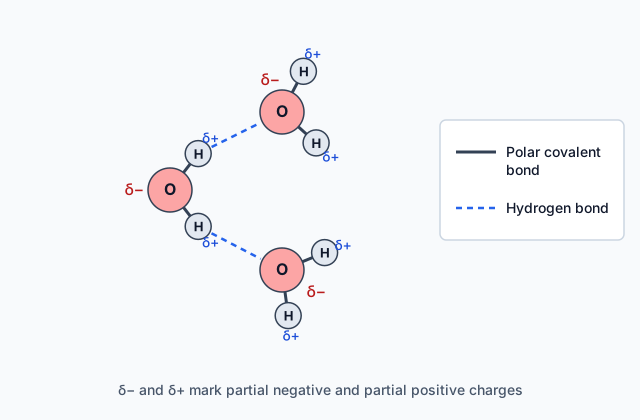 Tap to open the picture full size
Part 1 Think first What is in the bubbles?
Commit to a guess first. Being wrong now makes the right idea stick better.
Predict first
A pot of pure water is heated on a stove until it boils, and large bubbles rise through it and burst at the surface. Nothing but water was ever in the pot, and the air that was dissolved in it came out as tiny bubbles long before boiling. What are the large bubbles made of?
In short. Water is a polar molecule, so its molecules stick to each other and to other polar surfaces through hydrogen bonds, and those bonds explain the properties living things depend on.
- Polar covalent bonds between oxygen and hydrogen make water polar, and polarity lets water form hydrogen bonds.
- Hydrogen bonds between water molecules produce cohesion, adhesion and surface tension.
- A high specific heat and a high heat of vaporization help organisms keep a steady body temperature.
Part 2 Learn it Why water behaves the way it does
2a. A polar molecule
A water molecule is one oxygen atom joined to two hydrogen atoms by covalent bonds, in which the atoms share electrons. The sharing is unequal: oxygen pulls the shared electrons toward itself more strongly than hydrogen does. A covalent bond with unequal sharing is a polar covalent bond.
Because the electrons spend more time near the oxygen, the oxygen end of the molecule carries a slight negative charge and each hydrogen carries a slight positive charge. These are partial charges, smaller than the full charge of an ion. A molecule with a partially charged end like this is polar.
Opposite partial charges attract. The partially positive hydrogen of one water molecule is drawn to the partially negative oxygen of a neighbor. That attraction is a hydrogen bond. It is much weaker than the covalent bond inside a molecule, and it forms and breaks constantly in liquid water.
Water is not the only place this happens. Polarity also produces hydrogen bonds between and within the large molecules of life, such as between the two strands of DNA and within a folded protein.
Quick check · Fill the statement
Complete the description of a model of two neighboring water molecules.
Inside each molecule, the solid lines are bonds. The oxygen atom is labeled partially . The dashed line from a hydrogen of one molecule to the oxygen of the other is a bond.
2b. Water sticks to water, and to other surfaces
Hydrogen bonds between neighboring water molecules give water three properties you can see.
Cohesion is water sticking to water. Each molecule is held to its neighbors, so a column of water tends to hold together as one piece rather than breaking apart.
Adhesion is water sticking to other polar or charged surfaces, such as glass or the walls of a plant's water-carrying tubes.
Surface tension comes from cohesion at the surface. Molecules at the surface are pulled inward and sideways by their neighbors, so the surface acts like a thin, elastic film. A water strider can stand on a pond because of it.
In a plant, these properties work together. As water evaporates from the leaves, cohesion pulls the column of water behind it upward, molecule by molecule, while adhesion to the tube walls helps keep the column from sliding back down.
Quick check · Match
Match each property of water to the observation it best explains.
2c. Water resists changes in temperature
Temperature measures how fast molecules move on average. To warm water, energy has to speed its molecules up, but in water much of the added energy first goes into breaking hydrogen bonds between molecules. So water must absorb a lot of energy for each degree its temperature rises, and it gives off a lot as it cools. That is a high specific heat capacity.
This matters because organisms are mostly water. A body full of water warms and cools slowly when the air around it changes, which helps an organism hold a steady internal temperature. Keeping internal conditions steady like this is homeostasis.
The same property steadies the places organisms live. A lake or an ocean changes temperature far less between day and night than the land beside it, so the organisms in it face smaller swings.
Quick check · Multiple choice
A jellyfish and a dry rock sit in the same sunlight on a warm afternoon. The jellyfish's temperature rises much more slowly than the rock's. Which explanation is best supported?
2d. Evaporation carries heat away
For a molecule to leave liquid water as vapor, it has to break free of all the hydrogen bonds holding it to its neighbors. That takes a lot of energy, so water has a high heat of vaporization: a large amount of energy must be absorbed to turn liquid water into vapor.
The molecules that escape are the ones that took that energy from their surroundings. So when water evaporates from a surface, it carries heat away and leaves the surface cooler. This is evaporative cooling.
Your body uses it. When you are hot, you sweat. As the sweat evaporates, it absorbs heat from your skin and carries it off as vapor, which lowers your skin temperature and helps keep your body temperature steady. A dog panting and a plant losing water from its leaves cool themselves the same way.
Quick check · Sort it
Each card describes something that happens in or around a living thing. Tap a card, then the property of water that best explains it.
High specific heat capacity
High heat of vaporization
Cohesion and adhesion
Part 3 Watch it done Water or oil?
Predict first, then watch each step, then finish the reasoning yourself.
A student puts 100 g of water in one beaker and 100 g of vegetable oil in another. Both start at 20 °C. She heats them on identical hot plates for 2 minutes, so each receives the same amount of energy.
- Water: 20 °C at the start, 26 °C after 2 minutes
- Oil: 20 °C at the start, 32 °C after 2 minutes
These numbers are a teaching example, not a published study. Which liquid has the higher specific heat capacity?
Predict first
Before you open the first step, predict: which liquid needed more energy for each degree it warmed?
Step 1 · Find each temperature change
Water went from 20 °C to 26 °C, a rise of 6 °C. Oil went from 20 °C to 32 °C, a rise of 12 °C.
Step 2 · Compare the changes
The water rose 6 °C and the oil 12 °C, so the water warmed half as much as the oil, 6 divided by 12, or 0.5. Per minute, the water rose 3 °C and the oil 6 °C.
Why this step?
Why use the same mass, the same starting temperature and identical hot plates?
So that the only difference between the beakers is the liquid. With the same mass and the same energy, a difference in temperature change can be pinned on the liquid itself.
Step 3 · Connect the change to energy
Both beakers received the same energy. The water's temperature rose by only half as many degrees, so each degree of warming took twice as much energy in the water as in the oil.
Your step · Decide and justify
Which liquid has the higher specific heat capacity?
Which reason supports your decision?
Water's hydrogen bonds soak up energy before its molecules speed up, so it warms slowly. That is the same reason a body made mostly of water, or a pond, changes temperature slowly when the air around it changes.
Part 4 Try it The wet thermometer
A new setup, a new question. A student places two thermometers side by side in front of a fan in a dry room. One bulb is bare. The other is wrapped in a cloth that was soaked in water at room temperature. After 10 minutes she reads them. These numbers are a teaching example.
- Bare thermometer: 24.0 °C
- Thermometer in wet cloth: 18.5 °C
Try it · Calculate
How many degrees Celsius cooler is the thermometer in the wet cloth than the bare thermometer?
Try it · Decide and justify
A classmate says the wet thermometer reads lower only because the water in the cloth was cold. Is the classmate right?
Which piece of evidence supports your decision?
Part 5 Explain it Read a model of water
On the exam this is handwritten, so answer on paper first. Nothing you type here leaves this page. Then check your answer against the model and each scoring point.
Free response is 50% of the exam score. This one is shaped like Question 5, Analyze Model or Visual Representation of a Biological Concept or Process.
Free-response practice · Question 5 style
A model shows four water molecules. In each molecule, the oxygen atom is labeled with a partial negative charge and each hydrogen atom with a partial positive charge. Solid lines join the atoms within each molecule, and dashed lines join a hydrogen atom of one molecule to the oxygen atom of a neighboring molecule.
(a) Describe what the solid lines and the dashed lines in the model each represent.
(b) Explain why the oxygen atom carries a partial negative charge.
(c) Explain how hydrogen bonds involving water allow it to move up the narrow water-carrying tubes of a tall plant.
Model answer
(a) The solid lines are polar covalent bonds, in which oxygen and hydrogen share electrons within a molecule. The dashed lines are hydrogen bonds, weaker attractions between a partially positive hydrogen of one molecule and the partially negative oxygen of another.
(b) Oxygen pulls the shared electrons toward itself more strongly than hydrogen does, so the electrons spend more time near the oxygen, giving it a partial negative charge.
(c) Hydrogen bonds hold water molecules to each other (cohesion), so as water evaporates from the leaves, the column of water is pulled up without breaking. Water also forms hydrogen bonds with the tube walls (adhesion), which helps hold the column in place.
Score your own answer. This is a self-check, not a grade. Tick each point your answer makes.
Part 6 Check yourself A pond and its shore
All three case questions use the table.
A student measures the temperature of the surface water of a pond and of the dry sand on its shore at four times on one sunny day. Both receive the same sunlight. These numbers are a teaching example.
| Time of day | Pond water | Dry sand |
|---|---|---|
| 6 a.m. | 18 | 12 |
| 10 a.m. | 19 | 24 |
| 2 p.m. | 21 | 36 |
| 6 p.m. | 20 | 22 |
Case question 1 · Calculate
Using the table: the range of the sand's temperature over the day (highest minus lowest) is how many times the range of the pond water's temperature?
Case question 2 · Multiple choice
Using the table: which explanation best accounts for the difference between the pond and the sand?
Case question 3 · Multiple choice
Using the table: a frog spends the day in the pond, and a beetle spends it on the sand. Neither can control its own body temperature well. Which prediction do the data best support?
The rest stand on their own and do not use the case.
Check yourself · Spot the error
A student explains how water climbs from a plant's roots to its leaves. Tap the line with the mistake.
Check yourself · Put it in order
A person exercising on a hot day starts to sweat. Put the events in the order they happen.
Part 7 Keep it Bring back earlier ideas
This is the course's first lesson, so there is nothing earlier to bring back yet. Later lessons will ask you about water's polarity and hydrogen bonds again.
In three lines
- Polar covalent bonds make water polar, and polarity lets water form hydrogen bonds with other water molecules and with other polar molecules.
- Hydrogen bonds between water molecules produce cohesion, adhesion and surface tension, which help move water up a plant.
- Water's high specific heat and high heat of vaporization let organisms hold a steady body temperature and cool by evaporation.
Exam strategy for this topic
- Section I, Multiple Choice: 60 questions in 90 minutes.
- Section II, Free Response: 6 questions in 90 minutes.
- This lesson's Explain it is shaped like free-response question 5, Analyze Model or Visual Representation of a Biological Concept or Process.
- A four-function, scientific, or graphing calculator is allowed on both sections of the exam.
When a question asks why water does something, name the property (cohesion, adhesion, surface tension, specific heat or heat of vaporization) and then trace it back to hydrogen bonds between polar molecules.
Questions students ask
Why is water a polar molecule?
Oxygen pulls the electrons it shares with hydrogen toward itself, so the oxygen end is partially negative and the hydrogen ends are partially positive. Those bonds are polar covalent bonds.
What is the difference between a hydrogen bond and a covalent bond in water?
A covalent bond joins the atoms inside one water molecule by sharing electrons. A hydrogen bond is a weaker attraction between a hydrogen of one molecule and the oxygen of a neighbor.
What is the difference between cohesion and adhesion?
Cohesion is water sticking to water. Adhesion is water sticking to a different surface, such as glass or the walls of a plant's tubes. Both come from hydrogen bonds.
How does sweating cool the body?
Water has a high heat of vaporization, so evaporating sweat absorbs a lot of heat from the skin and carries it away as vapor, which lowers the skin's temperature.
Why does water's high specific heat matter to living things?
Organisms are mostly water, so they warm and cool slowly, which helps them keep a steady body temperature. Lakes and oceans also stay steadier than land.
Course alignment, for teachers
AP Biology topic 1.1, Unit 1: Chemistry of Life.
- Skill 2.A: Describe characteristics of visual representations of biological concepts and processes.
This lesson maps all 2 essential knowledge statements of the topic to the part that teaches each one: 2 are checked by a scored question. The map is in the lesson file.