Unit 1 · Topic 1.2 · about 30 minutes · 7 parts · 11 scored checks, 3 of them multiple choice, plus 2 from earlier lessons
AP Biology 1.2: Elements of Life
Unit 1: 8 to 11% of the multiple-choice section
What you'll be able to do
- Describe the elements that make up the macromolecules living things need, and which element each kind of macromolecule needs beyond carbon, hydrogen and oxygen.
Key vocabulary
| Term | What it means | The exam trap |
|---|---|---|
| Macromolecule | A large biological molecule: a carbohydrate, protein, lipid or nucleic acid. | Questions often name a specific molecule, such as starch or DNA, so place it in its group before you decide which elements it needs. |
| Carbohydrate | A sugar, or a larger molecule built from sugars, such as starch. | Starch and simple sugars are both carbohydrates, so a question naming a food may mean either; decide which one the stem describes. |
| Protein | A macromolecule built from amino acids that does much of a cell's work. | Tracer questions often turn on which element a protein needs, so keep the protein element separate from the nucleic acid elements. |
| Nucleic acid | DNA or RNA, the macromolecules that hold and use a cell's genetic information. | A question about a cell that cannot copy its DNA is often a question about a missing element, so look for what the cell lacks. |
| Phospholipid | A kind of lipid that makes up the membranes around and inside cells. | Phospholipids are lipids, so a question asking about lipids and an element may mean the phospholipids in membranes. |
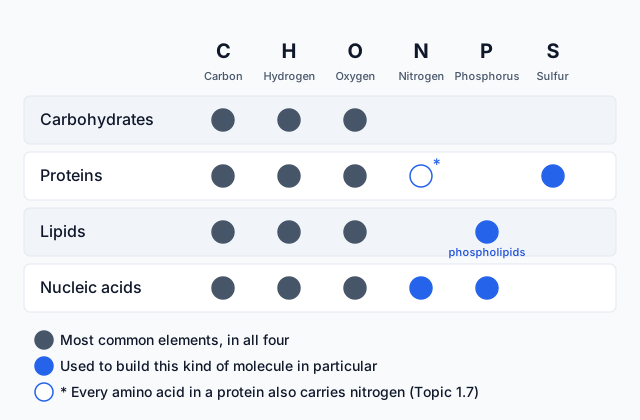 Tap to open the picture full size
Part 1 Think first Where does a tree come from?
Commit to a guess first. Being wrong now makes the right idea stick better.
Predict first
An acorn weighing a few grams grows into an oak tree weighing several tons. The soil around it is still there afterward, almost as deep as before. Where did most of the matter in the tree's wood come from?
In short. Living things take in atoms and molecules from their environment and use them to build new molecules, mostly from carbon, hydrogen and oxygen, with sulfur, phosphorus and nitrogen for particular jobs.
- Carbohydrates, proteins, lipids and nucleic acids are built mostly from carbon, hydrogen and oxygen.
- Sulfur is used to build proteins; phosphorus is used to build phospholipids and nucleic acids.
- Nitrogen is used to build nucleic acids, so an organism short of it cannot make new DNA or RNA.
Part 2 Learn it The elements life is built from
2a. Building molecules from the environment
An organism cannot make atoms. Every atom in a new cell, a new strand of DNA or a new protein came in from the environment: from food, from water, from the air, or from minerals in soil or water.
What an organism does is rearrange those atoms. It breaks down molecules it takes in and uses their atoms to build the molecules it needs. A plant takes in carbon dioxide and water and builds sugars from them. An animal eats the plant, breaks its molecules down and builds its own.
So a living thing's growth is limited by the atoms it can get. If one element it needs is missing from its surroundings, it cannot build the molecules that contain that element, no matter how much of everything else it has.
The molecules it builds fall into four large groups, the macromolecules: carbohydrates, proteins, lipids and nucleic acids.
Quick check · Multiple choice
A rabbit eats only grass. Where do the atoms in the new proteins it builds as it grows come from?
2b. Carbon, hydrogen and oxygen are everywhere
Carbon, hydrogen and oxygen are the most common elements in the molecules of life. All four kinds of macromolecule are built mostly from them: carbohydrates, such as sugars and starch; proteins; lipids, such as fats and oils; and nucleic acids, DNA and RNA.
Carbon is the backbone. A carbon atom can form covalent bonds with up to four other atoms, including other carbons, so it can build long chains, branches and rings. Hydrogen and oxygen are attached along those chains.
Some molecules need nothing else. Sugars and starch are built from carbon, hydrogen and oxygen alone. That is why a plant with only air, water and light can still make sugar, but cannot build everything it needs.
Quick check · Fill the statement
Complete the description of the elements in biological molecules.
The three most common elements in carbohydrates, proteins, lipids and nucleic acids are carbon, hydrogen and . Phosphorus is used to build phospholipids and . A sugar such as glucose is built from carbon, hydrogen and oxygen .
2c. Sulfur, phosphorus and nitrogen have particular jobs
Beyond carbon, hydrogen and oxygen, three more elements matter because particular molecules cannot be built without them.
- Sulfur is used to build proteins.
- Phosphorus is used to build phospholipids, the lipids that make up cell membranes, and nucleic acids.
- Nitrogen is used to build nucleic acids. (You will see in Topic 1.7 that every amino acid in a protein carries nitrogen too.)
This is why fertilizers supply nitrogen and phosphorus, and why a shortage of one element has specific effects. A cell short of phosphorus cannot build new DNA, RNA or membranes. A cell short of sulfur cannot finish building proteins. Sugar itself contains neither element: it is built from carbon, hydrogen and oxygen alone.
It also lets biologists track molecules. Give a cell a form of sulfur that can be traced, and the trace turns up in its proteins; give it traceable phosphorus, and the trace turns up in its nucleic acids and membranes.
Quick check · Match
Match each element to what a cell uses it to build.
Part 3 Watch it done Following the sulfur
Predict first, then watch each step, then finish the reasoning yourself.
A student grows bacteria in a medium where the only sulfur is a form she can trace. After the bacteria grow, she separates their molecules into four groups and measures how much traced sulfur each group holds, in arbitrary units.
- Proteins: 245
- Nucleic acids: 2
- Lipids: 2
- Carbohydrates: 1
These numbers are a teaching example, not a published study. What share of the traced sulfur ended up in proteins, and what does that say about what sulfur is used for?
Predict first
Before you open the first step, predict: roughly how much of the traced sulfur is in the proteins?
Step 1 · Find the total
Add the four groups: 245 + 2 + 2 + 1 = 250 units of traced sulfur in all.
Step 2 · Find the share in proteins
245 divided by 250 is 0.98, so 98% of the traced sulfur is in the proteins. The other three groups together hold 5 units, 2%.
Why this step?
Why must the traced form be the only sulfur in the medium?
If untraced sulfur were also available, the bacteria could build some molecules with it, and those would not show up. With only traceable sulfur, wherever sulfur goes, the trace goes.
Step 3 · Say what the number means
Almost all the sulfur the bacteria took in was built into proteins. That is what we expect if sulfur is used to build proteins and not the other macromolecules.
Your step · Decide and justify
She repeats the experiment with a second culture, where the only phosphorus is a traceable form. Which groups will hold most of the traced phosphorus?
Which reason supports your decision?
Tracing one element at a time shows which molecules it is built into. That is the same reasoning as the oak tree: follow the atoms, and you can say where every part of a living thing came from.
Part 4 Try it Algae with something missing
A new experiment. A student grows the same algae in four flasks under the same light and temperature. One flask has a complete nutrient solution. Each of the others has the same solution with one element left out. After 7 days she counts the cells. These numbers are a teaching example.
- Complete solution: 480 thousand cells per mL
- No nitrogen: 60 thousand cells per mL
- No phosphorus: 72 thousand cells per mL
- No sulfur: 120 thousand cells per mL
Try it · Calculate
The flask with no sulfur reached what percentage of the cell count in the complete flask? Give your answer to the nearest whole percent.
Try it · Decide and justify
A classmate says the algae without sulfur grew less because they could not build carbohydrates. Is the classmate right?
Which reason supports your decision?
Part 5 Explain it Lettuce without soil
On the exam this is handwritten, so answer on paper first. Nothing you type here leaves this page. Then check your answer against the model and each scoring point.
Free response is 50% of the exam score. This one is shaped like Question 4, Conceptual Analysis.
Free-response practice · Question 4 style
A grower raises lettuce with its roots in a tank of water, with air bubbled through the water and bright lights overhead. There is no soil. Each week she adds a mineral mix to the water.
(a) Describe which elements are the most common in the carbohydrates, proteins, lipids and nucleic acids of the lettuce.
(b) Identify one element the lettuce must get from the mineral mix to build nucleic acids.
(c) Explain why the lettuce needs sulfur from the mix to build proteins, even though sulfur is not part of the sugars it makes.
(d) Predict the effect of leaving phosphorus out of the mix on the lettuce's ability to build new cell membranes, and justify your prediction.
Model answer
(a) Carbon, hydrogen and oxygen are the most common elements in all four kinds of macromolecule.
(b) Nitrogen (or phosphorus).
(c) Sulfur is used to build proteins, so without it the lettuce cannot complete them. Sugar is built from carbon, hydrogen and oxygen only, which the lettuce gets from carbon dioxide in the air and from water, so sulfur is not part of it.
(d) The lettuce would not be able to build new membranes, because membranes are made of phospholipids and phosphorus is used to build phospholipids.
Score your own answer. This is a self-check, not a grade. Tick each point your answer makes.
Part 6 Check yourself Four unknown molecules
All three case questions use the table.
A student is given four molecules, W, X, Y and Z, each taken from a living cell, and a test that shows which elements each contains. Each one is a carbohydrate, a protein, a lipid or a nucleic acid. These results are a teaching example.
| Molecule | Carbon | Hydrogen | Oxygen | Nitrogen | Phosphorus | Sulfur |
|---|---|---|---|---|---|---|
| W | yes | yes | yes | no | no | no |
| X | yes | yes | yes | yes | no | yes |
| Y | yes | yes | yes | yes | yes | no |
| Z | yes | yes | yes | no | yes | no |
Case question 1 · Multiple choice
Using the table: which molecule is most likely a protein?
Case question 2 · Multiple choice
Using the table: which molecule is most likely a nucleic acid?
Case question 3 · Decide and justify
Using the table: a student says W must be a carbohydrate. Do the data show that?
Which reason supports your decision?
The rest stand on their own and do not use the case.
Check yourself · Spot the error
A student explains which elements a cell must take in to build new DNA. Tap the line with the mistake.
Check yourself · Sort it
Each card names a molecule. Tap a card, then the bin that says whether a cell needs phosphorus to build it.
Needs phosphorus
Built without phosphorus
Part 7 Keep it Bring back earlier ideas
Water is the molecule all of these are built and used in. Pulling back how it works keeps it from fading.
From 1.1 Structure of Water and Hydrogen Bonding · Multiple choice
A jellyfish and a dry rock sit in the same sunlight on a warm afternoon. The jellyfish's temperature rises much more slowly than the rock's. Which explanation is best supported?
From 1.1 Structure of Water and Hydrogen Bonding · Spot the error
A student explains how water climbs from a plant's roots to its leaves. Tap the line with the mistake.
In three lines
- Organisms cannot make atoms; they take in atoms and molecules from the environment and rearrange them into new molecules.
- Carbohydrates, proteins, lipids and nucleic acids are built mostly from carbon, hydrogen and oxygen.
- Sulfur is used to build proteins, phosphorus to build phospholipids and nucleic acids, and nitrogen to build nucleic acids.
Exam strategy for this topic
- Section I, Multiple Choice: 60 questions in 90 minutes.
- Section II, Free Response: 6 questions in 90 minutes.
- This lesson's Explain it is shaped like free-response question 4, Conceptual Analysis.
- A four-function, scientific, or graphing calculator is allowed on both sections of the exam.
When a question gives an element and asks what a cell can or cannot build, name the macromolecule that element is used for (sulfur for proteins, phosphorus for phospholipids and nucleic acids, nitrogen for nucleic acids) before you choose.
Questions students ask
What are the most common elements in living things' molecules?
Carbon, hydrogen and oxygen. All four kinds of macromolecule, carbohydrates, proteins, lipids and nucleic acids, are built mostly from them.
What is sulfur used for in living things?
Sulfur is used to build proteins. A cell without sulfur cannot complete its proteins, although it can still make sugars.
Which macromolecules contain phosphorus?
Phosphorus is used to build phospholipids, the lipids of cell membranes, and nucleic acids, DNA and RNA.
Why do fertilizers contain nitrogen and phosphorus?
Plants get carbon, hydrogen and oxygen from air and water, but they need nitrogen and phosphorus from the soil to build nucleic acids and, for phosphorus, membranes.
Where does a plant's mass come from?
Mostly from carbon dioxide in the air and from water, which supply the carbon, hydrogen and oxygen of its sugars. Soil supplies smaller amounts of elements such as nitrogen and phosphorus.
Course alignment, for teachers
AP Biology topic 1.2, Unit 1: Chemistry of Life.
- Skill 2.A: Describe characteristics of visual representations of biological concepts and processes.
This lesson maps the one essential knowledge statement of the topic to the part that teaches each one: 1 is checked by a scored question. The map is in the lesson file.