Unit 8 · Topic 8.6 · about 30 minutes · 7 parts · 11 scored checks, 2 of them multiple choice, plus 2 from earlier lessons
AP Biology 8.6: Biodiversity
Unit 8: 10 to 15% of the multiple-choice section
What you'll be able to do
- Describe the relationship between ecosystem diversity and its resilience to changes in the environment.
- Explain how the addition or removal of any component of an ecosystem will affect its overall short-term and long-term structure.
Key vocabulary
| Term | What it means | The exam trap |
|---|---|---|
| Resilience | How well an ecosystem withstands a change in its environment and recovers from it. | Name the change first, then judge how an ecosystem responds to that change. |
| Biodiversity | The variety of life in an area, from the genes within species to the species and ecosystems present. | Say whether you are comparing genes, species or ecosystems before you compare diversity. |
| Abundance | How many individuals of a species are present in an area. | Give abundance as a number or a share of the total before comparing species. |
| Artificial ecosystem | An ecosystem that people build and manage, such as a farm field, a lawn or a stocked pond. | Describe its parts the same way you would a natural ecosystem's before judging it. |
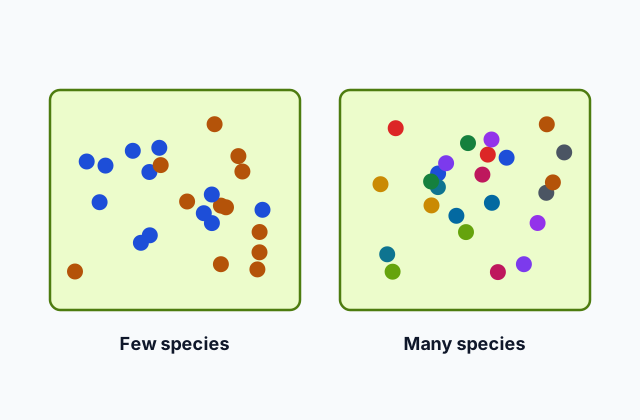 Tap to open the picture full size
Part 1 Think first Two grasslands in a drought
Commit to a guess first. Being wrong now makes the right idea stick better.
Predict first
Two grasslands are the same size and get the same rain. Grassland A has 3 kinds of plants; grassland B has 20 kinds, from deep-rooted shrubs to low grasses. Then a severe drought hits both. Which grassland is more likely to still have most of its plant cover a year later?
In short. Ecosystems with fewer component parts, and with little diversity among those parts, are often less resilient to changes in the environment.
- This holds for natural ecosystems and for artificial ones, such as a field planted with one crop.
- Keystone species, producers, and essential abiotic and biotic factors contribute to maintaining the diversity of an ecosystem.
- A keystone species has effects out of proportion to its abundance, and when it is removed, the ecosystem often collapses.
Part 2 Learn it Diversity and what holds an ecosystem together
2a. Diversity and resilience
An ecosystem's resilience is how well it withstands a change in the environment, such as a drought, a new disease or a flood, and recovers from it.
Natural and artificial ecosystems with fewer component parts, and with little diversity among the parts, are often less resilient to changes in the environment.
- A field planted with a single crop variety is an artificial ecosystem with very few parts. A disease that harms that variety can sweep through the whole field.
- A prairie with many species of grasses, flowers and animals has many parts that respond to a change in different ways. When some parts are harmed, others can carry on.
Notice the word often: diversity raises the odds of withstanding a change, but it is not a guarantee.
Quick check · Multiple choice
Two coastal wetlands face the same rise in salt levels after a storm. Wetland X holds many species of plants and animals of many different kinds; wetland Y holds a few species, most of them alike. Which wetland is often less resilient to this change, and why?
2b. What keeps an ecosystem diverse
Several components contribute to maintaining the diversity of an ecosystem.
- Producers, such as plants and algae, capture energy that the rest of the community depends on.
- Essential abiotic factors, the nonliving parts such as sunlight, water, temperature and soil minerals, set what can live there.
- Essential biotic factors, the living parts such as pollinators, prey and decomposers, support other species.
- Keystone species, which the next chunk explains, also help hold an ecosystem's diversity in place.
Lose or change one of these components, and the diversity it supported can be lost with it.
Quick check · Fill the statement
Complete the description of three components that help keep an ecosystem diverse.
Plants and algae that capture the energy the rest of a community depends on are . Sunlight, water and soil minerals are essential factors. Living parts of the ecosystem, such as the insects that pollinate flowers, are essential factors.
2c. Keystone species
A keystone species has effects on the ecosystem that are disproportionate relative to its abundance: it can be a small share of the organisms present and still shape the whole community. When a keystone species is removed from the ecosystem, the ecosystem often collapses.
Removing any component changes an ecosystem's structure in the short term and the long term:
- In the short term, the species it interacted with most directly change first. A predator's prey, for example, may increase.
- In the long term, those changes spread through the community, and many other species can decline or disappear.
So judge a species by its effect when it is removed, not by how many of it there are.
Quick check · Decide and justify
A teaching example. A dung beetle makes up about 1% of the insects in a forest. When researchers remove the beetles from test plots, the number of plant species in those plots falls from 30 to 12 over five years, while plots with beetles keep about 30. Is the dung beetle better described as a keystone species or an ordinary species?
Which statement supports your decision?
Part 3 Watch it done A small share with a large effect
Predict first, then watch each step, then finish the reasoning yourself.
A teaching example. In a set of ponds, one fish species makes up 3 of every 100 animals counted. Researchers remove it from some test ponds. Over two years, the number of species in those ponds falls from 20 to 8, while untouched ponds keep about 20. What percentage of the species did the test ponds lose, and does the fish fit the description of a keystone species?
Predict first
Before you open the first step, predict: does a fish that is 3% of the animals fit the description of a keystone species?
Step 1 · Read the abundance
The fish is 3 of every 100 animals counted, which is 3%: a small share of the community.
Step 2 · Read the effect
Without the fish, the test ponds fall from 20 species to 8. The untouched ponds keep about 20, so the drop follows the removal.
Why this step?
Why compare with ponds where the fish was left in place?
The untouched ponds show what would have happened anyway. If they had lost species too, something else, such as the weather, could explain the drop.
Step 3 · Find the share lost
Subtract the species left from the species at the start, then divide by the species at the start.
Your step · Calculate
A teaching example: after one fish species is removed from test ponds, the number of species in each pond falls from 20 to 8. What percentage of the species did the ponds lose?
%
60% of the species were lost after removing a fish that was 3% of the animals. An effect that large from so small a share fits a keystone species, and the community lost most of its species without it, the kind of collapse that often follows losing a keystone species.
Part 4 Try it Removing a predator, and judging ecosystems
Two new situations, both teaching examples. First, a predator that eats sea urchins is removed from a coast where urchins graze on kelp, a large seaweed that many species live in: put the events that follow in order. Second, sort several ecosystems by how resilient they often are to a change.
Try it · Put it in order
On a coast, a predator eats sea urchins, and urchins graze on kelp, a large seaweed that many other species use for food and shelter. The predator is removed. Put the events in order, from the removal to the long-term state of the coast.
Try it · Sort it
Each card describes an ecosystem. Tap a card, then how resilient that ecosystem often is to a change in the environment, compared with the others.
Often more resilient
Often less resilient
Part 5 Explain it A grassland and a wheat farm
On the exam this is handwritten, so answer on paper first. Nothing you type here leaves this page. Then check your answer against the model and each scoring point.
Free response is 50% of the exam score. This one is shaped like Question 4, Conceptual Analysis.
Free-response practice · Question 4 style
A teaching example. A grassland holds many species of plants, several kinds of grazing animals, and a predator that makes up a small share of its animals. Nearby, a farm grows a single variety of wheat.
(a) Describe which of the two ecosystems is often more resilient to a change in the environment, such as a new plant disease.
(b) Explain how producers contribute to maintaining the diversity of the grassland.
(c) The predator is a keystone species. Predict one short-term and one long-term effect of removing it from the grassland.
(d) In test plots where the predator was removed, the number of plant species fell from 25 to 9. Justify calling the predator a keystone species even though it is a small share of the animals.
Model answer
(a) The grassland is often more resilient. It has many component parts that differ from one another, so a disease that harms one species leaves others to carry on. The wheat farm has few parts with little diversity, so one disease can harm the whole crop.
(b) Producers, the grassland's plants, capture the energy the grazers and every other consumer depend on, so many kinds of producers support many kinds of consumers.
(c) Short term: the grazing animals the predator ate increase in number. Long term: the grazers eat down the plants, the species that depend on those plants decline, and the ecosystem may collapse.
(d) A keystone species has effects disproportionate to its abundance. Although it is only a small share of the animals, removing it cut the plant species from 25 to 9, a change to the whole community far larger than its numbers.
Score your own answer. This is a self-check, not a grade. Tick each point your answer makes.
Part 6 Check yourself Grassland plots in a drought
All three case questions use the table.
Researchers sow two grassland plots of the same size. Plot A gets 2 plant species; plot B gets 12. They weigh the plant mass in each plot (grams per square meter) just before a severe drought and again just after it. These numbers are a teaching example.
| Plot | Plant species | Mass before (g/m²) | Mass after (g/m²) |
|---|---|---|---|
| A | 2 | 400 | 160 |
| B | 12 | 420 | 336 |
Case question 1 · Calculate
Using the table: what percentage of its plant mass from before the drought did plot B still have after it?
Case question 2 · Multiple choice
Using the table: which statement do the data support?
Case question 3 · Decide and justify
Using the table: a student claims these data prove that adding species to any ecosystem makes it resilient to every kind of change. Is the claim supported by the data, or too broad?
Which statement supports your decision?
The rest stand on their own and do not use the case.
Check yourself · Spot the error
In a teaching example, sea stars are a small share of the animals in a tide pool community. A student explains why they are a keystone species. Tap the line with the mistake.
Check yourself · Match
Match each component of an ecosystem to the description that fits it.
Part 7 Keep it Bring back earlier ideas
An ecosystem's diversity can be measured, and its populations vary within themselves. Pulling back how to compute a diversity index, and why a population with little genetic variation is at risk, sets ecosystem resilience beside them.
From 8.5 Community Ecology · Calculate
A teaching example: a pond holds 40 animals: 20 frogs, 12 newts and 8 turtles. Using Simpson's Diversity Index = 1 − Σ(n/N)², what is the pond's index? Give your answer to two decimal places.
From 7.11 Variations in Populations · Multiple choice
Two populations of the same species of tree are the same size. In population X, the trees carry many different alleles at most genes; in population Y, nearly all the trees carry the same alleles. Which population is more at risk of decline from a change in its environment, and why?
In three lines
- Ecosystems with fewer component parts and little diversity among them, natural or artificial, are often less resilient to changes in the environment.
- Keystone species, producers, and essential abiotic and biotic factors contribute to maintaining an ecosystem's diversity.
- A keystone species has effects disproportionate to its abundance; when it is removed, the ecosystem often collapses.
Exam strategy for this topic
- Section I, Multiple Choice: 60 questions in 90 minutes.
- Section II, Free Response: 6 questions in 90 minutes.
- This lesson's Explain it is shaped like free-response question 4, Conceptual Analysis.
- A four-function, scientific, or graphing calculator is allowed on both sections of the exam.
When a question asks about removing a species, give one short-term effect on the species it touches directly and one long-term effect on the rest of the community, and keep the hedge: an ecosystem often collapses, not always.
Questions students ask
How does diversity affect an ecosystem's resilience?
Natural and artificial ecosystems with fewer component parts, and with little diversity among the parts, are often less resilient to changes in the environment.
What is a keystone species?
A species whose effects on the ecosystem are disproportionate relative to its abundance. When it is removed from the ecosystem, the ecosystem often collapses.
What maintains the diversity of an ecosystem?
Keystone species, producers, and essential abiotic and biotic factors contribute to maintaining the diversity of an ecosystem.
Is a farm field an ecosystem?
Yes, an artificial one. A field of a single crop variety has few component parts with little diversity among them, so it is often less resilient to a change such as a new disease.
What happens when a component of an ecosystem is removed?
In the short term, the species it interacted with directly change; over the long term, those changes can spread through the community and alter the ecosystem's overall structure.
Course alignment, for teachers
AP Biology topic 8.6, Unit 8: Ecology.
- Skill 6.E: Predict the causes or effects of a change in, or disruption to, one or more components in a biological system.
This lesson maps all 3 essential knowledge statements of the topic to the part that teaches each one: 3 are checked by a scored question. The map is in the lesson file.