Unit 8 · Topic 8.7 · about 30 minutes · 7 parts · 12 scored checks, 2 of them multiple choice, plus 2 from earlier lessons
AP Biology 8.7: Disruptions in Ecosystems
Unit 8: 10 to 15% of the multiple-choice section
What you'll be able to do
- Explain the interaction between the environment and random or preexisting variations in populations.
- Explain how invasive species affect ecosystem dynamics.
- Describe human activities that lead to changes in ecosystem structure and dynamics.
- Explain how geological and meteorological activity leads to changes in ecosystem structure and dynamics.
Key vocabulary
| Term | What it means | The exam trap |
|---|---|---|
| Native species | A species that lives in an area where it evolved or arrived without human help. | Say where a species came from before calling it native or introduced. |
| Trophic level | A feeding step in an ecosystem, from producers up through each level of consumers. | Count the levels up from the producers before comparing two organisms. |
| Habitat | The place and conditions where an organism lives. | Name the habitat and the change to it before predicting what happens to a species. |
| Niche | The role a species plays in its community, including what it eats, what eats it and the resources it uses. | List what a species uses and what uses it before comparing its niche with another's. |
 Tap to open the picture full size
Part 1 Think first Goats on an island
Commit to a guess first. Being wrong now makes the right idea stick better.
Predict first
Goats are released on an island that has never had any large grazing animals. Within a few decades the goats have spread across the island, eating plants that native birds and insects depended on. What best explains how fast the goats spread?
In short. Ecosystems are disrupted when their environment changes, and how populations fare depends on the variation they already carry.
- Mutations are not directed by specific environmental pressures; an adaptation is a genetic variation favored by selection that gives an advantage in a particular environment.
- An invasive species can exploit a new niche free of predators or competitors, or outcompete native species for resources.
- Human activities accelerate change at local and global levels and can drive changes, such as biomagnification and eutrophication, that cause extinctions; geological and meteorological events also change habitats.
Part 2 Learn it How ecosystems are disrupted
2a. Variation meets a changing environment
When the environment changes, what happens to a population depends on the variation it already carries.
- Mutations are not directed by specific environmental pressures. A new drug, a colder winter or a new predator does not cause the mutations an organism would need. Mutations arise at random, whether or not they help.
- An adaptation is a genetic variation that is favored by selection and manifests as a trait that provides an advantage to an organism in a particular environment.
So the environment does not create helpful variations. It favors some of the random or preexisting ones, and individuals with those variations leave more offspring.
Quick check · Multiple choice
A population of bacteria is exposed to an antibiotic. Most cells die, but a few survive and reproduce, and every survivor carries the same mutation that makes it resistant. Which statement best describes where that mutation came from?
2b. Heterozygote advantage
Sometimes neither homozygous genotype is the fittest.
Heterozygote advantage is when the heterozygous genotype has a higher relative fitness than either the homozygous dominant or homozygous recessive genotype.
Fitness is measured by offspring that survive to reproduce. To compare genotypes, divide each genotype's fitness by the highest one: the fittest genotype has a relative fitness of 1, and the others fall below it. For heterozygote advantage, the genotype at 1 must be Aa, with AA and aa both below it.
Quick check · Multiple choice
Each choice gives, for one plant population, the average number of offspring per plant that survive to reproduce for genotypes AA, Aa and aa. Which population shows heterozygote advantage?
2c. Invasive species
People move species to new places, sometimes on purpose (a garden plant, a game animal) and sometimes by accident (seeds in cargo, animals in a ship's water).
The intentional or unintentional introduction of an invasive species can allow the species to exploit a new niche free of predators or competitors, or to outcompete native species for resources.
In its native range, a species is often held in check by the predators and competitors it evolved with. In a new place, those checks may be missing, so its numbers can climb while native species lose food, space or light.
Quick check · Fill the statement
Complete the description of how introduced species can spread.
A vine brought to a new region on purpose, as a garden plant, is an introduction. Snails carried by accident in a ship's water are an introduction. Free of the that ate them in their native range, the snails can spread quickly.
2d. Human activity and natural events
Human impact accelerates changes at local and global levels. These activities can drive changes in ecosystems that cause extinctions, such as:
- Biomagnification: a pollutant that organisms take in but do not break down or excrete becomes more concentrated at each higher trophic level, so top predators carry the most.
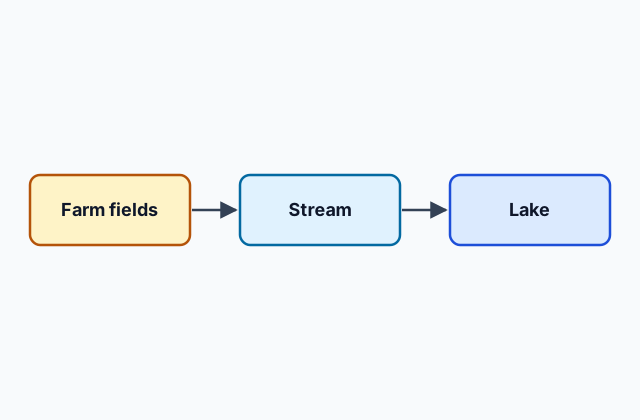
- Eutrophication: extra nutrients, such as fertilizer washing into a lake, feed a fast growth of algae. When the algae die, decomposers break them down and deplete the oxygen in the water, and fish and other animals can die.
Not every disruption is human. Geological and meteorological events, such as volcanic eruptions, earthquakes, hurricanes and droughts, affect habitat change and where ecosystems are found. Biogeographical studies, which track where species live and how that shifts, illustrate these changes.
Quick check · Sort it
Each card describes a change to an ecosystem. Tap a card, then its source.
Human activity
Geological or meteorological event
Part 3 Watch it done A pollutant climbs a food chain
Predict first, then watch each step, then finish the reasoning yourself.
A teaching example. A pollutant enters a lake. Its concentration is 0.04 parts per million (ppm) in plankton, 0.4 ppm in small fish that eat plankton, 2 ppm in large fish that eat small fish, and 10 ppm in eagles that eat large fish. How many times as concentrated is the pollutant in the eagles as in the plankton?
Predict first
Before you open the first step, predict: where is the pollutant most concentrated?
Step 1 · Order the trophic levels
Plankton are eaten by small fish, small fish by large fish, and large fish by eagles: four levels, plankton at the bottom and eagles at the top.
Step 2 · Read the trend
0.04, then 0.4, then 2, then 10 ppm. The concentration rises at every higher trophic level: biomagnification.
Why this step?
Why does the concentration rise rather than stay the same?
Each organism eats many organisms from the level below. A pollutant it does not break down or excrete stays in its body, so it builds up from all that food.
Step 3 · Compare top and bottom
Divide the eagles' concentration by the plankton's.
Your step · Calculate
A teaching example: a pollutant's concentration is 0.04 ppm in a lake's plankton, 0.4 ppm in small fish, 2 ppm in large fish and 10 ppm in eagles. How many times as concentrated is the pollutant in the eagles as in the plankton?
250 times as concentrated. A pollutant that builds up at each higher trophic level reaches its highest levels in top predators, which is how biomagnification can harm species far from where the pollutant entered.
Part 4 Try it Resistant insects and a green lake
Two new situations, both teaching examples. First, decide whether a student is right about where pesticide resistance in insects comes from. Second, fertilizer washes into a lake: put the events that follow in order.
Try it · Decide and justify
A field has been sprayed with the same pesticide for ten years, and most of its insects are now resistant to it. A student claims the spray caused resistance mutations in the insects that needed them. Does the student's claim hold, or does it fail?
Which statement supports your decision?
Try it · Put it in order
Fertilizer from farms near a lake washes into it after heavy rain. Put the events in order, from the runoff to the change in the lake's animals.
Part 5 Explain it Testing an invasive snail
On the exam this is handwritten, so answer on paper first. Nothing you type here leaves this page. Then check your answer against the model and each scoring point.
Free response is 50% of the exam score. This one is shaped like Question 3, Scientific Investigation.
Free-response practice · Question 3 style
A teaching example. A snail introduced to a lake is spreading quickly and replacing a native snail. In its native range, the introduced snail is eaten by a crayfish that does not live in the lake. Researchers set up 10 tanks of lake water with the same number of introduced snails. Five tanks also get crayfish from the snail's native range; five get none. They count the snails after eight weeks.
(a) Identify the independent variable in this investigation.
(b) State the null hypothesis.
(c) Predict the result if the snail spreads in the lake because it is free of its predator.
(d) Justify your prediction using how invasive species can affect ecosystem dynamics.
Model answer
(a) Whether crayfish are present in the tank.
(b) The presence of crayfish has no effect on the number of introduced snails after eight weeks.
(c) Tanks without crayfish will hold more snails after eight weeks than tanks with crayfish.
(d) An introduced species can exploit a new niche free of predators. In the lake, nothing eats the snail the way the crayfish does in its native range, so its numbers can grow; restoring the predator should hold the numbers down.
Score your own answer. This is a self-check, not a grade. Tick each point your answer makes.
Part 6 Check yourself Three genotypes of a plant
All three case questions use the table.
In a region where a leaf fungus is common, researchers follow plants of one species with three genotypes at one gene. For each genotype they record the average number of offspring per plant that survive to reproduce. These numbers are a teaching example.
| Genotype | Average surviving offspring per plant |
|---|---|
| AA | 3.0 |
| Aa | 4.5 |
| aa | 1.2 |
Case question 1 · Calculate
Using the table: what is the relative fitness of genotype AA, taking the fittest genotype as 1? Give your answer to two decimal places.
Case question 2 · Rank it
Using the table: rank the three genotypes by fitness, from highest to lowest.
Highest fitness first
Give each one a place, 1 for first. Give two the same place if they are equal.
Your ranking: none yet
Case question 3 · Decide and justify
Using the table: do these data show heterozygote advantage?
Which statement supports your decision?
The rest stand on their own and do not use the case.
Check yourself · Spot the error
In a teaching example, a vine brought to a new region is spreading quickly. A student explains why. Tap the line with the mistake.
Check yourself · Match
Match each term to the description that fits it.
Part 7 Keep it Bring back earlier ideas
How populations fare when an ecosystem is disrupted depends on diversity and on fitness. Pulling back why an ecosystem with few, similar parts copes poorly with change, and how fitness is measured, sets these disruptions beside them.
From 8.6 Biodiversity · Multiple choice
Two coastal wetlands face the same rise in salt levels after a storm. Wetland X holds many species of plants and animals of many different kinds; wetland Y holds a few species, most of them alike. Which wetland is often less resilient to this change, and why?
From 7.1 Introduction to Natural Selection · Multiple choice
Four birds of one species nest in the same forest. Bird A lays 12 eggs, and 2 of its chicks survive to breed. Bird B lays 6 eggs, and 5 survive to breed. Bird C lays 8 eggs, and 3 survive to breed. Bird D lays 4 eggs, and all 4 survive to breed. Which bird has the highest evolutionary fitness?
In three lines
- Mutations are not directed by environmental pressures; adaptations are variations favored by selection, and in heterozygote advantage, Aa is the fittest genotype.
- An invasive species can exploit a new niche free of predators or competitors, or outcompete native species for resources.
- Human activities accelerate change and can drive changes, such as biomagnification and eutrophication, that cause extinctions; geological and meteorological events change habitats too.
Exam strategy for this topic
- Section I, Multiple Choice: 60 questions in 90 minutes.
- Section II, Free Response: 6 questions in 90 minutes.
- This lesson's Explain it is shaped like free-response question 3, Scientific Investigation.
- A four-function, scientific, or graphing calculator is allowed on both sections of the exam.
When a question asks why a trait became common after a change, say the variation was already present at random and the change favored it. Never write that the environment caused the mutation.
Questions students ask
Do environmental pressures cause mutations?
No. Mutations are not directed by specific environmental pressures. A pressure favors variations that are already present.
What is heterozygote advantage?
Heterozygote advantage is when the heterozygous genotype has a higher relative fitness than either the homozygous dominant or homozygous recessive genotype.
Why do invasive species spread so well?
The intentional or unintentional introduction of an invasive species can allow it to exploit a new niche free of predators or competitors, or to outcompete native species for resources.
What are biomagnification and eutrophication?
Two human-driven changes that can cause extinctions. In biomagnification, a pollutant becomes more concentrated at each higher trophic level. In eutrophication, extra nutrients feed algae whose decomposition uses up the oxygen in water.
How do geological and weather events change ecosystems?
Geological and meteorological events, such as eruptions and hurricanes, affect habitat change and ecosystem distribution. Biogeographical studies illustrate these changes.
Course alignment, for teachers
AP Biology topic 8.7, Unit 8: Ecology.
- Skill 5.D: Use data to evaluate a hypothesis or prediction, including rejecting or failing to reject the null hypothesis.
This lesson maps all 6 essential knowledge statements of the topic to the part that teaches each one: 6 are checked by a scored question. The map is in the lesson file.