Timed practice
Full practice exams
Pick an exam. Each one shows its format first, then runs one section at a time on its own clock.
Practice Exam 1
42 multiple-choice and 6 free-response questions, in the format of the AP Calculus AB Exam.
| Section | Questions | Time | Calculator |
|---|---|---|---|
| Section I Part A: Multiple Choice (calculator not permitted) | 29 | 62 minutes | Calculator not permitted |
| Section I Part B: Multiple Choice (graphing calculator required) | 13 | 38 minutes | Graphing calculator required |
| Section II Part A: Free Response (graphing calculator required) | 2 | 30 minutes | Graphing calculator required |
| Section II Part B: Free Response (calculator not permitted) | 4 | 60 minutes | Calculator not permitted |
How the exam works
- One section at a time. When a section's clock reaches zero, the section ends and is scored.
- Multiple choice is scored when its section ends, with an explanation for every choice.
- Free response is never scored by the page. When the section ends, you see the scoring guide and a model response for each part and tick the points your answer earns.
- At the end you get your score and the time you used for each section.
- In study mode each multiple-choice answer is checked as soon as you give it, with its explanation, and each free-response question has a button that opens its scoring guide.
- Switching to study mode partway keeps your answers and checks the ones you have given. Start over clears everything and lets you choose a mode again.
- Your answers are kept in this browser tab if the page reloads, and nowhere else.
Section I Part A: Multiple Choice (calculator not permitted)
-
No calculator. What is ?
Answer: B.
- A
Leading coefficients at a finite point: the ratio of leading coefficients gives a limit as . Here approaches 3, so factor and cancel instead, which gives .
- B
Correct. Substituting 3 gives , so factor: for . The limit is .
- C
Constant terms only: is the value of the expression at , not near . Cancel the common factor and substitute 3 into .
- D
Reading as "no limit": is an indeterminate form, a signal to rewrite the expression. After canceling the limit is .
- A
-
No calculator. What is ?
Answer: D.
- A
Treating as : , which is when is negative. The numerator stays positive while is negative, so the quotient is negative.
- B
Dropping the square root: the leading term of the numerator is , not , so compare with .
- C
Counting the degree inside the root: has degree 2, but the square root brings the numerator down to degree 1, the same as the denominator, so the quotient levels off at a finite value.
- D
Correct. For large , behaves like , and for negative , . So the quotient behaves like . The numerator is always positive and the denominator is negative, so a negative limit fits.
- A
-
No calculator. The function is defined for all real numbers, and . The table gives values of for selected values of near 1.
Which of the following is the best conclusion about from the table?
Answer: A.
- A
Correct. From the left the values approach 2, and from the right they approach 5. The two one-sided limits disagree, so the two-sided limit does not exist.
- B
Reading one side only: 2 is where the values from the left are headed. A two-sided limit also needs the values from the right, which approach 5.
- C
Using the value at the point: and the right-hand values both point to 5, but a limit ignores and needs both sides to agree. The left-hand values approach 2.
- D
Averaging the two sides: when the one-sided limits differ, there is no single value the outputs approach, so the limit does not exist. Averaging 2 and 5 describes neither side.
- A
-
No calculator. Let be the function defined by for and , where is a constant. For what value of is continuous at ?
Answer: C.
- A
Flipping the simplified fraction: after the conjugate step the expression is , so the limit is the reciprocal of 4, not 4.
- B
Reading as 0: the numerator and denominator both approach 0, which is indeterminate, not zero. Simplify with the conjugate to find the limit, .
- C
Correct. is continuous at 3 when equals the limit there. Multiply by the conjugate: . At that is .
- D
Mistaking a removable discontinuity for one that cannot be removed: the limit as exists and equals , so defining fills the hole.
- A
-
No calculator. If and , what is ?
Answer: B.
- A
Losing the sign of : approaches , so the numerator approaches , not .
- B
Correct. The limit of each piece exists and the denominator's limit, , is not 0, so the properties of limits apply: .
- C
Dropping the in the denominator: itself approaches 2, so the denominator approaches , not 3.
- D
Doubling instead of squaring: approaches , not .
- A
-
No calculator. What is ?
Answer: A.
- A
Correct. Since , this is the limit definition of the derivative of at , with . The derivative is , so the limit is .
- B
Setting in the numerator only: the numerator and the denominator both approach 0, an indeterminate form. The quotient is a difference quotient, whose limit is a derivative.
- C
Reporting the function value: 8 is . The limit of the difference quotient is the slope , not the height .
- D
Not squaring in the power rule: the derivative of is , so at it is , not .
- A
-
No calculator. The functions and are differentiable, with , , and . If , what is ?
Answer: D.
- A
Multiplying the derivatives: the derivative of a product is not the product of the derivatives, . Use .
- B
Subtracting the two terms: is the start of the quotient rule's numerator. The product rule adds the terms: .
- C
Reporting the product itself: is , the value of , not its rate of change.
- D
Correct. By the product rule, .
- A
-
No calculator. If , what is ?
Answer: C.
- A
Reversing the order in the numerator: the quotient rule is (bottom times derivative of top) minus (top times derivative of bottom). Subtracting the other way round flips the sign.
- B
Dividing the derivatives: at is the derivative of the top over the derivative of the bottom, which is not how a quotient differentiates.
- C
Correct. By the quotient rule, . At : .
- D
Forgetting to square the denominator: the quotient rule divides by at , not by .
- A
-
No calculator. If , what is ?
Answer: A.
- A
Correct. . At , and , so .
- B
Wrong sign on the derivative of secant: the derivative of is . The minus sign belongs to the derivative of , not of .
- C
Using as the derivative of : the derivative of is , which is 2 at , not .
- D
Using as the derivative of : the derivative of is at , so the second term is , not 2.
- A
-
No calculator. If , which of the following is ?
Answer: B.
- A
Dropping the innermost derivative: the chain rule multiplies by the derivative of every inside function, including .
- B
Correct. is a composition of three functions, so the chain rule applies twice: .
- C
Differentiating the sine inside the power instead of the power: the outer function is the cube, whose derivative is , and only then is differentiated.
- D
Differentiating each layer in place: replacing by and keeping the cube is not a rule. Work from the outside in, multiplying the derivatives of the layers.
- A
-
No calculator. The point lies on the curve . What is the slope of the line tangent to the curve at ?
Answer: D.
- A
Skipping the product rule on : its derivative is , not alone. Without the term the slope comes out .
- B
Forgetting the chain rule on : its derivative is . Writing alone leaves only to solve for.
- C
Losing a sign when solving: moving to the other side makes it negative, so .
- D
Correct. Differentiate implicitly: , so . At : .
- A
-
No calculator. If , what is ?
Answer: B.
- A
Dropping the inner derivative: the chain rule multiplies by , which halves .
- B
Correct. . At : .
- C
Using the arccosine formula: the derivative of carries a minus sign, but the derivative of is positive.
- D
Using the arctangent formula: is the derivative of . For it is .
- A
-
No calculator. The radius of a spherical balloon is increasing at a constant rate of 2 centimeters per minute. The volume of a sphere of radius is . At the instant the radius is 3 centimeters, how fast is the volume increasing, in cubic centimeters per minute?
Answer: C.
- A
Leaving out : is , the rate per centimeter of radius. The chain rule multiplies by how fast the radius changes, 2 centimeters per minute.
- B
Swapping the radius and its rate: puts the rate where the radius belongs. The radius is 3 and it changes at 2 per minute.
- C
Correct. Differentiate with respect to time: cubic centimeters per minute.
- D
Differentiating as : the power rule gives , so , not .
- A
-
No calculator. The function is twice differentiable with , and for all . The line tangent to the graph of at is used to approximate . Which of the following is true?
Answer: A.
- A
Correct. The tangent line is , so . Since , the graph is concave up and lies above its tangent lines, so the approximation is an underestimate.
- B
Concavity backward: a concave up graph bends away from its tangent line upward, so the line runs below the graph and underestimates.
- C
Adding the change when the slope is negative: with slope , moving 0.1 to the right lowers the line by 0.3, giving .
- D
Two errors at once: the slope is negative, so the line drops to 4.7, and a concave up graph lies above its tangent line, so the estimate is too small, not too large.
- A
-
No calculator. What is ?
Answer: D.
- A
Dropping the 2 on the second step: the derivative of is 2, so the second application gives , not .
- B
Missing the chain rule on : its derivative is , not .
- C
Reading as no limit: is the indeterminate form L'Hospital's Rule is built for. Two applications give a finite limit.
- D
Correct. Substituting 0 gives , so apply L'Hospital's Rule: , which is again at 0. Apply it again: , which approaches .
- A
-
No calculator. The derivative of a function is given by . At which values of does have a relative maximum?
Answer: C.
- A
Treating every critical point as an extremum: , but is negative on both sides of 1, so keeps decreasing through .
- B
Mixing up the sign change: at , changes from negative to positive, so has a relative minimum there.
- C
Correct. The factor is never negative, so the sign of is the sign of : positive for , negative for (except 0 at ), and positive for . changes from positive to negative only at .
- D
Counting every sign change as a maximum: a change from positive to negative is a maximum, and the change at is from negative to positive, a minimum.
- A
-
No calculator. What is the absolute maximum value of on the closed interval ?
Answer: B.
- A
Checking only the endpoints: and , but the candidates also include the critical points inside the interval, and is larger.
- B
Correct. , so the critical points are and , both in the interval. The candidates are , , and . The largest is 7.
- C
Reporting where, not what: is where the maximum occurs. The maximum value is .
- D
Picking the extreme in the wrong direction: is the smallest candidate, the absolute minimum value.
- A
-
No calculator. Which of the following describes all values of for which the graph of is concave down?
Answer: A.
- A
Correct. , which is negative exactly when . There the graph is concave down.
- B
Reading the sign of backward: is positive outside , where the graph is concave up.
- C
Using instead of : is negative on these intervals, so is decreasing there. Concavity comes from the sign of .
- D
Confusing concave down with below the axis: is negative between and , but concavity is about how the graph bends, the sign of .
- A
-
Questions 19 to 20 refer to the following.
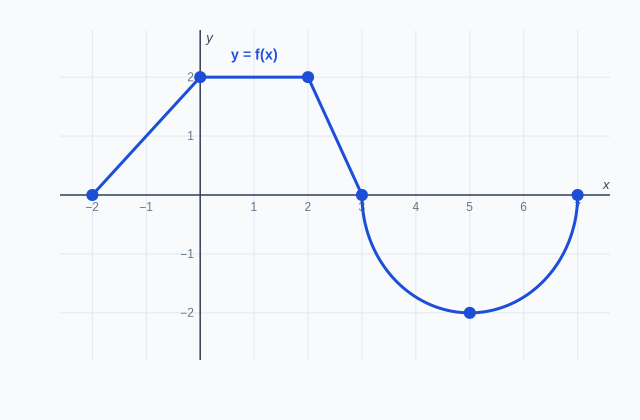
The graph of the continuous function on the closed interval is shown. It consists of three line segments and a semicircle. Let be the function defined by .
No calculator. On which interval is both increasing and concave down?
Answer: C.
- A
Taking increasing as concave down: on , is positive and increasing, so and . is increasing and concave up there.
- B
Taking a level graph of as concave down: is constant at 2 here, so and is a line with slope 2, neither concave up nor down.
- C
Correct. and . is increasing where , on , and concave down where is decreasing, on and . Both hold on .
- D
Ignoring the sign of : is decreasing here, so is concave down, but , so is decreasing, not increasing.
- A
-
Uses the material above question 19.
No calculator. What is the value of ?
Answer: D.
- A
Counting every area as positive: a region below the -axis contributes negatively to a definite integral. is the total area, not the net.
- B
Starting at the wrong lower limit: accumulates from 0, not from . The triangle of area 2 on is not part of .
- C
Using the area of a whole disk: the region from 3 to 7 is half a disk, area , not .
- D
Correct. . From 0 to 3 the region lies above the axis: a rectangle of area 4 and a triangle of area 1, total 5. From 3 to 7 it is half a disk of radius 2 below the axis, area , which counts as negative. .
- A
-
No calculator. Let . What value of satisfies the conclusion of the Mean Value Theorem for on the closed interval ?
Answer: A.
- A
Correct. is a polynomial, so it is continuous on and differentiable on . The average rate of change is . Solve : , and is the solution in .
- B
Applying Rolle's Theorem instead: , but the Mean Value Theorem sets equal to the average rate of change, 6, not 0. Here .
- C
Taking the midpoint of the interval: the theorem promises a point where the instantaneous rate equals the average rate, and for a nonlinear function that point is usually not the midpoint. .
- D
Using the total change instead of the average rate: must be divided by the length of the interval, 3. Solving gives , which is not even in .
- A
-
No calculator. For the curve , . At which points on the curve is the line tangent to the curve horizontal?
Answer: B.
- A
Setting the denominator to 0: leaves with no value, which gives vertical tangents, not horizontal ones.
- B
Correct. A horizontal tangent needs : the numerator while the denominator is not 0. Substituting into the curve: , so and the points are and . At both, .
- C
Setting : these are where the curve crosses the -axis. A horizontal tangent needs the slope, not the height, to be 0; at the slope is .
- D
Setting : these are where the curve crosses the -axis, and the slope there is , not 0.
- A
-
No calculator. Which of the following is equal to ?
Answer: D.
- A
Dropping the starting value: starts at 1, so the interval is from 1 to 4. With on , the sample points would be .
- B
Losing the factor 3 in : with from 0 to 1, , so this integral is the limit of the sum with in place of , one third of the given limit.
- C
Reading the length as the right endpoint: says the interval is 3 units long, so it runs from 1 to , not to 3.
- D
Correct. Read as , so the interval has length 3, and as the right endpoint , which runs from just above 1 up to 4. The function evaluated there is . The limit is .
- A
-
No calculator. Let . What is ?
Answer: C.
- A
Leaving out the chain rule: the upper limit is , not , so the integrand evaluated there is multiplied by .
- B
Differentiating the value : , but a function can be 0 at a point and still be changing there. is the rate, 8.
- C
Correct. By the Fundamental Theorem of Calculus and the chain rule, . At : .
- D
Substituting instead of the upper limit: the integrand is evaluated at , giving , not at , which gives .
- A
-
No calculator. What is ?
Answer: A.
- A
Correct. Let , so , and the limits become to : .
- B
Keeping the -limits after substituting: in terms of the limits are and . Evaluating from 0 to 1 uses the old limits with the new variable.
- C
Dropping the from : only appears in the integral, which is .
- D
Integrating the factors separately and multiplying: is not an antiderivative of the product. Its derivative is not .
- A
-
No calculator. Which of the following is ?
Answer: D.
- A
Dropping the constant from : the derivative of is , twice the integrand.
- B
Choosing the arctangent form because of the : that form fits , with a constant on top. With on top the integrand is up to a constant, which gives a logarithm.
- C
Integrating the top and bottom separately: an antiderivative of a quotient is not built from antiderivatives of its parts. Differentiate this choice to see that it does not return the integrand.
- D
Correct. The numerator is a constant multiple of the derivative of the denominator, so substitute , : . Since , the absolute value is not needed.
- A
-
Questions 27 to 27 refer to the following.
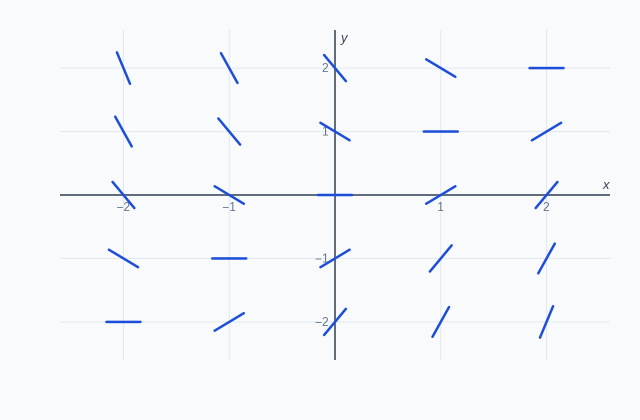
The slope field for a certain differential equation is shown at the points where and are each , , , or .
No calculator. Which of the following differential equations could have this slope field?
Answer: B.
- A
Right zero line, wrong signs: is also 0 along , but it is negative below the line, where the field's segments rise.
- B
Correct. The segments are horizontal along the line , where . Below that line, where , the slopes are positive, and above it they are negative, as gives. At , , a steep rise, matching the field.
- C
Wrong zero line: along , so the segments at and would be horizontal. In the field they are the steepest ones.
- D
Zero slopes on the axes: whenever or , but in the field the segments at and are not horizontal.
- A
-
No calculator. Let be the solution to the differential equation with initial condition . What is ?
Answer: C.
- A
Losing the minus sign of the antiderivative: . Without the sign the solution becomes , which decreases, though for .
- B
Finding the constant before rearranging, with a sign slip: from , gives , not . With the solution is negative, but is positive.
- C
Correct. Separate: , so . At , , so and near . Then .
- D
Integrating as : only integrates to a logarithm. The power rule gives .
- A
-
No calculator. A rumor spreads through a town of 5000 people. The rate at which the number of people who have heard the rumor, , increases with respect to time is proportional to the product of the number who have heard it and the number who have not. Which differential equation models this, where is a positive constant?
Answer: A.
- A
Correct. people have heard it and have not. "Proportional to the product" means the rate equals a constant times .
- B
Using only one factor: proportional to alone would be exponential growth with no limit, but the statement names the product of two quantities.
- C
Using only the other factor: this rate depends only on the people who have not heard the rumor. The statement multiplies that by the number who have.
- D
Reading "product" as a quotient: a product multiplies the two quantities, .
- A
Section I Part B: Multiple Choice (graphing calculator required)
-
Graphing calculator required. The function is continuous on the closed interval . The table gives values of at selected points.
What is the least possible number of zeros of on the interval ?
Answer: C.
- A
Missing the last sign change: and have opposite signs too, so the theorem gives a third zero in .
- B
Counting the interval with equal values: guarantees nothing about 0 in between. The graph could stay below the axis there.
- C
Correct. By the Intermediate Value Theorem, a continuous function takes the value 0 somewhere in each interval where it changes sign: on from 2 to , on from to 3, and on from 3 to . The intervals do not overlap, so there are at least three zeros. On the table shows no sign change, so no zero is guaranteed there.
- D
Thinking the theorem guarantees only one value in all: it guarantees at least one in each interval with a sign change, and three separate intervals here have one.
- A
-
Graphing calculator required. If , what is the value of ?
Answer: A.
- A
Correct. With the calculator in radian mode, the numerical derivative of at is about 1.367. By hand, , which gives the same value.
- B
Calculator in degree mode: calculus formulas, and the AP Exam, use radians. In degree mode the calculator treats as degrees.
- C
Evaluating instead of : is the height of the graph, not its slope.
- D
Leaving out the chain rule by hand: the derivative of is , so the second term is , not .
- A
-
Graphing calculator required. The temperature of a cup of coffee, in degrees Fahrenheit, is modeled by , where is the time in minutes since the coffee was poured. Which of the following is the best interpretation of ?
Answer: D.
- A
Reading a rate as a total change: describes the moment , in degrees per minute. The drop over the first 10 minutes is , about 39.56 degrees.
- B
Using the average rate as the instantaneous rate: averages over the first 10 minutes. The coffee cools faster at first, so the rate at is smaller in size.
- C
Confusing with : a statement about how the rate itself changes, in degrees per minute per minute, describes , about 0.129.
- D
Correct. , so . A derivative is an instantaneous rate, in degrees per minute, at the moment , and the negative sign means the temperature is falling.
- A
-
Graphing calculator required. A particle moves along the -axis with velocity for . On which of the following intervals is the speed of the particle increasing for the entire interval?
Answer: B.
- A
Taking positive velocity as speeding up: here, but , so the particle moves right while slowing down.
- B
Correct. Speed increases when velocity and acceleration have the same sign. at and , and at and . On , and .
- C
Taking positive acceleration as speeding up: on this whole interval, but until , and while and have opposite signs the speed decreases.
- D
Taking negative velocity alone as the test: on this interval, but changes sign at , so after that the particle slows down.
- A
-
Graphing calculator required. The derivative of a function is given by for . Which of the following describes all values of in the interval for which is increasing?
Answer: C.
- A
Reading the sign backward: after , so is decreasing there.
- B
Using where is increasing: rises until , which makes the graph of concave up there. itself increases wherever is positive, which continues past 1.772 to 2.507.
- C
Correct. is increasing where . On , while , that is, for . A graph of shows it crossing the axis there.
- D
Stopping at where turns down: on this interval, so does increase there, but is positive on too. All the values where increases run from 0 to 2.507.
- A
-
Graphing calculator required. A rectangle has its base on the -axis and its two upper vertices on the graph of , for . What is the maximum possible area of the rectangle?
Answer: D.
- A
Using as the width: the rectangle is symmetric about the -axis, so its width is . Maximizing finds half the rectangle.
- B
Reporting where, not what: is the value that maximizes the area. The question asks for the area itself.
- C
Reporting the height: is the height of the best rectangle. The area multiplies it by the width, .
- D
Correct. With upper vertices at and for , the width is and the area is . at , where changes from increasing to decreasing. .
- A
-
Graphing calculator required. Water flows into a tank at a rate of liters per minute, where is continuous. The table gives values of at selected times , in minutes.
Using a trapezoidal sum with the four subintervals given by the table, what is the approximate number of liters of water that flow into the tank from to ?
Answer: A.
- A
Correct. Each trapezoid is the width times the average of its two heights: liters.
- B
Using a left Riemann sum: uses only the left height of each subinterval. A trapezoid averages the left and right heights.
- C
Using a right Riemann sum: uses only the right height of each subinterval.
- D
Assuming equal widths: the subintervals have widths 2, 3, 4 and 1, so the shortcut with does not apply.
- A
-
Graphing calculator required. A function satisfies and . What is the value of ?
Answer: B.
- A
Leaving out the starting value: is the change in from 1 to 3. Add it to to get .
- B
Correct. By the Fundamental Theorem of Calculus, .
- C
Evaluating the derivative at 3: is the rate of change at , not the value of there.
- D
Subtracting the change: the integral of a positive rate is a positive change, so increases from 4. .
- A
-
Graphing calculator required. A particle moves along the -axis with velocity for . At time the particle is at . What is the total distance the particle travels from to ?
Answer: D.
- A
Finding the displacement: lets motion to the left cancel motion to the right. Distance adds the size of both.
- B
Finding the final position: is where the particle ends up at , not how far it went.
- C
Taking the absolute value of the displacement: still lets the two directions cancel first. Integrate instead.
- D
Correct. Total distance is . The velocity changes sign at , so the absolute value keeps the leftward motion from canceling the rightward motion.
- A
-
Graphing calculator required. During a storm, snow accumulates on a flat roof at a rate of cubic feet per hour, and it melts at a rate of cubic feet per hour, where is measured in hours. At time there are 10 cubic feet of snow on the roof. To the nearest thousandth of a cubic foot, how much snow is on the roof at time ?
Answer: A.
- A
Correct. The amount at is the starting amount plus the net change: cubic feet.
- B
Leaving out the starting amount: the integral of the net rate is the change in the amount of snow. Add the 10 cubic feet already on the roof.
- C
Ignoring the melting: counts the snow that falls but not the snow that melts. The net rate is .
- D
Multiplying the rate at one instant by the time: treats the net rate as constant at its value at . The rate changes, so integrate it.
- A
-
Graphing calculator required. Let be the region enclosed by the graphs of and . What is the area of ?
Answer: C.
- A
Starting at : the region extends below the -axis down to , so the lower limit is that intersection, not 0.
- B
Leaving out the second curve: is the region between the parabola and the -axis. The region is bounded on the left by .
- C
Correct. The curves meet where , at and . Between them is the curve on the right, so the area is , with the intersection values stored in the calculator.
- D
Adding the curves instead of subtracting: the width of a horizontal slice is the right curve minus the left curve, .
- A
-
Graphing calculator required. Let be the region bounded by the graph of , the -axis and the line . What is the volume of the solid generated when is revolved about the -axis?
Answer: B.
- A
Leaving out : the area of a disc of radius is , so the integrand is .
- B
Correct. Each cross section perpendicular to the -axis is a disc of radius , so the volume is .
- C
Not squaring the radius: multiplies by a length. A disc's area uses the radius squared.
- D
Using for a disc: is a circumference. The area of each disc is , so the volume is half this value.
- A
-
Graphing calculator required. What is the average value of on the closed interval ?
Answer: D.
- A
Not dividing by the length of the interval: is the accumulated total. Divide it by .
- B
Averaging the endpoint values: uses two points of the curve, not all of it.
- C
Using the value at the midpoint: is the height at the middle of the interval, which equals the average value only for a linear function.
- D
Correct. The average value is .
- A
Section II Part A: Free Response (graphing calculator required)
-
Question 1: Water in a storage tank 9 points
Water is pumped into a storage tank at a rate modeled by gallons per hour, and water drains out of the tank at a rate modeled by gallons per hour, for , where is measured in hours. At time the tank holds 250 gallons of water.
A graphing calculator is required for this question. For each part, show the setup that leads to your answer (the equation you solve, or the derivative or definite integral you evaluate) as well as the value your calculator gives. Decimal answers should be accurate to three places after the decimal point. Respond to parts A, B, C and D.
-
A.
How many gallons of water are pumped into the tank during the time interval ?
Score part A
Model response
-
B.
Find . Using correct units, interpret the meaning of in the context of the problem.
Score part B
Model response
. At time hours, the rate at which water is pumped into the tank is increasing at a rate of about 1.005 gallons per hour per hour.
-
C.
Is the amount of water in the tank increasing or decreasing at time ? Give a reason for your answer.
Score part C
Model response
The amount of water changes at the rate . , so the amount of water in the tank is decreasing at : water is draining out faster than it is being pumped in.
-
D.
For , at what time is the amount of water in the tank at an absolute minimum? Find that minimum amount. Justify your answer.
Score part D
Model response
Let be the amount of water at time . Then , which is 0 at , and .
The absolute minimum on is the smallest of these: about 216.256 gallons, at hours.
Your score: 0 of 9, from the boxes you ticked.
-
-
Question 2: A particle on the x-axis 9 points
A particle moves along the -axis so that its velocity at time , for , is given by . At time the particle is at position .
A graphing calculator is required for this question. For each part, show the setup that leads to your answer (the equation you solve, or the derivative or definite integral you evaluate) as well as the value your calculator gives. Decimal answers should be accurate to three places after the decimal point. Respond to parts A, B, C and D.
-
A.
Find the acceleration of the particle at time . Is the speed of the particle increasing or decreasing at time ? Give a reason for your answer.
Score part A
Model response
. Since and , the velocity and acceleration have the same sign, so the speed is increasing at .
-
B.
Find the position of the particle at time .
Score part B
Model response
-
C.
Find the total distance traveled by the particle from time to time .
Score part C
Model response
(The particle moves right until , left until , then right again.)
-
D.
For , find the time at which the particle is farthest to the left. Justify your answer.
Score part D
Model response
. The velocity is 0 at , where it changes from positive to negative (a turn from right to left), and at , where it changes from negative to positive (a turn from left to right). The leftmost position is at an endpoint or at :
The particle is farthest to the left at , at . It moves right from to about , then back left, but only to about .
Your score: 0 of 9, from the boxes you ticked.
-
Section II Part B: Free Response (calculator not permitted)
-
Question 3: Reading f from the graph of f' 9 points
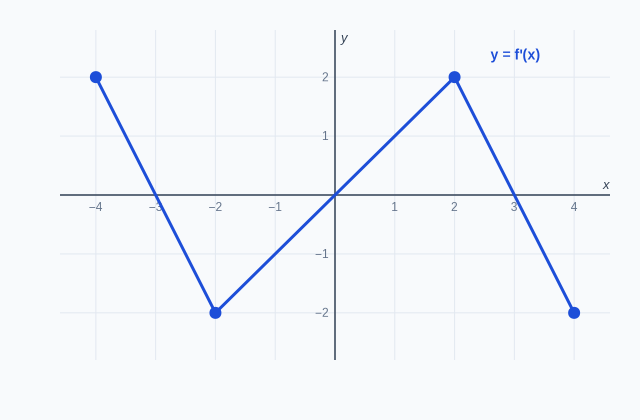
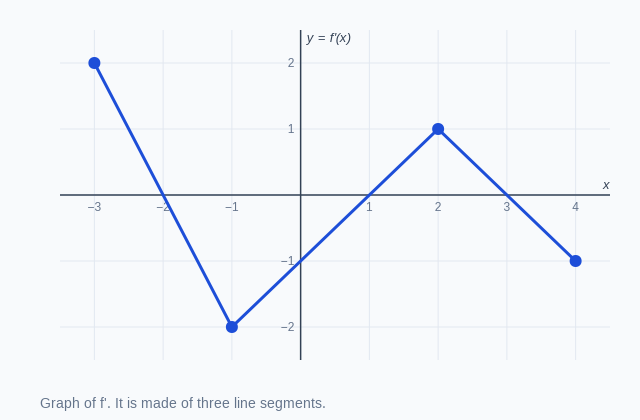
Let be a function defined on the closed interval with . The graph of , the derivative of , consists of three line segments, as shown in the figure.
No calculator is allowed for this question. Show the work that leads to each answer, and give exact values unless a part says otherwise. Respond to parts A, B, C and D.
-
A.
Find and .
Score part A
Model response
On the triangle above the axis has area 2, on area 1, and on the triangle below has area 1.
The triangle on lies below the axis with area 2.
-
B.
On the open interval , find all values of at which has a relative maximum. Justify your answer.
Score part B
Model response
has a relative maximum at and at , because changes from positive to negative at each of those values.
-
C.
Find all values of in the open interval at which the graph of has a point of inflection. Give a reason for your answer.
Score part C
Model response
The graph of has points of inflection at and . At , changes from decreasing to increasing, and at , changes from increasing to decreasing, so the concavity of changes at both.
-
D.
Find , or show that it does not exist. Show the work that leads to your answer.
Score part D
Model response
Since is differentiable, it is continuous, so ; also . By L'Hospital's Rule, The graph of is continuous with , so this is again . On the graph of is a line of slope 1, so there, and by L'Hospital's Rule again
Your score: 0 of 9, from the boxes you ticked.
-
-
Question 4: A cooling loaf of bread 9 points
The internal temperature of a loaf of bread is modeled by a twice-differentiable function , where is measured in degrees Celsius and is measured in minutes after the bread comes out of the oven. Values of at selected times are given in the table.
Selected values of (minutes) 0 2 5 9 12 (degrees Celsius) 98 90 80 70 66 No calculator is allowed for this question. Show the work that leads to each answer, and give exact values unless a part says otherwise. Respond to parts A, B, C, D and E.
-
A.
Use the data in the table to estimate . Show the computations that lead to your answer, and indicate units of measure.
Score part A
Model response
-
B.
Find the value of . Using correct units, explain the meaning of in the context of this problem.
Score part B
Model response
. The temperature of the bread decreases by 20 degrees Celsius from minutes to minutes.
-
C.
Use a trapezoidal sum with the four subintervals indicated by the table to approximate . Use the approximation to estimate the average temperature of the bread, in degrees Celsius, over the time interval .
Score part C
Model response
The average temperature is about degrees Celsius.
-
D.
For , . Is the approximation of in part C an overestimate or an underestimate? Give a reason for your answer.
Score part D
Model response
It is an overestimate. Since , the graph of is concave up, so on each subinterval the segment joining the two table values lies above the graph. Each trapezoid therefore has more area than the region under the graph on its subinterval.
-
E.
Must there be a time , for , at which ? Justify your answer.
Score part E
Model response
Yes. is twice differentiable, so it is differentiable on and continuous on . By the Mean Value Theorem there is a time with at which
Your score: 0 of 9, from the boxes you ticked.
-
-
Question 5: A region between a root curve and a line 9 points
Let be the region in the first quadrant enclosed by the graphs of and . The two graphs intersect at the origin and at the point .
No calculator is allowed for this question. Show the work that leads to each answer, and give exact values unless a part says otherwise. Respond to parts A, B, C and D.
-
A.
Find the area of .
Score part A
Model response
-
B.
Region is the base of a solid. For the solid, each cross section perpendicular to the -axis is a square. Find the volume of the solid.
Score part B
Model response
The side of each square is , so
-
C.
Write, but do not evaluate, an integral expression for the volume of the solid generated when is rotated about the horizontal line .
Score part C
Model response
Both curves lie below on , and there, so the outer radius is and the inner radius is :
-
D.
The vertical line , where , divides into two regions of equal area. Write, but do not solve, an equation involving one or more integrals whose solution gives the value of .
Score part D
Model response
Half the area from part A is , so
Your score: 0 of 9, from the boxes you ticked.
-
-
Question 6: A differential equation with cosine 9 points
Consider the differential equation . Let be the particular solution to the differential equation with the initial condition .
No calculator is allowed for this question. Show the work that leads to each answer, and give exact values unless a part says otherwise. Respond to parts A, B and C.
-
A.
Write an equation for the line tangent to the graph of at the point . Use the tangent line to approximate .
Score part A
Model response
At , , so the tangent line is , and .
-
B.
Find in terms of and . Is the approximation in part A an overestimate or an underestimate of ? Give a reason for your answer.
Score part B
Model response
At : . The graph of is concave down near , so it lies below its tangent line there, and is an overestimate of .
-
C.
Find , the particular solution to the differential equation with the initial condition .
Score part C
Model response
At : , so . Then , so . Near , , so and
Your score: 0 of 9, from the boxes you ticked.
-
Your results
| Section | Score | Time used |
|---|---|---|
| Section I Part A | ||
| Section I Part B | ||
| Section II Part A | ||
| Section II Part B |
Free-response scores are the points you ticked against the scoring guide. The page never grades them.
Practice Exam 2
42 multiple-choice and 6 free-response questions, in the format of the AP Calculus AB Exam.
| Section | Questions | Time | Calculator |
|---|---|---|---|
| Section I Part A: Multiple Choice (calculator not permitted) | 29 | 62 minutes | Calculator not permitted |
| Section I Part B: Multiple Choice (graphing calculator required) | 13 | 38 minutes | Graphing calculator required |
| Section II Part A: Free Response (graphing calculator required) | 2 | 30 minutes | Graphing calculator required |
| Section II Part B: Free Response (calculator not permitted) | 4 | 60 minutes | Calculator not permitted |
How the exam works
- One section at a time. When a section's clock reaches zero, the section ends and is scored.
- Multiple choice is scored when its section ends, with an explanation for every choice.
- Free response is never scored by the page. When the section ends, you see the scoring guide and a model response for each part and tick the points your answer earns.
- At the end you get your score and the time you used for each section.
- In study mode each multiple-choice answer is checked as soon as you give it, with its explanation, and each free-response question has a button that opens its scoring guide.
- Switching to study mode partway keeps your answers and checks the ones you have given. Start over clears everything and lets you choose a mode again.
- Your answers are kept in this browser tab if the page reloads, and nowhere else.
Section I Part A: Multiple Choice (calculator not permitted)
-
Questions 1 to 2 refer to the following.
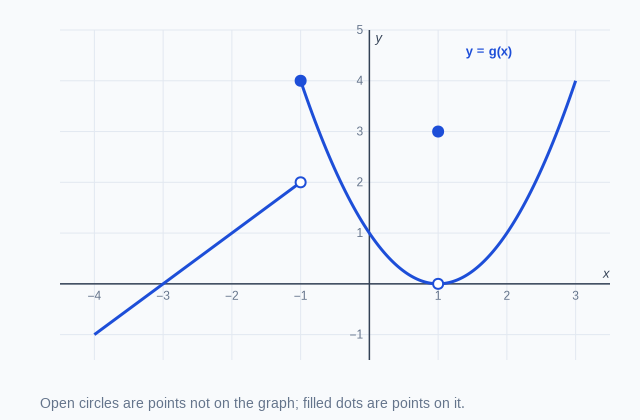
The graph of the function is shown for . It is a line for and a parabola for , except at , where .
No calculator. What is ?
Answer: A.
- A
From the left of the graph follows the line toward the open circle at height 2, so the left-hand limit is 2. Near the graph closes in on the open circle at from both sides, so that limit is 0, whatever the dot at height 3 says. The sum is .
- B
Read the wrong side of the jump: 4 is where the graph starts just to the right of , the right-hand limit and the value . A limit from the left uses only the values for , which approach 2.
- C
Used the function value as the limit: is the filled dot, but a limit describes the values near , which approach 0. Using 3 gives .
- D
Took a hole for a missing limit: the open circle at means is not 0, not that the limit fails. Both one-sided limits at are 0, and the left-hand limit at is 2, so the sum is a number.
- A
-
Uses the material above question 1.
No calculator. Which of the following describes the discontinuities of on the interval ?
Answer: A.
- A
At the one-sided limits are 2 from the left and 4 from the right: both exist and they differ, which is a jump. At the limit is 0 but : the limit exists and the value differs from it, so redefining as 0 would remove the discontinuity.
- B
Swapped the two types: a removable discontinuity has a two-sided limit, which lacks (2 from the left, 4 from the right). A jump needs one-sided limits that differ, and at both sides approach 0.
- C
Took a defined point as continuous: exists, but continuity also needs to equal the limit at , and .
- D
Called a break an asymptote: near the values stay between 2 and 4 and never grow without bound, so there is no vertical asymptote, only a jump.
- A
-
No calculator. What is ?
Answer: B.
- A
Dropped half of the conjugate: after rationalizing, the denominator is , which approaches 6, not 3. Using only one 3 doubles the answer.
- B
Substitution gives , so rewrite first. Multiply by the conjugate: for , and this approaches .
- C
Stopped at the numerator: the numerator approaches 0, but so does the denominator. A form says nothing yet; the expression has to be rewritten.
- D
Read as no limit: substitution failing does not mean the limit fails. After the conjugate step the expression approaches from both sides.
- A
-
No calculator. The table gives values of a function at selected values of near 2.
Which of the following could define for ?
Answer: D.
- A
Matched the look of the formula, not the values: this expression approaches near , and at it gives about 2.03, not 3.9.
- B
Canceled the wrong factor: , which approaches 0 near 2, not 4.
- C
Flipped the fraction: this is for , which approaches , the reciprocal of the table's limit.
- D
For , , which gives , , and every other entry. The values close in on 4, the limit the table shows, even though the expression has no value at 2.
- A
-
No calculator. Let . On which of the following intervals is continuous at every point?
Answer: B.
- A
Ignored the domain of the square root: for , is negative and is not defined, so it cannot be continuous there.
- B
A quotient is continuous wherever its numerator and denominator are and the denominator is not 0. The square root needs , so , and the denominator is 0 at . Every point of meets both conditions, with continuity from the right at .
- C
Forgot the zero of the denominator: lies inside and has no value at , so is not continuous on the whole interval.
- D
Treated an endpoint as exempt: a closed interval includes its endpoint , where the denominator is 0, so is not continuous on .
- A
-
No calculator. Let . Which of the following is true about at ?
Answer: B.
- A
Reversed the theorem: differentiability at a point forces continuity there, so this combination cannot happen for any function.
- B
Both pieces give 2 at : and , so the limit is 2 and equals . The slopes from the two sides differ: from the left and 3 from the right, so the graph has a corner and does not exist.
- C
Checked only that the pieces meet: matching values give continuity, but differentiability also needs the slopes from the two sides to match, and 2 is not 3.
- D
Treated a change of formula as a break: a piecewise function can be continuous where its formula changes, and here both pieces reach 2 at .
- A
-
No calculator. If , what is ?
Answer: A.
- A
Write . Then , and .
- B
Lost the sign from a negative exponent: the derivative of is , so the second term is subtracted, not added.
- C
Kept the old exponents: the power rule multiplies by the exponent and then lowers it by 1. Leaving the exponents at and gives .
- D
Differentiated the denominator alone: is not differentiated by replacing with . Treating it as gives ; rewrite it as and use the power rule.
- A
-
No calculator. The functions and are differentiable, with , , , and . If , what is ?
Answer: A.
- A
The constant multiple, sum, and difference rules give ; the constant 7 has derivative 0. So .
- B
Kept the constant: the derivative of 7 is 0, so the 7 adds nothing to the rate of change.
- C
Dropped a negative inside a difference: , not .
- D
Used function values for derivatives: is , the value of , not its slope.
- A
-
No calculator. If , what is ?
Answer: C.
- A
Gave sine the wrong derivative: the derivative of is , not . With the first term becomes at .
- B
Used the power rule on : the variable is in the exponent, not the base, so the derivative of is itself.
- C
, so .
- D
Evaluated instead of : is the value of the function, not its derivative.
- A
-
No calculator. The table gives values of the differentiable functions and and their derivatives at selected values of .
If , what is ?
Answer: A.
- A
By the chain rule, . At , , so .
- B
Evaluated the outer derivative at the wrong input: is evaluated at , not at 2. Using gives .
- C
Dropped the inner derivative: is only the outer factor; the chain rule multiplies it by .
- D
Used where belongs: multiplies the outer function's value, not its derivative, by the inner derivative.
- A
-
No calculator. Let , and let be the inverse function of . What is ?
Answer: B.
- A
Forgot the reciprocal: the slopes of a function and its inverse at matching points are reciprocals, so is , not .
- B
is the input where outputs 4: , so . Then , and gives . So .
- C
Evaluated at the output instead of the input: 4 is an output of . is the slope of at , a point that does not match at 4.
- D
Made both slips at once: is the slope of at the wrong point, and it is not flipped. The slope of at 4 is .
- A
-
No calculator. If , what is ?
Answer: B.
- A
Dropped the innermost derivative: differentiating gives ; leaving out the 2 gives .
- B
Two chain rules: . At , and , so .
- C
Stopped after the outer layer: the derivative of is , not just . leaves out .
- D
Put the inside's derivative in the denominator: treats the derivative of as . The rule is , with below.
- A
-
No calculator. If , what is ?
Answer: D.
- A
Dropped a term on the second pass: differentiates to , and the term adds 1 more. Losing that 1 gives .
- B
Stopped at the first derivative: is the slope of , not the second derivative.
- C
Multiplied the derivatives of the factors: is not the derivative of ; the product rule adds two terms. A constant first derivative then gives a second derivative of 0.
- D
. Then , and .
- A
-
No calculator. The volume of water in a tank is liters at time minutes. Which of the following is the best interpretation of ?
Answer: C.
- A
Read a rate as an amount of change: is a rate at one instant, in liters per minute, not the total change over the first 10 minutes.
- B
Confused the derivative with the function: the amount in the tank is . says how fast that amount is changing.
- C
is the instantaneous rate of change of the volume at , in liters per minute. A negative value means the volume is decreasing at that moment, at 3 liters per minute.
- D
Read an instantaneous rate as an average: the average rate over is . describes the moment alone.
- A
-
No calculator. Oil spilled on a calm lake spreads in a circle. The area of the circle is increasing at a constant rate of square meters per minute. At the instant the radius is 3 meters, how fast is the radius increasing?
Answer: A.
- A
The area is , so . With and : , so meters per minute.
- B
Dropped the 2 from the power rule: the derivative of is , not . Dividing by gives twice the true rate.
- C
Divided by the area instead of its derivative: uses itself. The chain rule relates the rates through .
- D
Solved the related-rates equation upside down: from , , not .
- A
-
No calculator. The local linear approximation of at is used to approximate . Which of the following gives the approximation and describes it?
Answer: C.
- A
Reversed the concavity rule: a concave-down graph bends below its tangent line, so the line's values are too high, not too low.
- B
Moved the wrong way along the line: 15.8 is 0.2 to the left of 16, so and the line drops by .
- C
The tangent line at has slope , so and . , so the graph is concave down and lies below its tangent line: 3.975 is too large, an overestimate.
- D
Made both slips: the step was taken to the right of 16 instead of the left, and the concavity rule was reversed.
- A
-
No calculator. What is the absolute maximum value of on the closed interval ?
Answer: D.
- A
Stopped at the critical points: the relative maximum at gives 5, but on a closed interval an endpoint can be higher, and .
- B
Gave the location for the value: the maximum occurs at ; the question asks for the value .
- C
Picked the smallest candidate: is the absolute minimum on , at the left endpoint.
- D
, so the critical points are and . The candidates are , , , and . The largest is 9.
- A
-
Questions 18 to 20 refer to the following.
The graph of , the derivative of a function , is shown for . It is made of three line segments, joining the points , , , and . The function is defined for , and .
No calculator. On which of the following intervals is the graph of concave up?
Answer: C.
- A
Used the sign of : on means is increasing there. Concavity depends on whether is increasing, and falls on .
- B
Used where is negative: means is decreasing, which says nothing about concavity. On the graph of falls, so is concave down there.
- C
The graph of is concave up where is increasing. The graph of rises from to and falls everywhere else.
- D
Read the slope of backward: falls on , so there and is concave down.
- A
-
Uses the material above question 18.
No calculator. At which value of does have a relative minimum?
Answer: B.
- A
Located the minimum of instead of : the lowest point of the graph of marks where is decreasing fastest, not where is smallest.
- B
has a relative minimum where changes from negative to positive. The graph of crosses the -axis upward only at .
- C
Read the crossing direction backward: at , changes from positive to negative, so has a relative maximum there.
- D
Used the peak of : at , changes from increasing to decreasing, which makes a point of inflection of , and is still increasing there.
- A
-
Uses the material above question 18.
No calculator. What is the value of ?
Answer: D.
- A
Accumulated in the wrong direction: treats as the start. Going from back to subtracts the integral.
- B
Added areas without signs: counting every region as positive gives an integral of 4, and . The regions below the axis count as negative change.
- C
Added the total area to the value: ignores both the signs of the regions and the direction from 1 back to .
- D
By the Fundamental Theorem of Calculus, . From the graph that integral is : a triangle above the axis on and triangles below it on and . So .
- A
-
No calculator. Consider the curve . At which points on the curve is the line tangent to the curve vertical?
Answer: B.
- A
Set the numerator equal to 0: makes , which gives horizontal tangents. A vertical tangent comes from a zero denominator.
- B
Differentiate implicitly: , so . A vertical tangent needs the denominator to be 0 and the numerator not 0: . Then , so and or .
- C
Ignored the horizontal shift: completing the square gives , a circle centered at , so its leftmost and rightmost points are 5 units either side of , not of .
- D
Set both parts to 0 at once: makes the numerator and the denominator 0, but it is the center of the circle, and , so it is not on the curve.
- A
-
No calculator. If , , and , what is ?
Answer: C.
- A
Forgot that the limits run backward: is the negative of .
- B
Added the pieces instead of subtracting: , not . With 11 the result is .
- C
First, . Then , and reversing the limits changes the sign: .
- D
Applied the constant multiple to the whole sum: the 2 multiplies only , so the integral is , not .
- A
-
No calculator. Let be an antiderivative of with . What is ?
Answer: D.
- A
Lost the sign on the antiderivative of : . Using gives and .
- B
Multiplied by the new exponent instead of dividing: . Multiplying gives , then and .
- C
Evaluated the integrand: is the rate , not the value .
- D
Antidifferentiate term by term: . Then gives , and .
- A
-
No calculator. What is ?
Answer: B.
- A
Kept the -limits after substituting: the integral in runs from to . Using 1 and 2 gives .
- B
Let , so ; gives and gives . Then .
- C
Lost the sign of the antiderivative: , so the result is , positive. The integrand is positive on , so a negative answer cannot be right.
- D
Used the logarithm rule on a squared denominator: , but this integrand is , which needs the power rule.
- A
-
No calculator. What is ?
Answer: B.
- A
Got the remainder wrong: , so the remainder is 3. A remainder of 1 gives in place of .
- B
Long division gives . Integrating, .
- C
Dropped a term of the quotient: the quotient is , and . Keeping only gives .
- D
Integrated the top and bottom separately: . The integral of a quotient is not the quotient of the integrals.
- A
-
No calculator. What is ?
Answer: C.
- A
Dropped the factor that comes from the 9: write ; the substitution brings a factor of .
- B
Chose a substitution for a numerator that is not there: works for , where is half of . With 1 on top there is no to match.
- C
This is the arctangent form: . From 0 to 3: .
- D
Treated the 9 as a 1: , but here the constant is 9, which changes both the coefficient and the input of the arctangent.
- A
-
No calculator. Which of the following functions is a solution to the differential equation for ?
Answer: C.
- A
Solved instead: for this function , but , so the two sides differ.
- B
Matched only the factor 2: solves . Dividing by changes the equation; , not .
- C
Substitute: , and . Both sides agree for every .
- D
Integrated and ignored : for this function , but , so the two sides differ.
- A
-
No calculator. Which of the following is the general solution of the differential equation , for solutions with ?
Answer: D.
- A
Lost the sign of the antiderivative: , not . This function has a derivative of the opposite sign from .
- B
Solved as if the equation were : dividing by leaves , not , so no logarithm appears.
- C
Added the constant after solving for : the constant belongs where the integration happens, inside the denominator. A constant added at the end no longer satisfies the equation.
- D
Separate: . Integrating, , so and , where .
- A
-
No calculator. Let be the solution to the differential equation with . What is ?
Answer: B.
- A
Dropped the one-half when integrating : . Writing gives and , which is at .
- B
Separate: , so . At : , so and . Since , , and .
- C
Added the constant after solving: putting it outside the square root, , gives . The constant belongs with the antiderivatives, before solving for .
- D
Held at its starting value: treating as the constant 2 gives and , which is 3 at . But changes as does, which is why the variables are separated.
- A
Section I Part B: Multiple Choice (graphing calculator required)
-
Graphing calculator required. Let . What is the average rate of change of over the interval ?
Answer: D.
- A
Used the derivative at the midpoint: is an instantaneous rate at one point. For an exponential function it is not the average rate over the interval.
- B
Used the instantaneous rate at the right endpoint: is how fast changes at , not over the whole interval.
- C
Found the change, not the rate: still has to be divided by the length of the interval, 5.
- D
The average rate of change is .
- A
-
Graphing calculator required. A particle moves along the -axis with velocity for . What is the acceleration of the particle at time ?
Answer: C.
- A
Gave the velocity: is how fast the particle moves, not how fast its velocity changes.
- B
Multiplied the derivatives of the factors: at 1.5 is about , but the product rule adds two terms.
- C
Acceleration is . By the product rule, , and . A calculator's numerical derivative of at 1.5 gives the same value.
- D
Dropped the second product-rule term: differentiates only and leaves unchanged.
- A
-
Graphing calculator required. The amount of a medicine in a patient's bloodstream hours after a dose is milligrams. At what rate, in milligrams per hour, is the amount changing at ?
Answer: B.
- A
Dropped the sign: , so the rate is negative. The amount is decreasing at .
- B
, so milligrams per hour: the amount is falling at about 3.012 milligrams per hour.
- C
Gave the amount, not its rate: milligrams is how much medicine is present at that moment.
- D
Found the average rate from : describes the first three hours, not the instant .
- A
-
Graphing calculator required. What is the absolute minimum value of on the closed interval ?
Answer: A.
- A
is 0 where : and in . The candidates are , , , and . The smallest is .
- B
Gave the location for the value: the minimum occurs at ; the question asks for the value of there.
- C
Checked only the endpoints: is the smaller endpoint value, but the critical point at gives a lower value.
- D
Picked the largest candidate: is the absolute maximum on .
- A
-
Graphing calculator required. The derivative of a function is . On which interval or intervals in is increasing?
Answer: A.
- A
increases where . Solving on a calculator gives and ; is positive before the first, negative between them, and positive after the second.
- B
Reversed the sign test: on , so is decreasing there.
- C
Dropped the 0.4: 1.253 and 2.171 are the zeros of . The derivative is , which stays positive a little past each of them.
- D
Used where is increasing: on makes concave up, which is a different property from increasing.
- A
-
Graphing calculator required. What is the shortest distance from the point to a point on the graph of ?
Answer: D.
- A
Reported the squared distance: minimizing instead of its square root finds the same point, but its minimum value, about 8.961, is the distance squared.
- B
Gave the location for the value: is where the closest point is. The question asks how far away it is.
- C
Used a convenient point instead of optimizing: is on the graph and is from , but a point a little to the right is closer.
- D
A point on the graph is , and its squared distance from is . The distance is smallest where is, so solve : , where changes from negative to positive. The distance is .
- A
-
Graphing calculator required. Water flows into a tank at a rate of liters per hour. The table gives selected values of .
Using a left Riemann sum with the four subintervals given by the table, what is the approximate amount of water, in liters, that flows into the tank from to ?
Answer: D.
- A
Used right endpoints: is the right Riemann sum.
- B
Used trapezoids: the average of the left and right sums, 62.25, is the trapezoidal sum, a different approximation.
- C
Assumed equal widths: the subintervals have widths 2, 1, 4, and 3, not 2.5 each. .
- D
A left sum uses each subinterval's left endpoint and its own width: liters.
- A
-
Graphing calculator required. Let . What is ?
Answer: C.
- A
Ignored the order of the limits: is the negative of , so the integral is subtracted from 3.
- B
Dropped the constant: includes the 3, which is the value of at .
- C
. A calculator gives , so .
- D
Used the rate for the amount: is the rate of change of at 0. Adding it to 3 does not give the value .
- A
-
Graphing calculator required. The temperature inside a greenhouse is modeled by degrees Fahrenheit, where is the number of hours after 6 a.m., for . What is the average temperature inside the greenhouse from to ?
Answer: D.
- A
Forgot to divide by the length of the interval: accumulates degree-hours. Dividing by 10 hours gives the average temperature.
- B
Averaged the endpoint values: uses the temperature at two moments. The temperature rises well above both in between.
- C
Found the average rate of change: is how fast the temperature changes on average, in degrees per hour, not the average temperature.
- D
The average value of on is degrees Fahrenheit.
- A
-
Graphing calculator required. A particle moves along the -axis with velocity for . At time the particle is at . What is the position of the particle at time ?
Answer: A.
- A
Position is the starting position plus the displacement: .
- B
Gave the displacement as the position: is how far the particle ends up from its start at , not where it is.
- C
Used total distance for displacement: counts the motion to the left after as motion to the right. Position needs the signed integral.
- D
Gave the velocity at : is how fast the particle moves then, not where it is.
- A
-
Graphing calculator required. Let and . The graphs of and intersect at three points. What is the total area of the region bounded by the two graphs?
Answer: B.
- A
Integrated across the crossing without switching top and bottom: because the two pieces cancel. Area between curves takes the top minus the bottom on each piece.
- B
The graphs meet at and at (solve on a calculator). Both functions are odd, so the region has two pieces of equal area: on and on . The area is .
- C
Counted only one of the two pieces: the region between the curves has a piece on each side of .
- D
Used the zeros of as limits: the region ends where the graphs meet, , not where crosses the axis at .
- A
-
Graphing calculator required. The region is bounded by the graphs of and . is the base of a solid whose cross sections perpendicular to the -axis are squares. What is the volume of the solid?
Answer: C.
- A
Multiplied by as if revolving: a square cross section has area equal to its side squared; the factor belongs to discs.
- B
Subtracted the squares instead of squaring the difference: is the washer pattern. A square's area is .
- C
The graphs meet at , and between them. Each square's side is , so the volume is .
- D
Found the area of the base: is the area of , not the volume of the solid built on it.
- A
-
Graphing calculator required. The region is bounded by the graph of , the line , and the -axis. What is the volume of the solid generated when is revolved about the line ?
Answer: C.
- A
Measured the radii from the -axis: is the volume when is revolved about the -axis, a washer, not a disc about .
- B
Forgot to square the radius: a disc's area is , and uses .
- C
Revolving about , each slice perpendicular to the -axis is a disc of radius . The region runs from to where , . The volume is .
- D
Left out : adds up squared radii, not disc areas.
- A
Section II Part A: Free Response (graphing calculator required)
-
Question 1: People at a festival 9 points
People enter a festival grounds at a rate modeled by people per hour and leave at a rate modeled by people per hour, for , where is measured in hours. At time there are 200 people on the grounds.
A graphing calculator is required for this question. Show the setup (the equation being solved, or the derivative or definite integral being evaluated) along with each calculator result. Any decimal answer should be accurate to three places after the decimal point. Respond to parts A, B, C, and D.
-
A.
How many people enter the grounds during the time interval ? Give your answer to the nearest whole number.
Score part A
Model response
, so about 1578 people enter the grounds.
-
B.
Is the number of people on the grounds increasing or decreasing at time ? Give a reason for your answer.
Score part B
Model response
The number of people changes at the rate . , so the number of people is increasing at .
-
C.
At what time , for , is the number of people on the grounds greatest? Justify your answer.
Score part C
Model response
Let . at , the only solution in . Candidates: , , . The number of people is greatest at hours.
-
D.
Find . Using correct units, explain the meaning of in the context of the problem.
Score part D
Model response
, so . At time hours, the rate at which people enter the grounds is decreasing at about 18.727 people per hour per hour.
Your score: 0 of 9, from the boxes you ticked.
-
-
Question 2: A region between a parabola and an exponential curve 9 points
Let and . Let be the region bounded by the graphs of and . The graphs intersect at and , where .
A graphing calculator is required for this question. Show the setup (the equation being solved, or the derivative or definite integral being evaluated) along with each calculator result. Any decimal answer should be accurate to three places after the decimal point. Respond to parts A, B, C, and D.
-
A.
Find and , and find the area of .
Score part A
Model response
Solving on a calculator gives and . On , , so the area of is .
-
B.
Find the volume of the solid generated when is revolved about the horizontal line .
Score part B
Model response
The line lies below . A slice at is a washer with outer radius and inner radius . The volume is .
-
C.
Region is the base of a solid. For this solid, each cross section perpendicular to the -axis is a semicircle whose diameter lies in . Find the volume of the solid.
Score part C
Model response
The diameter at is , so the radius is and the semicircle's area is . The volume is .
-
D.
The vertical line divides into two regions of equal area. Write an equation involving one or more integrals whose solution is , and find .
Score part D
Model response
Half the area is about 3.373. The line satisfies . Solving on a calculator gives .
Your score: 0 of 9, from the boxes you ticked.
-
Section II Part B: Free Response (calculator not permitted)
-
Question 3: A particle and its velocity graph 9 points
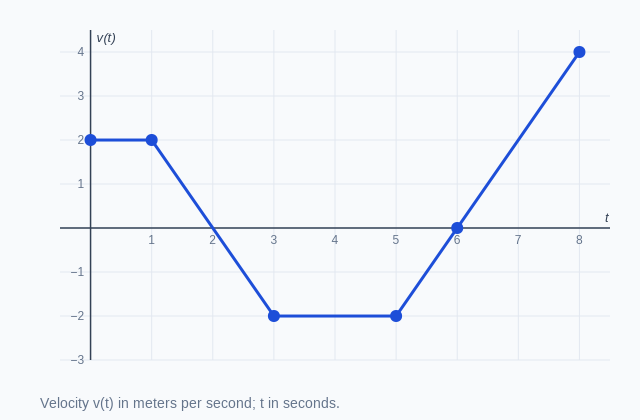
A particle moves along the -axis. Its velocity , in meters per second, is shown in the graph for seconds. The graph is made of five line segments joining the points , , , , , and . At time the particle is at position .
No calculator is allowed for this question. Show the work that leads to each answer. Respond to parts A, B, C, and D.
-
A.
Find the acceleration of the particle at time . Is the speed of the particle increasing or decreasing at ? Give a reason for your answer.
Score part A
Model response
The segment from to has slope , so meters per second per second. On that segment . Velocity and acceleration are both negative, so the speed of the particle is increasing at .
-
B.
At what times , for , does the particle change direction? Give a reason for your answer.
Score part B
Model response
The particle changes direction where changes sign. changes from positive to negative at and from negative to positive at , so the particle changes direction at and .
-
C.
Find the position of the particle at time . Find the total distance the particle travels from to .
Score part C
Model response
From the areas: , , and . So , and the total distance is meters.
-
D.
Find the leftmost position of the particle for . Justify your answer.
Score part D
Model response
The particle moves right on , left on , and right on , so the leftmost position is at or , and is checked with them. , , and . The leftmost position is , reached at .
Your score: 0 of 9, from the boxes you ticked.
-
-
Question 4: An implicitly defined curve 9 points
Consider the curve given by .
No calculator is allowed for this question. Show the work that leads to each answer. Respond to parts A, B, C, D, and E.
-
A.
Show that .
Score part A
Model response
Differentiate both sides with respect to : . Collect the terms: , so .
-
B.
Write an equation for the line tangent to the curve at the point .
Score part B
Model response
. The tangent line is , that is, .
-
C.
Find the coordinates of each point on the curve at which the line tangent to the curve is horizontal.
Score part C
Model response
A horizontal tangent needs , so with . Substituting : , so . The points are and ; at each, .
-
D.
Find the coordinates of each point on the curve at which the line tangent to the curve is vertical.
Score part D
Model response
A vertical tangent needs with . Substituting : , so . The points are and ; at each, .
-
E.
Find the value of at the point . Is the curve concave up or concave down at that point?
Score part E
Model response
. At , , , and , so . The second derivative is negative, so the curve is concave down at .
Your score: 0 of 9, from the boxes you ticked.
-
-
Question 5: A polynomial times an exponential 9 points
Let be the function given by for all real numbers . Its first and second derivatives are and .
No calculator is allowed for this question. Show the work that leads to each answer. Respond to parts A, B, C, and D.
-
A.
Find the -coordinate of each critical point of . Classify each as the location of a relative minimum, a relative maximum, or neither. Justify your answers.
Score part A
Model response
at and , since . The sign of is the sign of : positive on , negative on , and positive on . So has a relative maximum at , where changes from positive to negative, and a relative minimum at , where changes from negative to positive.
-
B.
On what intervals is the graph of concave up? Give a reason for your answer.
Score part B
Model response
, so has the sign of , which is 0 at and positive outside those roots. The graph of is concave up on and on , because there.
-
C.
Find . Show the work that leads to your answer.
Score part C
Model response
. As , the numerator and the denominator both increase without bound, so L'Hospital's Rule applies: . This is again of the form up to sign, so apply it again: . So .
-
D.
Must there be a value , for , such that ? Justify your answer.
Score part D
Model response
is differentiable, so it is continuous on . and . By the Intermediate Value Theorem there is a value with and . (It is .)
Your score: 0 of 9, from the boxes you ticked.
-
-
Question 6: A pot of soup heating up 9 points
A pot of soup is heating on a stove. The temperature of the soup, in degrees Celsius, minutes after the burner is turned up is . The temperature satisfies the differential equation , and .
No calculator is allowed for this question. Show the work that leads to each answer. Respond to parts A, B, and C.
-
A.
Use the line tangent to the graph of at to approximate the temperature of the soup at minute.
Score part A
Model response
. The tangent line is , so degrees Celsius.
-
B.
Find in terms of . Use it to determine whether the approximation in part A is an overestimate or an underestimate of the temperature at . Give a reason for your answer.
Score part B
Model response
. The temperature starts at 30 and rises toward 90 without reaching it (part C), so on and . The graph of is concave down there and lies below its tangent line, so 45 is an overestimate.
-
C.
Find , the particular solution to the differential equation with .
Score part C
Model response
, so . At , : . Then , so . Since , , and .
Your score: 0 of 9, from the boxes you ticked.
-
Your results
| Section | Score | Time used |
|---|---|---|
| Section I Part A | ||
| Section I Part B | ||
| Section II Part A | ||
| Section II Part B |
Free-response scores are the points you ticked against the scoring guide. The page never grades them.