Unit 1 · Topic 1.1 · about 30 minutes · 7 parts · 10 scored checks, 3 of them multiple choice
AP Calculus AB 1.1: Introducing Calculus: Can Change Occur at an Instant?
Unit 1: 10 to 15% of the multiple-choice section
What you'll be able to do
- Explain the rate of change at one instant as the value that average rates of change over shorter and shorter intervals containing that instant approach.
Key vocabulary
| Term | What it means | The exam trap |
|---|---|---|
| Average rate of change | The change in one variable divided by the change in another over an interval. | Subtract the outputs and the inputs in the same order, later minus earlier on both, or the sign comes out flipped. |
| Independent variable | The input variable, such as time , whose change goes on the bottom of an average rate of change. | Read its units in a context, such as seconds or minutes; they become the per in the rate's units. |
| Instantaneous rate of change | The rate of change at one instant, defined through the limit of average rates of change over intervals containing that instant. | Check whether a question names an interval, such as from to , or a single time, such as at ; they ask for different things. |
| Limit | The value that a quantity approaches as its input gets closer and closer to some number. | A limit is about inputs close to the number, not at the number itself. |
 Tap to open the picture full size
Part 1 Think first Is the coaster moving in the photo?
Guess before you learn. A wrong guess still makes the answer stick.
Predict first
A roller coaster car starts down its first drop. For the first 3 seconds, the distance it has traveled along the track after seconds is meters, so 8 meters after 2 seconds and 27 meters after 3. A camera takes a photo at exactly , and the car looks frozen in it. At that instant, how fast is the car moving?
In short. Calculus finds the rate of change at a single instant by taking average rates of change over intervals that contain the instant and seeing what value they approach as the intervals shrink.
- An average rate of change divides the change in one variable by the change in another over an interval.
- Over a single point the change in the input is 0, so an average rate of change does not exist there.
- The value that averages over shrinking intervals containing the instant approach, from both sides, is the instantaneous rate of change.
Part 2 Learn it Three short ideas, each checked as you go
1a. An average rate of change covers an interval
Calculus is the mathematics of change that does not hold still. A car speeds up and slows down. A tank drains faster when it is full than when it is nearly empty. In each case the rate itself keeps changing, and calculus is built to describe exactly that.
Start with what you already know. The average rate of change of a quantity over an interval divides the change in the quantity by the change in the input:
A family drives 110 miles in 2 hours, so their average rate of change of distance is miles per hour. The units come straight from the quotient: miles on top, hours on the bottom.
That 55 describes the whole two hours at once. It says nothing about the minute they sat at a red light or the minute they merged onto the highway. Different intervals of the same trip give different averages, because the car's speed kept changing. To talk about one moment, one average is not enough.
Quick check · Calculate
No calculator. A phone is plugged in to charge. Its battery level is percent, minutes after it is plugged in, with , and . What is the average rate of change of , in percent per minute, from to ?
1b. One instant has no average
Now try to use the same quotient at a single instant, say exactly seconds. The interval would run from to . The change in time is , and the change in distance is 0 as well, so the quotient is
That is not a number. It is not 0 and it is not 1, because division by zero has no answer. So an average rate of change does not exist at a point where the change in the input would be zero. That is true for every quantity, however fast it is changing.
This is the puzzle in the lesson's title. A photo taken at one instant shows a car frozen in place, yet the car really was moving. Its motion at that instant is real, but no single average can catch it, because one instant has no length of time to divide by.
Watch the two zeros. A student who sees 0 on top and stops there will say the rate is 0, as if the car were parked. The 0 on the bottom is the trouble: it means the quotient gives no value at all, not the value 0.
Quick check · Decide and justify
No calculator. A runner's distance from the start is meters, seconds into a race. A classmate says the average rate of change of over the interval from to is 0 meters per second, because the distance does not change from to . Is the classmate right?
Which reason supports your answer?
1c. Shrink the intervals around the instant
Calculus gets past the division by zero with a limit. Instead of using the instant itself, it uses intervals that contain the instant, and it shrinks them.
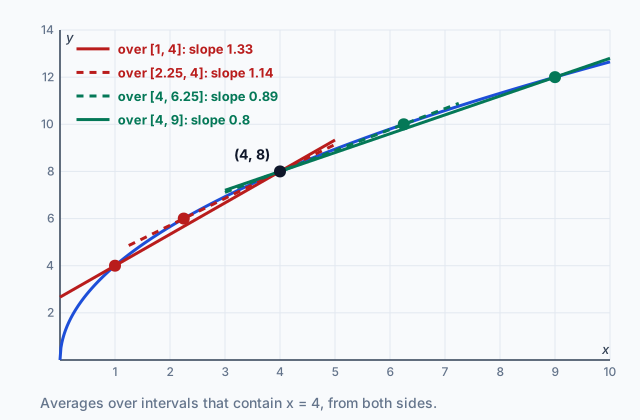
Take the graph at the top, , and the instant . Over the average rate of change is about 1.33, and over about 1.14. On the other side, gives 0.8 and about 0.89. Shrink further: gives about 1.026 and about 0.976. Every one of these intervals contains . As they shrink, the averages from the left come down and the averages from the right go up, and they close in on one number, 1.
That number is the instantaneous rate of change at : the value the average rates of change over intervals containing 4 approach as the intervals shrink toward zero length. No interval ever has length 0, so nothing divides by zero.
This is how calculus uses limits to understand and model dynamic change. Each instant gets its own rate, even when the rate never stays the same for two instants in a row.
One caution. Any single average, however short its interval, is still an estimate. The rate at the instant is the number the averages approach, not one of the averages.
Quick check · Multiple choice
No calculator. A factory's total water use since midnight is gallons, hours after midnight. The average rate of change of is 1205 gallons per hour over , 1200.5 over , 1199.5 over and 1195 over . Which statement do these values support?
Part 3 Watch it done Estimating a rate at an instant from averages
Watch each step, then do the last one yourself.
Water drains from a tank. The volume of water in the tank is liters, minutes after the drain opens, for . Use average rates of change over intervals containing to find how fast the volume is changing at the instant .
Step 1 · Average over an interval to the right
and , so over the average rate is liters per minute.
Step 2 · Average over an interval to the left
, so over the average rate is liters per minute.
Why this step?
Why use an interval on each side of instead of just one?
The rate at the instant is the value the averages over intervals containing 5 approach, on both sides. If the averages from the left and from the right close in on the same number, that number is the rate. Here they also bracket it, since is a little below it and a little above.
Step 3 · Shrink both intervals
and . Over the average is , and over it is liters per minute.
Your step · Calculate
No calculator. Finish it. For liters, the averages over and are and , and over and they are and liters per minute. At what rate, in liters per minute, is the volume changing at the instant ?
Part 4 Try it Two new situations
Try it · Sort it
No calculator. Each card describes a rate. Tap a card, then tap the kind of rate it is.
Average rate over an interval
Rate at one instant
Try it · Multiple choice
No calculator. A swimmer's distance from the wall is meters, seconds into a race. Which list of intervals gives average rates of change of that close in on how fast the distance is changing at the instant ?
Part 5 Explain it Write it the way the exam asks
On the exam free response is handwritten, so work on paper first. Nothing you type here leaves this page. Then compare with the model answer and score each point.
Free response is 50% of the exam score. This one is shaped like Question 3, from free-response Part B (calculator not permitted).
Free-response practice · Question 3 style
No calculator. A pizza oven is switched on. Its temperature, in degrees Fahrenheit, minutes after it is switched on is , for . Selected values are , , , and .
(a) Find the average rate of change of over the interval . Show the computation that leads to your answer. Using correct units, interpret the meaning of this value in the context of the problem.
(b) To find how fast the temperature is changing at the instant , a student writes . Explain why this expression cannot give that rate.
(c) Use the average rates of change of over and over to estimate the rate at which the temperature is changing at . Show the computations that lead to your answer, and explain why these averages give a good estimate.
Model answer
(a) degrees Fahrenheit per minute. Over the first 10 minutes, the oven's temperature rose at an average rate of 40 degrees Fahrenheit per minute.
(b) The change in time is , so the expression is , a division by zero. An average rate of change does not exist over an interval with no change in the input, so this expression gives no value.
(c) and . At the temperature is increasing at about 36 degrees Fahrenheit per minute. Both intervals contain and are short, one on each side, and the rate at an instant is the value that averages over shrinking intervals containing it approach. These two averages nearly agree, so a value between them, about 36, is a good estimate.
Score your own answer. This is a self-check, not a grade. Tick each point your answer makes.
Part 6 Check yourself A drone taking off
The two case questions use the same table. Answer them from it.
A drone lifts off from the ground. Its height is meters, seconds after takeoff. Some values are in the table.
| (seconds) | (meters) |
|---|---|
| 0 | 0 |
| 0.9 | 2.349 |
| 0.99 | 2.930499 |
| 1 | 3 |
| 1.01 | 3.070501 |
| 1.1 | 3.751 |
Case question 1 · Calculate
No calculator. What is the average rate of change of the drone's height, in meters per second, from to ? Do not round.
Case question 2 · Multiple choice
No calculator. Based on the table, which is the best estimate of the rate at which the drone is climbing at the instant ?
The rest stand on their own and do not use the case.
Check yourself · Spot the error
No calculator. A ball is thrown upward, and its height is meters after seconds. A student tries to find how fast the ball is rising at . Tap the first line with a mistake.
Check yourself · Fill the statement
No calculator. Tap a blank, then tap an answer.
The rate of change at an instant is the value that rates of change approach as the intervals containing that instant shrink toward a length of . Calculus uses to find a rate like this, even while the rate keeps changing.
Part 7 Keep it Hold on to it
This is the first lesson of the course, so there is nothing earlier to bring back yet. From the next lesson on, two questions from earlier lessons appear here.
In three lines
- An average rate of change is the change in one variable divided by the change in another over an interval.
- Over a single point the change in the input is 0, so the average rate of change does not exist there.
- The rate at an instant is the value that averages over shrinking intervals containing the instant approach, which calculus finds with a limit.
Exam strategy for this topic
- Section I Part A, Multiple Choice (calculator not permitted): 29 questions in 62 minutes.
- Section I Part B, Multiple Choice (graphing calculator required): 13 questions in 38 minutes.
- Section II Part A, Free Response (graphing calculator required): 2 questions in 30 minutes.
- Section II Part B, Free Response (calculator not permitted): 4 questions in 60 minutes.
When a question asks for an average rate of change, write the difference of outputs over the difference of inputs before any arithmetic, and give units such as degrees per minute. When a table gives values near an instant and asks for the rate there, show the averages over the shortest intervals that contain the instant and say what value they approach.
Questions students ask
Can change really happen at an instant if no time passes?
Yes. No single average can measure it, because one instant has no length of time to divide by. But the averages over shorter and shorter intervals around the instant approach one number, and calculus defines the rate at that instant to be that number.
Why can't I use the same time twice in the average rate formula?
Then the change in time is 0 and the quotient is . Division by zero has no answer, so the average rate of change does not exist over a single point.
Is an average over a very short interval good enough?
It is a good estimate, and often the best a table allows. It is still an average. The rate at the instant is the value the averages approach, so a careful answer says the averages from both sides are closing in on about that value.
Why look at intervals on both sides of the instant?
The rate at an instant comes from intervals that contain it, before it and after it. If the averages from both sides close in on the same number, that number is the rate. Sometimes they do not settle on one number, and Unit 2 shows what that means.
Is this the same thing as the derivative?
It is the idea behind it. Unit 2 names the rate at an instant the derivative and gives ways to find it exactly instead of estimating it from averages.
Course alignment, for teachers
AP Calculus AB topic 1.1, Unit 1: Limits and Continuity.
- Skill 2.B: Identify mathematical information from graphical, numerical, analytical, and/or verbal representations.
This lesson maps all 3 essential knowledge statements of the topic to the part that teaches each one: 3 are checked by a scored question. The map is in the lesson file.