Unit 1 · Topic 1.10 · about 30 minutes · 7 parts · 12 scored checks, 3 of them multiple choice
AP Calculus AB 1.10: Exploring Types of Discontinuities
Unit 1: 10 to 15% of the multiple-choice section
What you'll be able to do
- Justify whether a function is continuous at a point and, when it is not, name the type of discontinuity, removable, jump or due to a vertical asymptote, from its limits and its value there.
Key vocabulary
| Term | What it means | The exam trap |
|---|---|---|
| Discontinuity | An input at which the graph of breaks, because is not continuous there. | Check what does on both sides of before you decide; the value at is only part of the evidence. |
| Removable discontinuity | A discontinuity at where exists as a real number but does not exist or does not equal that limit. | Removable names the type of break; the function still has a break at as it is given. |
| Jump discontinuity | A discontinuity at where both one-sided limits exist as real numbers but are not equal. | In a justification, write both one-sided limits with their values; "the graph jumps" is a description, not a reason. |
| Discontinuity due to a vertical asymptote | A discontinuity at where increases or decreases without bound as approaches from at least one side. | Say which side and whether increases or decreases there; the two sides can behave differently. |
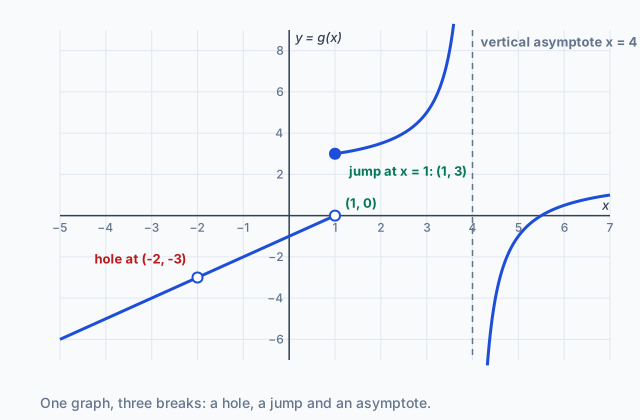 Tap to open the picture full size
Part 1 Think first What does the parking fee approach?
Guess before you learn. A wrong guess still makes the answer stick.
Predict first
A parking garage charges 4 dollars for a stay of up to 1 hour, 7 dollars for more than 1 hour and up to 2 hours, and 10 dollars for more than 2 hours and up to 3 hours. Let be the fee, in dollars, for a stay of hours. As gets closer and closer to 2, what does get close to?
In short. A discontinuity at is a break in the graph of there, and the one-sided limits at , together with , say which of three types it is.
- Removable: exists as a real number, but does not exist or is a different number.
- Jump: and both exist as real numbers and are not equal.
- Vertical asymptote: increases or decreases without bound as approaches from at least one side.
Part 2 Learn it Three short ideas, each checked as you go
10a. Three ways a graph can break
A function is continuous at when its graph passes through without a break: exists, exists, and the two are equal. The next topic, 1.11, works with that definition in full. Here the question is what kind of break you have when it fails. Such a break is a discontinuity, and there are three types.
- Removable discontinuity. exists as a real number, but does not exist or is a different number. The graph has a hole, sometimes with the point sitting somewhere else.
- Jump discontinuity. and both exist as real numbers, and they are not equal. The graph steps from one height to another.
- Discontinuity due to a vertical asymptote. increases or decreases without bound as approaches from at least one side, as in .
The graph at the top shows all three. Near it approaches from both sides, but does not exist: a removable discontinuity. At the left side approaches 0 while and the right side starts there: a jump. Near the graph runs off the top on the left and off the bottom on the right: a vertical asymptote.
So to name a break, find the limit from each side first, then look at .
Quick check · Sort it
No calculator. Each card describes a function near . Tap a card, then the type of discontinuity has at .
Removable discontinuity
Jump discontinuity
Discontinuity due to a vertical asymptote
10b. A zero in the denominator: hole or asymptote?
A quotient of polynomials breaks wherever its denominator is 0. Which type of break depends on what the numerator does there.
Factor the top and the bottom. If a factor is in both, cancel it: for the function equals the simpler form, so the simpler form gives . That limit exists and does not, so the discontinuity is removable.
If, after every shared factor is canceled, is still in the denominator, the top approaches a number that is not 0 while the bottom approaches 0. The quotient grows without bound in size, so there is a vertical asymptote at .
Take . For , , so , and has a removable discontinuity at . At the factor stays in the denominator while the top approaches 1, so has a vertical asymptote there.
Substituting into the original form and getting is not a verdict. It tells you to factor and look again.
Quick check · Match
No calculator. Tap a function, then what it does at .
10c. Where the formula changes: a jump, or no break
A function defined in pieces can break where its formula changes, but it does not have to. Find the one-sided limits from the piece on each side, and compare them.
Let for and for . From the left, . From the right, . Both are real numbers and they differ, so has a jump discontinuity at . Had the right piece been , both sides would approach 8, would be 8, and the graph would pass straight through.
An absolute value divided by its own inside is a piecewise function in disguise. is 1 for and for , so it jumps at 0.
A justification names the evidence: the two one-sided limits, with their values, and what they show.
" has a jump discontinuity at because and both exist and are not equal."
"The graph jumps" describes the picture. The limits are the reason.
Quick check · Decide and justify
No calculator. Let for and for . A classmate says has a jump discontinuity at , because the formula changes there. Is the classmate right?
Which reason supports your answer?
Part 3 Watch it done Two breaks in one quotient
Watch each step, then do the last one yourself.
Let . Identify the type of discontinuity of at and at , and justify each.
Step 1 · Factor
. The denominator is 0 at and , so and do not exist.
Step 2 · Cancel the shared factor
For every other than 1 and , .
Step 3 · At $x = 1$
. The limit exists and does not, so has a removable discontinuity at .
Why this step?
Why may you use for the limit at 1 when does not exist?
A limit at 1 looks only at inputs near 1, never at 1 itself. For every such input, and are equal, so they have the same limit.
Step 4 · At $x = -1$
The factor stays in the denominator. As , the top, , approaches 2 and the bottom, , approaches 0. For just greater than , is a small positive number.
Your step · Fill the statement
No calculator. Finish it. Tap a blank, then tap an answer.
For , use the canceled form . As its top approaches 2 and its bottom is a small positive number, so . That makes the break at .
Part 4 Try it Two new functions
Try it · Calculate
No calculator. Let for , and . The function has a removable discontinuity at . What is ?
Try it · Multiple choice
No calculator. Let . Which describes the discontinuities of ?
Part 5 Explain it Write it the way the exam asks
On the exam free response is handwritten, so work on paper first. Nothing you type here leaves this page. Then compare with the model answer and score each point.
Free response is 50% of the exam score. This one is shaped like Question 6, from free-response Part B (calculator not permitted).
Free-response practice · Question 6 style
No calculator. Water flows into a tank, and a sensor reports the volume of water in the tank. At the sensor is recalibrated, which changes every reading it gives from then on. The reading is liters, hours after noon, for , where
- for ,
- for , except at ,
- , because the sensor failed for an instant at .
(a) Find and .
(b) Is continuous at ? If not, identify the type of discontinuity. Justify your answer. Using correct units, interpret the difference between the two limits in part (a) in the context of the problem.
(c) Find . Identify the type of discontinuity of at , and justify your answer.
Model answer
(a) For , , so liters. For near 4, , so liters.
(b) No. has a jump discontinuity at because and both exist and are not equal. The difference, liters, means the sensor reading of the volume of water in the tank dropped suddenly by 20 liters at hours, when the sensor was recalibrated. The water in the tank did not suddenly drain.
(c) For near 6 with , , so liters. But . The limit exists and is not equal to , so has a removable discontinuity at .
Score your own answer. This is a self-check, not a grade. Tick each point your answer makes.
Part 6 Check yourself A table of one-sided limits
The two case questions use the same table. Answer them from it.
A function is defined for all real numbers except and . The table gives its one-sided limits and its value at five inputs .
| 2 | 2 | 2 | |
| 4 | 4 | does not exist | |
| 1 | 1 | 5 | 5 |
| 3 | does not exist | ||
| 5 | 0 | 0 | 6 |
Case question 1 · Multiple choice
No calculator. At which value of in the table does have a jump discontinuity?
Case question 2 · Calculate
No calculator. At how many of the five values of in the table does have a removable discontinuity?
The rest stand on their own and do not use the case.
Check yourself · Spot the error
No calculator. A student classifies the discontinuities of . Tap the first line with a mistake.
Check yourself · Fill the statement
No calculator. Tap a blank, then tap an answer.
Let . For , , and for , . So has at .
Part 7 Keep it Bring back earlier ideas
Naming a break rests on finding limits. Two earlier ways to find one, pulled back up.
Bring it back · Calculate
No calculator. A function satisfies for all real numbers . Find .
Bring it back · Multiple choice
No calculator. Suppose and . What is ?
In three lines
- A removable discontinuity has a limit at that is a real number, but is missing or is a different number.
- A jump discontinuity has one-sided limits that are real numbers and are not equal.
- A discontinuity due to a vertical asymptote has unbounded as approaches from at least one side.
Exam strategy for this topic
- Section I Part A, Multiple Choice (calculator not permitted): 29 questions in 62 minutes.
- Section I Part B, Multiple Choice (graphing calculator required): 13 questions in 38 minutes.
- Section II Part A, Free Response (graphing calculator required): 2 questions in 30 minutes.
- Section II Part B, Free Response (calculator not permitted): 4 questions in 60 minutes.
When a question asks you to identify a discontinuity, name the type and give the limits that prove it in the same sentence: for a jump, both one-sided limits with their values; for a removable discontinuity, the limit and the value ; for an asymptote, the one-sided limit that is infinite. A sketch of the graph is a picture, not a justification.
Questions students ask
Is a hole in a graph the same as a removable discontinuity?
A hole is one kind. A removable discontinuity is any break where exists as a real number but is missing or is a different number, so a graph whose point sits above or below the hole counts too.
Can a function have a value at and still be discontinuous there?
Yes. The parking fee in Think first has , but stays just over 2 hours cost 10, so the fee jumps at . A value at is one condition, not the whole test.
Does a zero in the denominator always mean a vertical asymptote?
No. In the factor cancels, and the limit at 1 is 2, so the break is removable. Only a factor that is still in the denominator after canceling gives an asymptote.
Can the two sides of a vertical asymptote go in different directions?
Yes. decreases without bound as and increases without bound as . The sides can also go the same way, as for , which increases without bound on both sides of 0.
Why is it called removable?
Because the whole problem is at one point: the limit exists, so the graph has a height it is heading for from both sides. Topic 1.13 takes up how a function can be changed at that point.
Course alignment, for teachers
AP Calculus AB topic 1.10, Unit 1: Limits and Continuity.
- Skill 3.B: Identify an appropriate mathematical definition, theorem, or test to apply.
This lesson maps the one essential knowledge statement of the topic to the part that teaches each one: 1 is checked by a scored question. The map is in the lesson file.