Unit 1 · Topic 1.12 · about 30 minutes · 7 parts · 12 scored checks, 3 of them multiple choice
AP Calculus AB 1.12: Confirming Continuity over an Interval
Unit 1: 10 to 15% of the multiple-choice section
What you'll be able to do
- Find the intervals on which a function is continuous, using the domains of the basic function families and checking every input where a piecewise formula changes.
Key vocabulary
| Term | What it means | The exam trap |
|---|---|---|
| Continuous on an interval | A function is continuous on an interval if it is continuous at each point in the interval. | A graph that looks smooth can still hide a single missing point. Give a reason that covers every input, not a few that you tried. |
| Domain | The set of inputs at which a function has a value. | Read the domain from the formula you are given, before you simplify it, and find it for the whole formula, not just one part. |
| Piecewise-defined function | A function that uses different formulas on different intervals of its domain. | Each formula applies only on its own interval, so read the condition beside it before you use it. |
 Tap to open the picture full size
Part 1 Think first Does the light meter ever lose the reading?
Guess before you learn. A wrong guess still makes the answer stick.
Predict first
A light meter is carried in a straight line toward and away from a lamp. A model says the brightness it reads at a distance of meters from the lamp is lux. Over which stretch of distances does the model give a reading at every distance, with no sudden jump anywhere?
In short. A function is continuous on an interval when it is continuous at each point of the interval, and polynomial, rational, power, exponential, logarithmic and trigonometric functions are continuous at every point of their domains.
- One input inside an interval where continuity fails is enough to make the function not continuous on that interval.
- For a function built from the basic families, the intervals of continuity come from its domain: find the inputs where it has no value and split there.
- For a piecewise-defined function, check each formula on its own interval, then test every input where the formula changes with the three conditions for continuity.
Part 2 Learn it Three short ideas, each checked as you go
12a. Continuous at every point of the interval
In Topic 1.11, is continuous at one input when exists, exists, and the two are equal.
A function is continuous on an interval if it is continuous at each point in the interval. One failure anywhere inside the interval is enough to lose it.
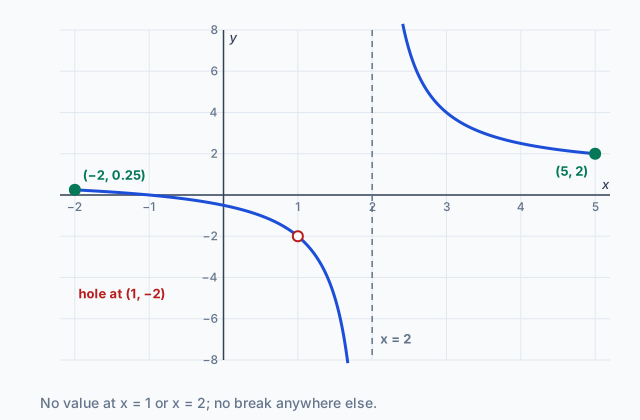
The graph at the top is . Neither nor exists, so is not continuous at either input. Everywhere else the graph runs without a break. So is continuous on , on and on . It is not continuous on , which holds both bad inputs, or on , which holds only one.
Two habits follow. To show that a function is continuous on an interval, give a reason that covers every point of it, not a few sample inputs. To show that it is not, one input inside the interval where continuity fails is enough.
At an endpoint of a closed interval, only inputs inside the interval count: the function needs a value there equal to its one-sided limit from inside, the right-hand limit at the left end and the left-hand limit at the right end. The same goes where a domain stops: only the side with values counts. So is continuous on , and at 0 itself, even though it has no values to the left of 0.
Quick check · Sort it
No calculator. A function is defined for all real numbers and is continuous at every real number except and . Tap an interval, then tap whether is continuous on it.
Continuous on this interval
Not continuous on this interval
12b. The basic families are continuous on their domains
No one checks every point of an interval one at a time. Instead, calculus leans on one fact: polynomial, rational, power, exponential, logarithmic and trigonometric functions are continuous at all points in their domains. Sums, differences, products, quotients and compositions of them are continuous wherever they are defined, by the limit theorems of Topic 1.5.
So for a function built from these families, the work is finding the domain:
- a polynomial, , or : every real number;
- a quotient: leave out each input where the denominator is 0;
- : you need , so an input where is kept;
- : you need , so an input where is left out;
- : leave out each zero of .
Then split the domain at the inputs you left out. Take . Its denominator is 0 at and , so is continuous on , on and on . And needs , so it is continuous on .
The fact covers the domain and nothing more. At an input outside the domain the function has no value, so it cannot be continuous there.
Quick check · Multiple choice
No calculator. On which of these intervals is continuous?
12c. Piecewise functions: each formula, then each seam
A piecewise-defined function uses different formulas on different intervals. Check it in two stages.
First, each formula on its own open interval, using the families from the last idea. A formula counts only where it is used, so a zero of its denominator outside that interval does not matter.
Second, each input where the formula changes. There the families say nothing, so use the three conditions from Topic 1.11: the value at the input, both one-sided limits, and whether all three agree.
For , is rational, and its denominator is 0 only at , an input this formula is never used for. For , is a polynomial. At : , and . All three agree, so is continuous at 2, and is continuous on .
If the one-sided limits had disagreed, would still be continuous on and on , because comes from and matches the right-hand limit, but not on any interval with 2 strictly inside it.
Quick check · Calculate
No calculator. Let for and for . At how many real numbers is not continuous?
Part 3 Watch it done Intervals of continuity for a quotient with a root
Watch each step, then do the last one yourself.
Let . Find the intervals on which is continuous.
Step 1 · Name the families
is a power function composed with the polynomial , and is a polynomial. A quotient of such functions is continuous at every input where it is defined.
Step 2 · Find the domain
The root needs , so . The denominator needs , so . The domain is with .
Why this step?
Why is kept, when is thrown out?
At the root is , so exists, and only inputs to its right are in the domain, so needs only its right-hand limit there. At the formula divides by zero, so does not exist and cannot be continuous at 1.
Step 3 · Split the domain
The domain is cut at the one input left out inside it, , which leaves one interval to the left of 1 and one to the right.
Your step · Fill the statement
No calculator. Finish it. Tap a blank, then tap an answer.
The domain of splits at 1 into two intervals that together hold every input of the domain: to the left of 1 and to the right of 1. is continuous on each of them.
Part 4 Try it Two new functions
Try it · Calculate
No calculator. Let . At how many values of in the interval is not continuous?
Try it · Decide and justify
No calculator. Let . A classmate says is continuous on every interval of real numbers. Is the classmate right?
Which reason supports your answer?
Part 5 Explain it Write it the way the exam asks
On the exam free response is handwritten, so work on paper first. Nothing you type here leaves this page. Then compare with the model answer and score each point.
Free response is 50% of the exam score. This one is shaped like Question 4, from free-response Part B (calculator not permitted).
Free-response practice · Question 4 style
No calculator. A chemist heats a mixture, and after 5 minutes turns the heater down. The temperature of the mixture, in degrees Celsius, minutes after the heater is switched on is modeled by
(a) Explain why is continuous on the interval .
(b) Find , using correct units. Using the definition of continuity, determine whether is continuous at . Justify your answer.
(c) Is continuous on the interval ? Justify your answer.
Model answer
(a) For , , so is defined at every in the interval. A logarithmic function is continuous at every point of its domain, and there, so is continuous on (from the left at ).
(b) degrees Celsius. and . So , and is continuous at .
(c) Yes. On , is a polynomial, so is continuous there (from the right at ). is continuous at by part (b) and on by part (a). So is continuous at each point of , and therefore on the interval.
Score your own answer. This is a self-check, not a grade. Tick each point your answer makes.
Part 6 Check yourself A function in two pieces
The two case questions use the same function. Answer them from the table.
A function is given by two formulas. The table says which formula gives on which inputs. Where a formula has no value, has none either.
| Inputs | |
|---|---|
Case question 1 · Multiple choice
No calculator. At which values of is not continuous?
Case question 2 · Calculate
No calculator. On how many of these four intervals is continuous: , , and ?
The rest stand on their own and do not use the case.
Check yourself · Spot the error
No calculator. A student finds where is continuous. Tap the first line with a mistake.
Check yourself · Match
No calculator. Tap a function, then the largest interval or intervals on which it is continuous.
Part 7 Keep it Bring back earlier ideas
Two earlier ideas this lesson stands on. Pulling them back up is what makes them last.
Bring it back · Multiple choice
No calculator. Let for every , and let . Which statement explains why is not continuous at ?
Bring it back · Calculate
No calculator. Suppose and . Find .
In three lines
- A function is continuous on an interval when it is continuous at each point of the interval; one failure inside is enough to lose it.
- The basic families are continuous on their domains, so find the domain and split it at the inputs left out.
- For a piecewise function, check each formula where it is used, then each seam with the value and both one-sided limits.
Exam strategy for this topic
- Section I Part A, Multiple Choice (calculator not permitted): 29 questions in 62 minutes.
- Section I Part B, Multiple Choice (graphing calculator required): 13 questions in 38 minutes.
- Section II Part A, Free Response (graphing calculator required): 2 questions in 30 minutes.
- Section II Part B, Free Response (calculator not permitted): 4 questions in 60 minutes.
When you justify that a function is continuous on an interval, name the family each part belongs to and say why every input of the interval is in its domain. At an input where a piecewise formula changes, write the value, both one-sided limits and the comparison before you state a conclusion.
Questions students ask
Is a function with a hole continuous on an interval that contains the hole?
No. At a hole either the function has no value, or its value sits off the curve and does not equal the limit, so the first or the third condition fails there, and one such point is enough. It is continuous on intervals on either side of the hole.
What happens at the endpoints of a closed interval?
Only inputs inside the interval count, so at the left endpoint the function needs a value and a right-hand limit equal to it, and at the right endpoint a left-hand limit. That is how is continuous on .
Does a continuous graph have to be smooth, with no corners?
No. A corner is not a break. has a sharp corner at 0, but it has a value there that equals its limit, so it is continuous on every interval.
If is continuous on and on , is it continuous on ?
Not necessarily. Neither interval contains 2, so you know nothing about at 2 yet. Check with the three conditions before you join the intervals.
Can I just say a function is continuous because it is a rational function?
Only at the inputs in its domain. A rational function is continuous at every point where its denominator is not 0, so the reason has to say that the interval avoids those zeros.
Course alignment, for teachers
AP Calculus AB topic 1.12, Unit 1: Limits and Continuity.
- Skill 1.E: Apply appropriate mathematical rules or procedures, with and without technology.
This lesson maps all 2 essential knowledge statements of the topic to the part that teaches each one: 2 are checked by a scored question. The map is in the lesson file.