Unit 1 · Topic 1.13 · about 30 minutes · 7 parts · 12 scored checks, 3 of them multiple choice
AP Calculus AB 1.13: Removing Discontinuities
Unit 1: 10 to 15% of the multiple-choice section
What you'll be able to do
- Find the value of , or of a constant in the formula, that makes a discontinuous function continuous, and explain why no value works when the limit does not exist.
Key vocabulary
| Term | What it means | The exam trap |
|---|---|---|
| Continuous at | A function is continuous at provided that exists, exists, and . | All three conditions have to be checked and stated; one of them alone does not show continuity. |
| Removable discontinuity | A discontinuity at which the limit of the function exists, so it can be removed by defining or redefining the function's value at that point to equal the limit. | Removing it changes one output only. The formula everywhere else stays as it is. |
| Jump discontinuity | A discontinuity at which the one-sided limits exist but are not equal. | Find both one-sided limits before you decide what kind of discontinuity you have. |
| Piecewise-defined function | A function given by different expressions on different parts of its domain. | Read the inequality signs to see which expression gives the value at the boundary itself. |
| Boundary | An input where a piecewise-defined function switches from one expression to the next, the edge of one part of the partition of its domain. | A function with several boundaries has to be checked at every one of them. |
 Tap to open the picture full size
Part 1 Think first One bad reading
Guess before you learn. A wrong guess still makes the answer stick.
Predict first
A probe records the temperature of the water in a tank as it slowly warms. It read 21.8 degrees Celsius at 4.9 minutes, 21.98 at 4.99 minutes, 22.02 at 5.01 minutes and 22.2 at 5.1 minutes. At exactly 5 minutes a glitch stored a reading of 0. Which value should replace the 0 so the record has no break at 5 minutes?
In short. Removing a discontinuity means choosing a function's value at a point, or a constant in its formula, so that the value there equals the limit there.
- A discontinuity can be removed only when the limit exists at that point; then the function's value there is defined or redefined as that limit.
- If the one-sided limits differ, or the function is unbounded or oscillates, no single value removes the discontinuity.
- A piecewise-defined function is continuous at a boundary when both expressions give the same value there and that value is also the function's value at the boundary.
Part 2 Learn it Three short ideas, each checked as you go
13a. Fill the hole with the limit
A function is continuous at when exists, exists, and the two are equal. A discontinuity is a point where one of those fails.
If the limit exists at the discontinuity, the break can be repaired. Define the function's value at , or redefine it if it already has one, to be the value of the limit. Then all three conditions hold and the function is continuous at . This is removing the discontinuity, and a discontinuity that can be removed this way is called removable.
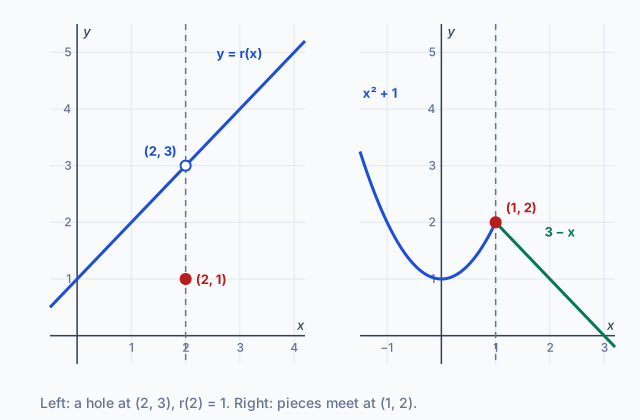
Take the left graph at the top of the lesson. Let for , and let . The quotient itself is not defined at 2; the value 1 was assigned there. For every ,
so . The value 1 is not 3, so the graph has a hole at and a lone point below it. Redefine as 3 and the hole is filled: the function is continuous at 2.
Only that one output changes. Every other value of stays as it was.
Quick check · Calculate
No calculator. Let for , and let . To what value should be redefined so that is continuous at ?
13b. When no value can fix it
The repair works only because the limit exists. If does not exist, there is no number for to equal, and the discontinuity cannot be removed by choosing .
A limit fails to exist in three ways you have met:
- The one-sided limits are different numbers. is for every and 1 for every . Whatever value you give at 0, the graph still breaks there.
- The function is unbounded near , as is near 4. Its values grow without bound, so no number can match them.
- The function oscillates near and never settles on one value.
So at any discontinuity, the first question is whether the limit exists. Find both one-sided limits. If they are the same number, the discontinuity is removable, and that number is the value to assign. If they are not, say so and say why. A question that asks for such a value "if possible" accepts "no value works" as the answer when you give the reason.
Quick check · Sort it
No calculator. Each card describes a function that is discontinuous at . Tap a card, then tap whether the discontinuity can be removed by defining or redefining .
Removable by choosing
Not removable by any
13c. Make the pieces meet
A piecewise-defined function uses different expressions on different parts of its domain. An input where one part ends and the next begins is a boundary. Each expression is usually continuous on its own part, so the boundaries are where continuity can fail.
At a boundary , three values must agree: the left expression's value at , the right expression's value at , and itself. The first gives and the second gives . If an expression gives at , simplify it first, as in the first idea, then take the one-sided limit. The piece whose inequality includes gives , unless has its own line.
In the right graph at the top, and both give 2 at , so the pieces meet at .
When the formula has a constant, choose it so the pieces meet. Let
From the left, . From the right, and at 1 itself, . So and . Check: with , both give 5 at 1 and .
Keep the when you evaluate a term like : at it is , but at it is .
Quick check · Calculate
No calculator. Let , where is a constant. What value of makes continuous at ?
Part 3 Watch it done Two constants, two boundaries
Watch each step, then do the last one yourself.
Let , where and are constants. Find the values of and that make continuous for all real numbers.
Step 1 · Find where continuity can fail
Each piece is a polynomial, and polynomials are continuous everywhere. So is continuous at every input except possibly the boundaries and .
Step 2 · Make the pieces meet at x = 1
. The middle piece includes 1, so , and as well. Continuity at 1 needs .
Why this step?
Why does the middle piece give both and the limit from the right, while the left piece gives neither?
The middle piece holds for , so it covers itself and the inputs just to the right of 1. The left piece holds only for , so it describes the inputs just to the left of 1 and never the value at 1.
Step 3 · Make the pieces meet at x = 2
The middle piece includes 2, so , which is also . From the right, . Continuity at 2 needs .
Step 4 · Combine the two conditions
The first condition gives . Put it into the second: , which is .
Your step · Calculate
No calculator. Finish it. The two continuity conditions are and . What is the value of ?
Part 4 Try it When it can be done, and when it cannot
Try it · Decide and justify
No calculator. Let , where is a constant. Is there a value of that makes continuous at ?
Which reason supports your answer?
Try it · Calculate
No calculator. Let for and . What value should be given so that is continuous at ? Give an exact decimal.
Part 5 Explain it Write it the way the exam asks
On the exam free response is handwritten, so work on paper first. Nothing you type here leaves this page. Then compare with the model answer and score each point.
Free response is 50% of the exam score. This one is shaped like Question 5, from free-response Part B (calculator not permitted).
Free-response practice · Question 5 style
No calculator. A chemist records the temperature of a mixture during a reaction. The temperature of the mixture, in degrees Celsius, minutes after the reaction starts is modeled by
where is a constant.
(a) Find . Show the work that leads to your answer.
(b) Find the value of for which is continuous at . Justify your answer using the definition of continuity.
(c) Suppose instead that . Is there a value to which could be redefined so that is continuous at ? Explain your reasoning.
Model answer
(a) For , , so . Then . As approaches 2 minutes from the left, the temperature approaches 60 degrees Celsius.
(b) , and since is a polynomial, . is continuous at when , and are equal, so and . With , exists, exists, and , so is continuous at .
(c) No. With , but . The one-sided limits are not equal, so does not exist, and no value of can equal it. Redefining one value removes a discontinuity only when the limit exists.
Score your own answer. This is a self-check, not a grade. Tick each point your answer makes.
Part 6 Check yourself A function with a value of its own
The two case questions use the same function. Answer them from it.
A function is defined in three parts, where is a constant. The table gives the expression for each part of the domain.
| Inputs | |
|---|---|
Case question 1 · Calculate
No calculator. For what value of does exist?
Case question 2 · Multiple choice
No calculator. Suppose . Which single change makes continuous at ?
The rest stand on their own and do not use the case.
Check yourself · Spot the error
No calculator. Let , where is a constant. A student looks for the value of that makes continuous at . Tap the first line with a mistake.
Check yourself · Match
No calculator. Each function is not defined at the input shown. Tap a function, then what can be done there to make it continuous.
Part 7 Keep it Bring back earlier ideas
This lesson rests on two earlier ideas. Pulling them back up is what makes them last.
Bring it back · Multiple choice
No calculator. Let . On which of these intervals is continuous?
Bring it back · Multiple choice
No calculator. Why does not exist?
In three lines
- A discontinuity is removable when the limit exists; define or redefine the function's value there as the limit.
- If the one-sided limits differ, or the function is unbounded or oscillates, no single value removes the discontinuity.
- At a boundary of a piecewise function, the expression on each side and the value at the boundary must all agree.
Exam strategy for this topic
- Section I Part A, Multiple Choice (calculator not permitted): 29 questions in 62 minutes.
- Section I Part B, Multiple Choice (graphing calculator required): 13 questions in 38 minutes.
- Section II Part A, Free Response (graphing calculator required): 2 questions in 30 minutes.
- Section II Part B, Free Response (calculator not permitted): 4 questions in 60 minutes.
When a question asks for a constant that makes a function continuous, write the limit from the left, the limit from the right and the function's value at the boundary as expressions, set them equal, and solve. Then justify with the definition: name all three conditions and show that they hold with your value.
Questions students ask
What does it mean to remove a discontinuity?
It means giving the function a value at the point, or replacing the value it has, so that the value equals the limit there. Then the function is continuous at that point, and nothing else about it changes.
Can every discontinuity be removed?
No. Only one where the limit exists. At a jump the one-sided limits differ, and at a vertical asymptote the function is unbounded, so there is no limit for a single value to equal.
Why can't I define the missing value as 0 when I get ?
Because is not a value. It only says the expression must be rewritten. Factor, cancel or multiply by a conjugate, find the limit, and use that number.
Which piece gives the value at a boundary?
The piece whose inequality includes the boundary, the one with or there. If the definition lists on its own line, that line gives it instead.
What if the constant drops out when I set the pieces equal?
Then the equation is either always true or never true. If it is never true, no value of the constant makes the function continuous, and that is the answer, as long as you show the equation and say why.
Course alignment, for teachers
AP Calculus AB topic 1.13, Unit 1: Limits and Continuity.
- Skill 1.E: Apply appropriate mathematical rules or procedures, with and without technology.
This lesson maps all 2 essential knowledge statements of the topic to the part that teaches each one: 2 are checked by a scored question. The map is in the lesson file.