Unit 1 · Topic 1.16 · about 30 minutes · 7 parts · 12 scored checks, 3 of them multiple choice
AP Calculus AB 1.16: Working with the Intermediate Value Theorem (IVT)
Unit 1: 10 to 15% of the multiple-choice section
What you'll be able to do
- Explain how a function behaves on an interval with the Intermediate Value Theorem, checking that its hypotheses hold before stating what it guarantees.
Key vocabulary
| Term | What it means | The exam trap |
|---|---|---|
| Intermediate Value Theorem | If is a continuous function on the closed interval and is a number between and , then there is at least one number between and such that . | Write both hypotheses about the function in front of you, with its numbers, before you write the conclusion. |
| Continuous on an interval | A function is continuous on an interval if it is continuous at each point in the interval. | Check every input of the interval, not just the endpoints. |
| Hypothesis | A condition that must hold before a theorem's conclusion can be drawn. | A hypothesis is about the given function on the given interval; check it there, not for the function in general. |
| Existence theorem | A theorem that lets you conclude something about a function's behavior on an interval without locating exactly where that behavior happens. | It tells you a value exists; finding that value is separate work, by algebra or on a calculator. |
 Tap to open the picture full size
Part 1 Think first Was she ever at 1,500 meters?
Guess before you learn. A wrong guess still makes the answer stick.
Predict first
A hiker starts up a mountain trail at 7 a.m. at an elevation of 1,200 meters and reaches the summit, at 2,000 meters, at noon. On the way she stops twice to rest, and one stretch of the trail runs downhill. Was she ever at an elevation of exactly 1,500 meters?
In short. The Intermediate Value Theorem says that a function continuous on a closed interval takes every value between its two endpoint values somewhere in that interval.
- The hypotheses come first: is continuous on the closed interval , and is a number between and .
- The conclusion is that for at least one number between and ; the theorem does not say how many such numbers there are or where they are.
- When a hypothesis fails, the theorem guarantees nothing, which is different from saying that no such exists.
Part 2 Learn it Three short ideas, each checked as you go
16a. What the theorem promises
A function that is continuous on an interval has no breaks there: its graph over the interval can be drawn without lifting your pencil. The Intermediate Value Theorem turns that picture into a promise.
If is continuous on the closed interval and is a number between and , then there is at least one number between and such that .
Read it in two halves. The hypotheses are what you must know first: is continuous on , and is between the two endpoint outputs. The conclusion is what you then get: an input at which takes the value .
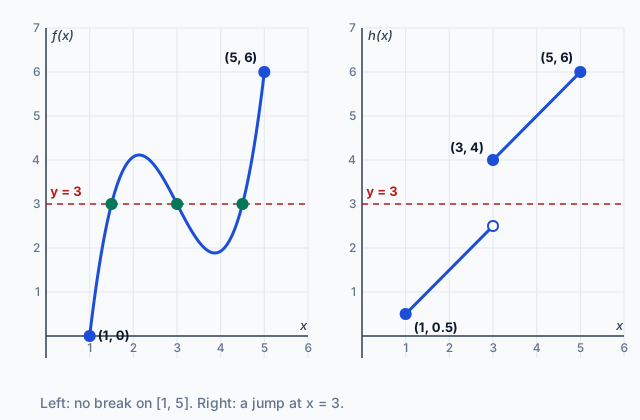
Look at the left graph at the top. It is continuous on , with and , and every height between 0 and 6 is reached somewhere between and . The dashed line meets the graph three times.
That is why the theorem says at least one. It promises that a exists and nothing about how many there are or where they sit. A theorem that tells you something exists without locating it is an existence theorem.
One more detail: is compared with the outputs and , not with the inputs and , and either output may be the larger one.
Quick check · Calculate
No calculator. A function is continuous on , with and . Consider the four values , , and . For how many of them does the Intermediate Value Theorem guarantee a number between 1 and 3 with ?
16b. Check the hypotheses first
The conclusion is only as good as the hypotheses, so a justification states them before it states the conclusion.
Continuity on the whole closed interval. One break is enough to spoil the promise. The right graph at the top starts at 0.5 and ends at 6, but at it jumps from heights near 2.5 up to 4, and it never takes the value 3.
To check continuity, use what you know from earlier in this unit: polynomial, rational, power, exponential, logarithmic and trigonometric functions are continuous at every point of their domains. So look for any input in , endpoints included, where the function is not defined. For example, on fails at .
between and . Work out both endpoint values and write the inequality, such as .
When a hypothesis fails, the theorem is silent. It does not say that no exists. For on , and , so 1 is not between them and the theorem on tells you nothing about the value 1, yet . A missing guarantee is not a no.
Quick check · Sort it
No calculator. On each card, decide whether the Intermediate Value Theorem, applied to the interval shown on the card, guarantees a number between and with . Tap a card, then tap a bin.
Guaranteed by the theorem
Not guaranteed by the theorem
16c. Tables, and the words at least
When a continuous function is given only by a table of values, each pair of neighboring entries is its own closed interval, and you can use the theorem on each pair.
Take a continuous function with , , and .
- From 1 to 3, goes from 4 to , and 0 is between them, so has a zero in .
- From 3 to 5, goes from to 1, so has another zero in .
- From 5 to 7, goes from 1 to 6, and 0 is not between them.
So has at least two solutions in . Not exactly two: the table says nothing about what does between its entries, and could dip below 0 and come back between 5 and 7. "At least" is the strongest claim the theorem supports.
When you write it up, attach the hypotheses to the interval you use: " is continuous on , and , so by the Intermediate Value Theorem, for some in ."
Quick check · Multiple choice
No calculator. A function is continuous on , with , , , and . Which statement must be true?
Part 3 Watch it done A justification, one hypothesis at a time
Watch each step, then do the last one yourself.
Let . Show that for at least one number between 2 and 3.
Step 1 · Check continuity
is a polynomial, so is continuous at every real number, and so is continuous on the closed interval .
Why this step?
Why check continuity before working out anything else?
The conclusion follows only when both hypotheses hold. A function with a break inside could jump right over 4, the way the right graph at the top jumps over 3, so the endpoint values alone would prove nothing.
Step 2 · Evaluate at the endpoints
and .
Step 3 · Place $d$ between the endpoint values
, so 4 is between and .
Your step · Fill the statement
No calculator. Finish it. Tap a blank, then tap an answer.
Both hypotheses hold, so by the Intermediate Value Theorem there is at least one number with such that .
Part 4 Try it Find the number, then test a claim
Try it · Calculate
Graphing calculator required. Let . Then is continuous on , and , so the Intermediate Value Theorem guarantees a number between 0 and 2 with . There is exactly one such . In radian mode, find it. Give your answer to three decimal places.
Try it · Decide and justify
No calculator. Let , so and . A classmate says the Intermediate Value Theorem guarantees a number between 1 and 4 with . Is the classmate right?
Which reason supports your answer?
Part 5 Explain it Write it the way the exam asks
On the exam free response is handwritten, so work on paper with your graphing calculator in radian mode. Nothing you type here leaves this page. Then compare with the model answer and score each point.
Free response is 50% of the exam score. This one is shaped like Question 1, from free-response Part A (graphing calculator required).
Free-response practice · Question 1 style
Graphing calculator required. During a storm, the depth of the water at a harbor dock is modeled by feet, where is measured in hours after midnight, for . Your calculator is in radian mode.
(a) Explain why there must be at least one time , with , at which the depth of the water is 9 feet.
(b) Find every time , with , at which the depth of the water is 9 feet. Give your answers to three decimal places.
(c) A dock worker says that because 6.5 is not between and , the depth of the water was never 6.5 feet for . Is the worker right? Justify your answer.
Model answer
(a) is the sum of a constant, a sine function and a linear function, each continuous for all , so is continuous on the closed interval . and , so . By the Intermediate Value Theorem, there is at least one time with at which , a depth of 9 feet.
(b) Solving on the calculator for gives , and hours.
(c) The worker is not right. The Intermediate Value Theorem guarantees only the depths between and . For 6.5 it guarantees nothing, and that does not mean the depth never reached 6.5. Solving on the calculator gives and hours, so the water was 6.5 feet deep at those times.
Score your own answer. This is a self-check, not a grade. Tick each point your answer makes.
Part 6 Check yourself A greenhouse through the day
The two case questions use the same table. Answer them from it.
A greenhouse warms up through the morning and cools in the afternoon. Its temperature, degrees Celsius, hours after 6 a.m., is a continuous function of . Some values are in the table.
| (hours) | (degrees Celsius) |
|---|---|
| 0 | 14 |
| 2 | 19 |
| 4 | 25 |
| 6 | 22 |
| 8 | 17 |
Case question 1 · Calculate
No calculator. What is the least number of times , with , at which the temperature must have been 20 degrees Celsius?
Case question 2 · Multiple choice
No calculator. Which statement justifies that the temperature was 23 degrees Celsius at some time with ?
The rest stand on their own and do not use the case.
Check yourself · Spot the error
No calculator. A student tries to show that has a zero between 0 and 2. Tap the first line with a mistake.
Check yourself · Match
No calculator. Each function is defined on . Tap what you know about , then what the Intermediate Value Theorem guarantees.
Part 7 Keep it Bring back earlier ideas
This lesson leans on two earlier ideas from this unit. Pulling them back up is what makes them last.
Bring it back · Multiple choice
No calculator. Which function is continuous on the closed interval ?
Bring it back · Calculate
No calculator. Let for and for . Find .
In three lines
- If is continuous on and is between and , then for at least one between and .
- State both hypotheses, for this function on this interval, before the conclusion; with a table, use the theorem on each pair of neighboring entries.
- The theorem says a exists, not how many or where, and when a hypothesis fails it guarantees nothing.
Exam strategy for this topic
- Section I Part A, Multiple Choice (calculator not permitted): 29 questions in 62 minutes.
- Section I Part B, Multiple Choice (graphing calculator required): 13 questions in 38 minutes.
- Section II Part A, Free Response (graphing calculator required): 2 questions in 30 minutes.
- Section II Part B, Free Response (calculator not permitted): 4 questions in 60 minutes.
When you use the Intermediate Value Theorem in a free-response answer, write the hypotheses as sentences about this function: " is continuous on " with a reason, then both endpoint values and the inequality that places between them, and only then the conclusion, naming the theorem. On a calculator question, keep the full values in your calculator and round to three decimal places only at the end.
Questions students ask
Does the theorem tell me where is?
No. It is an existence theorem: it guarantees at least one and says nothing about where. To find , solve , by algebra or numerically on a graphing calculator.
Can there be more than one ?
Yes. The theorem promises at least one. The left graph at the top of this lesson meets the line three times between and .
What if the function is not continuous on the interval?
Then the theorem guarantees nothing. The value might still be reached, or it might be skipped, as the jump in the right graph at the top skips the value 3.
Why must be between and , and not between and ?
Because is an output: the theorem is about which heights the graph reaches. The inputs and only mark the interval where you look for .
Does it matter which of and is larger?
No. just has to lie between them. If and , the theorem guarantees every with .
Course alignment, for teachers
AP Calculus AB topic 1.16, Unit 1: Limits and Continuity.
- Skill 3.E: Provide reasons or rationales for solutions and conclusions.
This lesson maps the one essential knowledge statement of the topic to the part that teaches each one: 1 is checked by a scored question. The map is in the lesson file.