Unit 1 · Topic 1.15 · about 30 minutes · 7 parts · 12 scored checks, 3 of them multiple choice
AP Calculus AB 1.15: Connecting Limits at Infinity and Horizontal Asymptotes
Unit 1: 10 to 15% of the multiple-choice section
What you'll be able to do
- Use limits as and as to describe a function's end behavior, find the horizontal asymptotes of its graph and compare how fast two functions grow.
Key vocabulary
| Term | What it means | The exam trap |
|---|---|---|
| Limit at infinity | A limit such as or : the value the outputs approach as the input grows or decreases without bound. | says which way is heading; it is never a number to substitute into the formula. |
| Horizontal asymptote | A line such that or . | It describes the ends of the graph only; in the middle the graph may cross it. |
| End behavior | What the outputs of a function do as and as , stated with limits at infinity. | State each end with its own limit, in limit notation, rather than describing the graph in words alone. |
| Relative magnitude | How large one function is compared with another for large inputs, read from the limit of their quotient. | Say which function is on top before you read the limit: and lead to opposite conclusions. |
 Tap to open the picture full size
Part 1 Think first What does a shirt cost in the long run?
Guess before you learn. A wrong guess still makes the answer stick.
Predict first
A print shop charges a 600 dollar setup fee for a design, plus 8 dollars for each shirt it prints. For an order of shirts, the average cost per shirt is dollars, which is 14 dollars a shirt for 100 shirts. What happens to the average cost per shirt as the orders get larger and larger?
In short. A limit at infinity, such as , describes what the outputs of approach as grows without bound, and when that limit is a number it gives a horizontal asymptote.
- If or for a number , the line is a horizontal asymptote of the graph of .
- For a rational function, dividing the top and the bottom by the highest power of in the denominator shows its end behavior.
- The limit of a quotient as compares how fast and grow.
Part 2 Learn it Three short ideas, each checked as you go
15a. Limits at infinity and horizontal asymptotes
A limit at infinity asks what the outputs of approach as the input grows without bound. We write when can be made as close to as we like by taking large enough, and when the same happens as decreases without bound. The symbol is not a number to substitute. It says which way is heading.
Take . At it is 5.2, at 100 it is 5.02, at 1000 it is 5.002. The piece shrinks toward 0, so . On the left, and , so as well.
A few end behaviors to know cold. For any positive integer , at both ends. As , . As , both and grow without bound, which is written .
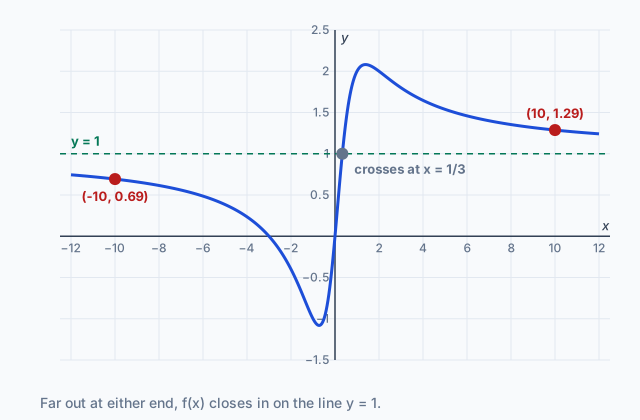
When or for a number , the line is a horizontal asymptote of the graph of . It describes the ends of the graph, not the middle: the graph at the top crosses its asymptote near the origin.
Quick check · Multiple choice
No calculator. Suppose . Which statement must be true?
15b. End behavior of rational functions
End behavior is what a function does as and as , and limits at infinity are how calculus states it. For a rational function, divide the numerator and the denominator by the highest power of in the denominator. Every term that is left with in its denominator then goes to 0.
For , divide by :
so is a horizontal asymptote. A value agrees: .
The same division gives three cases, by comparing the degree of the top with the degree of the bottom:
- top degree lower: the limit is 0;
- equal degrees: the limit is the quotient of the leading coefficients, signs included;
- top degree higher: the outputs grow or decrease without bound, so that end has no horizontal asymptote.
The leading coefficient belongs to the highest power, wherever that term is written. In it is on top, so the limit is .
The same move works beyond rational functions: for , divide the top and the bottom by , and the limit as is .
When a rational function has a horizontal asymptote, it has the same one at both ends. Other functions need not, so work out and separately.
Quick check · Sort it
No calculator. Each card is a function . Tap a card, then tap what does as .
Approaches 0
Approaches a nonzero number
Grows or decreases without bound
15c. Which function grows faster?
Limits at infinity also compare two functions. Suppose and are positive and grow without bound as . Look at :
- if it is 0, grows faster, and becomes negligible next to ;
- if it grows without bound, grows faster;
- if it is a positive number, the two grow at the same rate.
For example, is 1.5 at , 1.05 at 100 and 1.005 at 1000. Its limit is 1, so next to the stops mattering. That is why only the leading terms decided the limits in the last idea.
For large the common families line up in order. grows more slowly than any positive power , and every power of grows more slowly than an exponential with . So and .
A few values can mislead. At , is larger than , but the quotient is about 0.29 at and 0.0011 at , and its limit is 0. The same limit compares rates of change: if two tanks fill at and liters per minute, the second tank's rate eventually leaves the first one's far behind.
Quick check · Decide and justify
No calculator. A classmate compares and . At , and , so the classmate concludes that grows faster and that grows without bound as . Is the classmate right?
Which reason supports your answer?
Part 3 Watch it done Two different ends
Watch each step, then do the last one yourself.
Find every horizontal asymptote of the graph of .
Step 1 · Divide by the highest power, for $x > 0$
Under the root the highest power is , so divide by . For , , so divide the top and the bottom by : the bottom becomes , and for .
Step 2 · Let $x$ grow
As , , so , and is a horizontal asymptote.
Step 3 · Rewrite for $x < 0$
For , , so divide the top and the bottom by . The top becomes , and the bottom becomes . So for .
Why this step?
Why divide by , and not by , when is negative?
To move the divisor inside the square root, it has to equal , and is never negative. For , . Dividing by instead would quietly treat as and flip the sign of the bottom, which is how the left end gets the wrong asymptote.
Your step · Calculate
No calculator. Finish it. For , can be written . What is ?
Part 4 Try it Two new functions
Try it · Calculate
No calculator. Find . Give your answer as an exact decimal.
Try it · Multiple choice
No calculator. Which of these limits is equal to 0?
Part 5 Explain it Write it the way the exam asks
On the exam free response is handwritten, so work on paper first. Nothing you type here leaves this page. Then compare with the model answer and score each point.
Free response is 50% of the exam score. This one is shaped like Question 3, from free-response Part B (calculator not permitted).
Free-response practice · Question 3 style
No calculator. A large tank holds 200 liters of pure water. Starting at time , salt water flows into the tank at 10 liters per minute, and each liter of it carries 0.3 kilogram of salt. Nothing flows out, and the tank stays well mixed. For minutes, the concentration of salt in the tank, in kilograms per liter, is
(a) Find . Show the work that leads to your answer.
(b) The graph of has a horizontal asymptote. Write its equation. Using correct units, interpret the meaning of this asymptote in the context of the problem.
(c) Find the time at which .
(d) Is there a time at which ? Explain your reasoning.
Model answer
(a) For , divide the numerator and the denominator by : . As , , so .
(b) . As time goes on, the concentration of salt in the tank gets as close as we like to 0.3 kilogram per liter, the concentration of the salt water flowing in.
(c) gives , so and minutes.
(d) No. would need , that is, , which is false. The concentration approaches 0.3 kilogram per liter but never reaches it, because for every .
Score your own answer. This is a self-check, not a grade. Tick each point your answer makes.
Part 6 Check yourself A function with two different ends
The two case questions use the same function. The table shows only its right end, so use the formula for the left.
Let for all real numbers . Some of its values, rounded to four decimal places, are in the table.
| 0 | 3.5000 |
|---|---|
| 2 | 4.6424 |
| 5 | 4.9799 |
| 10 | 4.9999 |
Case question 1 · Multiple choice
No calculator. Which line is the horizontal asymptote of the graph of at its left end, as ?
Case question 2 · Calculate
No calculator. Find .
The rest stand on their own and do not use the case.
Check yourself · Spot the error
No calculator. A student finds the horizontal asymptote of the graph of . Tap the first line with a mistake.
Check yourself · Fill the statement
No calculator. Tap a blank, then tap an answer.
Suppose and are positive and grow without bound as . If , then the function grows faster. If that limit is , then and grow at the same rate.
Part 7 Keep it Bring back earlier ideas
Two earlier ideas this lesson builds on. Answer them from memory before you look back.
Bring it back · Calculate
No calculator. Let . The graph of has exactly one vertical asymptote. At what value of is it?
Bring it back · Calculate
No calculator. Suppose and . Find .
In three lines
- A limit at infinity tells what the outputs approach as grows or decreases without bound.
- A finite limit at either end gives a horizontal asymptote , and each end is worked out on its own.
- The limit of as shows which function grows faster, or that they keep pace.
Exam strategy for this topic
- Section I Part A, Multiple Choice (calculator not permitted): 29 questions in 62 minutes.
- Section I Part B, Multiple Choice (graphing calculator required): 13 questions in 38 minutes.
- Section II Part A, Free Response (graphing calculator required): 2 questions in 30 minutes.
- Section II Part B, Free Response (calculator not permitted): 4 questions in 60 minutes.
When a question asks for a horizontal asymptote, write the limit that produces it, as in ", so is a horizontal asymptote," and give the asymptote as the equation of a line. For a function that is not rational, find the limit as and as separately.
Questions students ask
Can a graph cross its horizontal asymptote?
Yes. A horizontal asymptote is about the ends of the graph. The graph at the top of this lesson crosses at and still closes in on it at both ends.
If , does the limit exist?
No. Writing describes how the limit fails to exist: the outputs grow without bound and approach no real number. That end of the graph has no horizontal asymptote.
Can a function have two different horizontal asymptotes?
Yes, one at each end. has on the right and on the left. It cannot have more than two, because there are only two ends.
Why do only the leading terms matter for a rational function?
Because every other term is negligible next to the leading one for large . The quotient approaches 1, so far out and are nearly the same size compared with each other.
Is there a rule for limits of quotients like ?
Topic 4.7 adds one, L'Hospital's Rule, once you have derivatives. Here, use the order of growth for large : , then powers of , then exponentials with base greater than 1.
Course alignment, for teachers
AP Calculus AB topic 1.15, Unit 1: Limits and Continuity.
- Skill 2.D: Identify how mathematical characteristics or properties of functions are related in different representations.
This lesson maps all 3 essential knowledge statements of the topic to the part that teaches each one: 3 are checked by a scored question. The map is in the lesson file.