Unit 2 · Topic 2.2 · about 30 minutes · 7 parts · 12 scored checks, 2 of them multiple choice, plus 2 from earlier lessons
AP Calculus AB 2.2: Defining the Derivative of a Function and Using Derivative Notation
Unit 2: 10 to 15% of the multiple-choice section
What you'll be able to do
- Write the derivative of a function as the limit of a difference quotient, in each of its notations, and work out that limit.
- Write an equation for the line tangent to a curve at a given point.
Key vocabulary
| Term | What it means | The exam trap |
|---|---|---|
| Derivative of a function | The function whose value at is , provided this limit exists. | Keep writing on every line until you actually take the limit; a line without it is a difference quotient, not the derivative. |
| Derivative notation: , and | For , three names for the same derivative, read "f prime of x," "y prime" and "dee y, dee x." | The letters follow the function and its input, so a function of has derivative or . |
| Line tangent to a curve | The line through a point on a graph whose slope is the derivative at that point, the limit of the slopes of secant lines through that point. | A tangent line can cross the graph somewhere else; it is tangent at the one point named. |
| Representations of the derivative | A derivative can be given graphically, numerically, analytically or verbally: as slopes or a graph, a table, a formula, or words with units. | A table can list and side by side, so read the column heading before you use a number. |
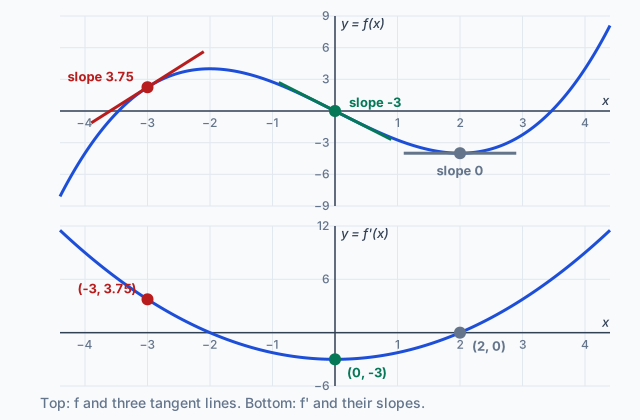 Tap to open the picture full size
Part 1 Think first One limit for every input?
Guess before you learn. A wrong guess still makes the answer stick.
Predict first
Maya used the definition of the derivative three times for , one input at a time, and got , and . Her homework now asks for . What is it?
In short. The derivative of is the function whose value at each input is , wherever that limit exists, and its value is the slope of the line tangent to the graph of at .
- For , the derivative can be written , or , and its units are output units per unit of input.
- The same derivative can be shown as a formula, a table of values, a graph or a sentence with units.
- The line tangent to the graph of at passes through with slope : .
Part 2 Learn it Four short ideas, each checked as you go
2a. The derivative is a function
In 2.1 Defining Average and Instantaneous Rates of Change at a Point you found at one number , and each new input meant a new limit. Do the same algebra with the letter in place of the number, and the limit comes out as a formula that works at every input.
The derivative of is the function whose value at is
provided this limit exists. While the limit is taken, stays fixed and only moves.
Take . Then , and subtracting all of leaves . For ,
which approaches as . So , and one limit now answers every input: and .
At an input where the limit does not exist, as for at 0, has no value. The derivative is defined only where its limit is.
Quick check · Calculate
No calculator. Let . Use the definition of the derivative to find . What is ?
2b. Three ways to write it
For , the derivative has three names you will see: , read "f prime of x"; , read "y prime"; and , read "dee y, dee x." They name the same function. For from 2a, , and say one thing three ways.
is a reminder of where the derivative came from: a change in over a change in , taken in the limit. It is one symbol, not a fraction of two numbers.
The letters follow the function. If is a volume at time , its derivative is or . At one input, write , or say at .
A derivative's units are the output's units per unit of input, because it is a limit of change in output over change in input. If is in meters and in seconds, is in meters per second.
Quick check · Fill the statement
No calculator. Tap a blank, then tap an answer.
A block of ice melts on a counter. It weighs grams minutes after it is set out. Its derivative can be written , or , and it is measured in .
2c. The slope of the tangent line
Picture the secant lines of 2.1, each through and a second point on the graph. As the second point slides toward , the secants close in on one line through : the line tangent to the graph at that point. Its slope is the limit of the secant slopes, and that limit is the derivative. So is the slope of the line tangent to the graph of at .
That gives the tangent line from two numbers: the point and the slope . In point-slope form,
For at : , and , so the tangent line is , which is also .
The slope has to be the number , not the formula , because a line has one slope. Where , the tangent line is horizontal. In the top graph of the picture, the line at is one.
Quick check · Multiple choice
No calculator. Let , whose derivative is . Which is an equation of the line tangent to the graph of at ?
2d. One derivative, four ways to show it
The same derivative can be shown four ways, and a question can hand you any of them.
- Analytically, as a formula: for the function of 2a.
- Numerically, as a table of values: at , 1 and 2, is 1, 5 and 9.
- Graphically, as slopes: is how steep the graph of is at , and the values of can be plotted as a graph of their own. In the picture at the top, each tangent slope on the graph of is a dot on the graph of below it.
- Verbally, as a sentence with units: if is a bike's distance in meters after seconds, says that at 4 seconds the distance is increasing at 6 meters per second.
Whichever way it comes, a value of is a rate, never an output. is how far the bike has gone after 4 seconds; is how fast that distance is growing at that instant.
Quick check · Match
No calculator. A town has thousand residents years after the start of 2020. Tap a statement, then what it says in words.
Part 3 Watch it done A derivative from the definition, then its tangent line
Watch each step, then do the last one yourself.
Let . Use the definition of the derivative to find . Then write an equation for the line tangent to the graph of at .
Step 1 · Write the limit
Step 2 · Expand the top
. Subtracting leaves .
Step 3 · Simplify the quotient
, for every .
Step 4 · Take the limit
.
Why this step?
Why does stay in the answer while disappears?
The limit is about approaching 0, with held fixed at whatever input you choose. So every term goes to 0, and the terms are left as a formula: the derivative at each input .
Step 5 · Find the point
, so the tangent line passes through .
Your step · Calculate
No calculator. Finish it. For , , and the line tangent to the graph at is . What is ?
Part 4 Try it A level tangent and a cubic
Try it · Decide and justify
No calculator. Let , so . A classmate says the line tangent to the graph of at is horizontal. Is the classmate right?
Which reason supports your answer?
Try it · Calculate
No calculator. Let , whose derivative is . The line tangent to the graph of at crosses the -axis. At what -value?
Part 5 Explain it Write it out, then score it
On the exam free response is handwritten, so work on paper first. Nothing you type here leaves this page. Then compare with the model answer and score each point.
Free response is 50% of the exam score. This one is shaped like Question 4, from free-response Part B (calculator not permitted).
Free-response practice · Question 4 style
No calculator. Water flows into a tank. The volume of water in the tank, in liters, minutes after the water starts, is for .
(a) Use the definition of the derivative to find . Show the work that leads to your answer.
(b) Find . Using correct units, interpret the meaning of in the context of the problem.
(c) Write an equation for the line tangent to the graph of at .
Model answer
(a) . , so . For , . So .
(b) . At time minutes, the volume of water in the tank is increasing at a rate of 14 liters per minute.
(c) , and the slope is . The tangent line is .
Score your own answer. This is a self-check, not a grade. Tick each point your answer makes.
Part 6 Check yourself A delivery drone's altitude
The three case questions use the same table. Answer them from it.
A delivery drone takes off from the ground. Its altitude is meters, seconds after takeoff, and is differentiable. The table gives some values of and of its derivative .
| (seconds) | (meters) | (meters per second) |
|---|---|---|
| 0 | 0 | 8 |
| 2 | 14 | 6 |
| 4 | 24 | 4 |
| 6 | 30 | 1 |
| 8 | 28 |
Case question 1 · Multiple choice
No calculator. Which is an equation of the line tangent to the graph of at ?
Case question 2 · Calculate
No calculator. The line tangent to the graph of at is extended back to . What value does that line give at ?
Case question 3 · Decide and justify
No calculator. A classmate reads from the table and says it means the drone came down 2 meters between and . Is the classmate right?
Which reason supports your answer?
The rest stand on their own and do not use the case.
Check yourself · Spot the error
No calculator. A student finds for from the definition. Tap the first line with a mistake.
Check yourself · Sort it
No calculator. Each card gives one fact about a function , with . Tap a card, then tap whether it gives a value of or a value of .
A value of
A value of
Part 7 Keep it Bring back earlier ideas
This lesson stands on the difference quotient from 2.1 and the limit algebra of Unit 1. Pulling them back up is what makes them last.
From 2.1 Defining Average and Instantaneous Rates of Change at a Point · Calculate
No calculator. Let . What is the average rate of change of over the interval ?
From 1.6 Determining Limits Using Algebraic Manipulation · Calculate
No calculator. Find . Give an exact decimal.
In three lines
- The derivative of is the function , defined wherever that limit exists.
- For it is written , or , and it can be shown as a formula, a table, a graph or in words.
- is the slope of the line tangent to the graph at , so that line is .
Exam strategy for this topic
- Section I Part A, Multiple Choice (calculator not permitted): 29 questions in 62 minutes.
- Section I Part B, Multiple Choice (graphing calculator required): 13 questions in 38 minutes.
- Section II Part A, Free Response (graphing calculator required): 2 questions in 30 minutes.
- Section II Part B, Free Response (calculator not permitted): 4 questions in 60 minutes.
When a question asks for a tangent line, write the two numbers first, the point and the slope , then the line in point-slope form. You can leave it there: every rearrangement is another chance for an arithmetic slip. When it asks for a derivative from the definition, write the limit on every line until you take it.
Questions students ask
What is the difference between and ?
is the derivative as a function, a rule that gives the rate of change at any input. is one value of it, a number: the rate at the input , and the slope of the tangent line there.
Is a fraction?
No. It is one symbol for the derivative, the limit of . The notation is a reminder of that quotient. Treat it as a single symbol, not as one number divided by another. Later topics sometimes write and apart in a step, but itself is still the limit.
Do I have to use the definition every time I need a derivative?
When a question says to use the definition, yes. The later lessons of this unit build rules, such as the power rule, that give the same derivatives faster, and each of those rules comes from this limit.
Can a tangent line cross the graph?
Yes. Tangent describes the line at one point. The line tangent to the graph of at , for example, crosses the graph again at .
What units does a derivative have?
The output's units per unit of input. If is in liters and in minutes, is in liters per minute, and a negative value means the volume is going down.
Course alignment, for teachers
AP Calculus AB topic 2.2, Unit 2: Differentiation: Definition and Fundamental Properties.
- Skill 1.D: Identify an appropriate mathematical rule or procedure based on the relationship between concepts (e.g., rate of change and accumulation) or processes (e.g., differentiation and its inverse process, anti-differentiation) to solve problems.
This lesson maps all 4 essential knowledge statements of the topic to the part that teaches each one: 4 are checked by a scored question. The map is in the lesson file.