Unit 4 · Topic 4.1 · about 30 minutes · 7 parts · 12 scored checks, 3 of them multiple choice
AP Calculus AB 4.1: Interpreting the Meaning of the Derivative in Context
Unit 4: 10 to 15% of the multiple-choice section
What you'll be able to do
- Interpret the meaning of a derivative in context: say what tells you about a real quantity at one input value, with its units.
Key vocabulary
| Term | What it means | The exam trap |
|---|---|---|
| Instantaneous rate of change | How fast a quantity is changing at one value of its input, given by the derivative there. | Before you answer, check whether the question is about one input value or about a whole interval. |
| Independent variable | The input of a function; a derivative is a rate of change with respect to it. | Take the input and its unit from the problem's own definition of the function, not from habit. |
| Units of a derivative | The unit for is the unit for divided by the unit for . | Read both units from the problem statement before you write either one, and say the result aloud as a rate. |
| Rate of change in context | A statement about how fast a real quantity changes, which a derivative expresses with its sign and its units. | Use the context's own words. A rate of change of volume, income or population is not a velocity. |
 Tap to open the picture full size
Part 1 Think first What does the chart say?
Guess before you learn. A wrong guess still makes the answer stick.
Predict first
A nurse tracks the amount of a medicine in a patient's blood. The amount is milligrams, hours after a dose. The chart says . What does that tell the nurse?
In short. In context, is the instantaneous rate of change of the quantity with respect to its input at , and its unit is the unit of divided by the unit of the input.
- A derivative value describes how fast a quantity is changing at one input value, not how much of the quantity there is.
- The unit of is the unit of per unit of , in that order.
- A full interpretation names the input value, the quantity, whether it is increasing or decreasing, and the rate with its units.
Part 2 Learn it Reading a derivative as a rate
4a. A derivative is a rate with respect to its input
In Unit 2, was a limit of average rates. In words, the derivative is the instantaneous rate of change of with respect to its input, at the input value . "With respect to" names the variable on the bottom of every difference quotient, so is the change in per one unit of that input, at that one input.
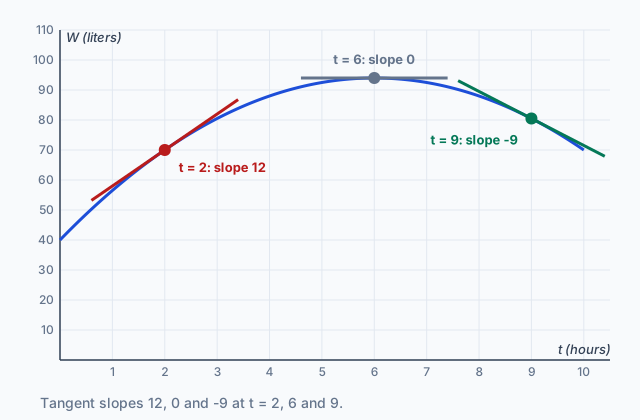
The graph at the top shows , the volume of water in a rain barrel, in liters, hours after a storm starts. The tangent line at has slope 12, so : two hours in, the water is rising at 12 liters per hour. At the slope is , so the water is falling at 9 liters per hour. At , , and for that instant the volume is neither rising nor falling.
A positive derivative means the quantity is increasing at that input, and a negative one means it is decreasing there.
A derivative is not the amount. liters is how much water there is, and is how fast it changes. It is not an average over an interval either; that is a difference quotient. And its input need not be time. If is the water pressure at a depth of meters, is a rate per meter of depth.
Quick check · Multiple choice
No calculator. A hiker's elevation, in feet above the trailhead, is when she has walked miles along the trail. Which statement is the best interpretation of ?
4b. The units of a derivative
Every derivative in context has units, and you can read them off the function before you compute anything.
The unit of is the unit of divided by the unit of . That comes straight from the difference quotient. Its top is a change in , measured in the unit of , and its bottom is a change in , measured in the unit of . The limit of those quotients keeps the same unit.
So if is in liters and is in hours, is in liters per hour. If is water pressure in kilopascals at a depth of meters, is in kilopascals per meter.
Order matters: the output's unit goes on top and the input's unit goes on the bottom, so the unit reads "output per input." Suppose is the number of pages a printer prints in hours. Then is in pages per hour. The function , the hours the printer needs for pages, has its derivative in hours per page, a different rate about a different function.
When the output and the input share a unit, keep both. If is the area of a square tile, in square meters, with side meters, is in square meters per meter.
Quick check · Match
No calculator. Tap a function, then the units of its derivative.
4c. Saying what a derivative value means
To interpret a derivative value in context, write one sentence that names the input value with its unit, the quantity that is changing, whether it is increasing or decreasing, and how fast, with units. For the rain barrel's :
At hours, the volume of water in the barrel is decreasing at a rate of 9 liters per hour.
The sign becomes a word. A negative derivative is "decreasing at a rate of 9," not "increasing at a rate of ," and never "the barrel holds liters." Say "rate," because the number tells you how fast the volume changes at that instant. It does not tell you how much water there is, or exactly how much will drain in the next hour, because the rate itself can change during that hour.
The translation runs the other way too. Let be the air in a balloon, in cubic centimeters, minutes after it is untied. "Five minutes after it is untied, the balloon is losing air at 40 cubic centimeters per minute" says . A sentence about an amount, such as "it holds 900 cubic centimeters at 5 minutes," says .
Use the words of the context. How fast the barrel's volume changes is not a velocity or a speed; call it the rate of change of the volume.
Quick check · Sort it
No calculator. is the depth of snow on the ground, in inches, hours after midnight. Tap a sentence, then tap what it gives a value of.
A value of
A value of
Part 3 Watch it done From a formula to a sentence
Watch each step, then do the last one yourself.
A tank is drained through a valve. The volume of water in the tank is liters, minutes after the valve opens, for . Find and interpret it in context, with units.
Step 1 · Differentiate
By the power rule with the sum and constant multiple rules, .
Step 2 · Evaluate at the input
.
Why this step?
Why does the sign of matter before you write the sentence?
The sign says which way the volume is changing at . Negative means decreasing. In the sentence the word "decreasing" carries the sign, and the rate is its size, 16, so you never say "decreasing at ."
Step 3 · Read the units
is in liters and is in minutes, so is in liters per minute.
Your step · Fill the statement
No calculator. Finish it. For liters, . Tap a blank, then tap an answer.
At time minutes, the volume of water in the tank is at a rate of .
Part 4 Try it A tide and a town
Try it · Calculate
Graphing calculator required. The depth of the water at a harbor wall is feet, hours after midnight. In radian mode, use your calculator's numerical derivative to find , in feet per hour. Give your answer to three decimal places.
Try it · Decide and justify
No calculator. A town's population is people, years after January 1, 2020. A classmate reads as "the town lost exactly 300 people during 2024." Is the classmate right?
Which reason supports your answer?
Part 5 Explain it Write it the way the exam asks
On the exam free response is handwritten, so work on paper first. Nothing you type here leaves this page. Then compare with the model answer and score each point.
Free response is 50% of the exam score. This one is shaped like Question 4, from free-response Part B (calculator not permitted).
Free-response practice · Question 4 style
No calculator. A cup of tea is poured and left on a counter to cool. Its temperature, in degrees Fahrenheit, is , where is measured in minutes after the tea is poured, for . is differentiable, and selected values are in the table.
(a) Use the data in the table to estimate . Show the computation that leads to your answer. Using correct units, interpret the meaning of your estimate in the context of the problem.
(b) At time minutes, the temperature of the tea is decreasing at a rate of 2.2 degrees Fahrenheit per minute. Write this fact as an equation in derivative notation, and indicate the units of .
(c) A student says that, by part (b), the tea will be exactly 2.2 degrees Fahrenheit cooler at than at . Explain why does not support this claim.
Model answer
(a) degrees Fahrenheit per minute. At time minutes, the temperature of the tea is decreasing at a rate of about 3 degrees Fahrenheit per minute.
(b) . The units of are degrees Fahrenheit per minute.
(c) is the instantaneous rate of change of the temperature at the single instant . The rate can change between and , and the table shows the tea cooling more slowly as time goes on, so the drop over that minute need not be exactly 2.2 degrees. says how fast the temperature is changing at , not how much it changes over the next minute.
Score your own answer. This is a self-check, not a grade. Tick each point your answer makes.
Part 6 Check yourself A day at a theme park
The two case questions use the same table. Answer them from it.
A theme park opens in the morning. The number of people in the park hours after it opens is , and is differentiable. The table gives and at selected times.
| (hours) | (people) | (people per hour) |
|---|---|---|
| 0 | 500 | 900 |
| 2 | 2800 | 1400 |
| 4 | 4800 | 600 |
| 6 | 5200 | -200 |
| 8 | 3500 | -1500 |
Case question 1 · Multiple choice
No calculator. At which of the times in the table is the number of people in the park increasing most rapidly?
Case question 2 · Decide and justify
No calculator. A manager says: "Because is negative, there were fewer people in the park at than at ." Is the manager right?
Which reason supports your answer?
The rest stand on their own and do not use the case.
Check yourself · Spot the error
No calculator. A balloon's volume is cubic centimeters when its radius is centimeters. A student finds and interprets it. Tap the first line with a mistake.
Check yourself · Calculate
No calculator. A bakery's flour supply is kilograms, days after a delivery. On day 5, the bakery is using up flour at a rate of 12 kilograms per day. What is ?
Part 7 Keep it Bring back earlier ideas
You can only interpret a derivative you can find, and continuity from Unit 1 sits underneath every derivative. Pulling them back up is what makes them last.
Bring it back · Calculate
No calculator. Let . Find .
Bring it back · Multiple choice
No calculator. Let for , and . Which statement is true?
In three lines
- A derivative in context is the rate at which a quantity changes with respect to its input, at one input value.
- Its unit is the unit of the quantity divided by the unit of the input.
- An interpretation names the input value, the quantity, the direction of change and the rate with units.
Exam strategy for this topic
- Section I Part A, Multiple Choice (calculator not permitted): 29 questions in 62 minutes.
- Section I Part B, Multiple Choice (graphing calculator required): 13 questions in 38 minutes.
- Section II Part A, Free Response (graphing calculator required): 2 questions in 30 minutes.
- Section II Part B, Free Response (calculator not permitted): 4 questions in 60 minutes.
When a question asks you to interpret a derivative value, write one sentence with the input value and its unit, the quantity, "increasing" or "decreasing" from the sign, and the rate with units. Leave out words like velocity or speed unless the quantity is a position.
Questions students ask
What is the difference between and in a word problem?
is how much of the quantity there is at the input , in the quantity's own units. is how fast that quantity is changing at , in the quantity's units per unit of input.
How do I get the units of a derivative?
Divide the unit of the function's output by the unit of its input. If is in gallons and is in minutes, is in gallons per minute.
If the derivative is negative, do I write a negative rate in my sentence?
Use the sign to choose the word "decreasing," then give the rate's size. If gallons per hour, write "decreasing at a rate of 5 gallons per hour," not "decreasing at a rate of ."
Does mean goes up by exactly 5 from to ?
Not exactly. The derivative is the rate at the single input 3, and the rate can change between 3 and 4. The change over that interval is .
Does the input of a derivative always have to be time?
No. A derivative is a rate with respect to whatever the input is. The rate of change of elevation with respect to distance walked is in feet per mile, and the rate of change of a balloon's volume with respect to its radius is in cubic centimeters per centimeter.
Course alignment, for teachers
AP Calculus AB topic 4.1, Unit 4: Contextual Applications of Differentiation.
- Skill 1.D: Identify an appropriate mathematical rule or procedure based on the relationship between concepts (e.g., rate of change and accumulation) or processes (e.g., differentiation and its inverse process, anti-differentiation) to solve problems.
This lesson maps all 3 essential knowledge statements of the topic to the part that teaches each one: 3 are checked by a scored question. The map is in the lesson file.