Unit 3 · Topic 3.6 · about 30 minutes · 7 parts · 11 scored checks, 3 of them multiple choice, plus 1 from earlier lessons
AP Calculus AB 3.6: Calculating Higher-Order Derivatives
Unit 3: 5 to 10% of the multiple-choice section
What you'll be able to do
- Find the second, third and higher derivatives of a function, and write each one in standard notation.
Key vocabulary
| Term | What it means | The exam trap |
|---|---|---|
| Second derivative | The derivative of , written , which exists wherever is differentiable. | Its units are the units of the first derivative per unit of input, such as people per year per year. |
| Higher-order derivative | Any derivative found by differentiating more than once: the second, third, fourth and later derivatives. | Simplify each derivative before you differentiate it again; a tidy expression keeps the next step short. |
| Leibniz notation, | The th derivative of with respect to ; is the second derivative. | In a written answer, write the whole symbol, top and bottom, with the raised number in its place on each. |
| Prime and parenthesis notation, and | Notation for derivatives of : primes for the first few, as in , and for the th derivative in general. | Count differentiations from itself: is three steps from , not three steps from . |
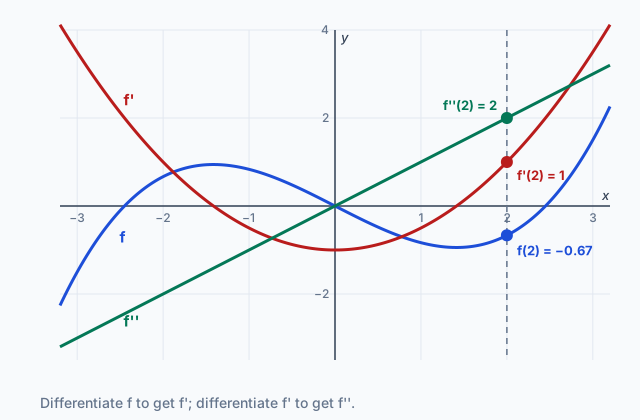 Tap to open the picture full size
Part 1 Think first How fast is the rate changing?
Guess before you learn. A wrong guess still makes the answer stick.
Predict first
A balloon is being inflated so that its volume after seconds is cubic inches, for . The rate at which the volume grows is not constant: it changes as the balloon fills. At the instant , how fast is that rate of growth itself changing?
In short. A higher-order derivative is a derivative of a derivative: differentiating gives the second derivative , provided the derivative of exists, and repeating the process gives the third, fourth and later derivatives.
- Each higher derivative uses the same rules as the first, applied to the expression the previous step produced.
- For , the second derivative is written , or , and the th derivative is or .
- To get a value such as , differentiate first and substitute last; putting in early turns into a constant, whose derivative is 0.
Part 2 Learn it Three short ideas, each checked as you go
2a. Differentiate the derivative
The derivative is a function, so it can have a derivative of its own. Differentiating produces the second derivative of , written , provided the derivative of exists. Nothing new is needed: use the same rules on that you used on .
The process repeats. Differentiate to get the third derivative , then differentiate again for the fourth, and so on. These are the higher-order derivatives of .
Take :
The fourth derivative is the constant 24, so every derivative after it is 0. For a polynomial, each step lowers the degree by one until a constant is left.
To find a value such as , find the formula for first and substitute last: . Substituting early does not work. is a single number, and the derivative of a constant is 0, which says nothing about how is changing at 2.
Quick check · Calculate
No calculator. Let . What is ?
2b. Names for higher derivatives
For the second derivative has three common names:
Read as : the operation applied twice to . That is why the 2 sits on the on top and on the underneath. It is not , the first derivative squared. For , , but .
Primes get hard to count after three, so the th derivative is written
The parentheses matter. is the fourth derivative of , while is usually read as , a power. So , , and all name the same thing: the third derivative.
Quick check · Match
No calculator. Let . Tap a piece of notation, then what it means.
2c. Every rule, applied again
The second derivative uses the rules you already know, on whatever turns out to be. If contains a product, the next differentiation needs the product rule; if it contains a composite function, it needs the chain rule again.
Take . The chain rule gives . Differentiating again, the 3 is a constant multiple and brings another factor of 3, so . Each differentiation multiplies by 3, so .
Sine and cosine cycle. For : , , , and , back where it started. From there the pattern repeats every four derivatives.
The common slip is to use the chain rule on the first step and forget it on the next. The inside function is still there in , so its derivative appears as a factor every time you differentiate.
Quick check · Multiple choice
No calculator. Let . Which expression is ?
Part 3 Watch it done A second and a third derivative with the product rule
Watch each step, then do the last one yourself.
Let . Find , and then find .
Step 1 · Differentiate once with the product rule
With and , . The 2 in is the chain rule factor from .
Step 2 · Differentiate $f'$ term by term
. The term is a product again, so .
Why this step?
Why does the second differentiation need the product rule again?
Because still contains the product . Each derivative is found from the form of the expression in front of you, and that term is times .
Step 3 · Collect the second derivative
.
Your step · Calculate
No calculator. Finish it. For , the second derivative is . What is ?
Part 4 Try it A new function, then a calculator
Try it · Spot the error
No calculator. A student finds at for . Tap the first line with a mistake.
Try it · Calculate
Graphing calculator required. A function has derivative . With your calculator in radian mode, find . Give your answer to three decimal places.
Part 5 Explain it Write it the way the exam asks
Free response is handwritten on the exam, so work this on paper first and write the setup beside every calculator result. Nothing you type here leaves this page. Then compare with the model answer and score each point.
Free response is 50% of the exam score. This one is shaped like Question 1, from free-response Part A (graphing calculator required).
Free-response practice · Question 1 style
Graphing calculator required. Water flows into a tank. The volume of water in the tank is liters, minutes after the flow starts, and its first derivative is liters per minute for . Use radian mode, and give decimal answers to three decimal places.
(a) Find . Give the units of your answer.
(b) Write an expression for in terms of . Show the rule you use.
(c) The third derivative of is written . Find its value at . Show the setup of your calculator work.
Model answer
(a) is the derivative of at . The calculator's numerical derivative of at gives liters per minute per minute.
(b) By the chain rule, with inner function , whose derivative is : .
(c) at is the derivative of at . The calculator's numerical derivative gives 0.498 liters per minute per minute per minute.
Score your own answer. This is a self-check, not a grade. Tick each point your answer makes.
Part 6 Check yourself A function known only from a table
The two case questions use the same table. Answer them from it.
A function is twice differentiable for all real numbers. The table gives values of , its derivative and its second derivative at three inputs.
| 1 | 4 | 3 | |
|---|---|---|---|
| 2 | 1 | 5 | |
| 3 | 2 |
Case question 1 · Calculate
No calculator. Let . What is ?
Case question 2 · Multiple choice
No calculator. Let . What is ?
The rest stand on their own and do not use the case.
Check yourself · Decide and justify
No calculator. Let . Its derivative is for every , so . A classmate says , because . Is the classmate right?
Which reason supports your answer?
Check yourself · Fill the statement
No calculator. Tap a blank, then tap an answer.
For , the second derivative can be written , or . The fifth derivative can be written or .
Part 7 Keep it Bring back earlier ideas
Higher derivatives stand on the chain rule and the product rule. Pulling them back up is what makes them last.
Bring it back · Multiple choice
No calculator. Let . Which expression is ?
From 2.8 The Product Rule · Calculate
No calculator. Let . What is ?
In three lines
- Differentiating gives the second derivative , provided it exists, and repeating gives the higher-order derivatives.
- The second derivative is written , or , and the th is or .
- Each step uses the usual rules on the previous derivative, and a value is substituted only at the end.
Exam strategy for this topic
- Section I Part A, Multiple Choice (calculator not permitted): 29 questions in 62 minutes.
- Section I Part B, Multiple Choice (graphing calculator required): 13 questions in 38 minutes.
- Section II Part A, Free Response (graphing calculator required): 2 questions in 30 minutes.
- Section II Part B, Free Response (calculator not permitted): 4 questions in 60 minutes.
When a part asks for a second derivative at a point, write what you are evaluating, such as as the derivative of at , before the number. On a calculator part, the numerical derivative of a given gives a value of directly; without a calculator, find each derivative's formula and keep every chain rule factor on each step.
Questions students ask
Does every function have a second derivative?
No. exists only when is differentiable at . For , the first derivative exists everywhere, but is not defined at 0, so does not exist.
How many derivatives can I take?
As many as exist. A polynomial of degree has a constant th derivative, and every derivative after that is 0. Functions such as and can be differentiated again and again without end.
Can my graphing calculator find a second derivative?
It finds a numerical derivative of a function you enter. Enter and take its numerical derivative at a point to get a value of . If you are given only , find by hand first.
Why write instead of four primes?
Four or more primes are hard to count at a glance. The number in parentheses says how many times to differentiate, and the parentheses keep it from being read as an exponent.
Where do second derivatives come up later in the course?
Unit 4 reads them in context, and Unit 5 uses them to describe the shape of a graph. This topic is about finding them and naming them.
Course alignment, for teachers
AP Calculus AB topic 3.6, Unit 3: Differentiation: Composite, Implicit, and Inverse Functions.
- Skill 1.E: Apply appropriate mathematical rules or procedures, with and without technology.
This lesson maps all 2 essential knowledge statements of the topic to the part that teaches each one: 2 are checked by a scored question. The map is in the lesson file.