Unit 4 · Topic 4.3 · about 30 minutes · 7 parts · 13 scored checks, 3 of them multiple choice
AP Calculus AB 4.3: Rates of Change in Applied Contexts Other Than Motion
Unit 4: 10 to 15% of the multiple-choice section
What you'll be able to do
- Find the rate of change of a real quantity with a derivative, and interpret it with the input value, the direction of change and the units.
Key vocabulary
| Term | What it means | The exam trap |
|---|---|---|
| Rate of change in context | How fast a real quantity, such as a cost or a population, changes as its input changes; at one input it is the derivative there. | Name the quantity that is changing in your answer, such as the cost or the temperature, and keep motion words like velocity for motion. |
| Applied context | A problem whose function measures something real, with units on both its input and its output. | Every answer in context carries units, and a sentence answer names the input value it describes. |
| Second derivative, | The derivative of : the rate at which the rate of change is itself changing. | Before you draw a conclusion from a sign, say which function it belongs to: , or . |
 Tap to open the picture full size
Part 1 Think first Liters per what?
Guess before you learn. A wrong guess still makes the answer stick.
Predict first
A water tank is being filled. Let be the volume of water in the tank, in liters, when the water is centimeters deep. An engineer reports that . What does the 8 tell you?
In short. In an applied problem, the derivative of a quantity is the rate at which that quantity changes with respect to its input, measured in the quantity's units per unit of input.
- Words such as rate of change, how fast, or is increasing at ask for a derivative, whatever the quantity measures.
- An interpretation names the input value, says increasing or decreasing from the sign, and gives the size of the rate with units.
- The sign of says whether the quantity rises or falls; the sign of says whether that rate rises or falls.
Part 2 Learn it Three short ideas, each checked as you go
2a. Any quantity, the same derivative
In Unit 2 the derivative was the rate of change of at an input. Nothing in that idea needs the input to be time or the output to be a position. If a quantity depends on an input , then is the rate at which changes as passes through , in units of per unit of .
The same structure turns up everywhere:
- , a town's population years after 2020: is in people per year.
- , the cost in dollars of making chairs: is in dollars per chair.
- , the liters of water in a tank that is centimeters deep: is in liters per centimeter.
The last one has no time in it at all, which is why no per minute answer fit in Think first.
When a problem says rate of change, how fast, or is increasing at, it is asking for a derivative. In your answer, name the quantity that changes. The rate of change of a company's income is not a velocity, even though the calculus is the same as for a moving car.
Quick check · Match
No calculator. Each function measures something real. Tap a function, then the units of its derivative.
2b. Find the rate, then say what it means
A rate question in context has two jobs: find the derivative's value, then say what it tells you.
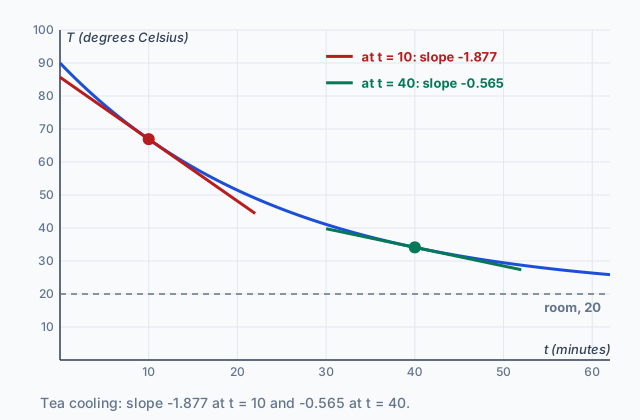
Take the graph at the top. A cup of tea is degrees Celsius minutes after it is poured. By the chain rule , so . A graphing calculator can also give straight from with its numerical derivative, and it can solve an equation such as for the time when the rate reaches a value.
A full interpretation says four things:
- when: the input value with its units, 10 minutes after pouring;
- what: the temperature of the tea;
- which way: the sign is negative, so decreasing;
- how fast: 1.877 degrees Celsius per minute.
So: 10 minutes after it is poured, the temperature of the tea is decreasing at 1.877 degrees Celsius per minute.
The sign goes in the word and the size goes in the number. "Decreasing at " is a double negative, and it reads as increasing.
Sometimes you get only a table of values. Then estimate with the difference quotient over the two table inputs closest to , one on each side, and keep the units: the change in output over the change in input, such as degrees Celsius per minute.
Quick check · Multiple choice
No calculator. Let be the number of people waiting in line at a stadium gate minutes after 6:00 p.m. Which statement is the best interpretation of ?
2c. A rate that is itself changing
The sign of says whether a quantity is going up or down. The second derivative from Unit 3 says whether that rate is going up or down. These are separate questions, and a context makes them easy to mix up.
Back to the tea. At the slope is and at it is . Both are negative, so the tea is cooling the whole time. But the rate rises from toward 0, because . The tea is still cooling, only more slowly.
Read each sign as a statement about its own function:
- : the quantity is increasing at . : it is decreasing.
- : the rate is increasing at . : the rate is decreasing.
So if is a company's total income in dollars after months, and and , the income is still rising at month , but more slowly than just before. The units stack as well: is in dollars per month and in dollars per month per month.
Quick check · Decide and justify
No calculator. Let be the amount of water in a reservoir, in millions of gallons, days after June 1. On day 6, and . A ranger says the amount of water in the reservoir is increasing on day 6, because is positive. Is the ranger right?
Which reason supports your answer?
Part 3 Watch it done Fish in a lake, from model to sentence
Watch each step, then do the last one yourself.
A lake is stocked with fish. The number of fish in the lake months after stocking is modeled by for . Find and interpret it in context, with units.
Step 1 · Read what is asked
"Interpret " asks about the rate of change of the number of fish at . counts fish and counts months, so is in fish per month.
Step 2 · Differentiate
By the power rule with the sum and constant multiple rules, .
Step 3 · Evaluate at the input
.
Why this step?
Why is in fish per month, and not in fish?
A derivative compares two changes: the change in the number of fish over the change in time, in months. So is a rate in fish per month, while is a count of fish.
Your step · Fill the statement
No calculator. Finish it. . Tap a blank, then tap an answer to complete the interpretation.
Twelve months after stocking, the number of fish in the lake is at a rate of fish per month.
Part 4 Try it New contexts, with and without a calculator
Try it · Calculate
Graphing calculator required. The depth of the water at a dock is meters, hours after midnight. With your calculator in radian mode, find , the rate of change of the depth at 5 a.m., in meters per hour. Give your answer to three decimal places.
Try it · Decide and justify
No calculator. A bakery's cost to make loaves of bread in a day is dollars, and . A student writes: "When 200 loaves are being made, the cost is increasing at 1.5 dollars per loaf." Is the student right?
Which reason supports your answer?
Try it · Calculate
Graphing calculator required. The temperature in a greenhouse is degrees Celsius, hours after 6 a.m., for . With your calculator in radian mode, find the time at which the temperature is increasing at a rate of 1 degree Celsius per hour. Give your answer to three decimal places.
Part 5 Explain it Write it the way the exam asks
Free response is handwritten on the exam, so work this on paper first and write the setup beside every calculator result. Nothing you type here leaves this page. Then compare with the model answer and score each point.
Free response is 50% of the exam score. This one is shaped like Question 1, from free-response Part A (graphing calculator required).
Free-response practice · Question 1 style
Graphing calculator required. After a dose of a medicine, its concentration in a patient's blood is modeled by milligrams per liter, where is the number of hours since the dose, for . Give decimal answers to three decimal places.
(a) Find . Using correct units, interpret the meaning of this value in the context of the problem.
(b) Find all times , for , at which the concentration is decreasing at a rate of 0.8 milligram per liter per hour.
(c) Is the rate of change of the concentration increasing or decreasing at time ? Give a reason for your answer.
Model answer
(a) , from the calculator's numerical derivative of at . At 1.5 hours after the dose, the concentration of the medicine is increasing at 1.756 milligrams per liter per hour.
(b) By the product rule, . Decreasing at 0.8 milligram per liter per hour means . Solving on the calculator gives and hours.
(c) , from the numerical derivative of at . Since , the rate of change of the concentration is decreasing at .
Score your own answer. This is a self-check, not a grade. Tick each point your answer makes.
Part 6 Check yourself A rain barrel in a storm
The two case questions use the same table. Answer them from it.
During a storm, rain runs off a roof into a barrel, and partway through someone opens the tap at the bottom. The amount of water in the barrel is liters, minutes after the storm begins. is differentiable, and some of its values are in the table.
| (minutes) | (liters) |
|---|---|
| 0 | 30 |
| 4 | 42 |
| 10 | 57 |
| 12 | 60 |
| 20 | 52 |
Case question 1 · Calculate
No calculator. Use the data in the table to estimate , in liters per minute.
Case question 2 · Multiple choice
No calculator. Use the table to estimate . Which statement is the best interpretation of your estimate?
The rest stand on their own and do not use the case.
Check yourself · Spot the error
No calculator. The volume of a spherical balloon is cubic centimeters when its radius is centimeters. A student finds and interprets the rate of change of the volume with respect to the radius when . Tap the first line with a mistake.
Check yourself · Sort it
No calculator. is the population of a town years after 2020. Sort each fact by what it tells you about the population at that time.
The population is increasing
The population is decreasing
Cannot tell from this fact alone
Part 7 Keep it Bring back earlier ideas
This lesson leans on two earlier ideas: the second derivative and the average rate of change. Pulling them back up is what makes them last.
Bring it back · Multiple choice
No calculator. Let . What is ?
Bring it back · Calculate
No calculator. Let . What is the average rate of change of over the interval ?
In three lines
- In any context, a rate of change is a derivative, measured in output units per unit of input.
- An interpretation names the input value, the quantity, increasing or decreasing, and the size of the rate with units.
- The sign of is about the quantity; the sign of is about its rate.
Exam strategy for this topic
- Section I Part A, Multiple Choice (calculator not permitted): 29 questions in 62 minutes.
- Section I Part B, Multiple Choice (graphing calculator required): 13 questions in 38 minutes.
- Section II Part A, Free Response (graphing calculator required): 2 questions in 30 minutes.
- Section II Part B, Free Response (calculator not permitted): 4 questions in 60 minutes.
When a question asks for a rate of change, write the derivative with its input, such as , before the number, and on a calculator part write that setup beside the calculator's value. Then interpret it in one sentence: at the input value, the quantity is increasing or decreasing at the size of the rate, with units.
Questions students ask
Is a rate of change always per unit of time?
No. A rate is per unit of whatever the input measures. A tank's volume as a function of its depth changes in liters per centimeter, and a bakery's cost as a function of the number of loaves changes in dollars per loaf.
Should the number in my sentence be negative when the derivative is?
Put the sign in the word and the size in the number: "decreasing at 12 fish per month." Writing "decreasing at " is a double negative, and it reads as increasing.
When do I need a calculator for a rate question?
When the value needs one of the calculator's jobs: a numerical derivative of a model at a point, or solving an equation such as for the time a rate reaches a value. On a calculator part, write the setup, the derivative being evaluated or the equation being solved, next to the result.
How is "how fast the quantity changes" different from "how fast the rate changes"?
The first is and the second is . A population can be growing while its growth slows: and at the same time.
How many decimal places should a calculator answer have?
Give the number of places the question asks for; the questions here ask for three after the decimal point, rounded or truncated. Keep the unrounded values in the calculator until the last step.
Course alignment, for teachers
AP Calculus AB topic 4.3, Unit 4: Contextual Applications of Differentiation.
- Skill 2.A: Identify common underlying structures in problems involving different contextual situations.
This lesson maps the one essential knowledge statement of the topic to the part that teaches each one: 1 is checked by a scored question. The map is in the lesson file.