Unit 4 · Topic 4.4 · about 30 minutes · 7 parts · 12 scored checks, 3 of them multiple choice
AP Calculus AB 4.4: Introduction to Related Rates
Unit 4: 10 to 15% of the multiple-choice section
What you'll be able to do
- Calculate a related rate by differentiating an equation that links changing quantities with respect to time, using the chain rule on every variable and the product or quotient rule where the equation needs one.
Key vocabulary
| Term | What it means | The exam trap |
|---|---|---|
| Related rates | Rates of change of quantities that are tied together by an equation, so that knowing some of the rates lets you calculate another. | Some numbers in a problem describe the whole situation and some describe one moment, and they are used at different points in the work. |
| Independent variable | The variable every quantity in the problem depends on; in a related rates problem it is usually time , even when never appears in the equation. | Name the independent variable first, so every derivative you write is with respect to the same one. |
| Chain rule | The rule for differentiating a composite function, and the basis for differentiating each variable in a related rates problem with respect to the same independent variable. | Differentiating with respect to and with respect to the variable itself give different expressions; know which one the question wants. |
| Product rule and quotient rule | Other differentiation rules that may also be necessary when the variables in the equation are multiplied or divided. | Look at how the variables are combined before you differentiate; a sum, a product and a quotient each call for a different rule. |
 Tap to open the picture full size
Part 1 Think first How fast does the ripple's area grow?
Guess before you learn. A wrong guess still makes the answer stick.
Predict first
A pebble drops into a still pond, and a circular ripple spreads out. Its radius grows at a steady 0.5 meters per second. At the moment the radius is 4 meters, how fast is the area inside the ripple growing?
In short. When quantities that change with time are tied together by an equation, differentiating both sides of that equation with respect to time gives an equation that ties their rates together.
- Every variable that changes is a function of time, so the chain rule puts its rate beside it: .
- Two changing quantities multiplied or divided need the product rule or the quotient rule as well as the chain rule.
- Differentiate the equation first, then substitute the values that hold at the instant you care about.
Part 2 Learn it Three short ideas, each checked as you go
4a. Every changing quantity is a function of time
In a related rates problem several quantities change at once, and an equation ties them together. The ripple's area and radius satisfy at every moment. Both and depend on the same independent variable, time , even though never appears in the equation.
To get rates, differentiate both sides with respect to . The right side is times the square of a function of , which is a composition, so the chain rule applies: the derivative of the outside, , times the derivative of the inside, . So
With and that is , about 12.57 square meters per second, the Think first answer.
Every variable picks up its own rate this way: , and . It is the move you made in implicit differentiation, where was a function of . Here every variable is a function of .
A constant such as , or a ladder's fixed length, stays a constant, and its derivative is 0.
Quick check · Multiple choice
No calculator. A cube of ice melts, so its edge length , in centimeters, and its volume , in cubic centimeters, both change with time , in minutes. Which expression is ?
4b. Differentiate first, then substitute
A problem gives you values at one instant: the bottom of a 13-foot ladder is 5 feet from a wall and sliding away at 2 feet per second. With the distance from the wall to the bottom and the height of the top, the equation holds at every instant of the slide, so you may differentiate it. The value holds at one instant only.
Differentiate first, with respect to :
Then substitute what is true at that instant: , (from ) and . That gives , so foot per second. The negative sign says the top slides down.
Put in first and the equation becomes , which says is 12 forever, so differentiating gives . That is wrong because is 5 for only an instant. Only quantities that stay fixed through the whole motion, like the ladder's 13 feet, may go in before you differentiate.
Quick check · Put it in order
No calculator. Put the steps for finding one rate from another in the order you do them. Tap them first to last.
4c. Products and quotients of changing quantities
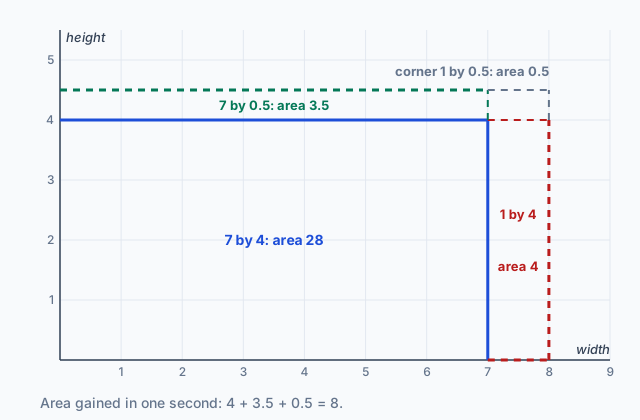
When two changing quantities are multiplied, differentiating with respect to takes the product rule along with the chain rule. The figure at the top shows why. A rectangle is wide and tall, and both grow. In one second it gains a strip along its side, tall and as wide as the change in , and a strip along its top, wide and as tall as the change in , plus a small corner. Both strips count, so for ,
The corner is the product of two small changes, and it shrinks away much faster than the strips as the time step shrinks.
A quotient of changing quantities takes the quotient rule. If a tank holds grams of salt in liters of water and both amounts change, the concentration changes at
The rules combine. In a product such as , the product rule splits the derivative into two terms, and in the term where is differentiated the chain rule turns it into .
Quick check · Fill the statement
No calculator. A box has a square base with side and a height , and both change with time , so its volume is . Tap a blank, then a term.
equals times , plus times .
Part 3 Watch it done Two cyclists moving apart
Watch each step, then do the last one yourself.
Two cyclists ride away from the same street corner, one due east and one due north. Their distances from the corner, and kilometers, and the straight-line distance between them, kilometers, satisfy . At one instant the eastbound cyclist is 9 kilometers from the corner and riding at 16 kilometers per hour, and the northbound cyclist is 12 kilometers from the corner and riding at 12 kilometers per hour. How fast is the distance between them changing at that instant?
Step 1 · Name what changes, and the values at the instant
, and all depend on time , in hours. At the instant, , , and , and . The unknown is .
Step 2 · Differentiate both sides with respect to t
. Nothing has been substituted yet, because , and all change.
Why this step?
Why does become , and not just ?
is a function of , so is a composition: squaring is the outside function and the inside. The chain rule multiplies the outside derivative, , by the inside derivative, . That factor is the rate the problem asks for, so without it there would be nothing to solve for.
Your step · Calculate
No calculator. Finish it. With differentiated to , substitute , , , and . At what rate, in kilometers per hour, is the distance between the cyclists changing?
Part 4 Try it A quotient and a sphere
Try it · Calculate
No calculator. A city's population density is people per square kilometer, where is its population and its area in square kilometers. Both change with time , in years. At one instant people and square kilometers, the population is growing at 3,000 people per year, and the city is annexing land at 1.5 square kilometers per year. Find at that instant, in people per square kilometer per year.
Try it · Decide and justify
No calculator. A spherical balloon is inflated so that its radius grows at a constant positive rate. Its volume is . A classmate says the volume grows faster and faster as the balloon gets bigger. Is the classmate right?
Which reason supports your answer?
Part 5 Explain it Write it the way the exam asks
On the exam free response is handwritten, so work on paper first. Nothing you type here leaves this page. Then compare with the model answer and score each point.
Free response is 50% of the exam score. This one is shaped like Question 3, from free-response Part B (calculator not permitted).
Free-response practice · Question 3 style
No calculator. Sand is poured onto a pile shaped like a cone. The radius and the height of the pile, both in feet, change with time , in minutes, and the volume of sand in the pile is cubic feet.
(a) Find an expression for in terms of , , and .
(b) At the instant when and , the radius is increasing at 0.5 foot per minute and the height is increasing at 0.2 foot per minute. Find the rate at which the volume of the pile is changing at that instant. Show the work that leads to your answer, and indicate units of measure.
(c) A student writes: "At that instant , so and ." Explain why the student's value is not the rate of change of the volume at that instant.
Model answer
(a) Both and change, so the product rule applies, and the chain rule gives :
(b) cubic feet per minute.
(c) The height is changing, so is true only at that instant. Substituting it before differentiating treats as a constant, which drops the term , the volume added because the pile is getting taller. That is why the student's is less than .
Score your own answer. This is a self-check, not a grade. Tick each point your answer makes.
Part 6 Check yourself A photo frame on a screen
The two case questions use the same table. Answer them from it.
A phone app animates a rectangular photo frame. Its width and height , in centimeters, change with time , in seconds, and the frame's area is square centimeters. The table gives the width, the height and their rates of change at four instants.
| (seconds) | (cm) | (cm) | (cm per second) | (cm per second) |
|---|---|---|---|---|
| 0 | 6.5 | 7 | 3 | |
| 1 | 10 | 5.2 | 4 | |
| 2 | 12 | 3.9 | 0.5 | |
| 3 | 12.4 | 3.6 | 0.25 | 0 |
Case question 1 · Calculate
No calculator. At what rate, in square centimeters per second, is the area of the frame changing at ?
Case question 2 · Multiple choice
No calculator. At which of the four instants in the table is the area of the frame decreasing?
The rest stand on their own and do not use the case.
Check yourself · Spot the error
No calculator. The legs of a right triangle, and centimeters, change with time, and its area is . At one instant , , and , in centimeters per second. A student finds at that instant. Tap the first line with a mistake.
Check yourself · Match
No calculator. In each equation, and are both functions of time . Tap an equation, then the result of differentiating both sides with respect to .
Part 7 Keep it Bring back earlier ideas
Related rates stand on implicit differentiation and the product rule. Pulling them back up is what makes them last.
Bring it back · Calculate
No calculator. The point lies on the curve . Find at .
Bring it back · Multiple choice
No calculator. Let , where , , and . What is ?
In three lines
- Every quantity that changes is a function of time, so the chain rule gives each one its rate when you differentiate.
- Changing quantities that are multiplied or divided need the product rule or the quotient rule as well.
- Differentiate the equation that holds at every time first, then substitute the values at the instant.
Exam strategy for this topic
- Section I Part A, Multiple Choice (calculator not permitted): 29 questions in 62 minutes.
- Section I Part B, Multiple Choice (graphing calculator required): 13 questions in 38 minutes.
- Section II Part A, Free Response (graphing calculator required): 2 questions in 30 minutes.
- Section II Part B, Free Response (calculator not permitted): 4 questions in 60 minutes.
Write the differentiated equation, with a rate beside every changing variable, before you put in a single number, and give the final rate with units such as cubic feet per minute. When a question gives a value at an instant, use it only after the derivative is taken.
Questions students ask
Why do I differentiate with respect to when the equation has no in it?
Because every quantity in the equation changes with time, so each one is a function of . The rates the problem talks about, such as feet per second, are derivatives with respect to time, and differentiating with respect to is how they appear.
How is this different from implicit differentiation?
It is the same chain rule. In implicit differentiation was a function of , so became . Here every variable is a function of , so becomes , and becomes too.
Which values can I substitute before differentiating?
Only quantities that stay the same for the whole situation, such as a ladder's fixed length or a constant like . A value that holds only at the instant in the question goes in after you differentiate.
When do I need the product rule in a related rates problem?
Whenever two quantities that both change are multiplied, as the radius and the height are in when both vary. If one of the two is fixed, it is a constant factor and the product rule is not needed.
What does a negative related rate mean?
That the quantity is decreasing at that instant, as the top of the sliding ladder was, at foot per second. Interpreting a rate like this in context is the work of the next topic.
Course alignment, for teachers
AP Calculus AB topic 4.4, Unit 4: Contextual Applications of Differentiation.
- Skill 1.E: Apply appropriate mathematical rules or procedures, with and without technology.
This lesson maps all 2 essential knowledge statements of the topic to the part that teaches each one: 2 are checked by a scored question. The map is in the lesson file.