Unit 5 · Topic 5.10 · about 30 minutes · 7 parts · 12 scored checks, 3 of them multiple choice
AP Calculus AB 5.10: Introduction to Optimization Problems
Unit 5: 15 to 20% of the multiple-choice section
What you'll be able to do
- Use the derivative to find the minimum or maximum value of a function on an interval, for a function you are given or one you build from a situation.
Key vocabulary
| Term | What it means | The exam trap |
|---|---|---|
| Optimization problem | A problem that asks for the minimum or maximum value of a function on a given interval. | In a situation the function is usually not given. Build it from the description before you differentiate. |
| Minimum or maximum value | The smallest or largest output of a function over the interval, such as the least cost or the greatest area. | The value and the input where it occurs are two different numbers. Answer with the one the question names. |
| Given interval | The inputs a problem allows, either stated outright or set by the situation, such as lengths that cannot be negative. | Write the interval before solving, because it decides which inputs can be the answer. |
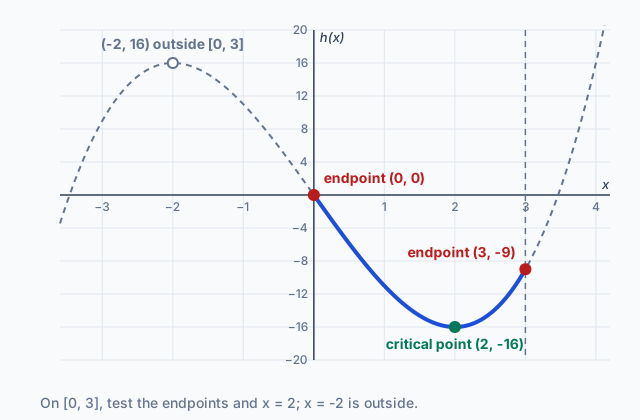 Tap to open the picture full size
Part 1 Think first How deep should the pen be?
Commit to a guess before the lesson. Guessing first, even wrongly, makes the answer easier to remember.
Predict first
A farmer has 120 meters of fence for a rectangular pen against the long wall of a barn. The wall forms one side, so the fence runs along only three sides. The two sides that meet the wall are each meters long. Which value of gives the pen the most area?
In short. An optimization problem asks for the minimum or maximum value of a function on an interval, and the derivative finds the inputs where that value can occur.
- In a situation, first write the quantity as a function of one variable and state the interval of inputs the situation allows.
- On a closed interval, compare the function at every critical point inside the interval and at both endpoints.
- On an interval with no endpoints, a single critical point where the derivative changes sign gives the absolute extreme value.
Part 2 Learn it Three ideas, each with a check
5a. Optimizing means finding an extreme value on an interval
An optimization problem asks for the minimum or maximum value of a function on a given interval, such as the most area or the least cost. The derivative tells you where to look.
On a closed interval , a continuous function has an absolute maximum and an absolute minimum, and each one occurs at a critical point inside the interval or at an endpoint. That is the Candidates Test, and it turns optimization into three steps:
- Find and every input in where or does not exist.
- Evaluate at those inputs and at both endpoints.
- The largest output is the maximum value, and the smallest is the minimum value.
Take on , the graph at the top. is 0 at and , but is not in , so it is not a candidate. The candidates give , and . The minimum value is , at . The maximum value is 0, at the endpoint , where is not zero at all.
Each answer has two parts: the value, an output such as , and where it occurs, an input such as . Read which one the question asks for.
Quick check · Calculate
No calculator. Let . What is the maximum value of on the interval ?
5b. Build one function of one variable
In a situation, nobody hands you the function. Problems that look different (a fence, a box) share one structure:
- a quantity to optimize, such as an area or a cost, which often depends on two measurements;
- a condition that ties those measurements together, such as a fixed length of fence or a fixed volume;
- the interval of inputs the situation allows.
Use the condition to write one measurement in terms of the other and substitute. That leaves a function of one variable, which you can differentiate.
For the barn in Think first, let be each side that meets the wall and the side along it. The fence gives , so and
No side can be negative, so and : the interval is .
Now the derivative does the rest. is 0 at , and comparing , and gives the maximum area, 1800 square meters, for a pen 30 meters deep and 60 meters long.
Quick check · Multiple choice
No calculator. A wire 24 centimeters long is bent into a rectangle of width centimeters. Which function and interval give the area for every width that leaves no side negative, and for no other width, so you can find the largest area?
5c. When the interval has no endpoints
Sometimes the situation allows every positive input. A rectangle of area 36 square meters can have any width , with length , so its perimeter is
There are no endpoints to compare, so use the sign of the derivative. is 0 at (and at , which is not a width). for and for , so decreases all the way to and increases after it. No width gives a smaller perimeter, so the minimum perimeter is meters.
This argument works because is the only critical point on the interval. A single critical point where the derivative changes sign gives the absolute extreme value on that interval. A critical point on its own is only a place to look.
Whichever argument you use, finish by answering the question that was asked: a value with its units (24 meters), the input where it happens (a width of 6 meters), or both.
Quick check · Decide and justify
No calculator. A workshop's cost per chair is dollars when it builds chairs a day, for . The only critical point is , where . A classmate says has its least value on at . Is the classmate right?
Which reason supports your answer?
Part 3 Watch it done The largest rectangle under a parabola
Watch each step, then do the last one yourself.
A rectangle has its base on the -axis and its two upper corners on the parabola . Find the largest possible area of the rectangle.
Step 1 · Name a variable and write the area
Put the upper right corner at with . The parabola is symmetric about the -axis, so the base runs from to : the width is and the height is . The area is .
Step 2 · State the interval
The corner must be on the parabola at or above the -axis, so and . The interval is . is a polynomial, so it is continuous on this closed interval, and its largest value is at a critical point or an endpoint.
Step 3 · Find the critical points
when , so or . Only is in .
Why this step?
Why is left out, when too?
Here is the coordinate of the right-hand corner, so the interval is . An input outside the interval describes no rectangle in this setup, so its output is not a candidate.
Your step · Calculate
No calculator. Finish it. For on , the candidates are , and . What is the largest possible area of the rectangle?
Part 4 Try it Two new situations
Try it · Calculate
No calculator. A rectangular garden with an area of 200 square meters is fenced on all four sides. One side of the garden faces the street, and fence on that side costs 12 dollars per meter. Fence on the other three sides costs 4 dollars per meter. What is the least possible cost of the fence, in dollars?
Try it · Match
No calculator. Each situation asks for an extreme value of one quantity. Tap a situation, then the function of alone that gives that quantity.
Part 5 Explain it Write it the way the exam asks
Free response is handwritten on the exam, so write your answer on paper first. Nothing you type here leaves this page. Then compare with the model answer and score yourself on each point.
Free response is 50% of the exam score. This one is shaped like Question 4, from free-response Part B (calculator not permitted).
Free-response practice · Question 4 style
No calculator. An open-top box with a square base is to hold 4000 cubic centimeters. The base is centimeters on each side, and the box is centimeters tall. The material covers the base and the four sides.
(a) Write an expression for in terms of . Verify that the area of material used is square centimeters.
(b) Find the value of , for , at which has its minimum value. Justify your answer.
(c) Find the minimum area of material and the height of the box that uses it. Indicate units of measure.
Model answer
(a) The volume is , so . The base has area and each of the four sides has area , so .
(b) . Setting gives , so and . for and for . Since is the only critical point for and changes from negative to positive there, has its minimum value at .
(c) square centimeters, and the height is centimeters.
Score your own answer. This is a self-check, not a grade. Tick each point your answer makes.
Part 6 Check yourself A medicine in the blood
The two case questions use the same function. The table lists only some of its values.
After a dose of a medicine, its concentration in a patient's blood hours later is milligrams per liter, for . The table gives some values, rounded to three decimal places.
| (hours) | (milligrams per liter) |
|---|---|
| 0 | 0 |
| 1 | 3 |
| 2 | 4.615 |
| 4 | 4.8 |
| 6 | 4 |
| 8 | 3.288 |
Case question 1 · Calculate
No calculator. What is the maximum concentration of the medicine on , in milligrams per liter?
Case question 2 · Multiple choice
No calculator. Let be the input in where . Which argument justifies that the maximum concentration on occurs at ?
The rest stand on their own and do not use the case.
Check yourself · Spot the error
No calculator. A student finds the largest area of a rectangle with a perimeter of 36 meters. Tap the first line with a mistake.
Check yourself · Sort it
No calculator. A function is differentiable for all real numbers, and only at , and . You want the maximum value of on . Tap an input, then say whether you must evaluate there.
A candidate to test
Not a candidate
Part 7 Keep it Bring back earlier ideas
Optimization stands on the first derivative test from this unit and the chain rule from Unit 3. Pulling them back up is what makes them last.
Bring it back · Multiple choice
No calculator. The derivative of a function is . Which statement about at is true?
Bring it back · Calculate
No calculator. Let . Find .
In three lines
- An optimization problem asks for the minimum or maximum value of a function on an interval.
- Build the function in one variable from the situation, and state the interval its inputs can take.
- Compare the values at every candidate, or use the sign of the derivative when there are no endpoints.
Exam strategy for this topic
- Section I Part A, Multiple Choice (calculator not permitted): 29 questions in 62 minutes.
- Section I Part B, Multiple Choice (graphing calculator required): 13 questions in 38 minutes.
- Section II Part A, Free Response (graphing calculator required): 2 questions in 30 minutes.
- Section II Part B, Free Response (calculator not permitted): 4 questions in 60 minutes.
When a free-response part asks for a minimum or maximum, write the derivative, set it equal to 0, and list every candidate, including the endpoints of a closed interval, before you name the answer with its units. On an interval with no endpoints, justify the answer with the sign of the derivative on each side of the only critical point.
Questions students ask
Do I always have to check the endpoints?
On a closed interval, yes. The extreme value can be at an endpoint even when the derivative there is not 0. On an interval with no endpoints, such as , there are none to check, so use the sign of the derivative instead.
What if the derivative is never 0 on the interval?
If exists everywhere on the interval and is never 0, then is always increasing or always decreasing there, so on a closed interval the maximum and minimum are at the two endpoints.
How do I know whether I found a maximum or a minimum?
On a closed interval, compare the values at the candidates: the largest is the maximum and the smallest is the minimum. With no endpoints, the sign of the derivative tells you: falling then rising is a minimum, rising then falling is a maximum.
Why does the interval matter so much?
It decides which critical points count and whether there are endpoints to test. A critical point outside the interval, such as a negative length, is not a possible answer.
Can I use a graphing calculator?
Only where the question allows one. There it can solve numerically, but write the equation you solved, and still compare the candidates or check the sign of the derivative.
Course alignment, for teachers
AP Calculus AB topic 5.10, Unit 5: Analytical Applications of Differentiation.
- Skill 2.A: Identify common underlying structures in problems involving different contextual situations.
This lesson maps the one essential knowledge statement of the topic to the part that teaches each one: 1 is checked by a scored question. The map is in the lesson file.