Unit 5 · Topic 5.11 · about 30 minutes · 7 parts · 12 scored checks, 3 of them multiple choice
AP Calculus AB 5.11: Solving Optimization Problems
Unit 5: 15 to 20% of the multiple-choice section
What you'll be able to do
- Find the greatest or least value of a quantity in a real situation, and explain what that value means there, with units.
Key vocabulary
| Term | What it means | The exam trap |
|---|---|---|
| Optimization problem | A problem solved by finding a minimum or maximum value of a function on a given interval. | Write the interval the situation allows before you look for critical points. |
| Maximum value | The greatest output of a function on an interval, which in an applied problem is a specific amount, such as the most area or the greatest profit. | The value and the input where it happens carry different units; say which one a question asks for. |
| Minimum value | The least output of a function on an interval, which in an applied problem is a specific amount, such as the least cost or the shortest time. | Before you name a minimum, decide what makes a point a candidate and what makes it the least. |
| Candidates | On a closed interval, the critical points inside the interval and the two endpoints, the only places an absolute extremum can occur. | Check every candidate against the situation's interval before you compare values. |
 Tap to open the picture full size
Part 1 Think first The biggest pen from 600 meters of fence
Guess before you learn. A wrong guess still makes the answer stick.
Predict first
A farmer has 600 meters of fence for a rectangular pen beside a straight river. The river side needs no fence, so the 600 meters covers the other three sides. Which pen encloses the most area?
In short. In an applied problem, a function's maximum or minimum value is a specific amount of something real, such as the most area or the least cost, and it is reached at a specific input.
- An optimization answer has two parts: the input where the extreme value happens, and the value of the function there.
- The situation sets the interval, and its endpoints are candidates along with the critical points inside it.
- An interpretation names the quantity, gives the value with its units, and says where or when it happens.
Part 2 Learn it Three short ideas, each checked as you go
2a. Where it happens, and how large it is
Every optimization problem asks about a quantity in a real situation, and its answer has two parts that are easy to mix up:
- the input where the greatest or least value happens, such as a time, a length or a price;
- the value itself, the function's output there, such as an area, a cost or a concentration.
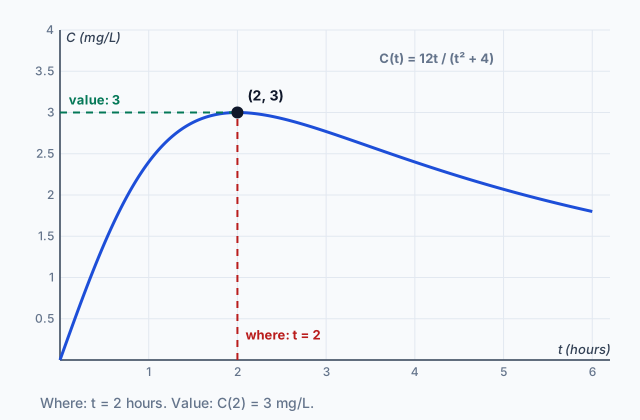
The graph at the top shows a drug's concentration in the blood, milligrams per liter, hours after a dose, for . Its derivative is zero at , and . Read as a sentence: the concentration is greatest 2 hours after the dose, when it reaches 3 milligrams per liter.
The 2 is measured in hours and answers "when?". The 3 is measured in milligrams per liter and answers "how much?". Calling 2 "the maximum" puts hours where a concentration belongs. The statement is a third fact: at 2 hours the concentration is neither rising nor falling. It locates the maximum, but it is not the maximum.
Quick check · Match
No calculator. A company's weekly profit is thousand dollars when it sells hundred units, for . On that interval has its absolute maximum at . Tap each fact, then what it means.
2b. The situation sets the interval
A formula usually makes sense for more inputs than the situation allows. A length cannot be negative, a pen cannot use more fence than there is, and a rule may set a limit. Those limits are the interval, and the answer has to come from inside it.
On a closed interval the candidates are:
- the critical points inside the interval;
- the two endpoints.
Work out the function at every candidate and compare. A critical point outside the interval is not a candidate, however good its value looks.
Go back to the pen from Think first, square meters with the pen meters deep. Now a barn stands 100 meters from the river, so . The critical point is , outside the interval. On , is positive, so the area grows the whole way, and the greatest area is at the endpoint: square meters. The 45,000 from before is not available to this farmer.
When a continuous function has only one critical point on an interval and it is a relative maximum, it is also the absolute maximum there (Topic 5.7); the same holds for a minimum.
Quick check · Calculate
No calculator. With trees per acre, an orchard harvests pounds of fruit per acre. It already has 35 trees per acre and will not remove any, and it has room for at most 50, so . What is the greatest harvest, in pounds per acre, that the orchard can get?
2c. Saying what the value means
A number alone is not an interpretation. A full one says:
- which quantity is greatest or least, named in the situation's words;
- its value, with units;
- where or when it happens, with units, and over what interval.
The units come from the function. If is in meters, its maximum is in meters. If the function is itself a rate, its maximum is a rate, and it describes how fast something changes, not how much of it there is.
Suppose a town's population grows at people per year, years after 2020, and for the maximum of is . That means the population was growing fastest in 2024, at 300 people per year. It does not mean the population was largest in 2024: while stays positive the town keeps growing after 2024, just more slowly.
A minimum reads the same way. The least value of a cost function is the cheapest the job can be done under the situation's limits, and the input says how to do it that cheaply.
Quick check · Multiple choice
No calculator. Water flows into an empty tank at liters per minute, minutes after a valve opens, and no water leaves. For the maximum value of is . Which statement interprets this maximum?
Part 3 Watch it done The cheapest speed for a delivery run
Watch each step, then do the last one yourself.
A truck makes a 240-mile delivery run at a steady miles per hour. The driver is paid 20 dollars an hour, so the pay for the run is dollars, and the company's fuel model for the run is dollars. The road allows . At what speed is the run cheapest, and what does it cost?
Step 1 · Write the function and its interval
dollars, for .
Step 2 · Find the critical points
. when , so . The other solution, , is outside the interval.
Step 3 · Compare the candidates
, and .
Why this step?
Why work out and when only at ?
On a closed interval the absolute minimum can be at an endpoint as well as at a critical point. Only comparing all three values shows which one is the least the run can cost.
Your step · Fill the statement
No calculator. Finish it: interpret the result for the delivery run. Tap a blank, then tap an answer.
The run costs the least, dollars, when the truck drives at miles per hour.
Part 4 Try it A box and a bacteria count
Try it · Calculate
No calculator. An open box is made from a 24 cm by 24 cm sheet of cardboard by cutting a square of side cm from each corner and folding up the sides. Its volume is cubic centimeters, for . What is the greatest volume the box can have, in cubic centimeters?
Try it · Decide and justify
No calculator. A lab culture holds thousand bacteria hours after it is treated, for . is differentiable, only at , and , , . A classmate says the culture is smallest 2 hours after treatment, when it holds 3 thousand bacteria. Is the classmate right?
Which reason supports your answer?
Part 5 Explain it Write it as a free-response answer
On the exam free response is handwritten, so work on paper with your graphing calculator first. Nothing you type here leaves this page. Then compare with the model answer and score each point.
Free response is 50% of the exam score. This one is shaped like Question 2, from free-response Part A (graphing calculator required).
Free-response practice · Question 2 style
Graphing calculator required. A ride at a theme park opens at 9 a.m. A person who joins the line hours after 9 a.m. waits minutes, where for . Use radian mode, and give each decimal answer to three decimal places.
(a) Find the value of at which the wait is longest for . Justify your answer.
(b) Find the longest wait. Using correct units, interpret the meaning of this value in the context of the problem.
(c) A sign at the ride says the shortest wait of the day is at opening time. Is the sign correct? Justify your answer.
Model answer
(a) . Solving on the calculator gives and . Candidates: , , and . The greatest is , so the wait is longest at .
(b) minutes. A person who joins the line 2.968 hours after 9 a.m. waits 46.188 minutes, longer than anyone else who joins between 9 a.m. and 7 p.m.
(c) No. The least of the candidates is , which is less than . The shortest wait of the day, 29.520 minutes, is for a person who joins 7.504 hours after 9 a.m., not at opening.
Score your own answer. This is a self-check, not a grade. Tick each point your answer makes.
Part 6 Check yourself A reservoir over one year
The two case questions use the same table. Answer them from it.
A reservoir holds million liters of water months after January 1, for . is differentiable, and only at and . Some values are in the table.
| (months) | (million liters) |
|---|---|
| 0 | 40 |
| 3 | 52 |
| 6 | 41 |
| 9 | 28 |
| 12 | 35 |
Case question 1 · Calculate
No calculator. What is the least amount of water, in million liters, that the reservoir holds for ?
Case question 2 · Multiple choice
No calculator. Over the year, the greatest value of is . What does that tell you about the reservoir?
The rest stand on their own and do not use the case.
Check yourself · Spot the error
No calculator. A factory uses megawatt-hours of energy on a day when its cooling runs hours overnight, for . A student finds the greatest daily energy use. Tap the first line with a mistake.
Check yourself · Sort it
No calculator. Each phrase is one part of the answer to an optimization problem. Tap a phrase, then the part it is.
Where or when it happens (an input)
How large it is (a value)
Part 7 Keep it Bring back earlier ideas
Optimization stands on the Candidates Test and on reading a derivative's units. Pulling them back up is what makes them last.
Bring it back · Calculate
No calculator. What is the absolute maximum value of on the closed interval ?
Bring it back · Multiple choice
No calculator. A tank holds liters of water minutes after a pump starts. What are the units of ?
In three lines
- An optimization answer has two parts: the input where it happens and the value of the function there.
- The interval comes from the situation, and its endpoints are candidates along with the critical points inside it.
- The value carries the function's units, so the maximum of a rate is a fastest change, not a largest amount.
Exam strategy for this topic
- Section I Part A, Multiple Choice (calculator not permitted): 29 questions in 62 minutes.
- Section I Part B, Multiple Choice (graphing calculator required): 13 questions in 38 minutes.
- Section II Part A, Free Response (graphing calculator required): 2 questions in 30 minutes.
- Section II Part B, Free Response (calculator not permitted): 4 questions in 60 minutes.
When a question asks you to interpret a maximum or minimum, write one sentence that names the quantity, gives the value with units, and says where or when it happens. Before you call a value the greatest or least, compare it with the endpoints, or say why a single critical point settles it.
Questions students ask
Is the maximum the input or the output?
The maximum value is the output, the greatest value of the function. The input says where it happens. A full answer gives both, each with its own units.
Do I have to check the endpoints if I found a critical point?
On a closed interval, yes, unless you can show the critical point settles it: a continuous function with one critical point on the interval, where it has a relative maximum, has its absolute maximum there. Otherwise compare the values at the critical points and both endpoints.
What if the interval is open, or not given?
Read it from the situation: lengths and times are not negative, and limits such as the fence available or a speed limit close it off. If an endpoint really is excluded, a single critical point with a relative extremum there still gives the absolute one.
Why does my answer need units?
Because the same number can mean different things. In a cost problem, 40 could be a speed in miles per hour or a cost in dollars, and only the units say which you mean.
What does the maximum of a rate tell me?
When the quantity changes fastest, and how fast. It does not say when the quantity itself is largest. For that, the quantity is the function to optimize, and the rate is its derivative: look where the rate changes sign, and at the endpoints.
Course alignment, for teachers
AP Calculus AB topic 5.11, Unit 5: Analytical Applications of Differentiation.
- Skill 3.F: Explain the meaning of mathematical solutions in context.
This lesson maps the one essential knowledge statement of the topic to the part that teaches each one: 1 is checked by a scored question. The map is in the lesson file.