Unit 5 · Topic 5.3 · about 30 minutes · 7 parts · 12 scored checks, 2 of them multiple choice
AP Calculus AB 5.3: Determining Intervals on Which a Function Is Increasing or Decreasing
Unit 5: 15 to 20% of the multiple-choice section
What you'll be able to do
- Use the sign of a function's first derivative to find, and justify, the intervals on which the function is increasing or decreasing.
Key vocabulary
| Term | What it means | The exam trap |
|---|---|---|
| Increasing on an interval | A function is increasing on an interval if for any two inputs in that interval. | It describes over a stretch of inputs, so give the answer as an interval of -values, not as -values. |
| Decreasing on an interval | A function is decreasing on an interval if for any two inputs in that interval. | Write the interval with the smaller input first, as with , even though falls as you move across it. |
| First derivative, | The function whose value is the instantaneous rate of change of at ; it gives information about and its graph. | When you write about it, say by name; "it" or "the graph" leaves the reader guessing which function you mean. |
 Tap to open the picture full size
Part 1 Think first A falling reading on a rising tank
Guess before you learn. A wrong guess still makes the answer stick.
Predict first
A meter on a water tank shows how fast the amount of water is changing, in gallons per minute. A positive reading means water is being added. Over 6 minutes the reading drops steadily from 12 to 0. During those 6 minutes, what happened to the amount of water in the tank?
In short. On an open interval where the function is increasing, and where it is decreasing, so the sign of the first derivative settles which way moves.
- To find the intervals, split the number line where , where does not exist, and where is not defined, then test the sign of on each piece.
- From a graph of , read whether it lies above or below the -axis, not whether it rises or falls.
- A justification names and its sign on the interval, as in " is increasing on because there."
Part 2 Learn it Three short ideas, each checked as you go
3a. The sign of the derivative gives the direction
A function is increasing on an interval if its outputs go up as moves right: for any two inputs in the interval, . It is decreasing on an interval if for any there.
The first derivative tells you which, because is the rate at which is changing at .
- If for every in an open interval, then is increasing on that interval.
- If for every in an open interval, then is decreasing on that interval.
Only the sign of matters here. In Think first the meter reading fell from 12 toward 0, but it stayed positive, so the water kept rising, just more slowly. A positive derivative that is getting smaller still means is going up. A negative derivative that is getting closer to 0 still means is going down.
The claim is about every input in the interval. Knowing tells you the rate at one input only. Knowing does not show increases from 1 to 5 either: could dip and recover in between. You need the sign of across the whole interval.
Quick check · Sort it
No calculator. Each card gives a fact about a function on the interval named. Sort each card by what it lets you conclude about on that interval.
is increasing there
is decreasing there
Not enough to tell
3b. Finding the intervals from a formula
To find where increases and decreases, first find where could change sign. That can happen only where , where does not exist (the critical points from 5.2), or where itself is not defined. Those inputs split the number line into intervals, and on each one keeps a single sign, so one test input per interval is enough.
Take . Then , which is 0 at , and and exists everywhere. Test one input in each of the four intervals:
| Interval | Test input | there | on the interval |
|---|---|---|---|
| decreasing | |||
| increasing | |||
| decreasing | |||
| increasing |
Here the signs happen to alternate, but do not count on it. A squared factor such as is never negative, so can touch 0 at and keep the same sign on both sides. Test every interval.
Quick check · Multiple choice
No calculator. The derivative of a function is . On which interval or intervals is increasing? Choose the answer that names all of them.
3c. Reading the graph of the derivative, and saying why
Often you are given the graph of , not of . Then one feature matters: is the graph of above or below the -axis? Above means , so is increasing. Below means , so is decreasing.
Whether the graph of is rising or falling answers a different question, about how itself changes. It does not tell you which way goes. This is the mistake from Think first again, in picture form.
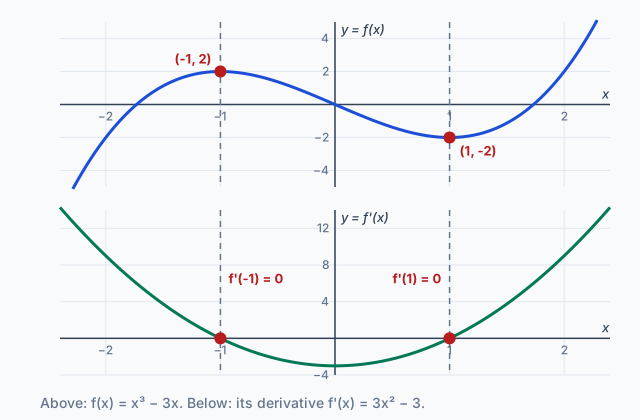
The figure at the top shows both graphs. The lower one, , is below the -axis between and , and that is exactly where the upper graph, , comes down. Where is above the axis, goes up.
When you justify a conclusion, say which function you mean and give the sign of the derivative:
- " is increasing on because there."
- not "it is increasing because the graph goes up."
The word "it" and the phrase "the graph" leave a reader unsure whether you mean or . Write and by name.
Quick check · Decide and justify
No calculator. On the interval , the graph of , the derivative of , falls steadily from to . Is increasing or decreasing on ?
Which reason supports your answer?
Part 3 Watch it done Intervals of increase and decrease, start to finish
Watch each step, then do the last one yourself.
Let . Find the intervals on which is increasing and the intervals on which is decreasing. Justify your answer.
Step 1 · Differentiate and factor
.
Step 2 · Find where the sign can change
at and . A polynomial's derivative exists everywhere, so the intervals are , and .
Step 3 · Test one input in each interval
, and .
Why this step?
Why is one test input enough for a whole interval?
is a polynomial, so it is continuous, and it is not 0 anywhere inside the interval. By the Intermediate Value Theorem it would have to pass through 0 to change sign, so it keeps the sign of the one value you tested.
Step 4 · State where f increases, with the reason
is increasing on and on because on those intervals.
Your step · Fill the statement
No calculator. Finish it. Write the conclusion about where is decreasing. Tap a blank, then tap an answer.
is decreasing on because for every in that interval.
Part 4 Try it Two new derivatives
Try it · Calculate
Graphing calculator required. The derivative of a function is . On the interval , is decreasing on and increasing on . Find , with your calculator in radian mode. Give your answer to three decimal places.
Try it · Match
No calculator. Each formula gives the derivative of a different function . Tap a derivative, then the interval or intervals on which that is decreasing.
Part 5 Explain it Write it the way the exam asks
On the exam free response is handwritten, so work on paper first. Nothing you type here leaves this page. Then compare with the model answer and score each point.
Free response is 50% of the exam score. This one is shaped like Question 2, from free-response Part A (graphing calculator required).
Free-response practice · Question 2 style
Graphing calculator required. Water flows into a storage tank at the rate gallons per hour and drains out of the tank at the rate gallons per hour, for , where is measured in hours. Let be the amount of water in the tank, in gallons, at time . Use your calculator in radian mode.
(a) Find . Is the amount of water in the tank increasing or decreasing at time ? Give a reason for your answer.
(b) Find all intervals of time in during which the amount of water in the tank is decreasing. Justify your answer.
(c) The rate at which water flows in is decreasing for . A worker says that this means the amount of water in the tank is decreasing for . Explain why the worker is not correct.
Model answer
(a) , so gallons per hour. The amount of water is increasing at because .
(b) at and (solved on the calculator). for , for example , and on the rest of . So the amount of water is decreasing on because there.
(c) Whether the amount of water rises or falls depends on the sign of , not on whether is rising or falling. For , (it is positive at and does not reach 0 until ), so water flows in faster than it drains and the amount of water is increasing there.
Score your own answer. This is a self-check, not a grade. Tick each point your answer makes.
Part 6 Check yourself Reading a derivative from a table
The two case questions use the same table. Answer them from it.
A function is differentiable on . The graph of its derivative consists of line segments joining the points in the table, one after the next.
Case question 1 · Multiple choice
No calculator. On which interval or intervals is decreasing? Choose the answer that names all of them.
Case question 2 · Decide and justify
No calculator. On the interval the graph of is a horizontal segment. Which describes on that interval?
Which reason supports your answer?
The rest stand on their own and do not use the case.
Check yourself · Spot the error
No calculator. A student finds where is decreasing. Tap the first line with a mistake.
Check yourself · Calculate
No calculator. The function , where is a constant, is decreasing on and increasing on . What is the value of ?
Part 7 Keep it Bring back earlier ideas
This lesson leans on critical points from 5.2 and on the derivative rules from Unit 3. Pulling them back up is what makes them last.
Bring it back · Calculate
No calculator. Let , which is defined for every real . How many critical points does have?
Bring it back · Calculate
No calculator. Let . What is ?
In three lines
- Where on an open interval, is increasing there, and where , is decreasing.
- Split the number line where is 0 or does not exist, or where is not defined, and test the sign of on every piece.
- Justify with the sign of , by name, on the interval, never with the direction of a graph of .
Exam strategy for this topic
- Section I Part A, Multiple Choice (calculator not permitted): 29 questions in 62 minutes.
- Section I Part B, Multiple Choice (graphing calculator required): 13 questions in 38 minutes.
- Section II Part A, Free Response (graphing calculator required): 2 questions in 30 minutes.
- Section II Part B, Free Response (calculator not permitted): 4 questions in 60 minutes.
When asked where is increasing or decreasing, show (or name the you were given), state where or does not exist, and finish with a sentence that names and its sign on the interval, such as " is decreasing on because there." On the calculator part, give the zeros of you found to three decimal places and say which equation you solved.
Questions students ask
Do I write the intervals as open or closed?
Open intervals are always safe, because the sign of is checked inside them. If is continuous at an endpoint, is also increasing on the interval with that endpoint included, so a closed interval is correct too.
If , is increasing at ?
Increasing is a statement about an interval, not one input. has , yet on both sides of 0 and is increasing on every interval, including those that contain 0.
What if does not exist somewhere?
Split the number line there as well. can change sign at an input where it does not exist, so that input is a boundary between intervals. For , does not exist at 0, and is decreasing on and increasing on .
Why can't I say "the graph is going up"?
Because it does not say which graph, and a graph going up is an observation, not a reason from calculus. Name the function and give the sign of its derivative: " is increasing on because there."
On the calculator part, can I just graph and look?
Use the calculator to find where , and to check your picture. The answer still needs the reason: name the equation you solved, give the zeros, and state the sign of on each interval.
Course alignment, for teachers
AP Calculus AB topic 5.3, Unit 5: Analytical Applications of Differentiation.
- Skill 2.E: Describe the relationships among different representations of functions and their derivatives.
This lesson maps the one essential knowledge statement of the topic to the part that teaches each one: 1 is checked by a scored question. The map is in the lesson file.