Unit 5 · Topic 5.2 · about 30 minutes · 7 parts · 12 scored checks, 3 of them multiple choice
AP Calculus AB 5.2: Extreme Value Theorem, Global Versus Local Extrema, and Critical Points
Unit 5: 15 to 20% of the multiple-choice section
What you'll be able to do
- Justify that a function has a maximum and a minimum value on an interval by applying the Extreme Value Theorem, after checking its hypotheses.
Key vocabulary
| Term | What it means | The exam trap |
|---|---|---|
| Extreme Value Theorem | If is continuous over the closed interval , then has at least one maximum value and at least one minimum value on . | State both hypotheses, continuity and a closed interval, before you state the conclusion. A justification that skips one does not use the theorem. |
| Global (absolute) maximum or minimum | The largest or smallest output of a function on its whole interval or domain. | A function has one global maximum value on an interval, though more than one input can reach it. Say the value, and where it occurs. |
| Local (relative) maximum or minimum | A value that is at least as large, or at least as small, as every value of at inputs near on both sides. | Say which kind you mean. A local maximum and a global maximum are different claims and need different evidence. |
| Critical point | A point on a function where the first derivative equals zero or fails to exist. | The input must be in the domain of . Search for both kinds, where is zero and where it does not exist, every time. |
 Tap to open the picture full size
Part 1 Think first When was the drone highest?
Guess before you learn. A wrong guess still makes the answer stick.
Predict first
A delivery drone takes off from a rooftop 10 meters above the ground. For the next 7 minutes its height is meters, minutes after takeoff. It climbs until , dips until , then climbs again until . At what time in those 7 minutes is the drone highest?
In short. The Extreme Value Theorem guarantees that a function continuous on a closed interval has a maximum and a minimum value there, and the places where a local maximum or minimum can occur are the critical points, where or does not exist.
- The theorem needs both hypotheses: continuous, and the interval closed. It says the extreme values exist, not where they are.
- A critical point is an input in the domain of where or does not exist.
- Every local extremum is at a critical point, but a critical point need not be a local extremum.
Part 2 Learn it Three ideas, each checked as you go
5a. The Extreme Value Theorem
Before you look for the largest value of a function, it helps to know that there is one. The Extreme Value Theorem says:
If is continuous over the closed interval , then has at least one maximum value and at least one minimum value on .
It is an existence theorem. It tells you the values are there, not where they are or what they are.
Both hypotheses matter, and each one can fail on its own:
- on the open interval is continuous, but its outputs get as close to 1 as you like without ever reaching 1. It has no maximum value, because the interval is not closed.
- on has a value at both endpoints, but it is not continuous at . Just to the right of 2 its outputs grow without bound, so it has no maximum value either.
When you use the theorem in a justification, name the function, say why it is continuous, and name the closed interval. A function that is differentiable on is continuous there, so a polynomial always qualifies. Checking only the two endpoints is not enough: continuity has to hold at every point in between.
Quick check · Decide and justify
No calculator. Does the Extreme Value Theorem guarantee that has a maximum value on the interval ?
Which reason supports your answer?
5b. Global versus local extrema
The maximum value the theorem promises is the largest output on the whole interval. It is called the global or absolute maximum. The smallest output on the whole interval is the global (absolute) minimum.
A local or relative maximum is a smaller claim. has a local maximum at when for every near , on both sides of . It only has to beat its neighbors. A local minimum is the same with .
The drone in Think first shows the difference. At its height, 62 meters, beats every nearby moment, so has a local maximum there. It is not the global maximum, because is larger.
Two facts connect the ideas:
- A local maximum need not be the global maximum, and a function can have several local maximums but only one global maximum value.
- A global maximum that occurs inside the interval, not at an endpoint, is also a local maximum, because it beats every value, so it beats the nearby ones too.
The global maximum can also sit at an endpoint, as the drone's does at . Local extrema are about inputs inside the interval, with neighbors on both sides.
Extrema is the plural of extremum, a word that covers both maximums and minimums.
Quick check · Fill the statement
No calculator. Tap a blank, then tap an answer.
A function is continuous on . for every near 4, but . So is a maximum value of , and it is not the maximum value of on .
5c. Critical points: where local extrema can be
A critical point of is an input in the domain of where or does not exist.
At a smooth peak or valley the tangent line is horizontal, so . At a sharp one, a corner or a cusp, there is no tangent slope, so does not exist; has a local minimum like this at . Either way the input is a critical point, so:
Every local extremum of occurs at a critical point.
The reverse is false. has , but for and for . is neither the largest nor the smallest value near 0, so is a critical point that is not a local extremum.
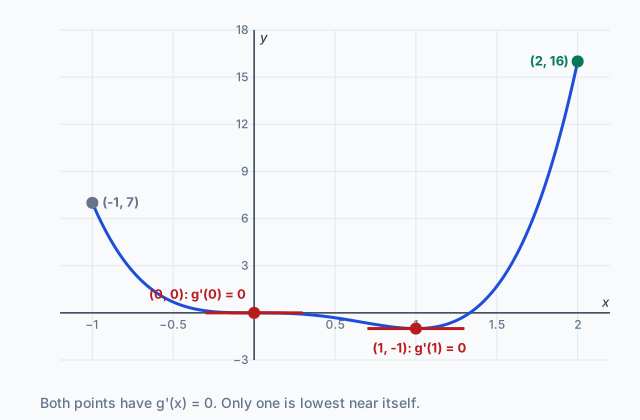
The graph at the top shows both kinds. For , , which is 0 at and . At , has a local minimum. At the graph only levels off for a moment and keeps falling.
So the critical points are the complete list of places a local extremum could be. To find them, solve , and also look for inputs in the domain where does not exist.
Quick check · Multiple choice
No calculator. Let , so for . What are all the critical points of ?
Part 3 Watch it done A theorem, then the critical points
Watch each step, then do the last one yourself.
Let on the interval . Explain why must have a maximum and a minimum value on , and find every critical point of in .
Step 1 · Check the hypotheses
is a polynomial, so it is continuous, and the absolute value of a continuous function is continuous. So is continuous on the closed interval , and by the Extreme Value Theorem has a maximum value and a minimum value on .
Step 2 · Write f without the absolute value
for and for . So on and on .
Step 3 · Where the derivative is 0
On , , which is 0 at . On , , which is never 0 there. So , and is a critical point.
Why this step?
Why is finding where the derivative is 0 not the end of the search?
A critical point is any input in the domain where is 0 or does not exist. A local extremum can sit at a sharp corner, where no tangent slope exists, so the inputs where fails to exist have to be found too.
Your step · Calculate
No calculator. Finish it. For on , the slope from the left of one input is and from the right is , and they disagree there. At what input in does fail to exist?
Part 4 Try it New functions
Try it · Sort it
No calculator. Sort each input. Is it a critical point because is 0 there, a critical point because does not exist there, or not a critical point?
Critical:
Critical: does not exist
Not a critical point
Try it · Decide and justify
No calculator. Let . Then does not exist, so is a critical point of . A classmate says that must therefore have a local maximum or a local minimum at . Is the classmate right?
Which reason supports your answer?
Part 5 Explain it Write it the way the exam asks
On the exam free response is handwritten, so work on paper first. Nothing you type here leaves this page. Then compare with the model answer and score each point.
Free response is 50% of the exam score. This one is shaped like Question 5, from free-response Part B (calculator not permitted).
Free-response practice · Question 5 style
No calculator. A lab heats a solution for 5 minutes. Its temperature, in degrees Celsius, minutes after heating starts is for .
(a) Explain why must have a maximum value on the interval .
(b) Find every value of in at which has a critical point. Show the work that leads to your answer.
(c) Note that . Does have a local maximum, a local minimum, or neither at the critical point from part (b)? Justify your answer.
(d) Determine the maximum temperature of the solution for , with units. Justify your answer using parts (a) to (c).
Model answer
(a) is a polynomial, so it is continuous on the closed interval . By the Extreme Value Theorem, has a maximum value on that interval.
(b) . exists for every , and only at . So is the only critical point.
(c) Neither. , and , which is negative for and positive for . So just before and just after: is neither the largest nor the smallest value near .
(d) By (a) the maximum exists. If it occurred at some with , it would be a local maximum, so it would be at a critical point. The only critical point is , and by (c) has no local maximum there. So the maximum is at an endpoint. and , so the maximum temperature is 50 degrees Celsius, at minutes.
Score your own answer. This is a self-check, not a grade. Tick each point your answer makes.
Part 6 Check yourself A table of derivative values
The two case questions use the same statement and table. Answer them from it.
A function is continuous on the closed interval . Its derivative exists at every in except . The table gives at some inputs. At every input in not listed in the table, exists and is not 0.
| 2 | |
| 0 | |
| 0 | |
| 1 | does not exist |
| 2 | 0 |
| 2.5 | 5 |
Case question 1 · Calculate
No calculator. How many critical points does have in the open interval ?
Case question 2 · Multiple choice
No calculator. Which statement about must be true?
The rest stand on their own and do not use the case.
Check yourself · Spot the error
No calculator. A student looks for the critical points of . Tap the first line with a mistake.
Check yourself · Decide and justify
No calculator. Let for and for . is not continuous at . A classmate says that still has a maximum value on . Is the classmate right?
Which reason supports your answer?
Part 7 Keep it Bring back earlier ideas
The Extreme Value Theorem is the second existence theorem in this unit, and critical points depend on when a derivative exists. Pull both earlier ideas back up.
Bring it back · Calculate
No calculator. Let on . The Mean Value Theorem guarantees a value in with equal to the average rate of change of over . Find .
Bring it back · Multiple choice
No calculator. Which function is continuous at but not differentiable at ?
In three lines
- A function continuous on a closed interval has a maximum and a minimum value there, by the Extreme Value Theorem.
- A critical point is an input in the domain where f' is 0 or does not exist.
- Every local extremum is at a critical point, but not every critical point is a local extremum.
Exam strategy for this topic
- Section I Part A, Multiple Choice (calculator not permitted): 29 questions in 62 minutes.
- Section I Part B, Multiple Choice (graphing calculator required): 13 questions in 38 minutes.
- Section II Part A, Free Response (graphing calculator required): 2 questions in 30 minutes.
- Section II Part B, Free Response (calculator not permitted): 4 questions in 60 minutes.
When a question asks you to justify that a maximum or minimum exists, name the Extreme Value Theorem, say why the function is continuous, and name the closed interval. When it asks for critical points, show , solve , and say where does not exist. Refer to and by name rather than "it", so a reader knows which function you mean.
Questions students ask
Does the Extreme Value Theorem tell me where the maximum is?
No. It only guarantees that a maximum value and a minimum value exist. Finding them takes more work, and the critical points are where that search starts.
If a function is not continuous, can it still have a maximum?
Yes. The theorem gives no guarantee then, but the function may still have one. A step function that jumps from 1 to 3 has the maximum value 3.
Is a critical point the same as a local maximum or minimum?
No. Every local extremum is at a critical point, but some critical points are neither. has and no extremum at 0.
Why count points where the derivative does not exist?
Because a local extremum can be at a sharp corner or cusp, where no tangent slope exists. has its minimum at 0, where its derivative does not exist.
Can a function have more than one local maximum?
Yes, as many as it has peaks. It still has only one global maximum value on an interval, though that value can be reached at more than one input.
Course alignment, for teachers
AP Calculus AB topic 5.2, Unit 5: Analytical Applications of Differentiation.
- Skill 3.E: Provide reasons or rationales for solutions and conclusions.
This lesson maps all 3 essential knowledge statements of the topic to the part that teaches each one: 3 are checked by a scored question. The map is in the lesson file.