Unit 5 · Topic 5.5 · about 30 minutes · 7 parts · 12 scored checks, 3 of them multiple choice
AP Calculus AB 5.5: Using the Candidates Test to Determine Absolute (Global) Extrema
Unit 5: 15 to 20% of the multiple-choice section
What you'll be able to do
- Find and justify the absolute maximum and minimum values of a function on a closed interval by comparing its values at the critical points and the endpoints.
Key vocabulary
| Term | What it means | The exam trap |
|---|---|---|
| Absolute (global) maximum | The value is the absolute maximum of on an interval if for every in the interval. | Report the value and the input separately: the maximum is an output, and "where" is the input that gives it. |
| Absolute (global) minimum | The value is the absolute minimum of on an interval if for every in the interval. | An absolute minimum can be negative, zero or positive; it is the smallest output, not the output closest to 0. |
| Critical point | An input in the domain of where or does not exist. | A critical point is named by its input ; when a question asks where, give the -value, not the point . |
| Endpoint | Either end, or , of a closed interval . | Read the interval in the question, not the whole domain of : the endpoints are the ones it gives. |
| Candidates Test | A method for absolute extrema on a closed interval: evaluate the function at its critical points in the interval and at the endpoints, and compare the values. | The method needs the function to be continuous on the closed interval, so check that first and say so. |
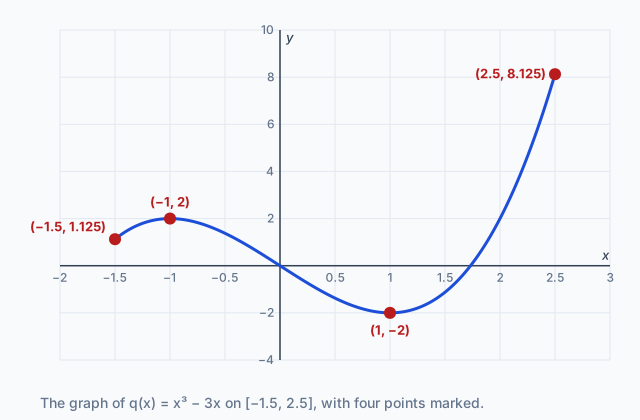 Tap to open the picture full size
Part 1 Think first Where is the highest point of the ride?
Guess before you learn. A wrong guess still makes the answer stick.
Predict first
A cycling route is 12 kilometers long. From the start the road climbs to a crest at kilometer 6, where it levels off. It then drops into a dip that bottoms out at kilometer 9 and climbs again all the way to the finish at kilometer 12. Without being told any heights, where could the highest point of the route be?
In short. The Candidates Test finds the absolute (global) extrema of a function that is continuous on a closed interval : evaluate the function at every critical point inside the interval and at both endpoints, then compare.
- An absolute extremum on a closed interval can only be at a critical point, where or does not exist, or at an endpoint.
- The largest candidate value is the absolute maximum and the smallest is the absolute minimum; no critical point needs to be classified first.
- A complete answer gives the value, where it occurs, and the comparison of candidate values that justifies it.
Part 2 Learn it Three short ideas, each checked as you go
2a. Only two kinds of places to look
If is continuous on a closed interval , the Extreme Value Theorem from 5.2 guarantees that has an absolute maximum value and an absolute minimum value there. The question for this lesson is where.
Suppose the highest value of on happens at an input strictly between and . If were positive, would be increasing at , so an input just to the right would give a higher output. If were negative, an input just to the left would. Either way would not be the highest. So at an interior extreme, is 0 or does not exist: is a critical point. The same argument works for the lowest value.
That leaves two kinds of places. Absolute (global) extrema of a function on a closed interval can only occur at critical points or at endpoints. The endpoints are on the list because the argument above needs inputs on both sides of . At the function can still be rising, and then its highest value on the interval is .
So the candidates are the two endpoints, and , and every critical point inside . A critical point outside the interval is not a candidate, and neither is an input where itself is 0.
Quick check · Sort it
No calculator. Let on the closed interval . Its derivative is , and . Sort each input: is it a candidate for an absolute extremum of on ?
A candidate
Not a candidate
2b. The Candidates Test
Since the absolute extrema must be at candidates, you find them by checking every candidate. This is the Candidates Test.
- Check that is continuous on , so the extrema exist.
- Find . Solve , and find where does not exist. Keep the solutions that lie in .
- Evaluate at each kept critical point and at and .
- The largest of those values is the absolute maximum, and the smallest is the absolute minimum.
You never have to decide whether a critical point is a relative maximum, a relative minimum or neither. Step 4 settles everything at once.
For on : is a polynomial, so it is continuous. is 0 at and , both inside. The candidate values are , , and .
An answer has two parts: the value, which is an output, and where it occurs, which is an input. Here the absolute maximum value is 1, at both and , and the absolute minimum value is , at both and .
Quick check · Calculate
No calculator. Let . What is the absolute maximum value of on the closed interval ?
2c. Justifying the answer, and the critical points that hide
A conclusion needs its reason, and the reason is the comparison. Name the function, the value and where it occurs: "The absolute maximum of on is 11, at , because is the largest of the candidate values , and ."
Two arguments fall short. ", so has its maximum at " shows only that 4 is a candidate. " changes from positive to negative at " shows a relative maximum, higher than the points near it, but the function can climb higher somewhere else in the interval, at an endpoint or past another critical point.
Some critical points do not come from solving . Take on . Its slope is to the left of 2 and 1 to the right, so is never 0, but does not exist. That makes a critical point. Comparing , and gives an absolute minimum of 0 at , a candidate you would miss by solving alone.
Quick check · Decide and justify
No calculator. Let on the closed interval , so for . A classmate says: " is never 0, so the absolute minimum of on must be at an endpoint." Is the classmate right?
Which reason supports your answer?
Part 3 Watch it done The Candidates Test, start to finish
Watch each step, then do the last one yourself.
Find the absolute maximum and absolute minimum values of on the closed interval .
Step 1 · Check the hypothesis
is a polynomial, so it is continuous on . By the Extreme Value Theorem it has an absolute maximum and an absolute minimum there.
Step 2 · Find the critical points
. It exists for every , and at and , both inside .
Why this step?
is negative on both sides of , so has no relative extremum there. Why keep on the list anyway?
The Candidates Test never classifies its candidates; it only needs every input where an extremum could be. Evaluating costs one line, and dropping a point because you judged it is not an extremum is how a real one gets missed.
Step 3 · Evaluate the first two candidates
The candidates are , , and . and .
Your step · Calculate
No calculator. Finish it. For on , the candidates are , , and , with and . Evaluate at the other two candidates. What is the absolute minimum value of on ?
Part 4 Try it A tank and a corner
Try it · Calculate
No calculator. A car wash fills a tank and draws water from it all day. The tank holds gallons of water hours after opening, for . What is the least amount of water in the tank, in gallons, during those 10 hours?
Try it · Multiple choice
No calculator. Let on the closed interval . Which list gives every candidate for an absolute extremum of on ?
Part 5 Explain it Write it the way the exam asks
On the exam free response is handwritten, so work on paper with your graphing calculator in radian mode. Nothing you type here leaves this page. Then compare with the model answer and score each point.
Free response is 50% of the exam score. This one is shaped like Question 1, from free-response Part A (graphing calculator required).
Free-response practice · Question 1 style
Graphing calculator required. A float rides on the water in a wave tank while the wave machine slowly ramps up. The float's height above the bottom of the tank, in centimeters, seconds after the machine starts is for . Your calculator is in radian mode.
(a) Explain why must have an absolute maximum and an absolute minimum on the interval .
(b) Find all times with at which . Give your answers to three decimal places.
(c) Find the greatest height and the least height of the float for . Justify your answers. Give your answers to three decimal places, with units.
Model answer
(a) is a sum and product of continuous functions, so is continuous on the closed interval . By the Extreme Value Theorem, has an absolute maximum and an absolute minimum on .
(b) . Solving on the calculator for gives and seconds.
(c) The candidates are the endpoints and the critical points from (b):
, , , .
The greatest height is 16.599 centimeters, at , and the least height is 7.186 centimeters, at , because these are the largest and smallest values of at the candidates.
Score your own answer. This is a self-check, not a grade. Tick each point your answer makes.
Part 6 Check yourself A function known from a table
The two case questions use the same statement and table. Answer them from it.
A function is differentiable on the closed interval . The only inputs in where are and . Some values of are in the table.
| 0 | 4 |
|---|---|
| 2 | 9 |
| 3 | 6 |
| 5 | |
| 8 | 7 |
Case question 1 · Calculate
No calculator. What is the absolute minimum value of on ?
Case question 2 · Multiple choice
No calculator. The absolute maximum value of on is 9. Which reason, on its own, justifies that conclusion?
The rest stand on their own and do not use the case.
Check yourself · Spot the error
No calculator. A student finds the absolute maximum value of on the closed interval . Tap the first line with a mistake.
Check yourself · Match
No calculator. In each case a function is continuous on the given closed interval, and its derivative is given. Tap a case, then the full list of candidates for the absolute extrema of on that interval.
Part 7 Keep it Bring back earlier ideas
The Candidates Test leans on two earlier ideas: reading a relative extremum from the sign of the derivative, and a derivative that fails to exist. Pulling them back up is what makes them last.
Bring it back · Multiple choice
No calculator. The derivative of a function is . At , does have a relative minimum, a relative maximum, or neither?
Bring it back · Decide and justify
No calculator. Let for and for . Both pieces give 3 at , so is continuous there. Is differentiable at ?
Which reason supports your answer?
In three lines
- On a closed interval, a continuous function reaches its absolute maximum and minimum only at critical points or endpoints.
- The Candidates Test evaluates the function at every critical point inside the interval and at both endpoints, then compares.
- A justified answer names the function, its value and where it occurs, and points to that comparison.
Exam strategy for this topic
- Section I Part A, Multiple Choice (calculator not permitted): 29 questions in 62 minutes.
- Section I Part B, Multiple Choice (graphing calculator required): 13 questions in 38 minutes.
- Section II Part A, Free Response (graphing calculator required): 2 questions in 30 minutes.
- Section II Part B, Free Response (calculator not permitted): 4 questions in 60 minutes.
When a question asks for an absolute maximum or minimum on a closed interval, write a short table: every candidate (critical points inside the interval and both endpoints) and the value of the function there. Then state the answer with the function's name, its value and where it occurs, "because it is the largest (or smallest) of the candidate values". On a calculator question, write the equation you solved, such as , before the solutions.
Questions students ask
Why do the endpoints count when the derivative is not 0 there?
Nothing beyond an endpoint is in the interval, so the function can still be rising at and have its highest value there. The argument that forces needs points on both sides of , and an endpoint only has one side.
Do I have to decide whether each critical point is a maximum or a minimum first?
No. Evaluating the function at every candidate and comparing the outputs settles both the absolute maximum and the absolute minimum. Classifying a point with the First Derivative Test is extra work here.
What if two candidates give the same largest value?
Then the absolute maximum value occurs at both inputs. For on , the maximum value 1 occurs at and .
Does the Candidates Test work on an open interval like ?
Not as it stands. The Extreme Value Theorem needs a closed interval and a continuous function. On an open interval the function can approach a value it never reaches, so there may be no absolute maximum or minimum at all.
When do I need a calculator for this?
When cannot be solved by hand, as with . Then graph or use the solver, write the equation you solved, and keep the stored solutions when you evaluate , rounding only the final answers to three decimal places.
Course alignment, for teachers
AP Calculus AB topic 5.5, Unit 5: Analytical Applications of Differentiation.
- Skill 1.E: Apply appropriate mathematical rules or procedures, with and without technology.
This lesson maps the one essential knowledge statement of the topic to the part that teaches each one: 1 is checked by a scored question. The map is in the lesson file.