Unit 5 · Topic 5.6 · about 30 minutes · 7 parts · 12 scored checks, 3 of them multiple choice
AP Calculus AB 5.6: Determining Concavity of Functions over Their Domains
Unit 5: 15 to 20% of the multiple-choice section
What you'll be able to do
- Justify where the graph of a function is concave up or concave down from whether its derivative is increasing or decreasing, or from the sign of its second derivative, and use the second derivative to locate its points of inflection.
Key vocabulary
| Term | What it means | The exam trap |
|---|---|---|
| Concave up | The graph of is concave up on an open interval if is increasing on that interval. | Rising and concave up are separate facts about a graph, and each is read from its own derivative. |
| Concave down | The graph of is concave down on an open interval if is decreasing on that interval. | A graph can be concave down on a stretch where it is still rising, so do not wait for it to fall. |
| Second derivative, | The derivative of , which provides information about and its graph, including intervals of upward or downward concavity. | Before you draw a conclusion from a sign, say whether it is the sign of or of . |
| Point of inflection | A point on the graph of , where is continuous, at which the graph changes concavity. | Some questions ask for the point and some only for its -coordinate; give what is asked, and name the function in your reason. |
 Tap to open the picture full size
Part 1 Think first Downloads that keep rising, more slowly
Commit to a guess before the lesson. Even a wrong guess makes the idea easier to remember.
Predict first
A new app got 500 downloads on its first day, then 800, 1000 and 1100 on the next three days. The daily count keeps rising, but by less each day: up 300, then 200, then 100. Let be the total number of downloads after days. Over these four days, what does the graph of look like?
In short. The graph of is concave up on an open interval where is increasing and concave down where is decreasing, and the sign of tells you which.
- on an open interval means the graph of is concave up there, and means it is concave down.
- A point of inflection is a point where the graph of changes concavity, so it sits where changes sign.
- An input where or does not exist is only a candidate until the sign of is checked on both sides.
Part 2 Learn it Three ideas, each checked as you go
2a. Concavity is about how the slope changes
Two graphs can both rise and still look different. One gets steeper as you move right; the other flattens out. The difference is in the derivative.
The graph of is concave up on an open interval if is increasing on that interval. The tangent slopes get larger from left to right, and the graph bends upward like a cup. The graph of is concave down on an open interval if is decreasing there: the slopes get smaller, and the graph bends downward.
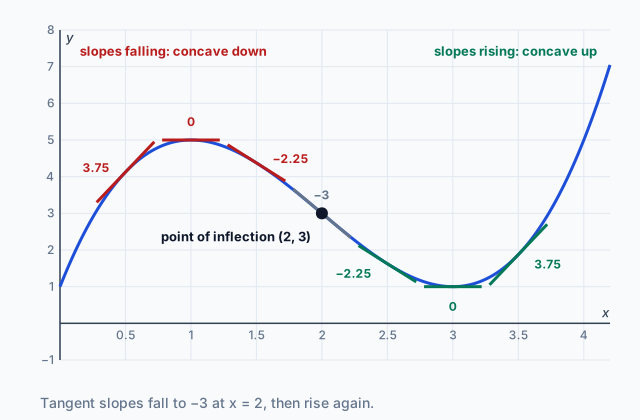
Look at the graph at the top. From to the tangent slopes are 3.75, 0, and . Each is smaller than the one before, so is decreasing and the graph is concave down there, even on the stretch where is still rising. After the slopes climb back through , 0 and 3.75, so the graph is concave up.
Concavity says nothing about whether goes up or down; that is the sign of . Concavity is whether itself goes up or down. A graph can be decreasing and concave up at once, like the stretch of this one between and .
Quick check · Sketch the graph
No calculator. Water flows into an empty tank for 5 minutes. The rate of flow, in liters per minute, stays positive the whole time but decreases from minute to minute. Sketch the volume of water in the tank against time, from 0 to 5 minutes. The first point is fixed at 0.
One shape that fits
Drag a point up or down, or tap it and use the arrow keys. Only the shape is checked.
2b. The second derivative reads concavity
Whether is increasing or decreasing is a question about the derivative of . That derivative is the second derivative, .
- If on an open interval, is increasing there, so the graph of is concave up.
- If on an open interval, is decreasing there, so the graph of is concave down.
So gives the intervals of concavity the way gives the intervals where increases and decreases. Find , find where it is 0 or does not exist, and check its sign between those inputs.
For the curve at the top, , so and . That is negative for and positive for . The graph of is concave down on and concave up on , which is what the falling and then rising tangent slopes showed.
When you justify a claim like this, name the function and the derivative you used: "the graph of is concave up on because there." A sentence such as "it curves up" names no function and gives no reason.
Quick check · Multiple choice
No calculator. Let . Which gives every open interval on which the graph of is concave down?
2c. Points of inflection
A point of inflection is a point on the graph of , where is continuous, at which the graph changes concavity: from up to down, or from down to up. On the graph at the top it is , where the tangent slopes stop falling and start rising.
Concavity follows the sign of , so the second derivative locates these points. The graph changes concavity at when changes sign there. The candidates are the inputs where or does not exist, and each one has to be tested on both sides.
A candidate can fail the test. For , , which is 0 at . But is positive on both sides of 0, so the graph of is concave up on both sides and is not a point of inflection. A zero of tells you where to look, not what you will find.
Write the reason with the function named: "The graph of has a point of inflection at because changes sign there." Because changes sign exactly where switches between decreasing and increasing, "because changes from decreasing to increasing at " is an equally good reason.
Quick check · Decide and justify
No calculator. Let , so . Since and , a classmate says the graph of has points of inflection at both and . Is the classmate right?
Which reason supports your answer?
Part 3 Watch it done Concavity and inflection points of a quartic
Open the steps one at a time, then write the conclusion yourself.
Let . Find the open intervals on which the graph of is concave up and concave down, and find the -coordinates of its points of inflection. Justify your answers.
Step 1 · Differentiate twice
, so .
Step 2 · Find the candidates
at and . Since is a polynomial, it exists everywhere, so there are no other candidates.
Step 3 · Test the sign of f'' between them
, and . So on , on , and on .
Why this step?
Why test a value on each side instead of stopping at the two zeros of ?
A zero of only marks a place where the sign might change. Here it changes at both, but for at 0 it does not. Only the signs on each side show whether the concavity actually changes.
Your step · Fill the statement
No calculator. Finish it. Tap a blank, then tap an answer.
From the signs of , the graph of is concave down on , and it has points of inflection at .
Part 4 Try it A new context and four new functions
Try it · Calculate
No calculator. After a dose of a medicine, the amount of it in a patient's blood is milligrams, hours after the dose, for . At what time , in hours, does the graph of have a point of inflection?
Try it · Match
No calculator. Tap a function, then the interval on which its graph is concave up.
Part 5 Explain it Write it as a free-response answer
Free response on the exam is written by hand, so work this on paper. Nothing you type here leaves the page. When you are done, open the model answer and score yourself on each point.
Free response is 50% of the exam score. This one is shaped like Question 4, from free-response Part B (calculator not permitted).
Free-response practice · Question 4 style
No calculator. The depth of the water in a reservoir is feet, months after January 1, for . The depth changes at the rate feet per month.
(a) Find . Using correct units, interpret the meaning of in the context of the problem.
(b) On what open interval or intervals in is the graph of concave up? Justify your answer.
(c) Find the value of , for , at which the graph of has a point of inflection. Justify your answer.
Model answer
(a) , so feet per month per month. At months, the rate at which the depth of the water changes is decreasing at 2 feet per month per month.
(b) when . The graph of is concave up on because there.
(c) . is negative for and positive for , so changes sign at and the graph of has a point of inflection there.
Score your own answer. This is a self-check, not a grade. Tick each point your answer makes.
Part 6 Check yourself A function known by the signs of its derivatives
Answer both case questions from the table.
A function is twice differentiable for all real numbers. The table gives the sign of and of on each interval, and the inputs where either one is 0.
| Positive | Negative | |
| 0 | Negative | |
| Negative | Negative | |
| Negative | 0 | |
| Negative | Positive | |
| 0 | Positive | |
| Positive | Positive |
Case question 1 · Multiple choice
No calculator. Which gives all the values of for which the graph of is concave up?
Case question 2 · Calculate
No calculator. At what value of does the graph of have a point of inflection?
The rest stand on their own and do not use the case.
Check yourself · Spot the error
No calculator. A student finds where the graph of is concave up and where it is concave down. Tap the first line with a mistake.
Check yourself · Put it in order
No calculator. Put the steps for finding the points of inflection of the graph of a function in order.
Part 7 Keep it Bring back earlier ideas
Concavity is read the way increasing and decreasing were, one derivative later. These two questions bring back the pieces it stands on.
Bring it back · Multiple choice
No calculator. The derivative of a function is . On which interval or intervals is decreasing?
Bring it back · Calculate
No calculator. Let . Find .
In three lines
- The graph of is concave up on an open interval where is increasing, and concave down where is decreasing.
- The sign of gives the intervals of concavity: positive for concave up, negative for concave down.
- Points of inflection are where the graph changes concavity, found where changes sign.
Exam strategy for this topic
- Section I Part A, Multiple Choice (calculator not permitted): 29 questions in 62 minutes.
- Section I Part B, Multiple Choice (graphing calculator required): 13 questions in 38 minutes.
- Section II Part A, Free Response (graphing calculator required): 2 questions in 30 minutes.
- Section II Part B, Free Response (calculator not permitted): 4 questions in 60 minutes.
Answer in the question's own words and name the function: "The graph of is concave down on because there," or "because is decreasing there." A sentence like "it curves down" leaves the reader unsure which function you mean and gives no calculus reason. When you are given the graph of , argue from that graph directly: whether it rises or falls tells you the concavity of .
Questions students ask
Is concave up the same as increasing?
No. Increasing is about the sign of ; concave up is about getting larger. is decreasing and concave up for , and is increasing and concave down for .
Can a point of inflection be where does not exist?
Yes, if is continuous there and the concavity changes. For , does not exist at 0, but it is positive for and negative for , so is a point of inflection.
What does concavity mean in a real context?
It says how a rate is changing. If is the amount of water in a tank and its graph is concave up, the rate is increasing: water comes in faster and faster, or, while is negative, drains more and more slowly.
If I am given the graph of instead of , how do I read concavity?
Look at whether the graph of rises or falls, not whether it is above or below the axis. Where the graph of rises, the graph of is concave up; where it falls, the graph of is concave down. A peak or a valley of the graph of is where the graph of changes concavity.
Does the graph have to be flat at a point of inflection?
No. The slope there can be any number. On the graph at the top, the slope at the point of inflection is . In the worked example, the point happens to have slope 0, but at the slope is .
Course alignment, for teachers
AP Calculus AB topic 5.6, Unit 5: Analytical Applications of Differentiation.
- Skill 2.E: Describe the relationships among different representations of functions and their derivatives.
This lesson maps all 3 essential knowledge statements of the topic to the part that teaches each one: 3 are checked by a scored question. The map is in the lesson file.