Unit 6 · Topic 6.10 · about 30 minutes · 7 parts · 12 scored checks, 3 of them multiple choice
AP Calculus AB 6.10: Integrating Functions Using Long Division and Completing the Square
Unit 6: 15 to 20% of the multiple-choice section
What you'll be able to do
- Find indefinite integrals and evaluate definite integrals of fractions by first rewriting them with long division or by completing the square.
Key vocabulary
| Term | What it means | The exam trap |
|---|---|---|
| Antiderivative | A function whose derivative is , so that . | Differentiate a proposed antiderivative before you trust it; if the result is not exactly the integrand, the antiderivative is wrong. |
| Indefinite integral | , where and is any constant. | Every indefinite integral ends in . Without it you have written one antiderivative, not all of them. |
| Equivalent forms | Two expressions that are equal for every input where both are defined, such as and . | A rewrite is allowed only if it equals the original. Recombine or multiply back to check it before you integrate. |
| Long division | Dividing one polynomial by another to write a fraction as a quotient plus a remainder over the divisor. | Subtract the whole product at each step, term by term; one sign slip changes the remainder and everything that comes from it. |
| Completing the square | Rewriting as . | Whatever you add inside the square, take back outside it, so the expression keeps its value. |
 Tap to open the picture full size
Part 1 Think first How much water in two minutes?
Guess first. Committing to an answer, even a wrong one, makes the explanation stick.
Predict first
A pump fills a tank at a rate of liters per minute, minutes after it starts. At the start the rate is 3 liters per minute, and at it is about 3.7. About how much water goes into the tank in the first 2 minutes?
In short. Integrating with long division or completing the square means rewriting a fraction as an equal sum of pieces that each have a known antiderivative, then integrating piece by piece.
- When the top's degree is at least the bottom's, divide: the fraction equals a quotient plus a remainder over the divisor.
- When a constant sits over a quadratic with no real zeros, complete the square and look for an inverse tangent.
- A definite integral uses the same rewrite, then with the antiderivative.
Part 2 Learn it Rewrite first, then integrate
6a. Top-heavy fractions: divide first
There is no quotient rule for integrals. When the top of a fraction has degree at least the degree of the bottom, divide first. Long division rewrites the fraction as a polynomial plus a remainder over the divisor:
Take . goes into exactly times. Subtract and is left. goes into twice. Subtract and 3 is left. So
Check it by multiplying back: . The two forms are equivalent, so they have the same antiderivatives, and now every piece has a rule:
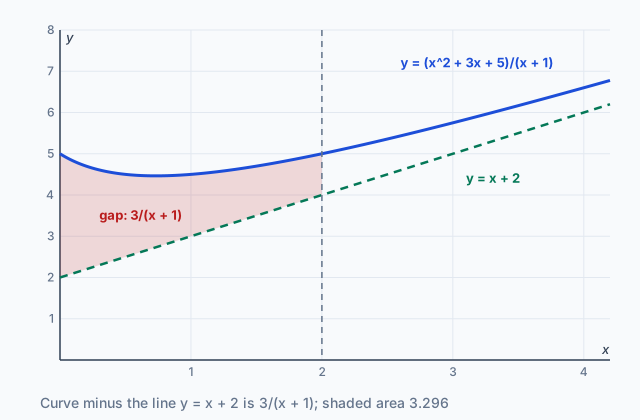
The graph at the top shows the rewrite. The curve is the line plus a gap, , that shrinks as grows. The remainder piece is the one that turns into a logarithm.
Quick check · Multiple choice
No calculator. Which of the following is ?
6b. A quadratic with no zeros: complete the square
Some fractions have a constant on top and a quadratic with no real zeros on the bottom, such as . Division does nothing here, because the top already has the lower degree. Complete the square instead: take half the coefficient of , square it, and split the constant around it.
Now the integrand has the shape with and , and you know . So
When the constant left over is not 1, the inverse tangent picks up a factor. For , , which is times too big, so
For example, , so and
Differentiate an answer like this to check it.
Quick check · Match
No calculator. Complete the square in each denominator. Tap an integral, then its antiderivative.
6c. Choosing the rewrite, and definite integrals
Look at a fraction before you start on it. Three questions sort most of them.
- Is the top's degree at least the bottom's? Divide first.
- Is the top a constant multiple of the bottom's derivative? Substitute for the bottom, as it stands.
- Is the top a constant and the bottom a quadratic with no real zeros? Complete the square.
A definite integral needs nothing new: rewrite, find an antiderivative , then use . For example, has top and bottom of the same degree, so divide: . Then
Write the antiderivative, , before any numbers go in, and put parentheses around each value, so the minus sign applies to the whole of . Leave the answer exact, as , unless a decimal is asked for.
Quick check · Sort it
No calculator. Sort each integrand by the method that handles it most directly, as it is written. Tap a card, then a bin.
Divide first
Substitute for the bottom
Complete the square
Part 3 Watch it done A definite integral by completing the square
Open one step at a time. The last line is yours.
Evaluate without a calculator.
Step 1 · Complete the square
Half of is , and , so .
Step 2 · Find an antiderivative
With , and : .
Why this step?
Why is there a in front of the inverse tangent?
Differentiate without it: , which is twice the integrand. The cancels that 2.
Step 3 · Apply the Fundamental Theorem
.
Your step · Calculate
No calculator. Finish it. , and that value is . What is ? Give an exact decimal.
Part 4 Try it Two new integrands
Try it · Calculate
No calculator. The exact value of can be written as . What is ? Give an exact decimal.
Try it · Decide and justify
No calculator. A classmate says cannot be found with the rules you know, because the top and the bottom have the same degree and there is no quotient rule for integrals. Is the classmate right?
Which reason supports your answer?
Part 5 Explain it Write it out by hand
Free response on the exam is handwritten, so work this on paper. Nothing you type here leaves this page. When you have an answer, open the model and score yourself against each point.
Free response is 50% of the exam score. This one is shaped like Question 6, from free-response Part B (calculator not permitted).
Free-response practice · Question 6 style
No calculator. Water is pumped into a tank at a rate of liters per minute for , where is measured in minutes.
(a) Use long division to write as a polynomial plus a fraction whose numerator is a constant.
(b) Find the total amount of water, in liters, pumped into the tank from to . Show the antiderivative you use.
(c) From to , water also drains out of the tank at a rate of liters per minute. Find the total amount of water, in liters, that drains out over that interval.
(d) From to , does the amount of water in the tank increase or decrease? Justify your answer.
Model answer
(a) , so .
(b) liters.
(c) , so liters.
(d) Water pumped in from to : liters, which is more than 10 liters because . Only liters, less than 4, drains out. More water enters than leaves, so the amount of water in the tank increases.
Score your own answer. This is a self-check, not a grade. Tick each point your answer makes.
Part 6 Check yourself One fraction, two rewrites
Both case questions use the function and the division in the table. Answer them from it.
A student divides by to integrate . The table shows her long division, one step per row.
| Step | Next term of the quotient | Subtract | Left over |
|---|---|---|---|
| 1 | |||
| 2 |
Case question 1 · Multiple choice
No calculator. Which of the following is ?
Case question 2 · Calculate
No calculator. The exact value of can be written as . What is ? Give an exact decimal.
The rest stand on their own and do not use the case.
Check yourself · Spot the error
No calculator. A student finds . Tap the first line with a mistake.
Check yourself · Put it in order
No calculator. Put the steps for evaluating in order. Tap them in sequence.
Part 7 Keep it Bring back earlier ideas
This lesson leans on substitution and on the derivative of the inverse tangent. Recalling them now keeps them ready.
Bring it back · Calculate
No calculator. Evaluate . Give an exact decimal.
Bring it back · Multiple choice
No calculator. What is ?
In three lines
- When the top's degree is at least the bottom's, long division turns a fraction into a polynomial plus a remainder over the divisor.
- A constant over a quadratic with no real zeros becomes by completing the square, and integrates to .
- For a definite integral, rewrite, find the antiderivative, then subtract its value at the lower limit from its value at the upper limit.
Exam strategy for this topic
- Section I Part A, Multiple Choice (calculator not permitted): 29 questions in 62 minutes.
- Section I Part B, Multiple Choice (graphing calculator required): 13 questions in 38 minutes.
- Section II Part A, Free Response (graphing calculator required): 2 questions in 30 minutes.
- Section II Part B, Free Response (calculator not permitted): 4 questions in 60 minutes.
Without a calculator, write the rewritten integrand and the antiderivative before any numbers, and end every indefinite integral with . For a definite integral, show with parentheses around each value, and leave an answer such as or exact unless the question asks for a decimal.
Questions students ask
How do I know whether to divide or to complete the square?
Compare degrees first. If the top's degree is at least the bottom's, divide. If the top is a constant and the bottom is a quadratic with no real zeros, complete the square. If the top is a constant multiple of the bottom's derivative, substitute instead, and neither rewrite is needed.
Why does a logarithm show up after long division?
The remainder sits over the divisor. When the divisor is linear, such as , the piece has antiderivative , where is the remainder.
Do I need the absolute value in ?
In an indefinite integral, yes: is an antiderivative of for negative as well as positive. Over an interval where stays positive, such as , gives the same values.
Does completing the square only ever lead to an inverse tangent?
No. Under a square root, a completed square can match the derivative of the inverse sine: for , . For example, , so .
How can I check an answer without a key?
Differentiate it. If the derivative of your antiderivative is the original fraction (after you combine terms over a common denominator), the answer is right, whatever form it is written in.
Course alignment, for teachers
AP Calculus AB topic 6.10, Unit 6: Integration and Accumulation of Change.
- Skill 1.E: Apply appropriate mathematical rules or procedures, with and without technology.
This lesson maps the one essential knowledge statement of the topic to the part that teaches each one: 1 is checked by a scored question. The map is in the lesson file.