Unit 6 · Topic 6.9 · about 30 minutes · 7 parts · 12 scored checks, 3 of them multiple choice
AP Calculus AB 6.9: Integrating Using Substitution
Unit 6: 15 to 20% of the multiple-choice section
What you'll be able to do
- Find indefinite integrals and evaluate definite integrals whose integrands need a substitution, or a rewrite into an equivalent form, before a basic rule applies.
Key vocabulary
| Term | What it means | The exam trap |
|---|---|---|
| Substitution of variables | A technique for finding antiderivatives that replaces an inside expression with a new variable and with . | Before you integrate, look at the rewritten integral: if any is still in it, the rewrite is not finished. |
| Indefinite integral, | The family of all antiderivatives of , written where . | Write the on every indefinite integral, and write the answer in the original variable. |
| Limits of integration | The numbers and in , the starting and ending values of the variable in the differential. | Ask which variable each limit belongs to every time you change variables. |
| Differential, | For , the expression , which tells you what a substitution replaces. | Compare with the factor that is actually in the integrand; they can differ by a constant. |
 Tap to open the picture full size
Part 1 Think first How much water in the first minute?
Make a guess before the lesson starts. Committing to an answer, even a wrong one, helps the right one stick.
Predict first
A pump starts filling an empty tank. After minutes, water flows in at liters per minute. The rate is 0 liters per minute when the pump starts and 24 liters per minute at . How much water flows into the tank during the first minute?
In short. Integration by substitution renames an inside function , so that and an integral of the form becomes , which a basic rule can finish.
- Substitution reverses the chain rule, so look for an inside function whose derivative, up to a constant factor, is also in the integrand.
- Before integrating, every and must be replaced, which may mean solving for or moving a constant outside the integral.
- In a definite integral the limits are values of the variable being integrated, so after substituting they become and . An indefinite integral ends in .
Part 2 Learn it Three short ideas, each checked as you go
6a. Substitution runs the chain rule backward
The chain rule from Unit 3 says . Read backward, it hands you an antiderivative:
So when an integrand is some function of an inside expression, multiplied by the derivative of that inside expression, you can undo the chain rule.
Substitution of variables makes this routine. Call the inside expression . Then , which is written . Replace by and by , integrate in , and then put back in place of .
Take . The inside expression is , and its derivative, , is sitting in front. Let , so , and
Check it by differentiating: the chain rule turns back into . An indefinite integral stands for every antiderivative at once, so it always ends in .
Quick check · Match
No calculator. Each integrand is a function of an inside expression times that expression's derivative. Tap an integral, then its antiderivative.
6b. Fixing a constant, and rewriting what is left
Often is in the integral only up to a constant factor. In , let . Then , but the integral has , not . Solve for what you have: . A constant can move outside an integral, so
Only a constant can be fixed this way. If calls for a factor of that the integrand does not have, as in , this substitution does not work, and you cannot divide by to rescue it.
Sometimes the leftover can be rewritten in terms of instead. In , let , so and :
which is .
Either way, the integral must hold only and before you integrate. A stray means the rewrite is not finished.
Quick check · Calculate
No calculator. For some positive integer , . What is ?
6c. Definite integrals: the limits change too
The limits of a definite integral are values of the variable in its differential: in , runs from 1 to 2. After a substitution the integral is in , so its limits must be values of . If , then gives and gives :
Take . Let , so . At , , and at , :
Keeping the old limits would give , the area of a different region.
You may instead go back to first, , and use the original limits: . Both routes work. What never works is a mix: a expression with limits, or an expression with limits.
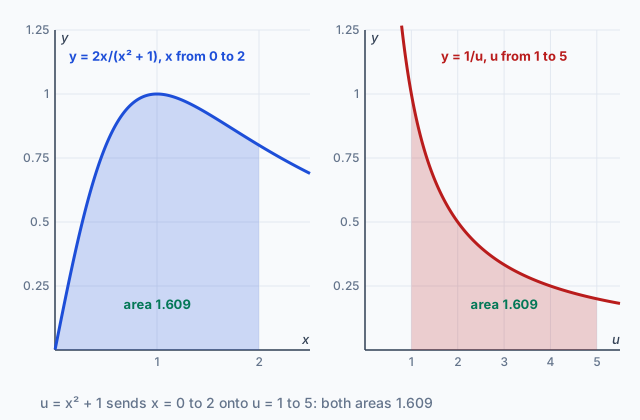
Keep the new limits in the order the substitution gives them, even when is larger than . The graphs at the top show one substitution: two curves on two intervals, with one area.
Quick check · Multiple choice
No calculator. Using the substitution , which integral is equal to ?
Part 3 Watch it done A definite integral by substitution
Watch each step, then finish the last one yourself.
Evaluate .
Step 1 · Choose u
The inside expression is , and its derivative, , is a factor of the integrand. Let , so .
Step 2 · Change the limits
When , . When , .
Why this step?
Why work out new limits instead of keeping 0 and ?
After the substitution the integral is in , and its limits have to be values of . The numbers 0 and are values of ; putting them on a integral would add up a different region.
Step 3 · Rewrite and find an antiderivative
, and an antiderivative of is .
Your step · Calculate
No calculator. Finish it. The integral is now , and an antiderivative of is . What is the value of the integral?
Part 4 Try it A logarithm and a leftover x
Try it · Calculate
No calculator. Evaluate .
Try it · Multiple choice
No calculator. Which integral is equal to after the substitution ?
Part 5 Explain it Write it as a free-response answer
Free response on the exam is written by hand, so do this one on paper. Nothing you type here leaves the page. When you are done, open the model answer and score yourself against each point.
Free response is 50% of the exam score. This one is shaped like Question 5, from free-response Part B (calculator not permitted).
Free-response practice · Question 5 style
No calculator. Water flows into a tank at a rate of liters per minute, where is measured in minutes, for .
(a) Find . Show the work that leads to your answer.
(b) Using the substitution , write as an integral in terms of , with limits of integration in terms of . Do not evaluate it.
(c) Evaluate . Using correct units, explain the meaning of this value in the context of the problem.
Model answer
(a) Let , so and . Then .
(b) When , , and when , . So .
(c) . From to minutes, 98 liters of water flowed into the tank.
Score your own answer. This is a self-check, not a grade. Tick each point your answer makes.
Part 6 Check yourself Two functions in a table
Both case questions use this table. Read every value you need from it.
The functions and are differentiable for all real numbers, and and are continuous. The table gives some of their values.
| 1 | 5 | 2 | 3 | |
|---|---|---|---|---|
| 2 | 2 | 2 | 4 | 1 |
| 3 | 8 | 1 | 3 | |
| 4 | 3 | 1 |
Case question 1 · Calculate
No calculator. What is the value of ?
Case question 2 · Decide and justify
No calculator. A classmate writes . Is the classmate right?
Which reason supports your answer?
The rest stand on their own and do not use the case.
Check yourself · Spot the error
No calculator. A student evaluates by substitution. Tap the first line with a mistake.
Check yourself · Fill the statement
No calculator. Tap a blank, then tap an answer.
To find , let . Then , so , and .
Part 7 Keep it Bring back earlier ideas
Substitution leans on the chain rule and on what an indefinite integral means. Pulling both back up is what keeps them.
Bring it back · Multiple choice
No calculator. If , what is ?
Bring it back · Calculate
No calculator. If , what is ?
In three lines
- Substitution reverses the chain rule: name the inside function u and replace its derivative and dx by du.
- Fix a constant factor by moving it outside, and rewrite any leftover x in terms of u before integrating.
- In a definite integral, change the limits to values of u, or go back to x and use the original limits; an indefinite integral ends in + C.
Exam strategy for this topic
- Section I Part A, Multiple Choice (calculator not permitted): 29 questions in 62 minutes.
- Section I Part B, Multiple Choice (graphing calculator required): 13 questions in 38 minutes.
- Section II Part A, Free Response (graphing calculator required): 2 questions in 30 minutes.
- Section II Part B, Free Response (calculator not permitted): 4 questions in 60 minutes.
On a free-response question, write , and, for a definite integral, the new limits on their own line before you integrate, and give the antiderivative before any arithmetic. Put on every indefinite integral, and never join a expression and an expression with an equals sign unless they really are equal.
Questions students ask
How do I know what to choose for u?
Look for an inside expression whose derivative, or a constant multiple of it, is also a factor of the integrand: the expression under a root, inside a power, in an exponent, or inside a trig function. If your first choice leaves an you cannot rewrite, try another.
Do I have to change the limits, or can I go back to x?
Either works. You can change the limits to values of and finish in , or find the antiderivative, put back for , and use the original limits. The one thing you cannot do is mix the two.
What if the new lower limit is bigger than the new upper limit?
Keep them in the order the substitution gives them. is a perfectly good integral, equal to , and the order is what keeps the sign right.
How can I check an answer to an indefinite integral?
Differentiate it. By the chain rule you should get the original integrand back exactly; a missing constant factor shows up at once.
Why can I move a constant outside the integral but not an x?
A constant multiple of a function has the same constant multiple of its antiderivative. An changes as you integrate, so it is not a constant multiple; it has to be written in terms of first.
Course alignment, for teachers
AP Calculus AB topic 6.9, Unit 6: Integration and Accumulation of Change.
- Skill 1.E: Apply appropriate mathematical rules or procedures, with and without technology.
This lesson maps all 2 essential knowledge statements of the topic to the part that teaches each one: 2 are checked by a scored question. The map is in the lesson file.