Unit 7 · Topic 7.1 · about 30 minutes · 7 parts · 13 scored checks, 3 of them multiple choice
AP Calculus AB 7.1: Modeling Situations with Differential Equations
Unit 7: 5 to 10% of the multiple-choice section
What you'll be able to do
- Interpret a verbal statement about how a quantity changes as a differential equation, an equation that involves a derivative of the unknown function.
Key vocabulary
| Term | What it means | The exam trap |
|---|---|---|
| Differential equation | An equation that relates a function of an independent variable to one or more of that function's derivatives. | Look for a derivative in the equation; an equation relating two variables without one is a different thing. |
| Independent variable | The input the function depends on, the variable written after "with respect to" and on the bottom of a derivative such as . | Do not assume it is ; read the derivative to see which variable it is. |
| Rate of change of with respect to | How fast is changing as changes, written . | A sentence about a rate puts the derivative on the left side, not itself. |
 Tap to open the picture full size
Part 1 Think first How fast will the frogs multiply?
Make a guess before the lesson starts. Committing to an answer, even a wrong one, helps the right one stick.
Predict first
A pond has 200 frogs, and right now the population is growing at 30 frogs per year. A biologist says the population grows at a rate proportional to the number of frogs in the pond. Some years later there are 400 frogs. If she is right, how fast is the population growing at that moment?
In short. A differential equation is an equation that relates a function of an independent variable to one or more of that function's derivatives, such as for "the rate of change of with respect to is proportional to the square root of ."
- "The rate of change of with respect to " is , and the variable after "with respect to" is the independent variable.
- "Proportional to " means a constant times , and "inversely proportional to " means . The right side uses whatever the words say the rate depends on.
- Substituting a state into the equation gives the rate at that state, and one known rate is enough to find . A falling quantity has a negative rate.
Part 2 Learn it Three short ideas, each checked as you go
7a. What a differential equation says
Most equations you have solved ask for a number. A differential equation asks for a function. It is an equation that relates a function, such as as a function of an independent variable , to one or more of that function's derivatives.
Take , where is a town's population years from now. The unknown is the function . The independent variable is , the variable on the bottom of . The equation does not give you directly. It tells you how fast is changing once you know : with 10,000 people, the town grows at people per year.
The right side can hold the independent variable, the function, or both: , and are all differential equations. One can also hold a second derivative, as does for an object falling near the ground.
The derivative is what makes it a differential equation. is a formula for a function, and relates and , but neither has a derivative in it. When a problem writes , the independent variable is whatever it says is a function of.
Quick check · Sort it
No calculator. Tap an equation, then tap whether it is a differential equation.
A differential equation
Not a differential equation
7b. Turning words into an equation
Applied problems describe a rate in words, and your job is to write the equation. These phrases do most of the work:
- "The rate of change of with respect to " is . The variable after "with respect to" is the independent variable.
- " is proportional to " means for some constant , the constant of proportionality.
- " is inversely proportional to " means .
Put them together. "The rate at which changes with respect to is proportional to the square root of " becomes
The left side is the derivative, because the sentence is about a rate. The right side is built from whatever the sentence says the rate depends on: here , the amount, not , the time.
A rate can also be proportional to a difference. "A bowl of soup cools at a rate proportional to the difference between its temperature and the room's 21 degrees Celsius" gives .
Watch the direction of change. If a quantity is decreasing and the problem says is a positive constant, put the minus sign in yourself: a draining tank with depth might be . If the problem does not say, carries the sign, and it comes out negative.
Quick check · Match
No calculator. In each statement is a function of and is a constant. Tap a statement, then the equation it describes.
7c. Reading a rate from the equation
A differential equation is a rule: give it the state, and it gives the rate. To find the rate at a particular moment, substitute what you know into the right side.
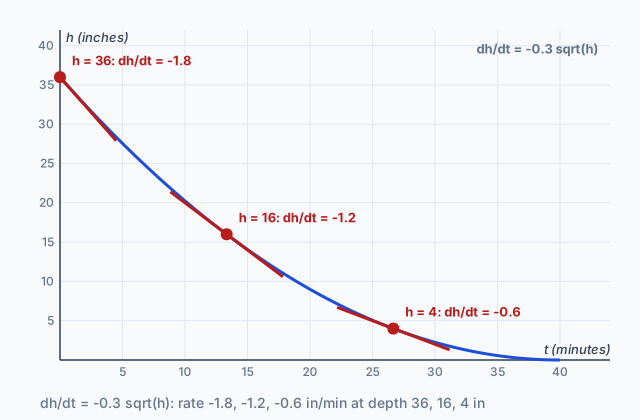
The barrel in the picture at the top drains so that its depth , in inches, satisfies , with in minutes. When the water is 36 inches deep,
The negative sign says the depth is falling. The units of are the units of over the units of . Notice that you never needed the time. This rate depends only on the depth, so 36 inches of water drains at the same rate at 9 a.m. or at noon. When the right side holds as well, you need the time too.
When the problem gives one rate and leaves unknown, that one fact pins down. Say , and is falling at 3 units per minute when . Falling means the rate is , so and . Now the equation gives the rate at every other state: at , .
Quick check · Calculate
No calculator. The number of bacteria in a dish, , in thousands, satisfies , with in hours. What is , in thousands of bacteria per hour, when ?
Part 3 Watch it done From a sentence to a rate
Watch each step, then finish the last one yourself.
A cup of tea at 90 degrees Celsius is set down in a room kept at 20 degrees Celsius. The temperature of the tea, degrees Celsius minutes later, changes at a rate proportional to the difference between the tea's temperature and the room's temperature. At the moment the tea is 90 degrees, it is cooling at 3.5 degrees per minute. How fast is its temperature changing when the tea is 60 degrees?
Step 1 · Name the variables
The function is , the tea's temperature, and the independent variable is , the time in minutes. The rate of change of with respect to is .
Step 2 · Translate the sentence
The rate is proportional to the difference between and 20, so for some constant .
Step 3 · Use the known rate to find k
When , the tea is cooling at 3.5 degrees per minute, so . Then , and . The equation is .
Why this step?
Why does come out negative here?
The tea is hotter than the room, so is positive, and the tea is cooling, so is negative. A positive number times can only be negative if is negative.
Your step · Calculate
No calculator. Finish it. The tea's temperature satisfies . What is , in degrees Celsius per minute, when ?
Part 4 Try it A decaying sample and a spreading rumor
Try it · Calculate
No calculator. A sample of a radioactive substance decays at a rate proportional to the amount present. When 80 grams remain, the amount is decreasing at 4 grams per day. What is , in grams per day, when 30 grams remain? Here is the amount in grams and is in days.
Try it · Multiple choice
No calculator. A town has 2000 residents. is the number who have heard a rumor days after it starts. The rate at which changes with respect to is proportional to the number of residents who have not yet heard the rumor. Which differential equation models this, where is a positive constant?
Part 5 Explain it Write it as a free-response answer
Free response on the exam is written by hand, so do this one on paper. Nothing you type here leaves the page. When you are done, open the model answer and score yourself against each point.
Free response is 50% of the exam score. This one is shaped like Question 4, from free-response Part B (calculator not permitted).
Free-response practice · Question 4 style
No calculator. A patient receives a drug through an IV drip at a constant rate of 30 milligrams per hour. At the same time, the patient's body removes the drug from the bloodstream at a rate proportional to the amount of the drug in the bloodstream. Let be the amount of the drug in the bloodstream, in milligrams, hours after the drip starts.
(a) Write a differential equation for in terms of and a positive constant .
(b) At the moment when , the amount of the drug in the bloodstream is increasing at 18 milligrams per hour. Find the value of .
(c) Find at the moment when . Using correct units, interpret this value in the context of the problem.
Model answer
(a) The drug comes in at 30 milligrams per hour and leaves at milligrams per hour, so .
(b) When , , so , which gives and .
(c) . At the moment the bloodstream holds 200 milligrams of the drug, the amount of the drug is increasing at 6 milligrams per hour.
Score your own answer. This is a self-check, not a grade. Tick each point your answer makes.
Part 6 Check yourself A colony's growth rate in a table
All three case questions use this table. Read every value you need from it.
A biologist grows a colony of bacteria. is the number of bacteria hours after the start. She measures the growth rate , in bacteria per hour, at three moments, and records the size of the colony at each one.
| (bacteria) | (bacteria per hour) |
|---|---|
| 100 | 2 |
| 400 | 4 |
| 900 | 6 |
Case question 1 · Decide and justify
No calculator. A classmate says the colony's growth rate is proportional to , because the rate goes up whenever goes up. Is the classmate right?
Which reason supports your answer?
Case question 2 · Multiple choice
No calculator. Which differential equation agrees with every row of the table?
Case question 3 · Calculate
No calculator. The colony's growth rate is proportional to a power of . Using the table, what is , in bacteria per hour, when the colony has 1600 bacteria?
The rest stand on their own and do not use the case.
Check yourself · Spot the error
No calculator. A can of soda at 6 degrees Celsius is left in a car at 30 degrees Celsius. Its temperature rises at a rate proportional to the difference between the car's temperature and the soda's. At the moment the soda is 6 degrees, it is warming at 1.2 degrees per minute. A student finds how fast it is warming when it reaches 18 degrees. Tap the first line with a mistake.
Check yourself · Fill the statement
No calculator. A balloon leaks so that the volume of air in it, liters, seconds after the leak starts, satisfies . Tap a blank, then tap an answer.
In this differential equation, the independent variable is , the unknown function is , and the equation relates that function to .
Part 7 Keep it Bring back earlier ideas
A differential equation is a statement about a derivative in context, and the area under a rate is the change it builds up. Both come back in this unit.
Bring it back · Calculate
No calculator. A cyclist's velocity is meters per second for , with in seconds. Using the area between the graph of and the -axis, how many meters does the cyclist travel from to ?
Bring it back · Multiple choice
No calculator. is the amount of water in a reservoir, in millions of gallons, days after June 1. Which statement is the best interpretation of ?
In three lines
- A differential equation relates a function of an independent variable to one or more of its derivatives.
- "The rate of change of y is proportional to Q" means dy/dt = kQ; read which variable Q is, and give a falling quantity a negative rate.
- Substitute a state into the equation to read the rate there, and use one known rate to find k.
Exam strategy for this topic
- Section I Part A, Multiple Choice (calculator not permitted): 29 questions in 62 minutes.
- Section I Part B, Multiple Choice (graphing calculator required): 13 questions in 38 minutes.
- Section II Part A, Free Response (graphing calculator required): 2 questions in 30 minutes.
- Section II Part B, Free Response (calculator not permitted): 4 questions in 60 minutes.
When a free-response question asks for a differential equation, write the derivative on the left with the right letters, such as , and keep the constant in it until the problem gives you a rate to find it. When you interpret a value of a derivative, give the moment, the units and whether the quantity is increasing or decreasing.
Questions students ask
What is the difference between a differential equation and an ordinary equation?
An ordinary equation like has numbers as its solutions. A differential equation contains a derivative of an unknown function, and its solutions are functions.
How do I know which variable is independent?
Read the derivative. In , depends on , so is independent. In words, it is the variable after "with respect to", usually time in an applied problem.
Does k have to be positive?
Not unless the problem says so. If it does say and the quantity is falling, write the minus sign into the equation, as in . If it does not, takes whatever sign the data give it.
Do I need to know the time to use a differential equation?
Only if the time appears on the right side. In , the rate depends only on , so knowing is enough. In , you need both.
Will I have to solve these equations?
Not in this topic. Here you write them and read rates from them. Later topics check whether a function satisfies one, sketch its slope field and then solve the ones that separate.
Course alignment, for teachers
AP Calculus AB topic 7.1, Unit 7: Differential Equations.
- Skill 2.C: Identify a re-expression of mathematical information presented in a given representation.
This lesson maps the one essential knowledge statement of the topic to the part that teaches each one: 1 is checked by a scored question. The map is in the lesson file.