Unit 7 · Topic 7.2 · about 30 minutes · 7 parts · 12 scored checks, 4 of them multiple choice
AP Calculus AB 7.2: Verifying Solutions for Differential Equations
Unit 7: 5 to 10% of the multiple-choice section
What you'll be able to do
- Verify that a function, or a whole family of functions with a constant in it, solves a given differential equation by differentiating and substituting.
Key vocabulary
| Term | What it means | The exam trap |
|---|---|---|
| Differential equation | An equation that relates a function of an independent variable to one or more of the function's derivatives, such as . | Read which variable is independent and which is the function before you differentiate anything. |
| Solution of a differential equation | A function that, with its derivatives substituted in, makes the equation true for every input in an interval. | Treat the check as a claim about every input on the interval, and simplify each side as an expression rather than plugging in a single value. |
| Verify | To show a proposed function is a solution by differentiating it, substituting into the equation, and simplifying until both sides match. | Work on each side separately; writing the equation as true before you have shown it assumes the result you are checking. |
| Family of solutions | A set of solutions written with one arbitrary constant, so that each value of the constant gives one function in the set. | Where the constant sits depends on the equation, so verify a family with the constant kept as a letter before trusting it. |
 Tap to open the picture full size
Part 1 Think first Which model of the cooling coffee is right?
Make a guess before the lesson starts. Committing to an answer, even a wrong one, helps the right one stick.
Predict first
A cup of coffee at 90 degrees Celsius sits in a 20-degree room. Newton's law of cooling says its temperature changes at the rate degrees per minute, where is in minutes. Two friends propose models: and . Both start at 90 degrees, and both cool at 7 degrees per minute at . Which model obeys the law of cooling?
In short. A function is a solution of a differential equation when substituting the function and its derivatives into the equation makes the two sides equal for every input in an interval.
- To verify, differentiate, substitute into both sides, and simplify until the two sides are the same expression. You never have to solve the equation to do this.
- Keep any constant as a letter while you check, so one calculation tests a whole family of functions at once.
- A differential equation may have infinitely many solutions, often one for each value of a constant, but some have fewer and some have none.
Part 2 Learn it Three short ideas, each checked as you go
7a. A solution makes the equation true at every input
A differential equation relates a function to its derivatives. A solution is a function that makes the equation true for every input in an interval, not just at one point.
To verify a solution, differentiate it, substitute the function and its derivative into the equation, and simplify each side until the two sides are the same expression.
Take and the function .
- Left side: , by the chain rule.
- Right side: .
The two sides are the same expression, so they agree at every , and is a solution.
Now try . Its derivative is , and . Those are equal only when . One matching point is not enough, so is not a solution.
An equation with a second derivative works the same way: find as well, and substitute everything the equation names. You never have to solve the equation to check a proposed answer.
Quick check · Calculate
No calculator. For what constant is a solution of ?
7b. A constant can give infinitely many solutions
Keep a constant as a letter when you differentiate, and one calculation checks a whole family of functions.
The coffee from the start cools by . Try , where is any constant.
- Left side: .
- Right side: .
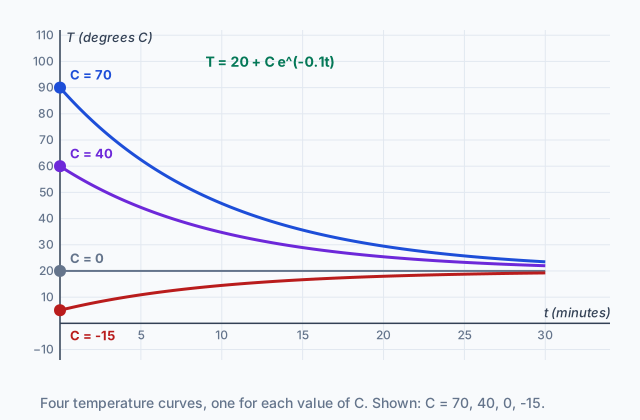
The sides match for every and every value of . So this one equation has infinitely many solutions, one for each . The graph at the top shows four of them. is the coffee starting at 90 degrees, and is an iced drink at 5 degrees warming toward the room. gives , a drink already at room temperature, which stays there.
Where the constant can go depends on the equation. Adding 5 to these solutions gives , and then the right side is , which no longer matches the derivative. A family is a solution only after you have verified it.
Quick check · Sort it
No calculator. Each card is a function. Tap a card, then tap whether it is a solution of .
Solves it
Does not solve it
7c. Many solutions is common, not guaranteed
The careful statement is that a differential equation may have infinitely many solutions. Most of the equations in this unit do, because a constant in the solution can take any value. Not every equation does.
Some solutions are constant functions. For , the function has derivative 0, and , so it works. A constant is easy to miss because it does not look like the other members of a family.
A solution also only has to work on an interval. solves for , even though it is not defined for .
So do not decide how many solutions an equation has by its look. Verify the candidates you are given, and let the algebra say which ones work.
Quick check · Multiple choice
No calculator. Which of these functions is a solution of ?
Part 3 Watch it done Verifying a whole family at once
Watch each step, then finish the last one yourself.
Determine which values of the constant make a solution of for .
Predict first
Before the steps open: for how many values of do you expect to be a solution?
Step 1 · Differentiate
Write . The power rule gives .
Why this step?
Why keep as a letter instead of picking a number for it?
A number checks one function. With the letter, a single calculation checks every member of the family, which is exactly what the problem asks.
Step 2 · Build the first term of the left side
.
Your step · Fill the statement
No calculator. Finish it. Tap a blank, then tap an answer.
Add to get the whole left side: . Compare it with the right side, : the equation holds for every for .
Part 4 Try it A family, then a second derivative
Try it · Decide and justify
No calculator. A classmate says is a solution of only when . Is the classmate right?
Which reason supports your answer?
Try it · Calculate
No calculator. For what positive constant is a solution of ?
Part 5 Explain it Write it as a free-response answer
Free response on the exam is written by hand, so do this one on paper. Nothing you type here leaves the page. When you are done, open the model answer and score yourself against each point.
Free response is 50% of the exam score. This one is shaped like Question 5, from free-response Part B (calculator not permitted).
Free-response practice · Question 5 style
No calculator. A pot of soup is set to cool in a kitchen kept at 25 degrees Celsius. The temperature of the soup, degrees Celsius after minutes, changes according to the differential equation .
(a) Verify that is a solution of the differential equation.
(b) Verify that is a solution for every constant . Explain what this tells you about the number of solutions of the differential equation.
(c) A classmate proposes , which also gives a starting temperature of 100 degrees Celsius. Determine whether this function is a solution of the differential equation. Justify your answer.
Model answer
(a) . Also . The two sides are equal for every , so is a solution.
(b) , and . The sides are equal for every and every constant , so the differential equation has infinitely many solutions, one for each value of .
(c) , but . The two sides differ by 5 degrees Celsius per minute at every , so is not a solution.
Score your own answer. This is a self-check, not a grade. Tick each point your answer makes.
Part 6 Check yourself Four models of salt in a tank
Both case questions use the equation and the table. Work each model out from its formula.
Salt water flows into a tank, and the well-mixed water flows out. The amount of salt in the tank, kilograms after minutes, satisfies the differential equation . Four students each propose a model for .
| Model | , in kilograms |
|---|---|
| P | |
| Q | |
| R | |
| S |
Case question 1 · Multiple choice
No calculator. Which of the four models are solutions of ?
Case question 2 · Calculate
No calculator. For model R, the expression has the same value at every time . What is that value?
The rest stand on their own and do not use the case.
Check yourself · Spot the error
No calculator. A student checks whether is a solution of . Tap the first line with a mistake.
Check yourself · Match
No calculator. Each family of functions is a solution of exactly one of these differential equations for every constant (take ). Tap an equation, then the family that solves it.
Part 7 Keep it Bring back earlier ideas
Verifying leans on writing a differential equation from words and on the chain rule. Pulling both back up is what keeps them.
Bring it back · Multiple choice
No calculator. The volume of water in a leaking tank, in liters, decreases at a rate proportional to the square root of the volume. If is time in minutes and is a positive constant, which differential equation models this?
Bring it back · Multiple choice
No calculator. If , what is ?
In three lines
- To verify a solution, differentiate, substitute into both sides, and simplify until the sides are identical for every input.
- Keep a constant as a letter, and one check covers a whole family: often infinitely many solutions, one for each value of C.
- Infinitely many is common, not guaranteed: some equations have only a few solutions or none, so verify every candidate.
Exam strategy for this topic
- Section I Part A, Multiple Choice (calculator not permitted): 29 questions in 62 minutes.
- Section I Part B, Multiple Choice (graphing calculator required): 13 questions in 38 minutes.
- Section II Part A, Free Response (graphing calculator required): 2 questions in 30 minutes.
- Section II Part B, Free Response (calculator not permitted): 4 questions in 60 minutes.
When a free-response part says verify, write the derivative first, then substitute the function and its derivative into each side and simplify each side on its own until they match. Do not start from the equation as if it were already true. A final sentence such as "the two sides are equal for every , so this is a solution" earns the conclusion.
Questions students ask
Do I have to solve the differential equation to check a solution?
No. Verifying only needs derivatives: differentiate the proposed function, substitute, and simplify. Solving an equation from scratch comes later in the unit.
Why is matching at one point not enough?
A differential equation describes the function everywhere on an interval. Two different expressions can be equal at one input and differ at all the others, like the linear coffee model that matched the cooling law only at .
Does every differential equation have infinitely many solutions?
No. Many do, usually because a constant in the solution can take any value, but some have only a few and some have none. Verify each candidate rather than assuming.
Can a constant function be a solution?
Yes, when its derivative, 0, makes the equation true. For , the function works, because .
How do I verify an equation with a second derivative?
Differentiate twice, keeping every chain rule factor, and substitute the function, its first derivative and its second derivative wherever the equation names them. Then simplify as usual.
Course alignment, for teachers
AP Calculus AB topic 7.2, Unit 7: Differential Equations.
- Skill 3.G: Confirm that solutions are accurate and appropriate.
This lesson maps all 2 essential knowledge statements of the topic to the part that teaches each one: 2 are checked by a scored question. The map is in the lesson file.