Unit 8 · Topic 8.9 · about 30 minutes · 7 parts · 11 scored checks, 3 of them multiple choice, plus 1 from earlier lessons
AP Calculus AB 8.9: Volume with Disc Method: Revolving Around the x- or y-Axis
Unit 8: 10 to 15% of the multiple-choice section
What you'll be able to do
- Find the volume of a solid formed by revolving a region around the x-axis or the y-axis, using a definite integral with the disc method.
Key vocabulary
| Term | What it means | The exam trap |
|---|---|---|
| Solid of revolution | The solid swept out when a flat region is revolved around a line. | Read which line the region turns around before you set anything up; the same region can make more than one solid. |
| Axis of revolution | The line a region is revolved around; in this topic, the x-axis or the y-axis. | Note whether the axis is horizontal or vertical. That orientation decides which variable you integrate with respect to. |
| Disc method | Finding the volume of a solid of revolution with a definite integral that adds the volumes of thin circular slices cut perpendicular to the axis. | Check what you wrote inside the integral: it has to be the area of one disc, not some other measurement of the circle. |
| Radius of a disc | The distance from the axis of revolution to the edge of the region, measured along one slice. | Measure it from the axis the region actually turns around, and write it in the variable you integrate with respect to. |
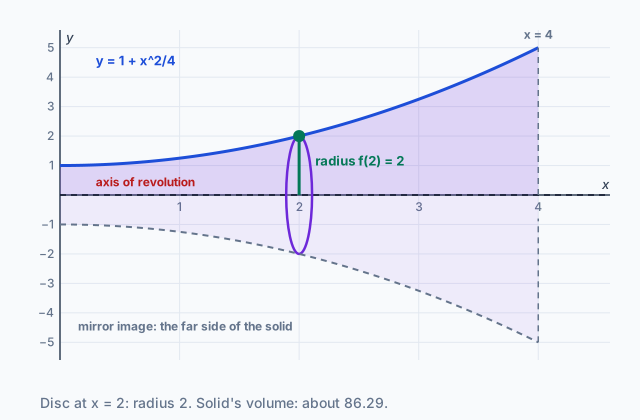 Tap to open the picture full size
Part 1 Think first How much wood is in the cone?
Guess before you learn. A wrong guess still makes the answer stick.
Predict first
A woodworker turns a solid cone on a lathe. It is 6 centimeters long, and its radius grows steadily from 0 at the tip to 3 centimeters at the base. A friend estimates the volume with a cylinder of the same length and the average radius, 1.5 centimeters: , about 42 cubic centimeters. Which range holds the cone's true volume?
In short. The disc method finds the volume of a solid formed by revolving a region around the x- or y-axis, by adding up the circular slices cut perpendicular to that axis with a definite integral.
- Around the x-axis, , where the radius is the height of the region at .
- Around the y-axis, the radius is a width, so write it as a function of and integrate with respect to .
- The limits of integration are values on the axis of revolution, where the slices start and stop.
Part 2 Learn it Three short ideas, each checked as you go
2a. A solid of revolution is a stack of discs
Spin a flat region around a line and it sweeps out a solid of revolution. The line is the axis of revolution.
Take the region under , where , from to , and spin it around the x-axis. Cut the solid with planes perpendicular to the x-axis. Each thin slice is a disc, like a coin. Its radius is the height of the region at that , which is , and its thickness is , so one slice has volume about .
Adding the slices is a Riemann sum, and as the slices get thinner its limit is a definite integral. That is the disc method:
Try it on a shape you already know. The triangle under from to , spun around the x-axis, makes a cone of radius 2 and height 4:
The cone formula gives the same .
Quick check · Multiple choice
No calculator. is the region bounded by the graph of and the two coordinate axes. Which integral gives the volume of the solid formed when is revolved around the x-axis?
2b. Around the y-axis, slice across y
Now spin a region around the y-axis. The slices are still cut perpendicular to the axis, so this time they are horizontal, with thickness . Each one is a disc whose radius is a horizontal distance: how far the region reaches out from the y-axis at height .
So the radius has to be written as a function of . If the region lies between the y-axis and the curve , from to , then
The limits are heights, values of , because the discs stack up along the y-axis.
Take the region bounded by with , the y-axis and the line . Solve the curve for the radius: . Then
The orientation of the axis settles the setup. A horizontal axis means vertical slices and an integral in . A vertical axis means horizontal slices and an integral in .
Quick check · Match
No calculator. Each region is revolved around the axis named. Tap a region, then the integral that gives the volume of its solid.
2c. Getting the setup right
Most wrong disc answers come from the setup, not from the antiderivative.
Square the radius inside the integral. Each disc has area , so the integrand is the radius squared, slice by slice. Squaring after integrating, , gives a different number. When you expand, keep the middle term: , not .
The radius is a distance from the axis, along the slice. Around the x-axis it is the height of the region at . Around the y-axis it is the width of the region at . A square root often disappears here: a radius of gives a disc of area .
Keep in exact answers. Without a calculator, leave the volume as a multiple of , such as . With one, write the integral first and then the decimal.
A quick sanity check: a solid fits inside a cylinder as long as the solid, with its largest radius. The cone in the first idea fits inside a cylinder of volume , and is smaller, as it must be.
Quick check · Decide and justify
No calculator. is the region bounded by the graph of , the x-axis and the line . A classmate writes the volume of the solid formed when is revolved around the x-axis as . Is the classmate right?
Which reason supports your answer?
Part 3 Watch it done A volume around the y-axis, step by step
Watch each step, then do the last one yourself.
is the region in the first quadrant bounded by the graph of and the coordinate axes. Find the volume of the solid formed when is revolved around the y-axis.
Step 1 · Pick the slices
The axis is vertical, so the slices are horizontal discs of thickness . runs from up to , where the curve meets the y-axis.
Why this step?
Why do the limits run from 0 to 9 and not from 0 to 3?
The discs stack along the y-axis, so the limits are heights. The curve meets the x-axis at , which is a width of , not a height.
Step 2 · Write the radius in terms of y
At height the radius is the -value on the curve. From , , so the radius is .
Step 3 · Set up the integral
.
Step 4 · Antidifferentiate
An antiderivative of is , so .
Your step · Calculate
No calculator. Finish it. The volume is , which equals . What is ? Give an exact decimal.
Part 4 Try it A drawer knob and a cone
Try it · Calculate
Graphing calculator required. A wooden drawer knob has the shape of the solid formed when the region under , for , is revolved around the x-axis, with and in centimeters. What is the volume of the knob, in cubic centimeters? Give your answer to three decimal places.
Try it · Decide and justify
No calculator. is the region bounded by the graph of , the y-axis and the line . A classmate finds the volume of the solid formed when is revolved around the y-axis as . Is the classmate right?
Which reason supports your answer?
Part 5 Explain it Write it the way the exam asks
On the exam free response is handwritten, so work on paper first. Nothing you type here leaves this page. Then compare with the model answer and score each point.
Free response is 50% of the exam score. This one is shaped like Question 5, from free-response Part B (calculator not permitted).
Free-response practice · Question 5 style
No calculator. A glassmaker shapes two paperweights from the same flat region. Let be the region in the first quadrant bounded by the graph of and the coordinate axes, where and are measured in centimeters.
(a) The first paperweight is the solid formed when is revolved around the x-axis. Write an integral expression for its volume, and find the volume. Indicate units of measure.
(b) The second paperweight is the solid formed when is revolved around the y-axis. Write an integral expression for its volume, and find the volume. Indicate units of measure.
(c) The glassmaker expects the two paperweights to have the same volume, since both come from . Using your answers to parts (a) and (b), explain why the volumes differ.
Model answer
(a) The slices are vertical discs of radius , for . cubic centimeters.
(b) The slices are horizontal discs. Solving for gives the radius , for . cubic centimeters.
(c) Revolving around different axes makes different solids. Around the x-axis the radii are heights of , up to 8 centimeters, on discs stacked over 2 centimeters. Around the y-axis the radii are widths of , at most 2 centimeters, on discs stacked over 8 centimeters. A disc's volume grows with the square of its radius but only in proportion to its thickness, so the first paperweight is larger: .
Score your own answer. This is a self-check, not a grade. Tick each point your answer makes.
Part 6 Check yourself A candle from a mold
The two case questions use the same table. Answer them from it.
A candle is poured in a mold shaped like a solid of revolution. At a distance of centimeters from the base, measured along the candle's central axis, the cross section is a disc of radius centimeters, where is continuous. The candle is 12 centimeters tall. Some values of are in the table.
| (centimeters) | (centimeters) |
|---|---|
| 0 | 2 |
| 3 | 4 |
| 6 | 5 |
| 9 | 4 |
| 12 | 1 |
Case question 1 · Multiple choice
No calculator. Which expression gives the volume of the candle, in cubic centimeters?
Case question 2 · Calculate
No calculator. Use a right Riemann sum with the four subintervals given by the table to approximate the volume of the candle. The approximation is cubic centimeters. What is ?
The rest stand on their own and do not use the case.
Check yourself · Spot the error
No calculator. is the region bounded by the graph of , the y-axis, the x-axis and the line . A student finds the volume of the solid formed when is revolved around the y-axis. Tap the first line with a mistake.
Check yourself · Fill the statement
No calculator. Tap a blank, then tap an answer.
To find the volume of a solid formed by revolving a region around the y-axis, cut the region into slices to the y-axis. Each disc's radius is then a width of the region, and the integral is taken with respect to .
Part 7 Keep it Bring back earlier ideas
Discs are one kind of cross section, and every volume ends in a definite integral. Pulling both back up is what makes them last.
Bring it back · Multiple choice
No calculator. The base of a solid is the region bounded by the graph of and the coordinate axes. Cross sections perpendicular to the x-axis are semicircles whose diameters lie in the base. Which expression gives the volume of the solid?
From 6.10 Integrating Functions Using Long Division and Completing the Square · Calculate
No calculator. The exact value of can be written as . What is ? Give an exact decimal.
In three lines
- Revolving a region around an axis makes a solid whose slices, cut perpendicular to that axis, are discs.
- Each disc has area , so the volume is times the definite integral of the radius squared.
- Around the x-axis integrate in ; around the y-axis write the radius in and integrate in .
Exam strategy for this topic
- Section I Part A, Multiple Choice (calculator not permitted): 29 questions in 62 minutes.
- Section I Part B, Multiple Choice (graphing calculator required): 13 questions in 38 minutes.
- Section II Part A, Free Response (graphing calculator required): 2 questions in 30 minutes.
- Section II Part B, Free Response (calculator not permitted): 4 questions in 60 minutes.
Write the setup before any arithmetic: with the actual radius, both limits and the differential, and the units of volume, such as cubic centimeters. On a calculator question, show that integral and then the decimal to three places; on a no-calculator question, show the antiderivative and leave in the answer.
Questions students ask
Why is it called the disc method?
Because every slice of the solid, cut perpendicular to the axis, is a flat disc. The integral adds up the volumes of those discs, times a thickness, the way a Riemann sum adds rectangles.
How do I know whether to integrate with respect to or ?
Look at the axis. The slices are perpendicular to it, so a horizontal axis (the x-axis) gives vertical slices and an integral in , and a vertical axis (the y-axis) gives horizontal slices and an integral in .
What if the region does not reach all the way to the axis?
Then each slice has a hole in the middle where the region stops short of the axis, and it is a washer rather than a disc. That is the washer method, which comes a few topics later. The disc method in this lesson is for regions that run right up to the axis.
Do I have to expand the square before integrating?
Only if you need to. A polynomial like is easiest to expand and integrate term by term. Something like simplifies to at once. On a calculator question you can integrate the square as it is.
Should my answer have in it?
Without a calculator, yes: an exact answer such as is the volume. With a calculator, give the decimal to the places the question asks for, after writing the integral that produced it.
Course alignment, for teachers
AP Calculus AB topic 8.9, Unit 8: Applications of Integration.
- Skill 3.D: Apply an appropriate mathematical definition, theorem, or test.
This lesson maps the one essential knowledge statement of the topic to the part that teaches each one: 1 is checked by a scored question. The map is in the lesson file.