Unit 8 · Topic 8.8 · about 30 minutes · 7 parts · 12 scored checks, 3 of them multiple choice, plus 1 from earlier lessons
AP Calculus AB 8.8: Volumes with Cross Sections: Triangles and Semicircles
Unit 8: 10 to 15% of the multiple-choice section
What you'll be able to do
- Calculate the volume of a solid whose cross sections are triangles, semicircles or other shapes by integrating the area of one cross section.
Key vocabulary
| Term | What it means | The exam trap |
|---|---|---|
| Cross section | The flat shape where a plane cuts a solid; in this topic the plane is perpendicular to the -axis or the -axis, and the shape stands on a segment across the base. | The base region is not a cross section. Each cross section stands up out of the base. |
| Triangular cross section | A cross section shaped like a triangle with one side on the slice across the base, such as an equilateral triangle, an isosceles right triangle, or a triangle of stated height. | Name the side of the triangle that lies in the base before you write its area. |
| Semicircular cross section | A cross section shaped like half a disc, standing on the slice across the base with that slice as its diameter. | Write the radius from the slice before you write the area. |
| Volume by cross sections | The definite integral of the cross-section area, , over the interval the base covers along the axis the slices are perpendicular to. | The limits are the ends of the base along that axis, not the heights of the curves. |
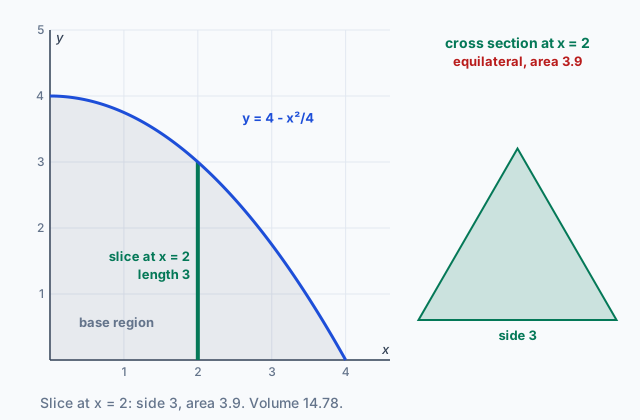 Tap to open the picture full size
Part 1 Think first Same base, half-discs instead of squares
Guess before you learn. A wrong guess still makes the answer stick.
Predict first
A sculptor casts two bronze pieces on the same flat base. In the first, every slice cut straight across the base is a square standing on that slice, and the piece takes 48 liters of bronze. In the second, every slice is a half-disc standing on the same slice, with the slice as its straight edge. About how much bronze does the second piece take?
In short. The volume of a solid with known cross sections is the definite integral of the cross-section area, , where comes from the area formula of the shape that stands on the slice across the base.
- The slice across the base at has length , the top boundary minus the bottom one, and every area formula is written from it.
- Read which part of the shape lies on the slice: a side of a triangle, a leg or a hypotenuse, or the diameter of a semicircle.
- When the cross sections are perpendicular to the -axis, write the slice length in terms of and integrate with respect to .
Part 2 Learn it Three short ideas, each checked as you go
8a. Triangles: one slice, one area
Every solid in this topic is built the same way. Its base is a region in the -plane. Cut the base with a segment perpendicular to the -axis at ; its length is the top boundary minus the bottom one. A flat shape stands on that segment, straight up out of the plane, and its area is . Adding the thin slabs from to gives
So the work is writing from . For a triangle, first read which side sits on the base:
- an equilateral triangle with side has height , so ;
- an isosceles right triangle with a leg on the base has both legs , so ;
- an isosceles right triangle with its hypotenuse on the base has legs , so ;
- a triangle with base and a stated height has .
In the picture at the top, the slice at is 3 long, so the equilateral triangle on it has area , about 3.9.
Quick check · Match
No calculator. The slice across a solid's base at has length . Tap each cross section, then its area .
8b. Semicircles: the slice is the diameter
When the cross sections are semicircles, the problem says where their diameters lie. When the diameters are in the base, the slice of length is the diameter, the radius is , and
Build it from the radius every time instead of trusting a memorized . The two slips students make are using as the radius, which makes every slice four times too big, and dropping the , which gives a whole disc.
Example. The base is the region between and the -axis for , and the cross sections perpendicular to the -axis are semicircles with diameters in the base. The slice is , so and
Square inside the integral. The integral of alone is the area of the base, and squaring that number does not add up the areas of the slices.
Quick check · Calculate
No calculator. The base of a solid is the region in the first quadrant bounded by the line and the coordinate axes. Cross sections perpendicular to the -axis are semicircles with diameters in the base. The volume of the solid is . What is ?
8c. Other shapes, and slices the other way
The same two steps work for any shape whose area you can write from the slice. A full circle with its diameter across the base has , which is how you would find the volume of a funnel from its widths. Sometimes a problem simply gives the area of each cross section as a function, and then you integrate that function as it is.
The cross sections do not have to be perpendicular to the -axis. When they are perpendicular to the -axis, each slice is a horizontal segment at one height . Its length is the right boundary minus the left one, written in terms of , and the volume is , from the lowest of the base to the highest.
Example. The base is the region between and , and the cross sections perpendicular to the -axis are equilateral triangles. At height the slice runs from to , so , and the curves meet where , at and . The volume is
Quick check · Multiple choice
No calculator. The base of a solid is the region bounded by and . Cross sections perpendicular to the -axis are semicircles with diameters in the base. Which integral gives the volume of the solid?
Part 3 Watch it done Triangles on a region between two curves
Watch each step, then do the last one yourself.
The base of a solid is the region bounded by and . Cross sections perpendicular to the -axis are isosceles right triangles with one leg in the base. Find the volume of the solid.
Step 1 · Find the limits
The curves meet where , so , at and . Between them the line is on top: at it is at 2 and the parabola is at 0.
Step 2 · Write the slice and the area
. A leg lies in the base, so both legs are and .
Why this step?
Why is the leg and not just ?
The triangle stands on the segment across the base, which runs from the lower curve up to the upper one, . Its length is the difference. On its own, is the height of the line above the -axis, and the -axis is not the bottom of this base.
Step 3 · Set up and expand
, and .
Step 4 · Integrate the square
.
Your step · Calculate
No calculator. Finish it. For this solid, , and each cross section is an isosceles right triangle with a leg in the base. What is the volume of the solid?
Part 4 Try it A new base, and a comparison
Try it · Calculate
No calculator. The base of a solid is the region between and for . Cross sections perpendicular to the -axis are equilateral triangles. The volume of the solid is . What is ?
Try it · Decide and justify
No calculator. Two solids have the same base. In one, the cross sections perpendicular to the -axis are semicircles with diameters in the base. In the other, they are equilateral triangles with a side in the base. A classmate says the semicircle solid has the greater volume. Is the classmate right?
Which reason supports your answer?
Part 5 Explain it Write it the way the exam asks
On the exam free response is handwritten, so work on paper first. Nothing you type here leaves this page. Then compare with the model answer and score each point.
Free response is 50% of the exam score. This one is shaped like Question 3, from free-response Part B (calculator not permitted).
Free-response practice · Question 3 style
No calculator. A garden designer is pouring a concrete sculpture. Its base is the region bounded by the graph of , the -axis and the line , where and are measured in feet.
(a) In the first design, the cross sections of the sculpture perpendicular to the -axis are semicircles with diameters in . Find the volume of the sculpture. Indicate units of measure.
(b) In a second design with the same base, the cross sections perpendicular to the -axis are equilateral triangles with one side in . Find the volume of this sculpture. Indicate units of measure.
(c) For the first design, the vertical plane cuts the sculpture into two pieces of equal volume. Find the value of .
Model answer
(a) The slice at is , the diameter, so the radius is and . Then cubic feet.
(b) , so cubic feet.
(c) The piece from to holds half of . Since , set . Then , and because , feet.
Score your own answer. This is a self-check, not a grade. Tick each point your answer makes.
Part 6 Check yourself A clay sculpture from a table
The three case questions use the same table. Answer them from it.
An artist builds a clay sculpture on a flat base. The base is the region between the graph of a function and the -axis for , where and are in centimeters, so the slice across the base at is centimeters long. Cross sections of the sculpture perpendicular to the -axis are semicircles with diameters in the base. Some values of are in the table.
| (centimeters) | (centimeters) |
|---|---|
| 0 | 2 |
| 2 | 4 |
| 4 | 8 |
| 6 | 6 |
Case question 1 · Calculate
No calculator. The area of the sculpture's cross section at is square centimeters. What is ?
Case question 2 · Multiple choice
No calculator. A second sculpture has the same base, but its cross sections perpendicular to the -axis are isosceles right triangles with the hypotenuse in the base. Which expression gives its volume in cubic centimeters?
Case question 3 · Calculate
No calculator. Use a right Riemann sum with the three subintervals the table gives to approximate the volume of the semicircle sculpture. The estimate is cubic centimeters. What is ?
The rest stand on their own and do not use the case.
Check yourself · Spot the error
No calculator. The base of a solid is the region between and the -axis for . Cross sections perpendicular to the -axis are isosceles right triangles with the hypotenuse in the base. A student finds the volume. Tap the first line with a mistake.
Check yourself · Sort it
No calculator. Sort each solid by the variable its volume integral uses. Tap a card, then a bin.
Integrate with respect to x
Integrate with respect to y
Part 7 Keep it Bring back earlier ideas
Every volume here starts from a base region and ends with a definite integral. Pulling those two skills back up keeps them ready.
Bring it back · Multiple choice
No calculator. What is the area of the region bounded by the graphs of and ?
From 6.9 Integrating Using Substitution · Calculate
No calculator. Evaluate .
In three lines
- The volume of a solid with known cross sections is the integral of the area of one cross section, .
- For a triangle, name the side on the base: equilateral , a leg , a hypotenuse .
- For a semicircle the slice is the diameter, so ; slices perpendicular to the -axis integrate in .
Exam strategy for this topic
- Section I Part A, Multiple Choice (calculator not permitted): 29 questions in 62 minutes.
- Section I Part B, Multiple Choice (graphing calculator required): 13 questions in 38 minutes.
- Section II Part A, Free Response (graphing calculator required): 2 questions in 30 minutes.
- Section II Part B, Free Response (calculator not permitted): 4 questions in 60 minutes.
Before you integrate, write the area of one cross section as a function of (or ), with the slice as top minus bottom and the radius or leg named. Then write the integral with its limits and . On a part without a calculator, show the antiderivative before the number, and give the volume in cubic units.
Questions students ask
Do I need to memorize and ?
It helps to know them, but you can always build them. A semicircle is half of with , and an equilateral triangle has height , so its area is half of times that height.
How do I know whether to integrate with respect to or ?
Read which axis the cross sections are perpendicular to. Perpendicular to the -axis means each slice sits at one , so you integrate . Perpendicular to the -axis means each slice sits at one , so you write its length in and integrate .
What if the base is between two curves?
The slice runs from the lower curve to the upper one, so its length is top minus bottom, as in the worked example. Find where the curves meet to get the limits.
Is this the same as the disc method?
It is the same idea, integrating the area of one slice, but here the shape stands on a flat base. In 8.9 to 8.12 the slice is a disc or a washer, made by turning a region about a line.
Can a cross section be a shape that is not on the list?
Yes. Any shape whose area you can write from the slice works, such as a full circle with its diameter across the base, a rectangle of given height, or an area function the problem hands you.
Course alignment, for teachers
AP Calculus AB topic 8.8, Unit 8: Applications of Integration.
- Skill 3.D: Apply an appropriate mathematical definition, theorem, or test.
This lesson maps all 2 essential knowledge statements of the topic to the part that teaches each one: 2 are checked by a scored question. The map is in the lesson file.