Unit 7 check
Unit 7 check: Equilibrium
12 questions from 12 lessons in Unit 7. Answer each one, and if you miss, follow the link back to where it is taught, then try again. Your score counts first tries.
Question 1 · from 7.1 · Match
Match each change to the process that reverses it.
Question 2 · from 7.2 · Fill the statement
A closed flask starts with only CO₂ and H₂, the products of CO(g) + H₂O(g) ⇌ CO₂(g) + H₂(g). Complete the description of what happens until equilibrium.
At first only the reaction can occur, so there is a net conversion of to . As the reaction goes on, the forward rate and the reverse rate , until the two rates are equal.
Question 3 · from 7.3 · Select all
A flask of N₂O₄(g) ⇌ 2 NO₂(g) has reached equilibrium at constant temperature. Which two statements are true? Select two.
Select 2 answers, then check.
Setup for question 4
Nitrosyl chloride forms from nitrogen monoxide and chlorine: 2 NO(g) + Cl₂(g) ⇌ 2 NOCl(g). In a sealed vessel at a fixed temperature the equilibrium partial pressures are 0.150 atm for NO, 0.0800 atm for Cl₂ and 0.410 atm for NOCl. These numbers are a teaching example.
A second student fills a 2.00 L flask with 0.500 mol of N₂O₄ at a fixed temperature. After the color stops changing, analysis finds 0.380 mol of N₂O₄ and 0.240 mol of NO₂ in the flask. The student calculates Kc for N₂O₄ ⇌ 2 NO₂. This is a teaching example.
Question 4 · from 7.4 · Calculate
What is Kp for 2 NO(g) + Cl₂(g) ⇌ 2 NOCl(g)? Give your answer to three significant figures.
Setup for question 5
Four reactions, each of the form A ⇌ B, are at equilibrium at the same temperature. Their K values are teaching examples: reaction P, 6.0 × 10⁻⁴; reaction Q, 2.0 × 10⁻⁸; reaction R, 9.0 × 10⁻⁵; reaction S, 1.0 × 10⁻³.
A student then describes the mixture for another reaction, C ⇌ D, with K = 1 × 10⁻²⁰ at a fixed temperature (a teaching example).
Question 5 · from 7.5 · Spot the error
Tap the line with the mistake.
Setup for question 6
Use the same two steps and K values at the same temperature: CH₄(g) + 2 H₂O(g) ⇌ CO₂(g) + 4 H₂(g) has K = (2.60 × 10⁻²)(8.40) = 0.2184 when its two steps are added. A plant operator needs to run it backward, as CO₂(g) + 4 H₂(g) ⇌ CH₄(g) + 2 H₂O(g).
In step 2, CO(g) + H₂O(g) ⇌ CO₂(g) + H₂(g) has K₂ = 8.40. A student writes the same step with every coefficient doubled.
Question 6 · from 7.6 · Decide and justify
The student says that for 2 CO(g) + 2 H₂O(g) ⇌ 2 CO₂(g) + 2 H₂(g), K = 2 × 8.40 = 16.8. Is the student correct?
Which reason supports your decision?
Setup for question 7
Fe³⁺(aq) + SCN⁻(aq) ⇌ FeSCN²⁺(aq) has Kc = 1.0 × 10² at the temperature of the experiment. This is a teaching example, not a measured value. A student prepares four mixtures and records the concentrations before anything has time to change.
| Mixture | [Fe³⁺] | [SCN⁻] | [FeSCN²⁺] |
|---|---|---|---|
| 1 | 0.0020 | 0.0020 | 0.0010 |
| 2 | 0.0050 | 0.0010 | 0.00050 |
| 3 | 0.0100 | 0.0010 | 0.00040 |
| 4 | 0.0010 | 0.0050 | 0.00080 |
Question 7 · from 7.7 · Multiple choice
Using the table: which mixture is at equilibrium?
Setup for question 8
A student drew one closed flask of H₂, I₂ and HI gas every minute, all at one temperature, for the reaction H₂(g) + I₂(g) ⇌ 2HI(g). Each box has the same size and each particle stands for the same amount of gas. These drawings are a teaching example.
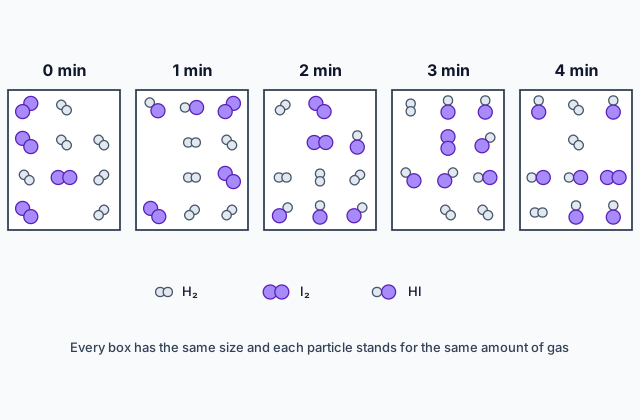 Tap to open the picture full size
Question 8 · from 7.8 · Select all
Using the figure: compare the 3 min box with the 4 min box. Select the two true statements.
Select 2 answers, then check.
Setup for question 9
Co(H₂O)₆²⁺(aq) + 4Cl⁻(aq) ⇌ CoCl₄²⁻(aq) + 6H₂O(l) is at equilibrium. Co(H₂O)₆²⁺ is pink and CoCl₄²⁻ is blue. A student starts four test tubes from the same purple solution at equilibrium, makes one change to each, and records the color. This is a teaching example.
| Tube | Change | Color afterward |
|---|---|---|
| A | Add concentrated hydrochloric acid, a source of Cl⁻ | Bluer |
| B | Add a large volume of water | Pinker |
| C | Place in hot water | Bluer |
| D | Place in ice water | Pinker |
Question 9 · from 7.9 · Select all
Using the table: select the two changes that would also make the solution bluer. Select two.
Select 2 answers, then check.
Question 10 · from 7.10 · Spot the error
A student explains what happens when an equilibrium mixture of 2 NO₂ ⇌ N₂O₄ (Kc = 170) is squeezed to half its volume at constant temperature. Tap the line with the mistake.
Question 11 · from 7.11 · Spot the error
A saturated solution of calcium fluoride, CaF₂, has a molar solubility of 2.0 × 10⁻⁴ M. A student calculates Ksp. Tap the line with the mistake.
Setup for question 12
A chemist collects solid barium sulfate, BaSO₄, on a filter and rinses it. Rinsing dissolves a little of the product and wastes it. BaSO₄ has Ksp = 1.1 × 10⁻¹⁰, a teaching example. The chemist compares rinsing with pure water and with 0.010 M Na₂SO₄ solution.
Question 12 · from 7.12 · Calculate
By what factor is the molar solubility of BaSO₄ in 0.010 M Na₂SO₄ smaller than in pure water? Assume s is tiny next to 0.010 M. Give your answer to two significant figures.
0 of 12 answered.