Unit 1 · Topic 1.1 · about 25 minutes · 7 parts · 9 scored checks, 2 of them multiple choice
AP Macroeconomics 1.1: Scarcity
Unit 1: 5 to 10% of the multiple-choice section
What you'll be able to do
- Define scarcity, and define economic resources as the land, labor and capital used to produce goods and services.
Key vocabulary
| Term | What it means | The exam trap |
|---|---|---|
| Economics | The study of how individuals and societies choose to use scarce resources. | Reading economics as the study of money misses the point: it studies how people choose to use scarce resources, so a question about more money is really asking whether any resource grew. |
| Scarcity | The condition in which resources are too limited to produce everything people want, so choices must be made. | A free or plentiful-looking resource can still be scarce, because scarcity compares the amount available with what people want, not with its price or with anyone's wealth. |
| Economic resources | The inputs used to produce goods and services: land, labor and capital. | Money is not an economic resource, so a bank loan or a pile of savings never belongs on the list; only what the money buys does. |
| Factors of production | Another name for economic resources, the inputs every good and service is made from. | Treat factors of production as the same list as economic resources, land, labor and capital, so a question that switches between the two names is not asking about anything new. |
| Land | Natural resources used in production, such as soil, water, forests and minerals. | Land means every natural resource, including water, forests and ore still in the ground, so do not limit it to soil or farmland. |
| Labor | The effort and time people put into producing goods and services. | Labor is the hours and effort a person puts into production, not the wages paid for them, which are money. |
| Capital | Goods made by people, such as tools, machines and buildings, that are used to produce other goods and services. | Capital in this course means physical things people built to produce other goods, such as an oven or a delivery van, never the money used to buy them. |
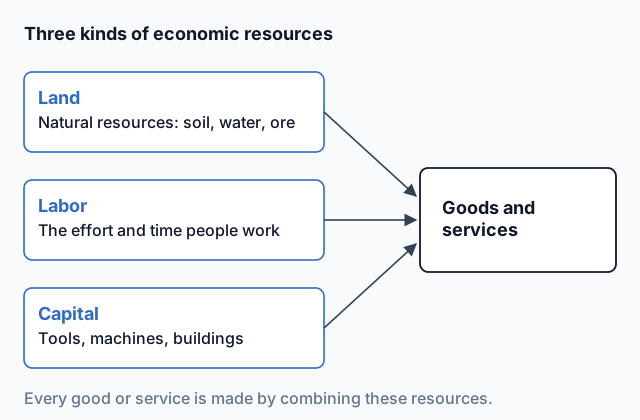 Tap to open the picture full size
Part 1 Think first Twice the money, same island
Make a guess first. Even a wrong guess helps the answer stick.
Predict first
On a small island, every family wakes up to find the money in its bank account has doubled overnight. The island's farms, fishing boats, workers and kitchens were already working flat out before this happened. Next month, how much more food can the island produce?
In short. Scarcity is the gap between what people want and the limited resources available to make it, and that gap forces individuals and societies to make choices.
- A resource is scarce when there is not enough of it for every use people want, even when it is free.
- Economic resources are land, labor and capital: natural resources, the work people do, and the tools and buildings people make to produce other things.
- Because most resources are scarce, putting a resource to one use leaves less of it for every other use.
Part 2 Learn it Three ideas, with a check after each
2a. Scarcity: wants outrun resources
People want more than the world can make. A family wants a bigger apartment and a newer car. A city wants smoother roads and more nurses. The things used to make all of it are limited: there is only so much farmland, so many workers, so many machines. Scarcity is that gap. Resources are too limited to produce everything people want.
Scarcity is not the same as being poor. A billionaire still has a 24-hour day, and a rich country still has a fixed number of workers and acres this year. It is not about price either. On a free bus at rush hour, the seats are scarce, because more riders want them than the bus holds.
So a resource is scarce when there is not enough of it for every use people want. That describes most resources, though not all. The air you breathe on a walk is so plentiful that your breath leaves nobody with less, so economists do not count it as scarce.
Quick check · Decide and justify
A mountain spring flows into the square of a village of 50 people. It runs day and night with far more water than the villagers ever collect, and anyone may take as much as they like. Is the spring's water scarce for the villagers?
Which reason supports your choice?
2b. Land, labor and capital
Economic resources, also called factors of production, are what every good and service is made from. Economists sort them into kinds.
- Land is every natural resource: soil, water, forests, minerals, and the space a building sits on.
- Labor is the work people do, their effort and their time.
- Capital is anything people have made that is used to make other goods and services: a dentist's chair, a delivery truck, a warehouse.
The word that trips students up is capital. In everyday talk it means money. Money can buy resources, but money itself produces nothing. When a bakery borrows $30,000 and buys an oven, the oven is the capital. You will hear money called financial capital later in this course; the factor of production is physical capital, the oven itself.
That is why the island in Think first could not make more food. Its money doubled, and not one of its resources did.
Quick check · Sort it
Tap a resource, then tap the kind of economic resource it is.
Land
Labor
Capital
2c. Scarcity forces choices
Because resources are scarce, every use of a resource is a use it cannot have somewhere else. An orchard's acre planted with apple trees cannot also be a parking lot. A mechanic's Saturday spent on one car is not spent on another. Someone has to decide.
Individuals decide. You have one free evening, and it can go to a concert or to finishing a project, not both. Businesses decide. A pizza shop with two delivery drivers on a Friday night chooses which orders go out first. Societies decide too. A town with one empty lot chooses between apartments and a library, and a country chooses how many of its workers build houses and how many build roads.
More money does not end this. A town that raises taxes can hire more workers, but each worker it hires is then not doing some other job. Scarcity never goes away, so neither does choosing. What a choice gives up has a name and can be measured, and that is the next lesson.
Quick check · Fill the statement
Tap a blank, then tap a word or phrase.
Ines has 15 free hours this week. Her coach wants 10 of them for practice, and the pharmacy where she works wants 12 for shifts. Her hours are , so she has to how to use them, and any hour she gives to practice .
Part 3 Watch it done The resources behind a taco truck
Follow each step, then finish the last one yourself.
Last spring Rosa quit her restaurant job and spent $8,000 of her own savings on a used food truck and a grill. She now sells tacos at a weekend market, where she rents a spot on the grassy field the market is held on, and she and a helper each cook about 30 hours a week. Sort the economic resources her business uses into land, labor and capital.
Step 1 · Labor
The hours Rosa and her helper spend cooking and serving are labor: about 60 hours a week between them.
Step 2 · Land
The spot on the market field is land. It is ground, a natural resource.
Why this step?
Why is the spot still land when Rosa rents it rather than owns it?
What kind of resource something is depends on what it is, not on who owns it. The field is natural ground whether Rosa owns it, rents it or borrows it.
Your step · Multiple choice
Rosa spent $8,000 of her savings on a used food truck and a grill, and she sells tacos from a rented spot on a market field. Which of these is capital in Rosa's taco business?
Part 4 Try it One gym, three teams
A new situation. Scarcity is easiest to see when it costs nobody any money, because then you cannot blame the price. Read the situation and decide which statements hold up.
Try it · Select all
Northside High has one gym. From 3 to 6 p.m. on weekdays, the basketball team, the volleyball team and the dance team each want the whole gym, and it can hold only one group at a time. Using the gym costs the groups nothing. Which two statements are correct? Select two.
Select 2 answers, then check.
Part 5 Explain it Answer a short free-response question
Nothing you type leaves this page.
Free response is 33.35% of the exam score. This one is shaped like Question 2, Short.
Free-response practice · Question 2 style
The country of Pinecrest has large forests, two million workers and a few hundred sawmills. (a) Define scarcity. (b) Identify the kind of economic resource that each of the following is: (i) Pinecrest's forests, (ii) Pinecrest's sawmills. (c) Pinecrest's government discovers a large deposit of copper. Will Pinecrest still face scarcity? Explain.
Model answer
(a) Scarcity is the condition in which resources are too limited to produce everything people want. (b) (i) The forests are land, because they are a natural resource. (ii) The sawmills are capital, because they are buildings and machines made to produce other goods. (c) Yes. The copper adds to Pinecrest's land, but its workers, machines and other resources are still too limited to produce everything its people want, so every worker or machine used to mine copper cannot be used for something else.
Score your own answer. This is a self-check, not a grade. Tick each point your answer makes.
Part 6 Check yourself Read a repair shop's records
Read the table first, then answer the questions from it.
Dana opened Juniper Bikes, a bike repair shop, with her own savings and a $12,000 bank loan, which bought the repair stands. In March, every repair stand was in use during every hour the shop was open. The shop kept these records:
| Item | March |
|---|---|
| Hours worked by the shop's two mechanics | 320 hours |
| Repair stands with tool sets | 4 |
| Shop space rented on Main Street | 900 square feet |
| Bank loan Dana used to buy the stands | $12,000 |
| Repairs customers asked for | 260 |
| Repairs the shop finished | 200 |
Case question 1 · Multiple choice
Which of these items from Juniper Bikes' March records is NOT an economic resource?
Case question 2 · Fill the statement
Tap a blank, then tap a word or number.
In March, customers asked Juniper Bikes for more repairs than the shop finished. The mechanics' hours and the repair stands were , so Dana had to which repairs the shop took on.
The rest stand on their own and do not use the case.
Check yourself · Spot the error
A student listed the economic resources used by Corner Coffee, a small cafe. Tap the first line with a mistake.
Check yourself · Match
Each choice below is forced by one scarce resource. Tap a choice, then tap the kind of economic resource that forces it.
Part 7 Keep it Keep it
In three lines
- Scarcity: resources are too limited to make everything people want.
- The economic resources are land, labor and capital; money is not one.
- Because most resources are scarce, individuals and societies have to choose.
Exam strategy for this topic
- Section I, Multiple Choice: 60 questions in 70 minutes.
- Section II, Free Response: 3 questions in 60 minutes.
- This lesson's Explain it is shaped like free-response question 2, Short.
- A four-function calculator is allowed on both sections of the exam.
When a question asks you to identify a resource, name the kind and give the reason in the same sentence, such as "the sawmill is capital because people built it to produce other goods." Look twice at any item that is money, since money is never land, labor or capital.
Questions students ask
Is money a factor of production?
No. Money buys land, labor and capital, but it produces nothing by itself. Later in the course you will hear money called financial capital; the factor of production is physical capital, such as the oven a bakery buys.
If something is free, how can it be scarce?
Scarcity compares how much of a resource exists with how much people want, so price has nothing to do with it. Seats on a free bus at rush hour are scarce because more riders want them than the bus holds.
Do rich countries escape scarcity?
No. A rich country still has a fixed number of workers, acres and machines this year, and its people still want more than those can make. Every worker hired for one job is not doing another.
My textbook lists entrepreneurship as a fourth resource. Which is right?
Both approaches are in use. Many textbooks add entrepreneurship, the work of starting a business, bringing the other resources together and taking the risk that it fails, while others count it as a kind of labor. This lesson sorts resources into land, labor and capital.
Is every resource scarce?
Most are, but not all. Air on an ordinary walk is so plentiful that your breathing leaves nobody else with less, so economists do not count it as scarce.
Course alignment, for teachers
AP Macroeconomics topic 1.1, Unit 1: Basic Economic Concepts.
- Skill 1.A: Describe economic concepts, principles, or models.
This lesson maps the one essential knowledge statement of the topic to the part that teaches each one: 1 is checked by a scored question. The map is in the lesson file.