Timed practice
Full practice exams
Pick an exam. Each one shows its format first, then runs one section at a time on its own clock.
Practice Exam 1
42 multiple-choice and 4 free-response questions, in the format of the AP Physics 2: Algebra-Based Exam.
| Section | Questions | Time |
|---|---|---|
| Section I: Multiple Choice | 42 | 85 minutes |
| Section II: Free Response | 4 | 95 minutes |
A four-function, scientific, or graphing calculator is allowed on both sections of the exam.
How the exam works
- One section at a time. When a section's clock reaches zero, the section ends and is scored.
- Multiple choice is scored when its section ends, with an explanation for every choice.
- Free response is never scored by the page. When the section ends, you see the scoring guide and a model response for each part and tick the points your answer earns.
- At the end you get your score and the time you used for each section.
- In study mode each multiple-choice answer is checked as soon as you give it, with its explanation, and each free-response question has a button that opens its scoring guide.
- Switching to study mode partway keeps your answers and checks the ones you have given. Start over clears everything and lets you choose a mode again.
- Your answers are kept in this browser tab if the page reloads, and nowhere else.
Section I: Multiple Choice
-
Two rigid containers hold helium gas. The gas in container X is at 300 K and the gas in container Y is at 1200 K. How does the average speed of the helium atoms in Y compare with the average speed in X?
Answer: C.
- A
This treats speed as proportional to temperature. It is the average kinetic energy, not the speed, that quadruples.
- B
The atoms have the same mass, but the temperatures differ, and temperature sets the average kinetic energy of the atoms.
- C
The average kinetic energy of the atoms is proportional to the absolute temperature, and kinetic energy depends on the square of speed. Quadrupling the temperature doubles the typical speed.
- D
A hotter gas has faster atoms, not slower ones. The speed rises with temperature.
- A
-
A fixed amount of ideal gas is in a cylinder with a movable piston. It starts at pressure , volume , and absolute temperature . The gas is heated at constant pressure until its volume is . The piston is then locked and the gas is cooled until its pressure is . What is the final absolute temperature?
Answer: A.
- A
At constant pressure, is constant, so the first step takes the gas to . At constant volume, is constant, so halving the pressure halves the temperature again, giving .
- B
This multiplies the temperature by 3 and then by 2 again. Cooling at constant volume lowers the pressure and the temperature together, so the second factor is .
- C
This stops after the heating step. The cooling step lowers the temperature as well.
- D
This applies only the cooling step to the starting temperature. The gas was heated first, so it cools from , not from .
- A
-
A 0.50 kg block of copper at 100 C is dropped into 0.50 kg of water at 20 C in an insulated container. The specific heat of copper is 390 J/(kgK) and the specific heat of water is 4200 J/(kgK). What is the final temperature of the block and water?
Answer: D.
- A
This averages the two temperatures. The masses are equal, but the specific heats are not, so the average is not the final temperature.
- B
This swaps the two specific heats, which puts the final temperature near the copper's starting value.
- C
Water's large specific heat keeps the change small, but not zero. The water still gains energy from the copper and warms by almost 7 C.
- D
Energy lost by the copper equals energy gained by the water: . This gives C. The water has the larger heat capacity, so the final temperature is close to its starting temperature.
- A
-
Questions 4 to 5 refer to the following.
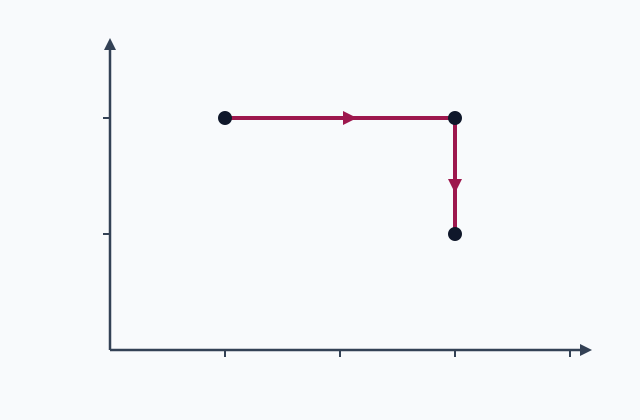
A fixed amount of ideal gas expands from state A to state B at a constant pressure of Pa. The volume rises from m to m. The gas is then cooled at constant volume to state C, where its pressure is Pa. The figure shows the process on a pressure-volume diagram.
How much work does the gas do on its surroundings as it goes from A to B?
Answer: B.
- A
This takes half of , as if the area under the process were a triangle. The pressure stays constant, so the area under the line is a rectangle.
- B
At constant pressure, J. The gas expands, so it does positive work on its surroundings.
- C
This multiplies the pressure by the final volume instead of the change in volume. Only the change in volume counts as work.
- D
This is the work done on the gas. The gas expands, so the work it does on its surroundings is positive.
- A
-
Uses the material above question 4.
A student claims that during the process from B to C the gas transfers thermal energy to its surroundings. Which piece of evidence from the figure best supports the claim?
Answer: D.
- A
A pressure drop at constant volume is not an expansion. The gas does no work, so the energy leaves as thermal energy.
- B
No work is done, but energy can still leave as thermal energy. A drop in temperature shows that it does.
- C
A zero area means zero work, not zero change in internal energy. The temperature falls, so the internal energy falls too.
- D
With no change in volume, no work is done. The pressure drops at constant volume, so the temperature drops, and the internal energy falls. By the first law, the gas must transfer that much thermal energy out.
- A
-
Block X is small and is at 80 C. Block Y is much larger and is at 20 C. They are placed in contact inside an insulated box. Which statement about their thermal interaction is correct?
Answer: A.
- A
Thermal energy flows from the higher-temperature object to the lower-temperature one until the temperatures match. The total amount of thermal energy in each block does not decide the direction.
- B
Direction depends on temperature, not on total energy. X is hotter, so energy goes from X to Y.
- C
Transfer stops when the temperatures are equal. The larger block would hold much more energy at that point.
- D
The insulation keeps energy from leaving the box. It does not stop energy from moving between the two blocks inside it.
- A
-
A cup of hot coffee sits in a cooler room and slowly cools to room temperature. Which statement about entropy is consistent with the second law of thermodynamics?
Answer: C.
- A
A decrease in one part can be allowed, but only if another part gains more. The total cannot decrease for a spontaneous process.
- B
Energy flowing into the room raises the room's entropy. Both parts cannot lose entropy while energy spreads out.
- C
The coffee loses entropy as it cools, but the room gains more than the coffee loses. The total entropy of the coffee and room together increases, as the second law requires for a spontaneous process.
- D
Energy is conserved, but entropy is not. The entropy of the combined system increases in this process.
- A
-
Two small charged spheres exert an electric force of magnitude on each other. The charge on one sphere is tripled, and the distance between the spheres is doubled. What is the new magnitude of the force?
Answer: B.
- A
This divides by 2 instead of by . Electric force depends on the square of the distance.
- B
The force is proportional to the product of the charges and inversely proportional to the square of the distance. The factor is .
- C
This multiplies by the distance factor instead of dividing. A larger distance weakens the force.
- D
This multiplies by 4 for the distance change. Doubling the distance divides the force by 4.
- A
-
Four identical point charges, each of charge , sit at the corners of a square of side . Which expression gives the magnitude of the net electric force on one of the charges due to the other three?
Answer: A.
- A
The two neighbors each push with , at right angles, so together they give along the diagonal. The opposite corner is away and pushes along the same line with . These add to .
- B
This adds the three magnitudes as numbers. The two side forces are perpendicular, so they combine as vectors, not by simple addition.
- C
This leaves out the charge at the opposite corner. It also pushes along the diagonal and adds to the net force.
- D
This uses a distance of for the opposite corner. That corner is away, so its force is , not .
- A
-
A neutral metal sphere stands on an insulating base. A negatively charged rod is brought near the sphere without touching it. A student briefly touches the far side of the sphere with a finger, then removes the finger, and then removes the rod. What is the charge of the sphere afterward?
Answer: D.
- A
The rod never touches the sphere, and the finger lets electrons leave rather than arrive. The sphere ends up short of electrons.
- B
Charge flowed off the sphere through the finger. That changed the net charge, so the sphere is no longer neutral.
- C
The charge separation disappears when the rod is removed. The net charge left behind spreads over the whole conductor.
- D
The rod repels electrons in the sphere, and the finger gives those electrons a path to leave. The sphere is left with fewer electrons than protons. After the rod is removed, the extra positive charge spreads over the whole sphere.
- A
-
A point charge of C is fixed at , and a point charge of C is fixed at m. Use Nm/C. What is the electric field at the midpoint, m?
Answer: B.
- A
The fields cancel only when they point in opposite directions. Here both point the same way.
- B
The positive charge pushes away from itself and the negative charge pulls toward itself. At the midpoint both fields point toward the negative charge. Each is N/C, so they add to N/C.
- C
This is the field of one charge alone. The second charge adds the same amount in the same direction.
- D
The size is correct, but the direction is reversed. A field points away from a positive charge and toward a negative one.
- A
-
A uniform electric field points in the direction. Point P is at the origin, point Q is at m on the -axis, and point R is at m on the -axis. How do the electric potentials at the three points compare?
Answer: C.
- A
This has the potential rising along the field. Electric potential falls in the direction of the field.
- B
R is farther from P, but distance alone does not change the potential. Only the displacement along the field matters.
- C
Potential decreases in the direction of the field, so is lower than . P and R lie on a line perpendicular to the field, which is an equipotential, so .
- D
Only points on a line perpendicular to the field share a potential. Q lies along the field, so its potential is different.
- A
-
A F capacitor is fully charged by a 12 V battery. How much energy is stored in the capacitor?
Answer: A.
- A
The stored energy is J.
- B
This uses , which leaves out the factor of . The potential difference builds up as charge is added, so the average is half.
- C
This is the charge in coulombs, not an energy.
- D
This uses , which is not an energy. The potential difference must be squared.
- A
-
A particle of mass and charge is released from rest at a positive plate. It accelerates across a potential difference to a negative plate in a vacuum. Which expression gives its speed at the negative plate?
Answer: D.
- A
This drops the factor of 2 from the kinetic energy. The kinetic energy is .
- B
This is , not . The square root is the last step.
- C
This puts the charge and mass in the wrong places. A larger mass must give a smaller speed.
- D
The electric potential energy lost, , becomes kinetic energy: . Solving gives .
- A
-
A wire has resistance . A second wire is made of the same material and has twice the length and twice the diameter of the first. What is the resistance of the second wire?
Answer: C.
- A
This treats the diameter change as a factor of 2, so the two doublings cancel. Area depends on the square of the diameter.
- B
This counts only the longer length. The thicker wire also has more area for the current to flow through.
- C
Resistance is . Doubling the length doubles . Doubling the diameter quadruples the cross-sectional area, which divides by 4. The net factor is .
- D
This counts only the larger area. The wire is also twice as long, which doubles the resistance.
- A
-
A battery of emf and negligible internal resistance is connected across two resistors, and , wired in series. Which expression gives the total power dissipated in the two resistors?
Answer: B.
- A
This gives each resistor the full emf, which is true only for resistors in parallel. In series they share the emf.
- B
In series the equivalent resistance is , and the battery delivers .
- C
This is the power in alone. The question asks for both resistors.
- D
This multiplies by the resistance. Power falls as the resistance rises.
- A
-
Questions 17 to 18 refer to the following.
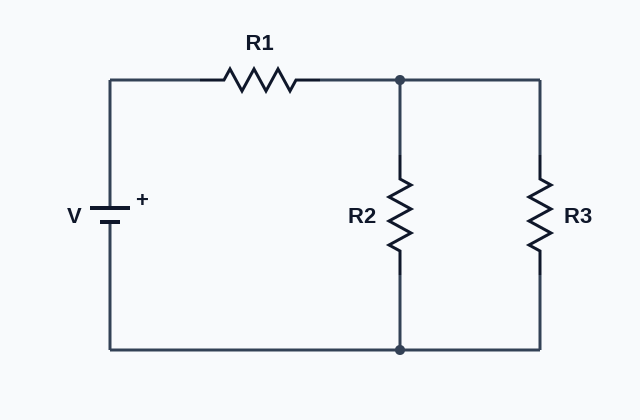
An ideal battery of emf is connected to a resistor in series with a parallel pair of resistors, and . The figure shows the circuit.
Which expression gives the current supplied by the battery?
Answer: D.
- A
This adds all three resistances as if they were in series. and share the same two junctions, so they are in parallel.
- B
This puts in parallel with the sum of and . The actual parallel pair is with .
- C
This gives every resistor the full emf and adds the currents, which describes three parallel branches. is in series with the others.
- D
The parallel pair acts like one resistor of , and it is in series with . The current is the emf divided by that total.
- A
-
Uses the material above question 17.
The battery in the circuit has V. The resistors are , , and . What is the current in ?
Answer: A.
- A
The parallel pair has , so the total resistance is and the battery supplies 1.5 A. The potential difference across is 6.0 V, which leaves 6.0 V across the pair. Then A.
- B
This splits the 1.5 A equally between the two parallel resistors. The larger resistor takes less current.
- C
This applies the full 12 V to , or it is the current in . Part of the emf is used up in .
- D
This is the total current from the battery. Only part of it goes through .
- A
-
Three identical bulbs are connected to a battery with negligible internal resistance. Bulb A is in series with the battery, and bulbs B and C are connected in parallel with each other, in series with A. Bulb C is then removed from its socket. What happens to the brightness of bulbs A and B?
Answer: B.
- A
B and C were in parallel, so removing C changes the total resistance of the circuit and the current in A.
- B
Removing C raises the resistance of the parallel part, so the total resistance goes up and the battery supplies less current. A dims. All of A's current now goes through B, which was getting only half of it before, so B brightens.
- C
The total resistance rises, so the battery supplies less current. Bulb A carries that current, so it must dim.
- D
The total resistance rises, so the current in A falls. Only B gets more current, because it now carries all of it.
- A
-
A single-loop circuit contains a 12 V battery, a resistor, a resistor, and a second battery of emf 3.0 V wired so that it opposes the 12 V battery. The 3.0 V battery is then turned around so that it aids the 12 V battery. How does the current change? Both batteries are ideal.
Answer: C.
- A
This reverses the order. The opposing arrangement is the first one, and it gives the smaller current.
- B
This ignores the second battery after the reversal. It still adds its emf to the loop.
- C
The loop rule gives A when the batteries oppose, and A when they aid.
- D
The resistance is unchanged, but the net emf in the loop changes from 9.0 V to 15 V, so the current changes.
- A
-
A student charges a capacitor through a resistor from a battery and claims that the capacitance is F. Which measurement would support the claim?
Answer: D.
- A
After one time constant the current has fallen to about 37% of its starting value, not 63%.
- B
A charging capacitor approaches the full emf but never reaches it in a finite time.
- C
A time constant of 0.040 s would match a capacitance of F, 100 times smaller than the claim.
- D
The time constant is s. After one time constant, a charging capacitor has reached about 63% of its final voltage.
- A
-
A long straight wire carries a current , and the magnetic field at a distance from the wire has magnitude . The current is doubled, and the field is then measured at a distance from the wire. What is the magnitude of the field at that point?
Answer: B.
- A
This changes the distance but leaves out the larger current. The field is proportional to the current.
- B
The field of a long straight wire is proportional to . Doubling and quadrupling gives a factor of .
- C
This treats the field as dropping with the square of the distance. For a long straight wire it drops as .
- D
This assumes the two changes cancel. The distance factor of 4 is larger than the current factor of 2.
- A
-
A particle of mass and charge is accelerated from rest through a potential difference . It then enters a region of uniform magnetic field , perpendicular to its velocity. Which expression gives the radius of its circular path?
Answer: A.
- A
The speed is . The magnetic force supplies the centripetal force, so . Substituting for gives .
- B
This is the speed divided by . The radius is , so the mass and charge must be rearranged.
- C
This drops the 2 that comes from the kinetic energy. The speed is .
- D
This skips the square root when finding the speed, so the mass and charge cancel. The speed really is .
- A
-
A proton moves in the direction and enters a region where the magnetic field points into the page, which is the direction. What is the direction of the initial magnetic force on the proton?
Answer: C.
- A
This is the direction for a negative charge, or for a field pointing out of the page.
- B
The force is always perpendicular to both the velocity and the field, so it cannot point along either of their directions.
- C
For a positive charge, . The cross product of with points in the direction.
- D
The velocity has a component perpendicular to the field, so there is a force. Only a charge moving along the field feels none.
- A
-
A straight wire carries a current in a uniform magnetic field and is perpendicular to the field. It feels a magnetic force of magnitude . The current in the wire is tripled, and the field is cut in half, with the same length of wire in the field. What is the new force?
Answer: B.
- A
This counts the tripled current but not the weaker field.
- B
The force on the wire is . Tripling and halving gives a factor of .
- C
This multiplies by the 2 instead of dividing. A weaker field gives a smaller force.
- D
This divides by the 3 and by the 2. The current is tripled, so that factor multiplies.
- A
-
A coil of 10 turns has a cross-sectional area of 0.050 m. A uniform magnetic field perpendicular to the coil increases steadily from 0.20 T to 0.60 T in 0.10 s. What is the magnitude of the average emf induced in the coil?
Answer: D.
- A
This leaves out the number of turns. Each turn contributes the same emf.
- B
This uses the final field instead of the change in the field. The emf depends on how much changes.
- C
This multiplies by the time instead of dividing by it. A faster change gives a larger emf.
- D
Faraday's law gives V.
- A
-
A person stands 2.0 m in front of a flat mirror and then walks 1.0 m toward it. How far is the person from her image after she has walked?
Answer: A.
- A
In a flat mirror the image is as far behind the mirror as the object is in front. After walking, she is 1.0 m from the mirror and her image is 1.0 m behind it, so they are 2.0 m apart.
- B
This is the distance from the person to the mirror. The image is behind the mirror, farther away.
- C
This adds the old and new distances. The image distance equals the new object distance, 1.0 m.
- D
This is the separation before she moved. She is now closer to the mirror, and so is her image.
- A
-
An object is placed a distance from a concave mirror of focal length , with . Which expression gives the image distance ?
Answer: C.
- A
This has the wrong sign in the denominator. It would follow from .
- B
This is the reciprocal of the correct form, so its units are wrong. An image distance must have units of length.
- C
The mirror equation is . Solving for the image distance gives .
- D
This is not a solution of the mirror equation. It is only a guess based on how the two distances compare.
- A
-
A ray of light in air strikes the flat surface of a glass block at an angle of 30 from the normal. The index of refraction of the glass is 1.50. What is the angle of the refracted ray from the normal?
Answer: D.
- A
This swaps the two indices of refraction. Light entering glass bends toward the normal.
- B
This leaves the ray undeviated, which would require equal indices of refraction.
- C
This halves the angle. Snell's law relates the sines of the angles, not the angles themselves.
- D
Snell's law gives , so and .
- A
-
Light travels in glass of index 1.50 toward a boundary with air at an angle of incidence of 45. Which statement describes what happens?
Answer: B.
- A
Light leaving glass for air bends away from the normal, not toward it. At this angle, no light leaves at all.
- B
The critical angle satisfies , so . The angle of incidence, 45, is greater than the critical angle, so all the light is reflected.
- C
Light would bend away from the normal at an angle of incidence below about 42. At 45 the refracted ray would need an angle past 90.
- D
Glass and air are both transparent. The light is reflected at the boundary, not absorbed.
- A
-
An object is placed at a distance of from a thin converging lens of focal length , and the image forms at on the other side. The object is then moved to a distance of from the lens. What is the new image distance?
Answer: A.
- A
The thin lens equation gives , so . The image moves closer to the lens as the object moves away.
- B
This assumes the image distance always equals the object distance, which holds only at .
- C
This keeps the image where it was. Moving the object changes the image distance.
- D
This puts the image at the focal point, which happens only for an object infinitely far away.
- A
-
A pulse travels at speed along a taut string. The tension in the same string is then quadrupled. What is the speed of a pulse on the string now?
Answer: B.
- A
This makes the speed proportional to the tension. It is proportional to the square root of the tension.
- B
Wave speed on a string is . The mass per length stays the same, so quadrupling the tension doubles the speed.
- C
A tighter string carries pulses faster, not slower.
- D
The speed depends on the properties of the medium, and tension is one of them.
- A
-
A periodic wave of frequency 5.0 Hz and wavelength 0.40 m travels along a string. The source frequency is increased to 10 Hz, and the string and its tension are unchanged. Which claim about the new wave is correct?
Answer: C.
- A
The speed does not depend on the source frequency. If the speed doubled and the wavelength stayed the same, the string would have to change.
- B
Doubling the frequency does not double the speed. The wavelength shortens instead.
- C
The wave speed is set by the string and its tension, so it stays m/s. With Hz, the wavelength is m.
- D
The speed would drop only if the string changed. A higher frequency alone does not slow the wave.
- A
-
A source at rest emits sound of frequency 600 Hz. A student walks toward the source at a steady speed and hears one frequency. The student then turns around and walks away from the source at the same speed. Which pair of measured frequencies is consistent with the Doppler effect?
Answer: A.
- A
An observer moving toward a source meets wave crests more often and hears a higher frequency. Moving away, the observer hears a lower one. For an observer moving at the same speed, the shifts are equal in size and opposite in sign.
- B
This reverses the shifts. Moving toward a source raises the frequency heard.
- C
The source is at rest, but the observer is moving. The observer's motion still changes the rate at which crests arrive.
- D
The frequency heard is higher only while the student walks toward the source. Walking away lowers it.
- A
-
A string of length is fixed at both ends and held at tension . Its mass per unit length is . Which expression gives the frequency of its lowest-frequency standing wave?
Answer: D.
- A
This uses a wavelength of . Both ends are nodes, so the lowest standing wave fits half a wavelength into the string.
- B
This inverts the ratio inside the square root. A tighter string must vibrate at a higher frequency.
- C
This multiplies by the length. A longer string has a lower frequency, so must be in the denominator.
- D
The lowest standing wave has a wavelength of . The wave speed is , so .
- A
-
Light of wavelength 600 nm passes through two narrow slits that are 0.20 mm apart. A screen is 2.0 m from the slits. What is the spacing between adjacent bright fringes near the center of the pattern?
Answer: C.
- A
This is off by a factor of 10, which comes from mishandling the units of the slit separation.
- B
This doubles the screen distance a second time. The spacing is .
- C
For small angles, the fringe spacing is m.
- D
This halves the correct result. The spacing between bright fringes needs no factor of .
- A
-
A thin soap film of index of refraction 1.33 hangs in air. Light of wavelength 600 nm in air strikes it at nearly normal incidence. What is the smallest nonzero film thickness for which the reflected light is brightest?
Answer: B.
- A
This uses the wavelength in air. The path difference is measured in the wavelength inside the film.
- B
The reflection from the front surface is inverted, and the one from the back surface is not, so constructive interference needs . With nm, the smallest thickness is nm.
- C
This is half the wavelength in the film. At that thickness the two reflected waves are a whole wavelength out of step, so they cancel.
- D
This is the full wavelength in the film. At that thickness the path difference is two whole wavelengths, but with one inverted reflection that gives destructive interference.
- A
-
What is the energy of a photon of light with a wavelength of 500 nm? Use eVnm.
Answer: A.
- A
The photon energy is eV.
- B
This divides by twice the wavelength. The wavelength is 500 nm.
- C
This is off by a factor of 10. Check that is about 2.5.
- D
This multiplies instead of dividing. A longer wavelength means a smaller photon energy.
- A
-
In the Bohr model of hydrogen, the energy levels are . Photon X is emitted when an electron drops from to , and photon Y is emitted when an electron drops from to . How do their wavelengths compare?
Answer: C.
- A
This inverts the relationship. The photon with less energy has the longer wavelength.
- B
This takes the ratio of the level numbers. The energy gaps are what matter, and they are not in that ratio.
- C
Photon X has an energy of 13.6(1/4 - 1/9) = 1.9 eV and photon Y has 13.6(1 - 1/4) = 10.2 eV. Wavelength is inversely proportional to photon energy, so X has a wavelength about 5.4 times longer.
- D
The levels are not evenly spaced, so a one-level drop gives different energies at different places.
- A
-
Questions 40 to 41 refer to the following.
A student shines light of different frequencies on a metal surface and measures the stopping potential, the smallest potential difference that stops the emitted electrons from reaching the collector. The table gives the results.
Frequency ( Hz) Stopping potential (V) 6.0 0.48 8.0 1.31 10.0 2.14 A student claims that the work function of the metal is about 2.0 eV. Which analysis of the data supports the claim?
Answer: D.
- A
The work function is a property of the metal and does not change with the light. The stopping potential rises because the photon energy rises.
- B
The stopping potential measures the leftover kinetic energy of the electrons, not the energy needed to free them.
- C
The slope of that graph is , a constant that does not depend on the metal. The work function comes from the intercept.
- D
The maximum kinetic energy is . The graph is a straight line, and it crosses zero at the threshold frequency, where . A threshold near Hz gives eV.
- A
-
Uses the material above question 40.
The student now doubles the intensity of the 8.0 10 Hz light, without changing its frequency. What happens to the stopping potential and to the photocurrent when the potential difference is zero?
Answer: A.
- A
The stopping potential depends on the photon energy, which depends only on frequency. Doubling the intensity doubles the number of photons per second, so twice as many electrons are emitted.
- B
A higher intensity does not give each electron more energy. The stopping potential is set by frequency.
- C
The stopping potential does not change, and more photons mean more electrons, so the current does change.
- D
Each photon still ejects an electron, and there are twice as many photons per second. The photocurrent doubles.
- A
-
A sample contains 8.0 mg of a radioactive isotope with a half-life of 3.0 days. How much of the isotope remains after 9.0 days?
Answer: B.
- A
This is the amount after two half-lives. Nine days is three half-lives.
- B
Nine days is three half-lives. The amount is halved three times: mg.
- C
This divides by 3 as if the sample decayed at a steady linear rate. Decay is exponential.
- D
This is the amount after one half-life. Nine days is three half-lives.
- A
Section II: Free Response
-
Question 1: Mathematical Routines 10 points
A vertical cylinder holds moles of a monatomic ideal gas beneath a frictionless piston that is free to move. The weight of the piston and the air above it keep the gas at a constant pressure . The gas starts at temperature and volume . A heater slowly adds thermal energy to the gas until its volume is . The internal energy of a monatomic ideal gas is .
Respond to parts (a), (b), (c), (d) and (e). Show your work for each part.
-
(a)
Derive an expression for the final temperature of the gas. Express your answer in terms of . Begin your derivation by writing a fundamental physics principle or an equation from the reference information.
Score part (a)
Model response
At constant pressure the ideal gas law gives . With , the final temperature is .
-
(b)
Derive an expression for the work done by the gas on the piston as it expands. Express your answer in terms of , and , as appropriate. Your answer need not contain every one of these symbols.
Score part (b)
Model response
At constant pressure, . The gas law at the start gives , so .
-
(c)
Derive an expression for the thermal energy the gas takes in during the expansion. Express your answer in terms of , and , as appropriate. Your answer need not contain every one of these symbols.
Score part (c)
Model response
The first law, with the work done by the gas, gives . Here and , so .
-
(d)
The sample is mol of gas, and K. Calculate the numerical value of . Use J/(molK).
Score part (d)
Model response
J.
-
(e)
Suppose the same thermal energy from part (c) were instead added to the same gas while the piston is held fixed, so the volume stays . Is the final temperature greater than, less than, or equal to ? Justify your answer with a calculation.
Score part (e)
Model response
The final temperature is greater. With the piston fixed the gas does no work, so all of goes into internal energy: , so and , which exceeds .
Your score: 0 of 10, from the boxes you ticked.
-
-
Question 2: Translation Between Representations 12 points
A thin converging lens has a focal length of 10 cm. A small arrow, 3.0 cm tall, stands upright on the principal axis, 15 cm from the lens. Light travels from left to right, and the object is on the left.
Respond to parts (a), (b), (c) and (d). Draw any diagram or graph on your own paper.
-
(a)
Draw a ray diagram on your own paper that locates the image. Mark the focal points on both sides of the lens, draw the object arrow, and draw two principal rays from the top of the object. Extend the rays until they show where the image forms, and draw the image.
Score part (a)
Model response
Draw the lens as a vertical line with focal points at 10 cm on each side. One ray leaves the top of the object parallel to the axis and bends through the right-hand focal point. A second ray runs straight through the center of the lens. The two rays cross about 30 cm to the right of the lens. The image is an inverted arrow with its tip at the crossing point, and it is twice as tall as the object.
-
(b)
Calculate the distance of the image from the lens and the height of the image.
Score part (b)
Model response
The thin lens equation gives , so cm. The magnification is , so the image is inverted and 6.0 cm tall.
-
(c)
The object is moved to a series of distances greater than 10 cm, and the image distance is found for each. Sketch a graph of against for values of from just above 10 cm to about 50 cm. Label the point that corresponds to the object distance of 15 cm in part (a).
Score part (c)
Model response
The graph is a curve that starts very high just above cm, falls quickly through the labeled point (15 cm, 30 cm) and through (20 cm, 20 cm), and then flattens as it approaches cm, the focal length, for large .
-
(d)
The converging lens is replaced by a diverging lens of focal length cm at the same position, with the object unchanged. (i) State whether the image is real or virtual, upright or inverted, and larger or smaller than the object. (ii) Calculate the distance of the image from the lens.
Score part (d)
Model response
A diverging lens spreads the rays, so they never meet, and the image is virtual, upright, and smaller. The lens equation gives , so cm: the image is 6.0 cm from the lens on the object's side.
Your score: 0 of 12, from the boxes you ticked.
-
-
Question 3: Experimental Design and Analysis 10 points
A student is given a long uniform wire of an unknown alloy, with a diameter of 0.50 mm, stretched along a meterstick. The student also has a battery, a switch, a variable resistor, an ammeter, a voltmeter, connecting wires, and two clips that can be attached to the wire at any two positions. The student also has several more wires of the same alloy with different diameters, and a micrometer. The student wants to find the resistivity of the alloy.
Resistance of the wire between the clips Length (m) Resistance () 0.20 1.2 0.40 2.2 0.60 3.4 0.80 4.5 1.00 5.6 Respond to parts (a), (b), (c) and (d). Draw any graph on your own graph paper.
-
(a)
Describe how the student can use the equipment to measure the resistance of the wire between the clips. You may include a circuit diagram on your own paper, and you must say which measurements to make and how to calculate the resistance from them.
Score part (a)
Model response
Connect the battery, switch, variable resistor, ammeter, and the wire between the two clips in one loop. Connect the voltmeter across the clips, so it reads the potential difference across just that length of wire. Close the switch, read on the ammeter and on the voltmeter, and calculate . Repeat for each length.
-
(b)
On your own graph paper, plot the data from the table, with resistance on the vertical axis and length on the horizontal axis. Label the axes with units and use a scale that fills most of the page, then draw a straight best-fit line.
Score part (b)
Model response
The axes are labeled (m) and (), with scales running to 1.0 m and to 6 . The five points lie close to a straight line through the origin, and the best-fit line passes through about (0, 0) and (1.00 m, 5.6 ).
-
(c)
Use your best-fit line to calculate an experimental value for the resistivity of the alloy.
Score part (c)
Model response
The resistance is , so the slope of against is . The best-fit line has a slope of about 5.6 /m. The area is m. Then m.
-
(d)
The student now wants to test the claim that the resistance of a wire of this alloy is inversely proportional to the area of its cross section. Describe an experimental procedure to test the claim, and say how the data would be analyzed to decide whether it is true.
Score part (d)
Model response
Obtain several wires of the same alloy and the same length with different diameters. Measure each diameter with a micrometer, and find each resistance by measuring and as in part (a). Calculate for each wire and graph against (or against ). If the graph is a straight line through the origin, resistance is inversely proportional to area.
Your score: 0 of 10, from the boxes you ticked.
-
-
Question 4: Qualitative/Quantitative Translation 8 points
A square wire loop of side and total resistance lies in the plane of the page and is pulled to the right at a constant speed by an outside agent. Its right edge enters a region of uniform magnetic field of magnitude that points into the page. The field occupies the region to the right of a vertical boundary, and the loop is only partly in the field, with its right edge still moving inside it. The magnetic force on the loop is the only force the agent must overcome.
Respond to parts (a), (b), (c) and (d).
-
(a)
State whether the induced current in the loop is clockwise or counterclockwise as viewed from above the page. Justify your answer qualitatively, without a calculation.
Score part (a)
Model response
The current is counterclockwise. As more of the loop enters the field, the magnetic flux into the page through it increases. By Lenz's law the induced current produces a field that opposes this change, so inside the loop its field points out of the page. A counterclockwise current produces a field out of the page inside the loop.
-
(b)
Derive an expression for the magnitude of the current in the loop. Express your answer in terms of , , and , as appropriate. Your answer need not contain every one of these symbols.
Score part (b)
Model response
The flux through the loop is , where is the length of the loop inside the field, so . The emf has this magnitude, and Ohm's law gives .
-
(c)
Derive an expression for the magnitude of the force the agent must exert on the loop to keep it moving at constant speed. Express your answer in terms of , , and , as appropriate. Your answer need not contain every one of these symbols.
Score part (c)
Model response
At constant speed the net force is zero, so the agent's force balances the magnetic force on the right edge, which is in the field. That force has magnitude . Substituting gives .
-
(d)
The loop is now pulled at twice the speed. By what factor does the power the agent must supply change? Justify your answer with a calculation.
Score part (d)
Model response
The power the agent supplies is . Because is proportional to , doubling the speed increases the power by a factor of 4.
Your score: 0 of 8, from the boxes you ticked.
-
Your results
| Section | Score | Time used |
|---|---|---|
| Section I | ||
| Section II |
Free-response scores are the points you ticked against the scoring guide. The page never grades them.