Unit 13 · Topic 13.1 · about 30 minutes · 7 parts · 10 scored checks, 1 of them multiple choice, plus 2 from earlier lessons
AP Physics 2: Algebra-Based 13.1: Reflection
Unit 13: 12 to 15% of the multiple-choice section
What you'll be able to do
- Describe light as a ray: what a ray shows, when the ray model works, when it does not, and what a ray diagram is for.
- Describe the reflection of light from a surface: the law of reflection, with both angles measured from the normal, and specular and diffuse reflection.
Key vocabulary
| Term | What it means | The exam trap |
|---|---|---|
| Wavefront | A surface joining the points of a wave that are at the same stage of their cycle, such as all its crests. | The spacing of wavefronts is the wavelength, not the brightness: brighter light of the same color has wavefronts the same distance apart. |
| Ray diagram | A drawing of the paths light takes before and after it meets matter, such as a mirror or a lens. | Each line in a ray diagram is a direction of travel, not a beam with a width; draw it with a ruler and an arrow. |
| Monochromatic | Of a single wavelength, which the eye sees as a single color. | White light is not monochromatic: a flashlight mixes many wavelengths, while a laser gives one. |
 Tap to open the picture full size
Part 1 Think first A wet road at night
Commit to a guess first. Being wrong now makes the right idea stick better.
Predict first
Driving at night on a dry road, you can see the lane markings in your headlights. After a rain, the same road shows a hard glare from oncoming headlights, and your own lane markings are hard to see. What changed?
In short. Light can be modeled as rays that travel in straight lines, and a ray reflected from a surface leaves at the same angle from the normal as it arrived, .
- A ray is a straight line perpendicular to the wavefronts of a light wave, pointing the way the wave travels; rays work whenever the wave nature of light can be neglected.
- Both angles in the law of reflection are measured from the normal, the line perpendicular to the surface where the ray strikes.
- Smooth surfaces give specular reflection, all in one direction; rough surfaces give diffuse reflection, in many directions, because the normal changes from place to place.
Part 2 Learn it Rays and the law of reflection
1a. Light as a ray
Light is a wave. Its wavefronts are surfaces where every point of the wave is at the same stage of its cycle, such as all the crests. A ray is a straight line drawn perpendicular to the wavefronts and pointing the way the wave travels. Far from a lamp, the wavefronts are nearly flat, so the rays are nearly parallel.
Rays are the model of geometric optics. They work whenever the wave nature of light can be neglected: light crossing a room, bouncing off a mirror, passing through a window. A ray diagram draws the path of light before and after it meets matter, such as a mirror, a pane of glass or a lens.
Rays do not explain everything. Light passing through a very narrow slit spreads out, and light from two narrow slits makes bright and dark bands where it overlaps. That spreading and those bands, diffraction and interference, need the wave model of Unit 14.
A laser makes a single narrow beam of one color, monochromatic light whose waves stay in step, called coherent. Away from narrow openings the beam travels in one straight line, so it is the easiest light to model as a ray.
Quick check · Sort it
Each card describes something light does. Tap a card, then the model you need to describe it.
Rays are enough
Needs the wave model
1b. The law of reflection
Light that strikes a surface can be reflected. To describe which way it goes, draw the normal: a line perpendicular to the surface at the point where the ray strikes. Measure both angles from the normal.
- The angle of incidence, , is between the incoming ray and the normal.
- The angle of reflection, , is between the reflected ray and the normal.
The law of reflection says they are equal:
The reflected ray leaves on the other side of the normal from the incoming ray. A ray that arrives along the normal, with , goes straight back the way it came.
Problems often give an angle from the surface instead. The normal is at 90° to the surface, so a ray that makes 35° with a mirror's surface makes 55° with the normal, and that is the angle the law of reflection uses. Convert first, then apply the law.
Quick check · Calculate
A laser beam strikes a flat mirror. The beam makes an angle of 25° with the surface of the mirror. What is the angle of reflection?
1c. Smooth and rough surfaces
Every patch of every surface obeys the law of reflection. What changes from one surface to another is the normal.
On a smooth surface, such as a mirror, still water or polished metal, the normal points in nearly the same direction over the whole area the light strikes. Parallel rays meet parallel normals, so they leave parallel: the light is reflected uniformly, in one direction. This is specular reflection, and it is why a mirror shows you an image.
On a rough surface, such as paper, a painted wall or a cotton shirt, the normal changes direction from one tiny patch to the next. Parallel rays meet normals tilted every which way, so they leave in many different directions. This is diffuse reflection. It is why you can read a page from almost anywhere in a room, and why a page shows no image of your face. The law of reflection has not failed anywhere on the page; the surface keeps changing direction under the light.
Quick check · Select all
Which two of these surfaces reflect light mostly by specular reflection? Pick two.
Select 2 answers, then check.
Part 3 Watch it done Where the spot lands
Predict first, then watch each step, then finish the problem yourself.
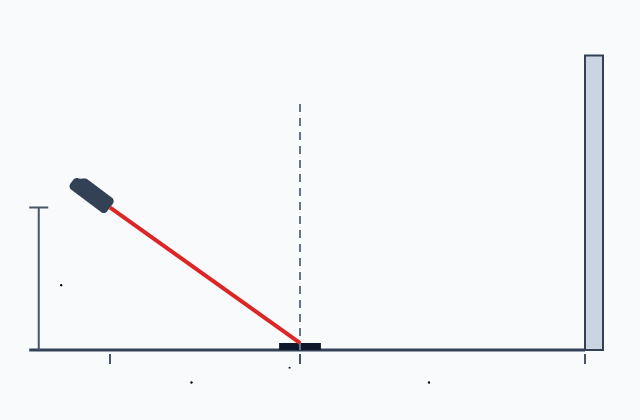
In the picture at the top of this lesson, a laser pointer is held 1.5 m above the floor and aimed at a small flat mirror lying on the floor 2.0 m away, measured along the floor. A wall stands 3.0 m beyond the mirror. How high up the wall does the reflected beam strike?
Predict first
Before you open the first step, predict: compared with the laser's height of 1.5 m, where will the spot be on the wall?
Step 1 · Draw the normal and find the angle of incidence
The mirror lies flat, so its normal is vertical. The beam drops 1.5 m while it moves 2.0 m along the floor, so it makes an angle with the vertical where , which gives .
Step 2 · Apply the law of reflection
The reflected beam leaves at from the vertical, on the other side of the normal. So it climbs at the same slope it came down: it rises 1.5 m for every 2.0 m it travels along the floor.
Why this step?
Why measure the angle from the vertical rather than from the floor?
The law of reflection compares angles from the normal, and the normal to a mirror lying flat on the floor is vertical. The floor is the surface itself, not the normal.
Your step · Calculate
Finish it. A laser held 1.5 m above the floor aims at a small flat mirror lying on the floor 2.0 m away, measured along the floor. The reflected beam strikes a wall 3.0 m beyond the mirror. How high up the wall is the spot? Give your answer to the nearest 0.01 m.
m
Part 4 Try it Four rays, one mirror
Predict first: of a ray that skims close to a mirror's surface and a ray that arrives close to its normal, which leaves at the larger angle of reflection? Then rank four rays.
Try it · Rank it
Four rays strike the same flat mirror. Ray A makes 20° with the mirror's surface. Ray B makes 20° with the normal. Ray C makes 70° with the normal. Ray D arrives along the normal. Rank the rays by their angle of reflection.
Largest angle of reflection first
Give each one a place, 1 for first. Give two the same place if they are equal.
Your ranking: none yet
Part 5 Explain it Two mirrors at a corner
On the exam this is handwritten, so answer on paper first. Nothing you type here leaves this page. Then check your answer against the model and each scoring point.
Free response is 50% of the exam score. This one is shaped like Question 4, Qualitative/Quantitative Translation.
Free-response practice · Question 4 style
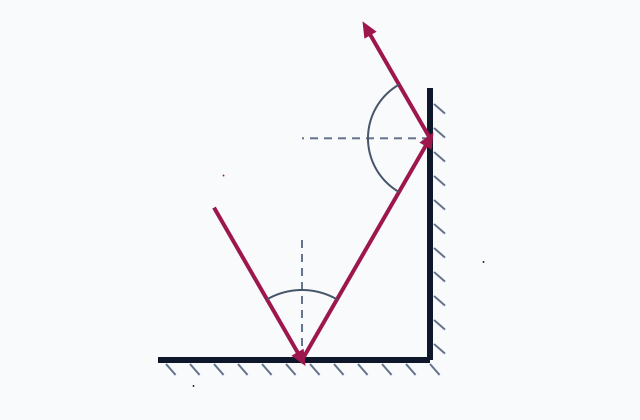
Two flat mirrors meet at a right angle: mirror 1 lies level, and mirror 2 stands upright at its right-hand end. A ray in the plane of the page comes down from the upper left and strikes mirror 1 with an angle of incidence . It reflects to mirror 2, reflects again, and leaves.
(a) On paper, draw the path of the ray for , with both normals drawn as dashed lines and all four angles between the ray and the normals marked. Do this by hand before you open the model.
(b) Without using equations, explain why the ray that leaves mirror 2 travels parallel to the incoming ray but in the opposite direction, for any value of , as long as the ray strikes both mirrors.
(c) Derive an expression for the angle of incidence at mirror 2 in terms of . Use it to show that the leaving ray is antiparallel to the incoming ray, and explain how this agrees with your reasoning in (b).
Model answer
(a) Compare your drawing with the model below. At mirror 1 the ray arrives and leaves at 30° from the vertical normal. It meets mirror 2 at 60° from that mirror's level normal, leaves at 60°, and heads up and to the left.
(b) A reflection reverses only the part of the ray's motion that is straight into the mirror and keeps the part that runs along it. Mirror 1 is level, so it reverses the downward motion and keeps the rightward motion. Mirror 2 is upright, so it reverses the rightward motion and keeps the upward motion. After both, the ray moves left and up: both parts of its motion are reversed, so it travels back along a line parallel to the one it came in on. Nothing in that argument depends on .
(c) After mirror 1 the ray makes with the vertical. Mirror 2's normal is horizontal, at 90° to the vertical, so the angle of incidence at mirror 2 is . A ray reflected at an angle of incidence turns through . So it turns at mirror 1 and at mirror 2, both the same way round: in all, for any . A ray turned through 180° travels antiparallel to its first direction, which is the result (b) reached by tracking the two parts of the motion.
 Tap to open the picture full size
Score your own answer. This is a self-check, not a grade. Tick each point your answer makes.
Part 6 Check yourself A rough surface, magnified
Both case questions use the picture.
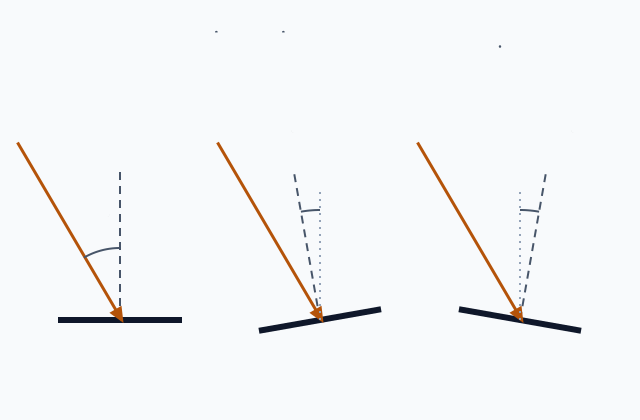
Under a microscope, a rough surface is a jumble of tiny flat patches. The picture shows three of them, P, Q and R, side by side. Parallel rays strike all three, each making 30° with the vertical. P lies level, so its normal is vertical. Q is tilted so that its normal leans 10° from the vertical toward the incoming light. R is tilted the other way, so its normal leans 10° from the vertical away from the incoming light.
Case question 1 · Calculate
Using the picture of the three patches: what is the angle of incidence of the ray that strikes patch R?
Case question 2 · Multiple choice
Using the picture of the three patches: which patch sends its reflected ray closest to straight up?
The rest stand on their own and do not use the case.
Check yourself · Fill the statement
Complete the description of a light ray. Tap a blank, then an answer.
A light ray is a straight line drawn to the wavefronts of a light wave, pointing in the direction the wave . Rays describe light well whenever its can be neglected.
Check yourself · Spot the error
A student explains why a sheet of paper shows no image of her face. Tap the first line that goes wrong.
Check yourself · Decide and justify
A laser beam is aimed at a slit in a card, and the slit is narrower than a human hair. A student says that the light getting through makes a spot on a far wall exactly as wide as the slit, since a laser beam is a ray and rays travel in straight lines. Is the student right?
Which reason supports your answer?
Part 7 Keep it Bring back earlier ideas
Light is a wave of changing electric and magnetic fields, the electric fields of Unit 10 and the magnetic fields of Unit 12. Retrieving them now, between new ideas, is what makes them easy to find later.
From 12.4 Electromagnetic Induction and Faraday’s Law · Sort it
A loop of wire lies flat in the page in a uniform magnetic field. Each card describes the field through the loop. Tap a card, then the direction of the induced current, as seen from the front of the page.
Clockwise
Counterclockwise
No current
The force formula is used with numbers at 0°, 90° and 180°. Between those, reason from the pattern: the force grows as the angle between the velocity and the field gets closer to 90°. Predict first: is the force on a proton moving at 30° to a field larger than, smaller than, or the same as the force at 150°?
From 12.2 Magnetism and Moving Charges · Rank it
Four identical protons move at the same speed through the same uniform magnetic field. The angle between each proton's velocity and the field is 30° for proton W, 90° for proton X, 150° for proton Y and 180° for proton Z. Rank the protons by the size of the magnetic force on them.
Largest force first
Give each one a place, 1 for first. Give two the same place if they are equal.
Your ranking: none yet
In three lines
- A ray is a straight line perpendicular to the wavefronts, pointing the way light travels; rays fail for spreading and bands, which need the wave model.
- The law of reflection, , with both angles measured from the normal to the surface.
- Smooth surfaces reflect specularly, in one direction; rough surfaces reflect diffusely, in many, because their normals change from place to place.
Exam strategy for this topic
- Section I, Multiple Choice: 42 questions in 85 minutes.
- Section II, Free Response: 4 questions in 95 minutes.
- This lesson's Explain it is shaped like free-response question 4, Qualitative/Quantitative Translation.
- A four-function, scientific, or graphing calculator is allowed on both sections of the exam.
When you draw a reflection on paper, draw the normal as a dashed line at the point where the ray strikes, and mark both angles from it. It keeps you from measuring from the surface, and it shows your reasoning on the page.
Questions students ask
What is the law of reflection?
The angle of reflection equals the angle of incidence, , with both measured from the normal, the line perpendicular to the surface where the ray strikes.
What is the difference between specular and diffuse reflection?
Specular reflection is from a smooth surface, whose normal keeps one direction, so parallel rays leave parallel. Diffuse reflection is from a rough surface, whose normal changes from place to place, so parallel rays leave in many directions.
When can light be treated as a ray?
Whenever its wave nature can be neglected: light traveling between surfaces and objects much wider than its wavelength. Spreading through narrow openings and bright and dark bands need the wave model.
What does a ray diagram show?
The path light takes before and after it meets matter, drawn as straight lines with arrows, with normals where the light meets a surface.
Why can a laser beam be modeled as a ray?
A laser makes a single narrow beam of one color whose waves stay in step, and away from narrow openings that beam travels as one straight line.
Course alignment, for teachers
AP Physics 2: Algebra-Based topic 13.1, Unit 13: Geometric Optics.
- Skill 1.A: Create diagrams, tables, charts, or schematics to represent physical situations.
- Skill 2.B: Calculate or estimate an unknown quantity with units from known quantities, by selecting and following a logical computational pathway.
- Skill 2.C: Compare physical quantities between two or more scenarios or at different times and locations in a single scenario.
- Skill 3.B: Apply an appropriate law, definition, theoretical relationship, or model to make a claim.
This lesson maps all 9 essential knowledge statements of the topic to the part that teaches each one: 9 are checked by a scored question. The map is in the lesson file.