Unit 12 · Topic 12.4 · about 30 minutes · 7 parts · 11 scored checks, 1 of them multiple choice, plus 2 from earlier lessons
AP Physics 2: Algebra-Based 12.4: Electromagnetic Induction and Faraday’s Law
Unit 12: 12 to 15% of the multiple-choice section
What you'll be able to do
- Describe the emf induced by a changing magnetic flux: find the flux, the size of the emf from Faraday's law, and its direction from Lenz's law.
Key vocabulary
| Term | What it means | The exam trap |
|---|---|---|
| Magnetic flux | The amount of magnetic field passing through a surface, measured in webers. | Flux depends on how the loop is tilted in the field as well as on the field and the area, so check the angle before you multiply the field by the area. |
| Weber | The SI unit of magnetic flux, written Wb; one weber is one tesla square meter. | Change a flux in milliwebers to webers before dividing by seconds, or the emf comes out a thousand times too large in volts. |
| Emf | Short for electromotive force: the energy given to each coulomb of charge driven around a circuit, measured in volts. | Despite its name, an emf is not a force; it is measured in volts, like a potential difference. |
 Tap to open the picture full size
Part 1 Think first A magnet sitting in a coil
Commit to a guess first. Being wrong now makes the right idea stick better.
Predict first
A strong magnet sits motionless inside a coil of wire, and the coil's ends are connected to a sensitive current meter. What does the meter read?
In short. A changing magnetic flux through a loop induces an emf of size , and Lenz's law gives its direction: the induced current's field opposes the change in flux.
- Magnetic flux, , measures the field passing through a surface, with measured from the area vector, at right angles to the surface.
- A steady flux, however large, induces nothing; changing the field, the area in the field or the angle does.
- A rod of length sliding at speed along rails in a uniform field at right angles to them has an emf .
Part 2 Learn it Flux, Faraday's law and Lenz's law
2a. Magnetic flux
Magnetic flux describes how much magnetic field passes through a surface: the part of the field perpendicular to the surface, times the surface's area.
To measure the angle, give the surface an area vector, : an arrow at right angles to the surface, as long as its area. For a closed surface, such as a balloon, it points outward. is the angle between and , so it is measured from the line at right angles to the surface, not from the surface itself.
- Field straight through the loop, along : , and , the most there can be.
- Field running along the plane of the loop: , and .
- Field through the loop against : , and .
The sign of the flux says whether the field is parallel or antiparallel to the area vector. Flux is measured in webers: 1 Wb = 1 T·m². A loop 0.20 m by 0.10 m, facing a 0.50 T field straight on, has Wb.
Quick check · Rank it
Four flat loops sit in the same uniform 0.40 T magnetic field. Loop W has an area of , and the field runs along its area vector. Loop X has an area of , and its area vector makes 60° with the field. Loop Y has an area of , and the field lines run along its plane. Loop Z has an area of , and its plane makes 30° with the field lines. Rank the loops by the size of the magnetic flux through them.
Largest flux first
Give each one a place, 1 for first. Give two the same place if they are equal.
Your ranking: none yet
2b. Faraday's law: change makes an emf
An emf is induced in a loop when the magnetic flux through it changes. Faraday's law says how big it is: the rate of change of the flux.
A steady flux, however large, induces nothing. What matters is how fast the flux changes, so the same change made twice as quickly induces twice the emf.
Since , there are three ways to change the flux:
- change the field, , by moving a magnet or changing a current;
- change the area, , inside the field, by stretching the loop or sliding it into or out of the field;
- change the angle, , by turning the loop, as a generator does.
An induced emf in a closed loop drives an induced current, just as a battery's emf would. Emf is measured in volts, and one weber per second is one volt.
Quick check · Select all
Which two of these situations induce an emf in the loop? Pick two.
Select 2 answers, then check.
2c. Lenz's law: the direction
Faraday's law gives the size of the emf. Lenz's law gives its direction: the induced emf drives a current whose own magnetic field opposes the change in flux. It opposes the change, not the field.
Work it in three steps.
- Which way does the field through the loop point, and is the flux increasing or decreasing?
- The induced current's field through the loop opposes that change. If the flux is increasing, the induced field points opposite to the outside field. If it is decreasing, the induced field points the same way as the outside field, propping it up.
- Find the current that makes that field with the curl grip: point your right thumb along the induced field through the loop, and your fingers curl the way the current runs. The three-finger rule gives the same current (index finger along the current in one part of the loop, middle finger toward the center, thumb along the field), but it makes you try a direction and check it.
So one field direction can drive currents in opposite directions, depending on whether the field is growing or shrinking. Lenz's law is the minus sign in
Quick check · Sort it
A loop of wire lies flat in the page in a uniform magnetic field. Each card describes the field through the loop. Tap a card, then the direction of the induced current, as seen from the front of the page.
Clockwise
Counterclockwise
No current
2d. A rod sliding on rails
A common example: a metal rod slides along two parallel metal rails that are joined at one end, in a uniform field at right angles to the plane of the rails. The rod, the rails and the joined end form a loop, and the loop's area grows as the rod moves away from that end.
If the length of rod between the rails is and it moves at speed , then in a time it sweeps out an area . The flux grows by , so
You can reach the same emf from the last two lessons. The charges in the rod move with it through the field, so each feels a magnetic force along the rod, and those forces push charge around the loop.
The direction follows Lenz's law. As the area in the field grows, the flux increases, so the induced current makes a field through the loop that points against the outside field.
Quick check · Calculate
A metal rod 50 cm long slides at a steady 3.0 m/s along two parallel metal rails, joined at one end, in a uniform 0.40 T magnetic field at right angles to the plane of the rails. The rod lies across the rails at right angles to them. What emf is induced in the loop? Give your answer to the nearest 0.01 V.
Part 3 Watch it done A growing field through a loop
Predict first, then watch each step, then finish the problem yourself.
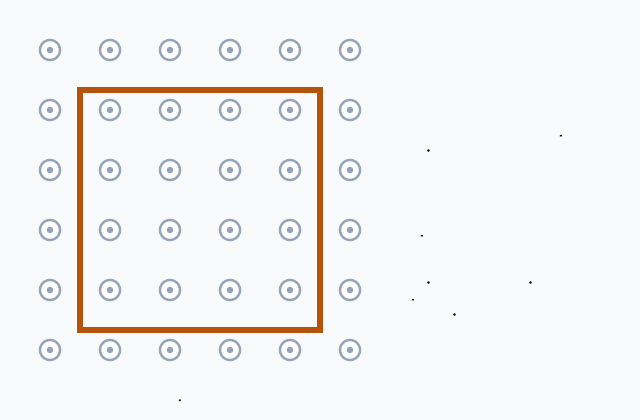
In the picture at the top of this lesson, a square loop 0.20 m on a side lies flat in the page in a uniform magnetic field that points out of the page. The field rises steadily from 0.10 T to 0.50 T in 0.40 s. What emf is induced in the loop, and which way does the induced current flow?
Predict first
Before you open the first step, predict: if the loop's sides were twice as long, 0.40 m, with the same rise in the field over the same 0.40 s, how would the emf compare?
Step 1 · Find the change in flux
The field runs straight through the loop, so with . The flux goes from Wb to Wb, so Wb.
Step 2 · Find the direction of the current
The field points out of the page and the flux is increasing, so the induced current makes a field into the page through the loop, against the increase. Point your right thumb into the page, along that induced field: your fingers curl clockwise. So the current runs clockwise. (Index finger right along the top of the loop, middle finger down to the center, gives a thumb into the page, which agrees.)
Why this step?
Why use the change in flux, 0.016 Wb, rather than the flux at the end, 0.020 Wb?
An emf comes from a changing flux, not from the flux itself. A loop sitting in a steady 0.50 T field has 0.020 Wb through it and no emf at all. Only the part that changed, and how quickly it changed, sets the emf.
Your step · Calculate
Finish it. A square loop 0.20 m on a side lies flat in a uniform magnetic field that is perpendicular to the loop and rises steadily from 0.10 T to 0.50 T in 0.40 s. What is the size of the emf induced in the loop? Give your answer in millivolts, to the nearest 1 mV.
mV
Part 4 Try it Through the field and out again
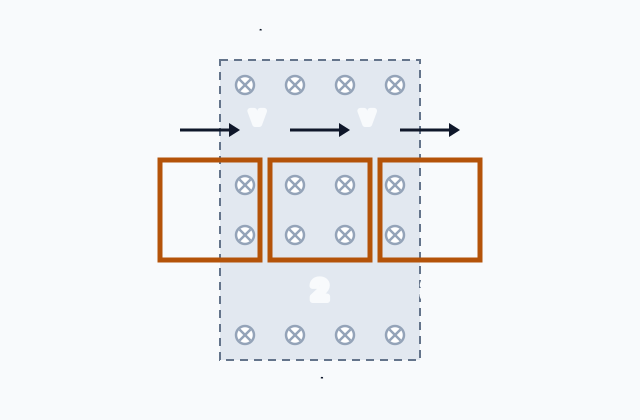
Predict first: as the loop in the picture slides all the way through the field, is there a current while it is wholly inside the field? Say yes, no, or only at the moment it is centered. Then sketch the flux and find the currents.
Try it · Sketch the graph
A square loop 10 cm on a side moves to the right at a steady 2.0 cm/s through a region of uniform 0.50 T magnetic field into the page, 20 cm wide, with no field outside it. At t = 0 the loop's right edge reaches the region. Sketch the magnetic flux through the loop, taking it as positive, against time from t = 0 until the loop has left the field. The first point is fixed at zero.
One shape that fits
Drag a point up or down, or tap it and use the arrow keys. The shape is checked, and so are the values the question lets you work out.
Try it · Match
A square loop moves to the right at a steady speed through a region of uniform magnetic field into the page, with no field outside the region. Tap each moment, then the direction of the induced current in the loop, as seen from the front of the page.
Part 5 Explain it From a field to an emf, on paper
On the exam this is handwritten, so answer on paper first. Nothing you type here leaves this page. Then check your answer against the model and each scoring point.
Free response is 50% of the exam score. This one is shaped like Question 2, Translation Between Representations.
Free-response practice · Question 2 style
A flat loop of wire with an area of lies in the page in a uniform magnetic field that points out of the page. The field rises steadily from 0 to 0.30 T between and s, stays at 0.30 T until s, then falls steadily to 0 at s. Take the flux as positive with the area vector out of the page, and the emf as positive when it drives current counterclockwise, as seen from the front of the page.
(a) On paper, sketch a graph of the magnetic flux through the loop and a graph of the induced emf, each against time from 0 to 6.0 s. Do this by hand before you open the model.
(b) Derive an expression for the size of the emf while the field is changing, in terms of the loop's area , the change in the field and the time it takes. Calculate the emf in each of the three time intervals.
(c) Use Lenz's law to explain the sign of the emf in the first and last intervals, and say whether your graphs in (a) agree with your values in (b).
Model answer
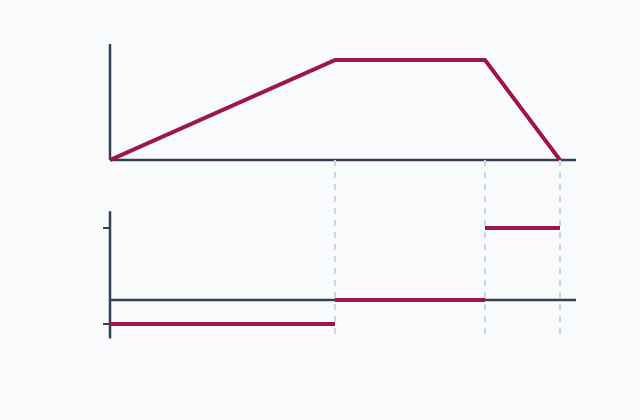
(a) Compare your sketches with the model below. The flux follows the field: a straight rise to 6.0 mWb, level, then a steeper straight fall to zero. The emf is level within each interval: negative while the flux rises, zero while it is steady, and positive and three times as large while it falls.
(b) The area is fixed, so and . From 0 to 3.0 s: V, or 2.0 mV. From 3.0 to 5.0 s, , so the emf is zero. From 5.0 to 6.0 s: mV.
(c) From 0 to 3.0 s the flux out of the page increases, so the induced current makes a field into the page, opposing the increase: a clockwise current, so the emf is mV. From 5.0 to 6.0 s the flux out of the page decreases, so the induced field points out of the page: a counterclockwise current and an emf of mV. The graphs agree with these values: the emf is zero where the flux is level, has opposite signs on the rise and the fall, and is three times as large where the flux changes three times as fast.
 Tap to open the picture full size
Score your own answer. This is a self-check, not a grade. Tick each point your answer makes.
Part 6 Check yourself A magnet and a loop
Both case questions use the picture.
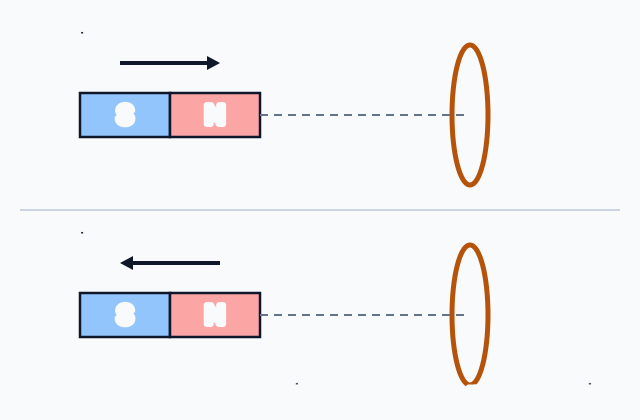
A bar magnet lies on the axis of a fixed circular loop of wire, with its north end facing the loop. The picture shows it twice: moving toward the loop, and moving away from it. Directions around the loop are as seen from the magnet's side.
Case question 1 · Multiple choice
Using the picture of the magnet and the loop: while the magnet moves away from the loop, which way is the induced current in the loop, as seen from the magnet's side?
Case question 2 · Decide and justify
Using the picture of the magnet and the loop: a student says that while the magnet moves toward the loop, the induced current makes a field through the loop that points away from the magnet, the same way as the magnet's own field there. Is the student right?
Which reason supports your answer?
The rest stand on their own and do not use the case.
Check yourself · Fill the statement
A flat loop lies in the page in a uniform magnetic field that points into the page, and its area vector is chosen to point out of the page. Tap a blank, then an answer.
The area vector is at right angles to the . The field is to the area vector, so the flux through the loop is .
Check yourself · Spot the error
A student finds the direction of an induced current. Tap the first line that goes wrong.
Part 7 Keep it Bring back earlier ideas
Every induced current makes a magnetic field of its own, like any current in a wire, and magnetic materials respond to those fields. Retrieving them now, between new ideas, is what makes them easy to find later.
From 12.3 Magnetism and Current-Carrying Wires · Calculate
A long, straight wire carries a steady current of 15 A. What is the size of its magnetic field at a point 3.0 cm from the wire? Give your answer in microtesla, to the nearest 1 T.
From 12.1 Magnetic Fields · Sort it
Each card describes a material near a strong magnet. Tap a card, then the kind of material it is.
Ferromagnetic
Paramagnetic
Only diamagnetic
In three lines
- Magnetic flux is , with measured from the area vector; its sign says whether the field is parallel or antiparallel to that vector.
- Faraday's law: a changing flux induces , and a steady flux induces nothing; a rod on rails gives .
- Lenz's law: the induced current's field opposes the change in flux, so the same field growing and shrinking drives currents in opposite directions.
Exam strategy for this topic
- Section I, Multiple Choice: 42 questions in 85 minutes.
- Section II, Free Response: 4 questions in 95 minutes.
- This lesson's Explain it is shaped like free-response question 2, Translation Between Representations.
- A four-function, scientific, or graphing calculator is allowed on both sections of the exam.
For Lenz's law, write two things before you use the right-hand rule: which way the field through the loop points, and whether the flux is increasing or decreasing. The induced field opposes the change: against the field if the flux grows, along it if the flux shrinks.
Questions students ask
What is magnetic flux?
The amount of magnetic field passing through a surface, : the part of the field at right angles to the surface times the area, measured in webers.
What does Faraday's law say?
An emf is induced in a loop whenever the magnetic flux through it changes, and its size is the rate of change of the flux, .
How do you use Lenz's law?
Find which way the field through the loop points and whether the flux is increasing or decreasing. The induced current makes a field that opposes that change, and the right-hand rule turns that field into a current direction.
Why is there a minus sign in Faraday's law?
The minus sign is Lenz's law: the induced emf drives a current whose field opposes the change in flux that caused it.
What emf does a rod sliding on rails produce?
, for a rod of length moving at speed through a uniform field at right angles to the rails. The loop's area, and so its flux, grows at the rate .
Course alignment, for teachers
AP Physics 2: Algebra-Based topic 12.4, Unit 12: Magnetism and Electromagnetism.
- Skill 1.C: Create qualitative sketches of graphs that represent features of a model or the behavior of a physical system.
- Skill 2.B: Calculate or estimate an unknown quantity with units from known quantities, by selecting and following a logical computational pathway.
- Skill 2.D: Predict new values or factors of change of physical quantities using functional dependence between variables.
- Skill 3.C: Justify or support a claim using evidence from experimental data, physical representations, or physical principles or laws.
This lesson maps all 9 essential knowledge statements of the topic to the part that teaches each one: 9 are checked by a scored question. The map is in the lesson file.