Unit 13 · Topic 13.3 · about 30 minutes · 7 parts · 10 scored checks, 1 of them multiple choice, plus 2 from earlier lessons
AP Physics 2: Algebra-Based 13.3: Refraction
Unit 13: 12 to 15% of the multiple-choice section
What you'll be able to do
- Describe the refraction of light between two media: why it bends, which way, by how much from Snell's law, and when it is totally internally reflected instead.
Key vocabulary
| Term | What it means | The exam trap |
|---|---|---|
| Medium | The material light travels through, such as air, water or glass; the plural is media. | Light needs no medium at all: it crosses a vacuum, and travels fastest there. |
| Speed of light, | The speed of light in a vacuum, m/s. | In air light is only slightly slower than , so to three figures the index of refraction of air is 1.00. |
| Transmitted ray | The ray that passes into the second medium at a boundary. | "Transmitted" means the light got through, not that its direction is unchanged. |
 Tap to open the picture full size
Part 1 Think first A coin that appears
Commit to a guess first. Being wrong now makes the right idea stick better.
Predict first
A coin lies on the bottom of an empty mug. You move your head back until the rim just hides the coin. Without moving your head, you watch a friend slowly fill the mug with water, and the coin comes into view. Why?
In short. Refraction is the change in direction of light passing from one medium into another, caused by the change in its speed, and Snell's law, , gives the new direction.
- The index of refraction, , is larger in a medium where light travels more slowly.
- Into a higher index a ray bends toward the normal; into a lower index it bends away; along the normal it does not bend.
- Heading into a lower index, light striking beyond the critical angle is totally internally reflected: none is transmitted.
Part 2 Learn it Speed, Snell's law and the critical angle
3a. Why light bends
Refraction is the change in direction of a ray as it passes from one medium into another. It happens because light travels at different speeds in different media.
Picture wavefronts reaching a water surface at a slant. One end of each wavefront enters the water first and slows down, while the other end, still in the air, keeps its speed. The wavefront pivots, and the ray, always perpendicular to the wavefronts, turns with it.
The index of refraction of a medium compares the speed of light in a vacuum, m/s, with its speed in the medium:
has no unit, and the slower light travels, the larger is. Light is fastest in a vacuum, so no medium has below 1.
| Medium | Index of refraction |
|---|---|
| Air | 1.00 |
| Water | 1.33 |
| Crown glass | 1.52 |
| Diamond | 2.42 |
Quick check · Calculate
Light travels through a sample of fused quartz at m/s. What is the index of refraction of the quartz? Use m/s, and give your answer to the nearest 0.01.
3b. Snell's law
Snell's law relates the angles on the two sides of a boundary to the two indices:
Medium 1 is the one the light comes from, and both angles are measured from the normal, as in reflection. Since is the same on both sides, a larger goes with a smaller angle:
- From a lower index into a higher one, such as air into water, the ray refracts toward the normal.
- From a higher index into a lower one, such as glass into air, it refracts away from the normal.
- A ray that arrives along the normal, , has : it is not refracted at all.
A ray in air strikes a pool at 40° from the normal. In the water,
so , bent toward the normal. Light coming back out along the same path bends away from the normal, to 40° again.
Quick check · Sort it
Each card describes a ray crossing a boundary, with the angle measured from the normal. Use the indices in the table: air 1.00, water 1.33, crown glass 1.52, diamond 2.42. Tap a card, then what the ray does.
Bends toward the normal
Bends away from the normal
Does not bend
3c. Total internal reflection
Going from a higher index into a lower one, the ray bends away from the normal, so its angle of refraction is always larger than its angle of incidence. Tilt the incoming ray farther from the normal and the refracted ray swings toward the surface.
At one angle of incidence, the critical angle, the refracted ray leaves at 90° and travels along the surface. Put into Snell's law, with :
Beyond the critical angle there is no refracted ray at all: all the light is reflected back into the first medium, and none is transmitted. This is total internal reflection. For glass with meeting air, , so a ray inside the glass that strikes the surface at 50° is totally reflected.
It can happen only when light heads into a medium with a lower index, since only then does it bend away from the normal. Light going from air into water bends toward the normal at every angle, so some of it always gets in.
Quick check · Decide and justify
Sunlight traveling through air strikes the surface of a still pond at 80° from the normal. A student says that all of the light is reflected and none enters the water, because 80° is past the critical angle for water and air. Is the student right?
Which reason supports your answer?
Part 3 Watch it done Keeping light inside a fiber
Predict first, then watch each step, then finish the problem yourself.
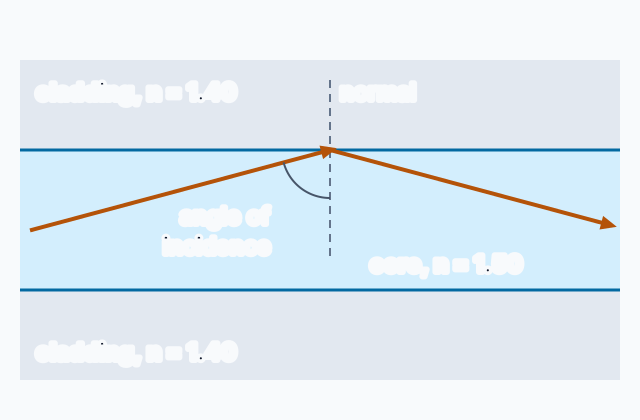
In the picture at the top of this lesson, an optical fiber has a glass core with an index of refraction of 1.50, surrounded by cladding with an index of 1.40. What is the critical angle for light inside the core meeting the boundary with the cladding?
Predict first
Before you open the first step, predict: how will this critical angle compare with 41.8°, the critical angle for the same glass meeting air?
Step 1 · Check that a critical angle exists
The light is in the core, , heading for the cladding, . It goes from a higher index to a lower one, so it bends away from the normal, and total internal reflection can happen.
Step 2 · Set up Snell's law at the critical angle
At the critical angle the refracted ray travels along the boundary, : , so .
Why this step?
Why is the core's index n1 and the cladding's n2, and not the other way round?
Medium 1 is the one the light comes from. The light travels inside the core and meets the cladding, so the core is medium 1. Swapped, the ratio would be larger than 1, and no angle has a sine larger than 1.
Your step · Calculate
Finish it. An optical fiber has a core with an index of refraction of 1.50 and cladding with an index of 1.40. What is the critical angle for light in the core striking the boundary with the cladding? Give your answer to the nearest 0.1°.
°
Part 4 Try it Reading indices from a ray
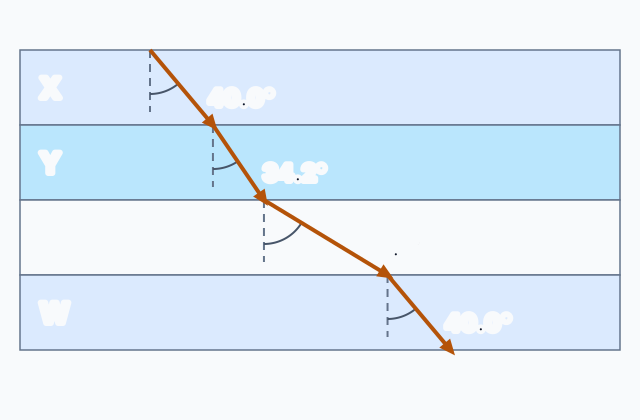
Predict first: in the layer with the largest index of refraction, will the ray make the smallest angle with the normal or the largest? Then rank the layers in the picture, and predict how a critical angle changes when an index grows.
Try it · Rank it
A ray passes down through four flat transparent layers, X, Y, Z and W, stacked with parallel boundaries. Its angle from the normal is 40.0° in X, 34.2° in Y, 58.7° in Z and 40.0° in W. Rank the layers by their index of refraction.
Largest index first
Give each one a place, 1 for first. Give two the same place if they are equal.
Your ranking: none yet
Try it · Calculate
For light inside one kind of glass meeting air, the critical angle is 40.0°. A second kind of glass has an index of refraction 1.20 times as large. What is the critical angle for light inside the second glass meeting air? Give your answer to the nearest 0.1°.
Part 5 Explain it An index from a block of gelatin
On the exam this is handwritten, so answer on paper first. Nothing you type here leaves this page. Then check your answer against the model and each scoring point.
Free response is 50% of the exam score. This one is shaped like Question 3, Experimental Design and Analysis.
Free-response practice · Question 3 style
A student wants to find the index of refraction of a clear rectangular block of gelatin without cutting it. She has a red laser pointer, a protractor, a large sheet of paper to set the block on, and a pencil.
(a) Describe a procedure she could use to collect data for a graph that gives the index of refraction. Say what she changes, what she measures, and one step that reduces experimental uncertainty.
(b) Her results are below, with each angle measured from the normal: in air and in the gelatin. Describe what she should plot on each axis so that the slope of a straight best-fit line is the index of refraction, and explain why. Then make that graph on paper, with a scale on each axis, and draw a best-fit line. Do this by hand before you open the model.
- 15° and 11°
- 30° and 22°
- 45° and 31°
- 60° and 40°
- 75° and 46°
(c) Use your best-fit line to calculate the index of refraction of the gelatin, and the speed of light in it.
Model answer
(a) Set the block on the paper and trace its outline. Mark a point on one long side, draw the normal there, and aim the laser along the paper so the beam enters at that point with an angle of incidence of 15°, set with the protractor. Mark where the beam leaves the far side, join the two points, and measure the angle of refraction from the normal. Repeat at 30°, 45°, 60° and 75°. To reduce uncertainty, repeat each angle and average, or mark the beam at points far apart so the line drawn through them is long.
(b) With air, , Snell's law gives . So plot on the vertical axis against on the horizontal axis: the points fall on a straight line through the origin whose slope is . The angles themselves would not give a straight line, because Snell's law relates their sines. The pairs of sines are 0.259 and 0.191, 0.500 and 0.375, 0.707 and 0.515, 0.866 and 0.643, and 0.966 and 0.719. See the graph below: a scale on each axis and one straight best-fit line through the points, passing very near the origin.
(c) From (0.200, 0.271) and (0.700, 0.944) on the line, the slope is , so . Then m/s.
Sine of the angle in air against sine of the angle in gelatin, with the best-fit line
The line passes very near the origin and through (0.700, 0.944).
Score your own answer. This is a self-check, not a grade. Tick each point your answer makes.
Part 6 Check yourself A ray in a glass prism
Both case questions use the picture.
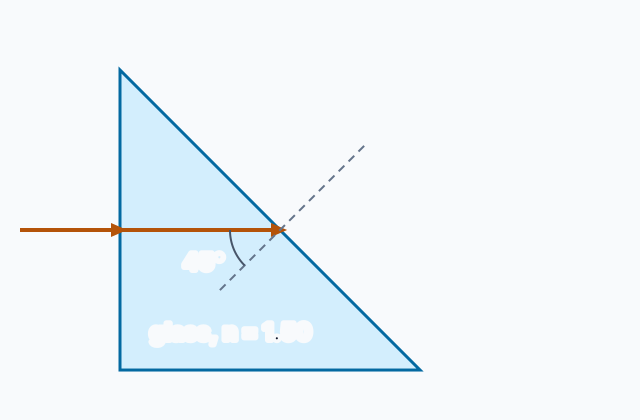
A glass prism with an index of refraction of 1.50 has a cross section shaped like a right isosceles triangle, with angles of 45°, 45° and 90°. A ray enters its upright face along the normal and travels to the long face, as the picture shows. Each question says what surrounds the prism.
Case question 1 · Multiple choice
Using the picture of the prism, with air all around it: what happens to the ray at the long face?
Case question 2 · Calculate
Using the picture of the prism: suppose instead it is surrounded by water, with an index of refraction of 1.33, and the ray enters it the same way. At what angle from the normal does the ray leave the long face into the water? Give your answer to the nearest 0.1°.
The rest stand on their own and do not use the case.
Check yourself · Fill the statement
Complete the statements about refraction. Tap a blank, then an answer.
Light changes direction at a boundary because its changes from one medium to the next. A ray that strikes a boundary along the normal . A ray that strikes at exactly the critical angle is refracted at 90° and travels .
Check yourself · Spot the error
A student finds the angle of refraction of light entering water. Tap the first line that goes wrong.
Part 7 Keep it Bring back earlier ideas
The mirror equation comes back in the next lesson as the thin-lens equation, and induction was the last big idea of Unit 12. Retrieving them now, between new ideas, is what makes them easy to find later.
From 13.2 Images Formed by Mirrors · Calculate
A convex mirror has a focal length of magnitude . An object stands on the principal axis a distance in front of it, with rays close to the axis. Derive the image distance, with its sign in this course's convention (negative for a virtual image behind the mirror). It can be written as , with the magnitude. What is ?
From 12.4 Electromagnetic Induction and Faraday’s Law · Calculate
A metal rod 50 cm long slides at a steady 3.0 m/s along two parallel metal rails, joined at one end, in a uniform 0.40 T magnetic field at right angles to the plane of the rails. The rod lies across the rails at right angles to them. What emf is induced in the loop? Give your answer to the nearest 0.01 V.
In three lines
- Refraction is a change in direction caused by a change in speed, and .
- Snell's law, , with angles from the normal: toward the normal into a higher index, away from it into a lower one, no bending along it.
- Into a lower index, beyond all light is reflected; at the refracted ray runs along the surface.
Exam strategy for this topic
- Section I, Multiple Choice: 42 questions in 85 minutes.
- Section II, Free Response: 4 questions in 95 minutes.
- This lesson's Explain it is shaped like free-response question 3, Experimental Design and Analysis.
- A four-function, scientific, or graphing calculator is allowed on both sections of the exam.
Before you use Snell's law, write which medium the light comes from and which it goes into, each with its index, and sketch the normal. The sketch tells you whether the ray should bend toward or away from the normal, a quick check on whatever angle you calculate.
Questions students ask
What is refraction?
The change in direction of a ray of light as it passes from one medium into another, caused by the change in the speed of light between them.
What is the index of refraction?
: the speed of light in a vacuum divided by its speed in the medium. It has no unit and is never below 1; the slower the light, the larger .
What does Snell's law say?
, with medium 1 the one the light comes from and both angles measured from the normal. Into a higher index a ray bends toward the normal; into a lower index, away from it.
What is the critical angle?
For light heading into a lower index, the angle of incidence at which the refracted ray travels along the surface, . Beyond it, all the light is reflected.
When does total internal reflection happen?
Only when light travels toward a medium with a lower index and strikes the boundary beyond the critical angle. Light going into a higher index always has a refracted ray.
Course alignment, for teachers
AP Physics 2: Algebra-Based topic 13.3, Unit 13: Geometric Optics.
- Skill 1.B: Create quantitative graphs with appropriate scales and units, including plotting data.
- Skill 2.B: Calculate or estimate an unknown quantity with units from known quantities, by selecting and following a logical computational pathway.
- Skill 2.D: Predict new values or factors of change of physical quantities using functional dependence between variables.
- Skill 3.A: Create experimental procedures that are appropriate for a given scientific question.
- Skill 3.B: Apply an appropriate law, definition, theoretical relationship, or model to make a claim.
This lesson maps all 11 essential knowledge statements of the topic to the part that teaches each one: 11 are checked by a scored question. The map is in the lesson file.