Unit 13 · Topic 13.4 · about 30 minutes · 7 parts · 12 scored checks, 2 of them multiple choice, plus 2 from earlier lessons
AP Physics 2: Algebra-Based 13.4: Images Formed by Lenses
Unit 13: 12 to 15% of the multiple-choice section
What you'll be able to do
- Describe the image a thin converging or diverging lens forms: find it with principal rays and with the thin-lens equation, and give its location, type, size and orientation.
Key vocabulary
| Term | What it means | The exam trap |
|---|---|---|
| Thin lens | A lens thin enough, compared with the distances in a problem, that each ray can be drawn bending once, at the lens's midline. | "Thin" compares the lens with the distances in the problem; it says nothing about how strongly the lens bends light. |
| Focal length | The distance from a lens's midline to its focal point, written . | The focal length belongs to the lens: moving an object changes where its image forms, not the focal length. |
| Midline | The plane through the center of a thin lens, at right angles to its principal axis, from which object and image distances are measured. | Measure from the midline, not from either curved surface; for a thin lens the difference is small enough to ignore. |
 Tap to open the picture full size
Part 1 Think first Half a lens
Commit to a guess first. Being wrong now makes the right idea stick better.
Predict first
A magnifying glass projects a sharp, upside-down image of a bright window onto a sheet of paper. You cover the top half of the lens with a card. What happens to the image on the paper?
In short. A thin lens forms an image by refraction: where refracted rays from each point of an object meet (a real image) or seem to come from (a virtual image), at a distance given by .
- A converging lens bends rays parallel to its axis to a focal point on the far side; a diverging lens spreads them as if from a focal point on the near side; a lens has a focal point on each side.
- In this course's sign convention is negative for a diverging lens, and is positive for a real image on the far side and negative for a virtual image on the object's side.
- Magnification is a ratio of sizes, ; for one lens, a real image is inverted and a virtual image upright.
Part 2 Learn it Lenses, images and the thin-lens equation
4a. Converging and diverging lenses
A lens bends light by refraction at both of its surfaces. A thin lens is thin enough, compared with the distances in the problem, to draw each ray bending once, at the lens's midline. Every lens here is thin, with air on both sides.
- A convex, or converging, lens is thicker in the middle than at its edges. Rays parallel to its principal axis are refracted and converge toward a common point on the transmitted side, the side the light leaves from: its focal point.
- A concave, or diverging, lens is thinner in the middle. Rays parallel to its axis are refracted and spread apart as if they came from a focal point on the incident side, the side the light arrives from.
Light can arrive from either side, so a lens has a focal point on each side, set by the shape of its surfaces. For a thin lens in air, the two are the same distance from the lens, the focal length .
Turn a magnifying glass around, even a lens that is flat on one side, and it still focuses sunlight to a spot the same distance away.
Quick check · Fill the statement
Complete the statements about thin lenses in air. Tap a blank, then an answer.
Rays parallel to the principal axis that pass through a converging lens meet at the focal point on the side. A diverging lens spreads such rays as if they came from the focal point on the side. A lens has a focal point on .
4b. Images and the three principal rays
As with mirrors, a lens forms a real image where refracted rays from one point of an object meet again, on the transmitted side, and a screen there shows it. It forms a virtual image where refracted rays spread apart as if from a common point; you see it by looking through the lens.
Three principal rays from the top of an object locate the image:
- A ray parallel to the principal axis is refracted through the focal point on the far side (converging), or away from the axis as if it came from the focal point on the near side (diverging).
- A ray through the center of the lens goes straight on.
- A ray through the focal point on the near side (converging), or aimed at the focal point on the far side (diverging), leaves parallel to the axis.
Where the refracted rays, or their backward extensions, cross is the top of the image.
The principal rays are only the easiest three to draw. Light from each point of the object passes through every part of the lens, and all of it goes to the same point of the image.
Quick check · Multiple choice
A ray heads toward the focal point on the far side of a thin diverging lens. How does it leave the lens?
4c. The thin-lens equation and magnification
The thin-lens equation has the same form as the mirror equation:
and are measured from the lens's midline. College Board's course framework says these locations follow a sign convention without printing one; this course uses the same real-is-positive convention as for mirrors:
- is positive for a converging lens and negative for a diverging lens.
- is positive for an object on the incident side.
- is positive for a real image, on the transmitted side, and negative for a virtual image, on the incident side.
The magnification is again a size only:
For one lens and a real object, a real image is inverted and a virtual image is upright.
A converging lens with cm and an object 60 cm away: , so cm, a real, inverted image on the far side, with .
Quick check · Calculate
A thin converging lens has a focal length of 15 cm. An object stands on the principal axis 10 cm from the lens. What is the image distance, with its sign in this course's convention, where a real image has a positive image distance and a virtual image a negative one? Give your answer in centimeters.
Part 3 Watch it done Focusing a camera
Predict first, then watch each step, then finish the problem yourself.
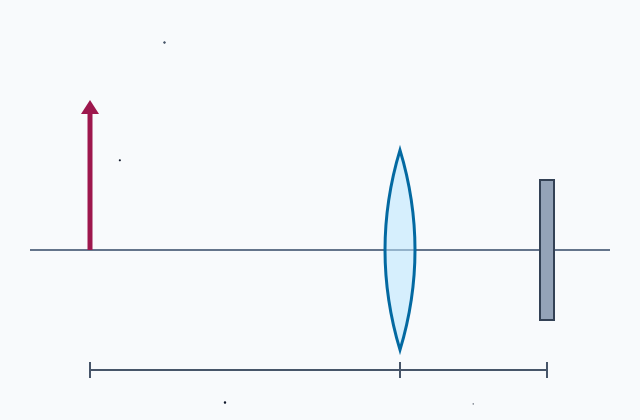
In the picture at the top of this lesson, a camera lens with a focal length of 50 mm forms an image of a person 1.6 m tall standing 2.55 m away. How far behind the lens must the sensor be?
Predict first
Before you open the first step, predict: how far behind the lens must the sensor be?
Step 1 · Put everything in one unit, with signs
A converging lens has mm. The person is 2.55 m, or 2550 mm, away on the incident side, so mm.
Step 2 · Set up the thin-lens equation
. Since 2550 is 51 times 50, put both terms over 2550 mm: .
Why this step?
Why change 2.55 m to millimeters before using the equation?
The equation adds and subtracts reciprocals of distances, so every distance has to be in the same unit. Putting in 2.55 beside 50 would treat the person as 2.55 mm from the lens, closer than the focal length.
Your step · Calculate
Finish it. A camera lens with a focal length of 50 mm forms an image of a person standing 2.55 m away, so . How far behind the lens must the sensor be? Give your answer in millimeters.
mm
Part 4 Try it Moving the object
Predict first: as an object moves away from a converging lens, starting outside its focal point, does its image move toward the lens or away from it? Then sketch it, rank four images by height, one of them from an object inside the focal point, and decide what covering half a lens does.
Try it · Sketch the graph
A thin converging lens has a focal length of 30 cm. An object is moved away from it along the principal axis, from 45 cm to 90 cm. Sketch the image distance against the object distance. The first point is fixed at 90 cm, the image distance when the object is 45 cm away.
One shape that fits
Drag a point up or down, or tap it and use the arrow keys. The shape is checked, and so are the values the question lets you work out.
Try it · Rank it
A thin converging lens has a focal length of 12 cm. An object is placed in turn at four distances from it on the principal axis: A at 6 cm, B at 18 cm, C at 24 cm and D at 36 cm. Rank the four images by how tall they are.
Tallest image first
Give each one a place, 1 for first. Give two the same place if they are equal.
Your ranking: none yet
Try it · Decide and justify
A converging lens projects a sharp image of a lamp onto a wall. A student tapes a card over the bottom half of the lens and says that the bottom half of the lamp's image will now be missing from the wall. Is the student right?
Which reason supports your answer?
Part 5 Explain it A candle, a lens and a card
On the exam this is handwritten, so answer on paper first. Nothing you type here leaves this page. Then check your answer against the model and each scoring point.
Free response is 50% of the exam score. This one is shaped like Question 1, Mathematical Routines.
Free-response practice · Question 1 style
A student uses a thin converging lens of focal length to form a sharp image of a candle flame of height on a white card. The flame is a distance from the lens, with .
(a) Derive expressions for the distance from the lens to the card and for the height of the flame's image, in terms of , and .
(b) For cm, cm and cm, calculate and , and state whether the image is upright or inverted.
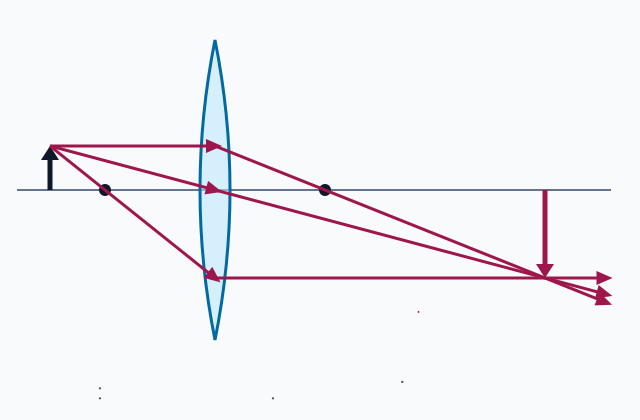
(c) On paper, draw a ray diagram for (b), roughly to scale, with at least two principal rays, and mark the image. Do this by hand before you open the model.
(d) The student moves the candle to 25 cm from the lens. She claims that the card must now be moved farther from the lens and that the image will be taller. Use your expressions from (a) to justify whether each part of her claim is correct.
Model answer
(a) From , the card is at . The image height is .
(b) cm and cm. The image is real, on the far side of the lens where the card catches it, so it is inverted.
(c) Compare your diagram with the model below: the three rays cross 30 cm past the lens and 4.0 cm below the axis.
(d) Both parts are incorrect. With cm, cm, so the card moves closer to the lens, from 30 cm to 16.7 cm. And cm, smaller than 4.0 cm. Both expressions have in the denominator, so as the candle moves away the image moves in toward the focal point and shrinks.
 Tap to open the picture full size
Score your own answer. This is a self-check, not a grade. Tick each point your answer makes.
Part 6 Check yourself A diverging lens
Both case questions use the ray diagram.
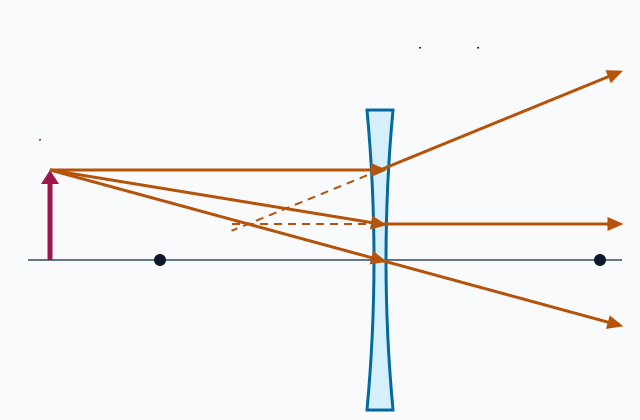
A thin diverging lens has a focal length of magnitude 20 cm. An object 3.0 cm tall stands upright on the principal axis, 30 cm from the lens. The ray diagram shows three principal rays from the top of the object, and each refracted ray traced backward through the lens as a dashed line.
Case question 1 · Multiple choice
Using the ray diagram of the diverging lens: which describes the image?
Case question 2 · Calculate
Using the diverging lens: its focal length has magnitude 20 cm, and the object, 3.0 cm tall, is 30 cm from it. How tall is the image? Give your answer in centimeters.
The rest stand on their own and do not use the case.
Check yourself · Spot the error
A student describes the image formed by a converging lens. Tap the first line that goes wrong.
Check yourself · Decide and justify
A student says that a single thin diverging lens in air always forms a virtual image of a real object, wherever the object is. Is the student right?
Which reason supports your answer?
Check yourself · Put it in order
A student wants to find the focal length of a magnifying glass from a graph, using a lit candle, a white card and a meter stick. Tap her steps in order.
Part 7 Keep it Bring back earlier ideas
A lens bends light by refraction at each surface, and the law of reflection from the first lesson of this unit still governs every mirror. Retrieving them now, between new ideas, is what makes them easy to find later.
From 13.3 Refraction · Sort it
Each card describes a ray crossing a boundary, with the angle measured from the normal. Use the indices in the table: air 1.00, water 1.33, crown glass 1.52, diamond 2.42. Tap a card, then what the ray does.
Bends toward the normal
Bends away from the normal
Does not bend
Predict first: of a ray that skims close to a mirror's surface and a ray that arrives close to its normal, which leaves at the larger angle of reflection? Then rank four rays.
From 13.1 Reflection · Rank it
Four rays strike the same flat mirror. Ray A makes 20° with the mirror's surface. Ray B makes 20° with the normal. Ray C makes 70° with the normal. Ray D arrives along the normal. Rank the rays by their angle of reflection.
Largest angle of reflection first
Give each one a place, 1 for first. Give two the same place if they are equal.
Your ranking: none yet
In three lines
- A converging lens brings parallel rays to a focal point on the transmitted side; a diverging lens spreads them as if from one on the incident side; each lens has a focal point on both sides.
- Real images form where refracted rays meet, on the far side; virtual images where they only seem to come from, on the object's side; three principal rays find either.
- with negative for diverging lenses and negative for virtual images, and .
Exam strategy for this topic
- Section I, Multiple Choice: 42 questions in 85 minutes.
- Section II, Free Response: 4 questions in 95 minutes.
- This lesson's Explain it is shaped like free-response question 1, Mathematical Routines.
- A four-function, scientific, or graphing calculator is allowed on both sections of the exam.
Draw two principal rays even when a question asks only for a calculation, and check that your diagram and your equation agree on which side of the lens the image is and which way up it stands. A sign slip in the thin-lens equation shows up at once as a disagreement.
Questions students ask
What is the thin-lens equation?
, with the object and image distances measured from the lens's midline and a sign convention for each.
What is the difference between a converging and a diverging lens?
A converging (convex) lens is thicker in the middle and brings parallel rays together at a focal point past the lens. A diverging (concave) lens is thinner in the middle and spreads parallel rays as if they came from a focal point before it.
What sign convention goes with the thin-lens equation?
This course uses real-is-positive: positive for converging and negative for diverging, positive on the incident side, positive for a real image on the transmitted side and negative for a virtual image on the incident side.
How do you find the magnification of a lens?
, a ratio of sizes. For one lens and a real object, a real image is inverted and a virtual image upright.
What happens if you cover half of a lens?
The whole image still forms, but dimmer. Light from every point of the object passes through every part of the lens, so covering half removes half the light from each image point, not half the image.
Course alignment, for teachers
AP Physics 2: Algebra-Based topic 13.4, Unit 13: Geometric Optics.
- Skill 1.C: Create qualitative sketches of graphs that represent features of a model or the behavior of a physical system.
- Skill 2.B: Calculate or estimate an unknown quantity with units from known quantities, by selecting and following a logical computational pathway.
- Skill 2.D: Predict new values or factors of change of physical quantities using functional dependence between variables.
- Skill 3.A: Create experimental procedures that are appropriate for a given scientific question.
- Skill 3.B: Apply an appropriate law, definition, theoretical relationship, or model to make a claim.
This lesson maps all 11 essential knowledge statements of the topic to the part that teaches each one: 11 are checked by a scored question. The map is in the lesson file.