Unit 15 · Topic 15.8 · about 30 minutes · 7 parts · 11 scored checks, 3 of them multiple choice, plus 2 from earlier lessons
AP Physics 2: Algebra-Based 15.8: Types of Radioactive Decay
Unit 15: 12 to 15% of the multiple-choice section
What you'll be able to do
- Describe how individual nuclei decay by alpha, beta-minus, beta-plus and gamma decay, the particles each emits, and how nucleon number, charge and lepton number are conserved in every decay.
Key vocabulary
| Term | What it means | The exam trap |
|---|---|---|
| Alpha particle | A helium-4 nucleus, written , or . | In this course only helium-4 nuclei count as alpha particles. |
| Positron | The antielectron, written or . | Its symbol looks like an electron's; read the sign of its charge. |
| Neutrino | A subatomic particle emitted in some decays, written . | A neutrino is not a neutron; it is not a nucleon at all. |
| Antineutrino | The antiparticle of the neutrino, written . | Read the bar over the symbol: is the antineutrino and the neutrino. |
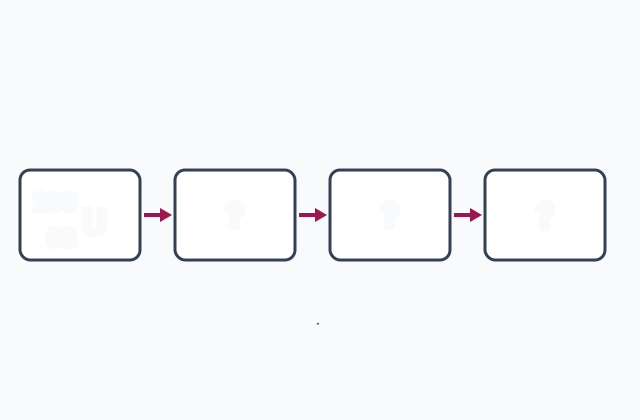 Tap to open the picture full size
Part 1 Think first An electron from the nucleus
Commit to a guess first. Being wrong now makes the right idea stick better.
Predict first
In one kind of radioactive decay, an atom's nucleus shoots out a fast electron, and the nucleus left behind has one more proton than before. Where did that electron come from?
In short. Unstable nuclei decay by alpha, beta-minus, beta-plus or gamma decay, and every decay conserves nucleon number, charge and lepton number.
- Write every particle in nuclear notation, with its mass number on top and its charge, in units of , below.
- Check nucleon number, charge and lepton number on both sides of every decay equation.
- A chain of decays can be drawn as arrows on a chart of mass number against atomic number.
Part 2 Learn it How nuclei decay
8a. The particles decays emit
Many nuclei decay by emitting subatomic particles, each with its own properties.
- An alpha particle, written or , is a helium nucleus: two protons and two neutrons, with charge . In nuclear notation it is . Only helium-4 nuclei count as alpha particles in this course.
- An electron emitted by a nucleus is written , or in nuclear notation.
- A positron, or antielectron, has the same mass as an electron and the opposite charge, . It is written or , and in nuclear notation.
- A neutrino, , and an antineutrino, , have no electric charge and negligible mass.
Neutrinos and antineutrinos interact with matter only through the weak force and the gravitational force, and so they interact very little with ordinary matter. Most of them pass through the whole Earth without being stopped or deflected, and detecting even a few takes an enormous detector.
Quick check · Match
Tap a particle, then its description.
8b. What every decay conserves
Every nuclear decay conserves three quantities.
- Nucleon number, the number of neutrons and protons: the top numbers add to the same total on both sides.
- Charge: the bottom numbers, charges in units of , add to the same total. An electron counts and a positron .
- Lepton number: electrons and neutrinos each count , and positrons and antineutrinos each count . Nucleons and photons count 0.
Neutrinos, antineutrinos and photons carry 0 nucleons and 0 charge. For example, phosphorus-32 decays as
Top: . Bottom: . Lepton number: 0 before, and after.
That last check is why the antineutrino has to be there: an electron created alone would add a lepton from nowhere. A decay that emits a positron emits a neutrino with it, for the same reason. A proposed decay that breaks any one of the three laws cannot happen.
Quick check · Sort it
Each card proposes a decay equation. Tap a card, then whether it obeys every conservation law.
Obeys every conservation law
Breaks a conservation law
8c. Alpha and beta decay
In this course nuclei decay in four ways: alpha, beta-minus, beta-plus and gamma decay.
Alpha decay occurs when a nucleus ejects an alpha particle. It loses 4 nucleons and 2 units of charge, so its mass number falls by 4 and its atomic number by 2, as for polonium-210:
Beta-minus decay occurs when a neutron in the nucleus changes to a proton by emitting an electron and an antineutrino. The electron is created in that change and flies out of the nucleus; it was never one of the atom's own electrons. The atomic number rises by 1, and the mass number stays the same, as in the phosphorus-32 decay of the last chunk.
Beta-plus decay occurs when a proton changes to a neutron by emitting a positron and a neutrino. The atomic number falls by 1, and the mass number stays the same:
Write every decay with a mass number and an atomic number on each particle, and check all three conservation laws before you trust it.
Quick check · Fill the statement
Complete the description of beta-minus decay. Tap a blank, then an answer.
In beta-minus decay, the number of neutrons in the nucleus . As a result, the atomic number , and the mass number .
8d. Gamma decay, and which decay happens
Gamma decay occurs after a nucleus has undergone alpha or beta decay and been left in an excited state. The excited nucleus decays to a lower energy state by emitting a photon, a gamma ray, much as an atom emits a photon when it drops to a lower energy level. In general,
where the asterisk marks the excited state.
Which way a nucleus decays, if it decays at all, is determined by its isotope. Carbon shows this. Carbon-12 is stable, carbon-14 undergoes beta-minus decay, and carbon-11 undergoes beta-plus decay. All three have 6 protons; the number of neutrons makes the difference. Heating a sample, or bonding its atoms into molecules, does not change how its nuclei decay.
You are not expected to remember which isotope decays which way, or its half-life. A problem tells you the decay, and your job is to work out what it does to the nucleus.
Quick check · Multiple choice
Nitrogen-14 is stable, nitrogen-16 undergoes beta-minus decay, and nitrogen-13 undergoes beta-plus decay. What decides which of these a nitrogen nucleus does?
Part 3 Watch it done Three steps from uranium-238
Predict first, then watch each step, then finish the problem yourself.
In the picture at the top of this lesson, a uranium-238 nucleus, , undergoes alpha decay, and the product then undergoes beta-minus decay twice. Which nucleus is at the end of the three steps? The elements with atomic numbers 90, 91 and 92 are thorium (Th), protactinium (Pa) and uranium (U).
Predict first
Before you open the first step, predict: what is at the end of the chain?
Step 1 · Alpha decay
The nucleus loses : . Top: . Bottom: . Atomic number 90 is thorium.
Step 2 · What a beta-minus decay does
A neutron in the nucleus becomes a proton, emitting an electron and an antineutrino: . Top: . Bottom: . The product is the next element up.
Why this step?
Why does the mass number stay the same in a beta-minus decay?
A neutron turns into a proton, so the nucleus has the same number of nucleons as before. The electron and the antineutrino it emits are not nucleons.
Your step · Multiple choice
Finish it. The thorium-234 nucleus, , now undergoes beta-minus decay twice. The elements with atomic numbers 90, 91 and 92 are thorium (Th), protactinium (Pa) and uranium (U). Which nucleus is at the end of the two decays?
Part 4 Try it A photon from the nucleus, and a long chain
Predict first: when an excited nucleus emits a gamma ray, does it become a different element? Then judge a claim, and follow a long chain of decays to its end.
Try it · Decide and justify
After a beta decay, a nickel nucleus is left in an excited state, , and it then emits a gamma-ray photon. A student says the nucleus that remains is still . Is the student right?
Which reason supports your answer?
Try it · Calculate
A nucleus with atomic number 90 and mass number 232 decays through a chain of steps. In all, it emits 6 alpha particles and 4 electrons from beta-minus decays, along with antineutrinos and gamma rays. What is the atomic number of the nucleus at the end of the chain?
Part 5 Explain it A decay chain on a chart
On the exam this is handwritten, so answer on paper first. Nothing you type here leaves this page. Then check your answer against the model and each scoring point.
Free response is 50% of the exam score. This one is shaped like Question 2, Translation Between Representations.
Free-response practice · Question 2 style
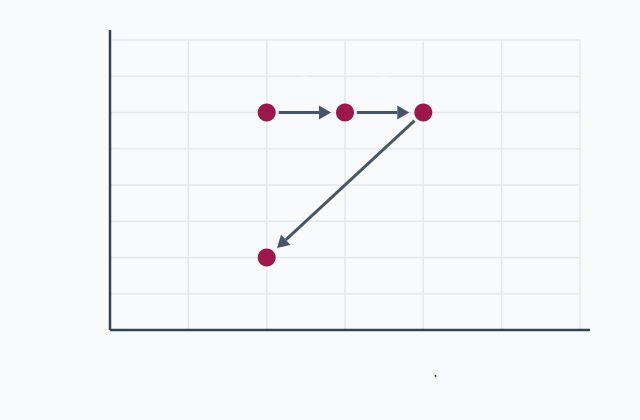
A nucleus P has atomic number 88 and mass number 228. It undergoes beta-minus decay to nucleus Q. Q undergoes beta-minus decay to nucleus R, and R undergoes alpha decay to nucleus S.
(a) On paper, draw a chart with atomic number on the horizontal axis, from 86 to 92, and mass number on the vertical axis, from 222 to 230. Plot P, Q, R and S, and draw an arrow for each decay, labeled with its type. Do this by hand before you open the model.
(b) Write the equation for the decay of Q into R in nuclear notation, using X for each element's symbol, and include every particle emitted. Show that nucleon number, charge and lepton number are conserved.
(c) A student says P and S are the same element. Explain, using your chart, whether the student is right, and how the number of neutrons changes from P to S.
(d) Another student says the electrons emitted in this chain came from the atoms' electron clouds. Using your equation from (b), explain why the student is wrong.
Model answer
(a) See the chart below: P (88, 228), Q (89, 228), R (90, 228), S (88, 224). The two beta-minus arrows run one step to the right at the same height; the alpha arrow runs 2 to the left and 4 down.
(b) . Nucleons: . Charge: . Lepton number: .
(c) The student is right. P and S sit at the same atomic number, 88, in the same column of the chart, so they have the same number of protons and are the same element, as different isotopes. P has neutrons and S has , so S has 4 fewer: two became protons in the beta-minus decays, and two left in the alpha particle.
(d) In (b), the atomic number rises from 89 to 90 at the same moment the electron appears. A neutron inside the nucleus changed into a proton and created the electron, which is why the nucleus gains a unit of charge. An electron knocked out of the cloud would leave the nucleus unchanged.
Score your own answer. This is a self-check, not a grade. Tick each point your answer makes.
Part 6 Check yourself Reading a decay chain
Both case questions use the chart.
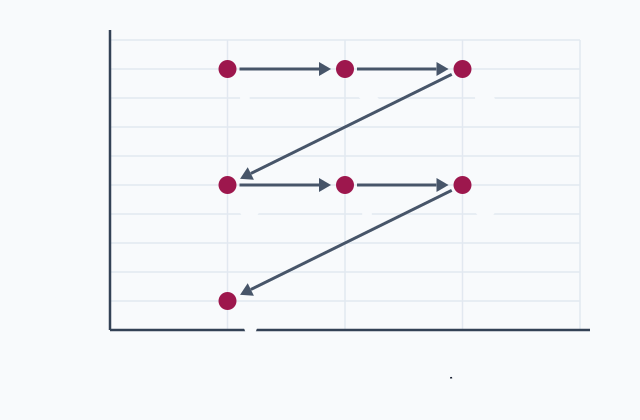
The chart shows part of a decay chain. Each nucleus is a lettered point, placed by its atomic number and mass number, and each arrow is one decay.
Case question 1 · Calculate
Using the chart: how many fewer neutrons does nucleus V have than nucleus P?
Case question 2 · Multiple choice
Using the chart: what happens in the step from P to Q?
The rest stand on their own and do not use the case.
Check yourself · Spot the error
A student writes the beta-plus decay of fluorine-18, . Atomic number 8 is oxygen (O) and 10 is neon (Ne). Tap the first line that goes wrong.
Check yourself · Rank it
Rank these four types of decay by how they change a nucleus's atomic number. A rise counts as more than no change, and no change as more than a fall.
Largest rise in atomic number first
Give each one a place, 1 for first. Give two the same place if they are equal.
Your ranking: none yet
Part 7 Keep it Bring back earlier ideas
Half-lives from the last lesson and the photoelectric effect from 15.5 are still part of the course. Retrieving them now, between new ideas, is what makes them easy to find later.
From 15.7 Fission, Fusion, and Nuclear Decay · Calculate
A sample of a radioactive isotope with a half-life of 6.0 hours starts with undecayed nuclei. How many undecayed nuclei remain after 15 hours?
From 15.5 The Photoelectric Effect · Calculate
Ultraviolet light of frequency Hz falls on a metal whose work function is 2.30 eV. What is the maximum kinetic energy of the electrons it frees? Use eV·s, and give your answer in electron volts.
In three lines
- Alpha decay ejects a helium-4 nucleus (, ); beta-minus turns a neutron into a proton with an electron and an antineutrino (); beta-plus turns a proton into a neutron with a positron and a neutrino ().
- Gamma decay follows alpha or beta decay: the excited nucleus emits a photon and keeps its and .
- Every decay conserves nucleon number, charge and lepton number, and which decay a nucleus undergoes is set by its isotope.
Exam strategy for this topic
- Section I, Multiple Choice: 42 questions in 85 minutes.
- Section II, Free Response: 4 questions in 95 minutes.
- This lesson's Explain it is shaped like free-response question 2, Translation Between Representations.
- A four-function, scientific, or graphing calculator is allowed on both sections of the exam.
Write the mass number on top and the charge below for every particle in a decay equation, the electron included, before you balance anything. Then add each row on both sides.
Questions students ask
What are the types of radioactive decay in this course?
Alpha decay, beta-minus decay, beta-plus decay and gamma decay.
What is conserved in a nuclear decay?
Nucleon number, the number of neutrons and protons; charge; and lepton number, which counts electrons and neutrinos.
How do you write a decay equation?
Write every nucleus and particle with its mass number on top and its charge in units of below, then check that both rows add to the same totals on each side.
Do I need to know how each isotope decays?
No. A problem names the type of decay; the task is to work out what it does to the nucleus.
Beyond the AP Exam
College Board sets this limit on what the AP Exam asks about this topic. Anything past it is not on the exam.
AP Physics 2 does not expect students to memorize the processes by which specific isotopes decay or the half-lives of specific isotopes. Neutron emission and electron capture are not included in the AP Physics 2 curriculum framework. Additionally, types of neutrinos, the characteristics that distinguish neutrinos and antineutrinos, and an explanation or application of the weak force are not within the scope of this course.
Course alignment, for teachers
AP Physics 2: Algebra-Based topic 15.8, Unit 15: Modern Physics.
- Skill 1.A: Create diagrams, tables, charts, or schematics to represent physical situations.
- Skill 2.C: Compare physical quantities between two or more scenarios or at different times and locations in a single scenario.
- Skill 3.B: Apply an appropriate law, definition, theoretical relationship, or model to make a claim.
- Skill 3.C: Justify or support a claim using evidence from experimental data, physical representations, or physical principles or laws.
This lesson maps all 12 essential knowledge statements of the topic to the part that teaches each one: 12 are checked by a scored question. The map is in the lesson file.