Unit 15 · Topic 15.7 · about 30 minutes · 7 parts · 11 scored checks, 1 of them multiple choice, plus 2 from earlier lessons
AP Physics 2: Algebra-Based 15.7: Fission, Fusion, and Nuclear Decay
Unit 15: 12 to 15% of the multiple-choice section
What you'll be able to do
- Describe what constrains nuclear reactions, including fission and fusion: the strong force, conservation of nucleon number, energy and momentum, and the exchange of mass and energy.
- Describe how a sample of radioactive nuclei decays over time, using the half-life and the decay constant to find how many nuclei remain or how old a material is.
Key vocabulary
| Term | What it means | The exam trap |
|---|---|---|
| Nucleon | A proton or a neutron, the particles that make up a nucleus. | Nucleon number counts protons and neutrons together; atomic number counts protons only. |
| Mass-energy equivalence | : a change in mass goes with an energy . | Use mass in kilograms and in meters per second to get an energy in joules. |
| Half-life | The time it takes for half of the initial number of radioactive nuclei in a sample to decay, written . | Use the same unit of time for the half-life and for the time elapsed. |
| Decay constant | The constant in , which sets how fast a radioactive sample decays. | It uses the same symbol as wavelength, so say which one you mean. |
 Tap to open the picture full size
Part 1 Think first Why the nucleus holds together
Commit to a guess first. Being wrong now makes the right idea stick better.
Predict first
A nucleus packs its protons so tightly that two neighbors, about m apart, push each other away with an electric force of a couple of hundred newtons. Yet most nuclei do not fly apart. What holds them together?
In short. Nuclear reactions conserve nucleon number, energy and momentum, and mass and energy can be exchanged by ; that exchange is where the energy of fission and fusion comes from.
- Fusion combines small nuclei into a larger one, and fission splits a nucleus into smaller ones; in both, products with less mass carry away the difference as energy.
- A sample of radioactive nuclei decays as , with decay constant .
- If the starting amount is known, measuring how much of a radioactive material remains gives its age.
Part 2 Learn it Inside nuclear reactions
7a. The strong force and conserved nucleons
A nucleus packs protons and neutrons, together called nucleons, into a space about m across. At that distance two protons repel each other with an electric force of about 230 N. The gravitational attraction between them is about times weaker.
What holds the nucleus together is the strong force. It is exerted at nuclear scales, between nucleons, protons and neutrons alike, and there it dominates: it outweighs the electric repulsion between protons. A little beyond the width of a nucleon it fades to almost nothing, so it has no part in holding atoms to each other.
In any nuclear reaction the nucleons are rearranged, never created or destroyed: nucleon number is conserved, and so is charge. In nuclear notation, the mass numbers (top) add to the same total on both sides, and so do the atomic numbers (bottom):
Top: 2 + 2 = 3 + 1. Bottom: 1 + 1 = 2 + 0. A neutron is written , one nucleon with no charge. Any reaction whose totals do not match cannot happen.
Quick check · Fill the statement
In one fission reaction, a uranium-235 nucleus absorbs a neutron and splits: . Tap a blank, then an answer.
The mass numbers on the two sides must add to the same total, so the krypton nucleus has mass number = . The atomic numbers must also add to the same total, so its atomic number is = .
7b. Mass, energy, fusion and fission
Nuclear reactions obey conservation of energy and conservation of momentum, as collisions do, with one addition: mass and energy can be exchanged, by mass-energy equivalence,
In many reactions the products have slightly less mass than what went in. The missing mass appears as energy, , released as kinetic energy of the products or as photons. Since is enormous, a tiny loss of mass releases a lot of energy: kg, about one electron's mass, is J.
Two kinds of reaction release energy this way.
- Fusion: two or more smaller nuclei combine to form a larger nucleus, along with subatomic particles such as neutrons. The reaction in the last chunk is one, and fusion powers the Sun.
- Fission: the nucleus of an atom splits into two or more smaller nuclei, along with subatomic particles, usually a few neutrons.
Some heavy nuclei undergo fission spontaneously. Others need an energy input first, such as absorbing a neutron. Which happens depends on the nucleus's binding energy, a measure of how tightly its nucleons are held.
Quick check · Calculate
In one fusion reaction, the products have kg less mass than the nuclei that fused, a typical value. How much energy does the reaction release? Use m/s, and give your answer in units of J.
7c. Radioactive decay and half-life
Some nuclei are unstable. Radioactive decay is the spontaneous transformation of a nucleus into one or more different nuclei, or into a lower energy level of the same nucleus. Nothing has to strike it.
The time at which one particular nucleus will decay cannot be determined. A nucleus that has waited a long time is no closer to decaying than one just formed. What can be described is probability: every nucleus of a given isotope has the same chance of decaying in the next second. Across a sample of many nuclei, that makes the decay of the whole sample predictable.
The half-life of a radioactive material is the time it takes for half of the initial number of radioactive nuclei to decay. After one half-life, half remain. In the next half-life, half of those decay, leaving a quarter of the start, then an eighth, and so on. The number falls more and more slowly and has no sudden end.
Half-lives differ enormously between isotopes, from fractions of a second to billions of years.
Quick check · Sketch the graph
A sample of a radioactive isotope with a half-life of 5.0 minutes starts with 800 undecayed nuclei. Sketch the number of undecayed nuclei against time, from 0 to 15 minutes. The first point is fixed at 800.
One shape that fits
Drag a point up or down, or tap it and use the arrow keys. The shape is checked, and so are the values the question lets you work out.
7d. The decay constant
The chance of decay is captured by the decay constant , related to the half-life by
A short half-life means a large decay constant. With it, the number of undecayed nuclei after a time is
where is the number at . Taking the natural log of both sides gives .
Two uses follow. Knowing , and , you can predict how many nuclei remain, even when is not a whole number of half-lives. And if you know how much of a radioactive material a sample started with, measuring how much is left gives its age:
For example, with years, per year. If 70.0 percent of the original nuclei remain, years. Keep and in matching time units.
Quick check · Calculate
A sample of a radioactive isotope with a half-life of 6.0 hours starts with undecayed nuclei. How many undecayed nuclei remain after 15 hours?
Part 3 Watch it done Where the energy of a fission comes from
Predict first, then watch each step, then finish the problem yourself.
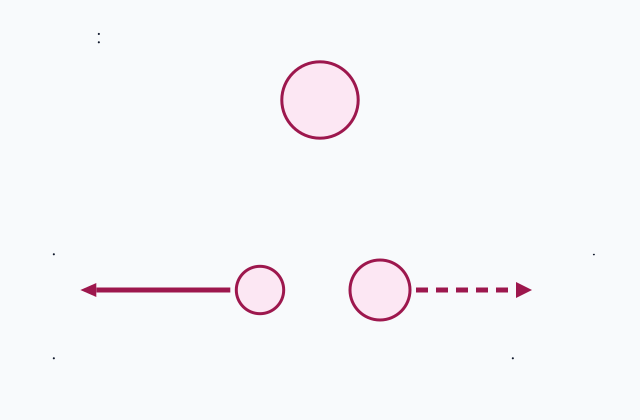
In the picture at the top of this lesson, a heavy nucleus at rest splits into two fragments with typical masses of kg and kg. Ignore the few neutrons it also releases. The lighter fragment moves off at m/s. By how much did the total mass decrease? Use m/s.
Predict first
Before you open the first step, predict: about what fraction of the nucleus's mass turned into the fragments' kinetic energy?
Step 1 · Conserve momentum
The nucleus was at rest, so the fragments' momenta must add to zero: they move in opposite directions with . So m/s.
Step 2 · Add up the kinetic energy
J.
Why this step?
Why must the heavier fragment move more slowly than the lighter one?
The two momenta are equal in size and opposite in direction, since together they must stay zero. With the same momentum, the fragment with more mass has the smaller speed.
Your step · Calculate
Finish it. A heavy nucleus at rest splits spontaneously into two fragments whose kinetic energies add to J, a typical value. Ignore any neutrons or photons. By how much did the total mass decrease? Use m/s, and give your answer in units of kg.
× 10⁻²⁸ kg
Part 4 Try it Half a half-life, and four samples
Predict first: in the first half of a half-life, does a radioactive sample lose more or less than a quarter of its nuclei? Then judge a claim, and rank four samples of different isotopes.
Try it · Decide and justify
A sample of a radioactive isotope with a half-life of 8.0 hours starts with undecayed nuclei. A student says that after 4.0 hours, half a half-life, a quarter of the nuclei will have decayed, leaving . Is the student right?
Which reason supports your answer?
Try it · Rank it
Four samples each hold a different radioactive isotope. Sample A starts with 1000 undecayed nuclei and has a half-life of 30 minutes; B starts with 600 and has a half-life of 60 minutes; C starts with 2000 and has a half-life of 15 minutes; D starts with 400 and has a half-life of 120 minutes. Rank the samples by the number of undecayed nuclei left after 60 minutes.
Most undecayed nuclei first
Give each one a place, 1 for first. Give two the same place if they are equal.
Your ranking: none yet
Part 5 Explain it Two samples, two half-lives
On the exam this is handwritten, so answer on paper first. Nothing you type here leaves this page. Then check your answer against the model and each scoring point.
Free response is 50% of the exam score. This one is shaped like Question 4, Qualitative/Quantitative Translation.
Free-response practice · Question 4 style
Two radioactive samples, X and Y, start with the same number of undecayed nuclei. The isotope in X has a half-life , and the isotope in Y has a half-life .
(a) Without using equations, explain which sample has more undecayed nuclei at time , and by what factor. A student says sample X has completely decayed by then; explain whether the student is right.
(b) Starting from and , derive an expression for the ratio at any time , in terms of and .
(c) Explain how your expression from (b) agrees with your reasoning in (a), and what it says about the ratio as keeps growing.
(d) A student has a detector that counts the decays from sample X in each minute; the count is proportional to the number of undecayed nuclei. Describe what she should measure, and what she should plot so that a straight line gives the half-life.
Model answer
(a) In a time , sample X goes through two of its half-lives: half of its nuclei decay, then half of those left, so a quarter of remain. Sample Y goes through only one of its half-lives, so half of remain. Y has twice as many. The student is wrong: each half-life removes half of what is present at its start, so X still has .
(b) and . So .
(c) At the expression gives , the factor found in (a). As grows, grows without limit: X, with the shorter half-life, keeps losing a larger fraction of its nuclei in each stretch of time than Y does.
(d) Record the number of decays in one minute at regular times, say every 10 minutes, for several half-lives. Since , plot the natural log of the count on the vertical axis against time: the points fall on a straight line of slope , and . Counting over a longer interval at each time reduces the uncertainty in each count.
Score your own answer. This is a self-check, not a grade. Tick each point your answer makes.
Part 6 Check yourself Reading a decay curve
Both case questions use the graph.
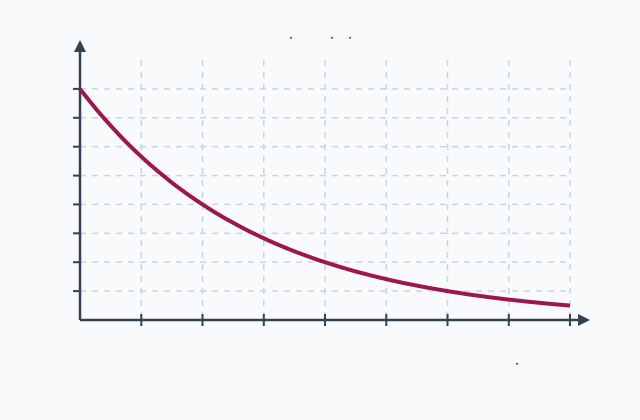
The graph shows the number of undecayed nuclei in a sample of one radioactive isotope over 12 hours.
Case question 1 · Calculate
Using the graph: what is the decay constant of this isotope? Give your answer in per hour.
Case question 2 · Multiple choice
Using the graph: one particular nucleus in the sample is still undecayed at 6.0 hours. Which statement about it is correct?
The rest stand on their own and do not use the case.
Check yourself · Sort it
Each card describes a nuclear process. Tap a card, then the kind of process it is.
Fusion
Fission
Radioactive decay
Check yourself · Select all
Which two statements about nuclei are true? Pick two.
Select 2 answers, then check.
Part 7 Keep it Bring back earlier ideas
Compton scattering from the last lesson and blackbody radiation from 15.4 are still part of the course. Retrieving them now, between new ideas, is what makes them easy to find later.
From 15.6 Compton Scattering · Rank it
X-ray photons, all of the same wavelength, scatter off free electrons at rest. Rank these scattered photons by their wavelength after the collision.
Longest wavelength first
Give each one a place, 1 for first. Give two the same place if they are equal.
Your ranking: none yet
Predict first: is a book on your desk, at room temperature, emitting electromagnetic radiation right now? Then judge a claim, and sketch how the peak wavelength depends on temperature.
From 15.4 Blackbody Radiation · Decide and justify
A book on a desk is at room temperature, about 300 K, and in a dark room it gives off no light that anyone can see. A student says the book is still emitting electromagnetic radiation. Model the book as a blackbody, with m·K. Is the student right?
Which reason supports your answer?
In three lines
- The strong force holds nucleons together at nuclear distances, and every nuclear reaction conserves nucleon number, charge, energy and momentum.
- Mass and energy are exchanged by : fusion and fission release the energy of lost mass as kinetic energy or photons.
- Each nucleus decays at random, but a sample follows with , halving every half-life.
Exam strategy for this topic
- Section I, Multiple Choice: 42 questions in 85 minutes.
- Section II, Free Response: 4 questions in 95 minutes.
- This lesson's Explain it is shaped like free-response question 4, Qualitative/Quantitative Translation.
- A four-function, scientific, or graphing calculator is allowed on both sections of the exam.
Keep the decay constant and the time in matching units: a decay constant in per hour needs the time in hours. Then check the answer: it must lie between and zero, and be smaller the longer the time.
Questions students ask
What does mean for nuclear reactions?
Mass and energy can be exchanged. When the products of a reaction have less mass than what went in, the difference is released as energy, .
What is a half-life?
The time it takes for half of the initial number of radioactive nuclei in a sample to decay.
How is the decay constant related to the half-life?
, and the number of undecayed nuclei after a time is .
How can radioactive decay give the age of a material?
If the starting number of radioactive nuclei is known, measuring how many remain and using gives the time that has passed.
Course alignment, for teachers
AP Physics 2: Algebra-Based topic 15.7, Unit 15: Modern Physics.
- Skill 1.B: Create quantitative graphs with appropriate scales and units, including plotting data.
- Skill 2.B: Calculate or estimate an unknown quantity with units from known quantities, by selecting and following a logical computational pathway.
- Skill 2.C: Compare physical quantities between two or more scenarios or at different times and locations in a single scenario.
- Skill 3.A: Create experimental procedures that are appropriate for a given scientific question.
- Skill 3.B: Apply an appropriate law, definition, theoretical relationship, or model to make a claim.
This lesson maps all 14 essential knowledge statements of the topic to the part that teaches each one: 14 are checked by a scored question. The map is in the lesson file.