Unit 9 · Topic 9.1 · about 30 minutes · 7 parts · 11 scored checks, 2 of them multiple choice
AP Physics 2: Algebra-Based 9.1: Kinetic Theory of Temperature and Pressure
Unit 9: 15 to 18% of the multiple-choice section
What you'll be able to do
- Describe the pressure a gas exerts on its container in terms of the collisions of its atoms, and explain why pressure exists everywhere in the gas.
- Describe the temperature of a gas in terms of the average kinetic energy of its atoms, find rms speeds, and read how the spread of atomic speeds changes with temperature.
Key vocabulary
| Term | What it means | The exam trap |
|---|---|---|
| Kelvin scale | The absolute temperature scale, in kelvins (K), which starts from absolute zero: . | A kelvin is the same size as a Celsius degree, so a temperature change is the same number on both scales, but a temperature itself is not. |
| Root-mean-square speed | The square root of the average of the squared speeds of the atoms in a gas, : the speed an atom with the average kinetic energy would have. | It describes the whole gas, so do not read it as the speed of any one atom you pick out. |
| Boltzmann constant | The constant J/K that links a temperature to the energy of single atoms. | It works per atom, so use it with a number of atoms, never with a number of moles. |
 Tap to open the picture full size
Part 1 Think first A tank in the sun
Commit to a guess first. Being wrong now makes the right idea stick better.
Predict first
A sealed steel tank of helium sits in the sun all afternoon, and the helium inside warms from 20 °C to 50 °C. No gas gets in or out. What changed about the helium atoms?
In short. Kinetic theory explains a gas's pressure as the push of its atoms colliding with surfaces, , and its temperature as the average kinetic energy of its atoms, .
- Only the part of each force perpendicular to a surface adds to the pressure, and pressure exists everywhere in the gas, not only at the walls.
- At one temperature every gas has the same average kinetic energy per atom, so lighter atoms move faster: , with in kelvins.
- Atoms have a spread of speeds. Heating a gas moves the peak of the distribution to higher speeds and makes the curve lower and wider.
Part 2 Learn it Atoms in motion
2a. Temperature is average kinetic energy
The atoms of a gas fly about in every direction. The temperature of the gas is a measure of the average kinetic energy of those atoms:
Here J/K is the Boltzmann constant, is the mass of one atom, and is the absolute temperature in kelvins: . At 0 °C atoms still move fast, so a Celsius temperature never goes into this equation.
is the root-mean-square speed: square each atom's speed, average the squares, then take the square root. It is the speed an atom with exactly the average kinetic energy would have.
The equation has no mass in its middle term, so every gas at the same temperature has the same average kinetic energy per atom. Since that energy is , lighter atoms move faster: .
For helium at 300 K, with kg, J and m/s.
Quick check · Calculate
Helium atoms have a mass of kg. Treat helium as an ideal gas and take J/K. At what temperature is the rms speed of the atoms in a sample of helium 1000 m/s? Give your answer in kelvins, to the nearest 1 K.
2b. A spread of speeds
Atoms in a gas do not all move at . Collisions keep trading energy between them, so at any instant some are nearly still and a few are very fast.
The Maxwell-Boltzmann distribution is a graph of how many atoms have each speed, for a gas at one temperature. You will not need its formula, only how its features follow the temperature:
- It starts at zero at zero speed, rises to a peak at the most common speed, and has a long tail at high speeds.
- The area under the curve stands for the number of atoms, so for a given sample it does not change.
- Heating the gas moves the peak to a higher speed. Since the area stays the same, a curve that spreads out to higher speeds must also get lower.
- At the same temperature, a gas of heavier atoms has its peak at a lower speed, with a taller, narrower curve.
So a temperature describes the whole crowd of atoms, never one atom.
Quick check · Match
Tap a change or feature of a Maxwell-Boltzmann speed distribution, then what it means.
2c. Pressure comes from collisions
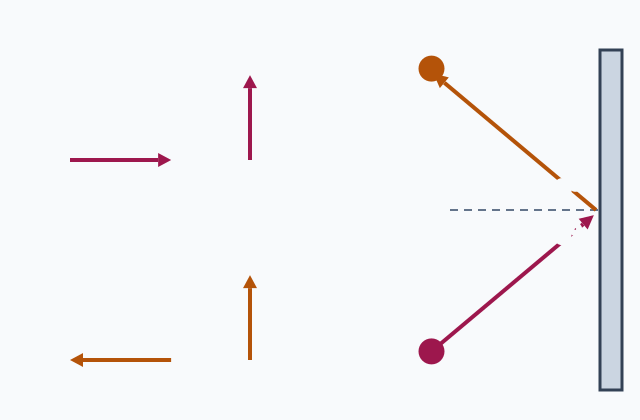
Atoms in a gas collide with each other and with the walls of their container. Treat an atom bouncing off a fixed wall as an elastic collision, so it leaves at the same speed. As the picture at the top of this lesson shows, the bounce reverses the part of the velocity perpendicular to the wall and leaves the part along the wall unchanged.
Reversing that perpendicular part changes the atom's momentum by , all of it perpendicular to the wall. A change in momentum needs a force, so the wall pushes the atom outward, and by Newton's third law the atom pushes the wall outward just as hard. Conservation of momentum describes collisions between pairs of atoms the same way.
Billions of these short pushes every second add up to a steady force. Pressure is the total of the perpendicular parts of those forces divided by the area they act on:
Pressure is measured in pascals: 1 Pa = 1 N/m². The air around you is at about Pa. A force along the surface adds nothing to the pressure.
Quick check · Decide and justify
Two identical atoms strike a flat, fixed wall at the same speed and bounce off elastically. Atom A moves straight at the wall. Atom B arrives at 60° from the straight-on direction. A student says the two collisions give the wall the same push, because the atoms have the same mass and the same speed and both bounce off elastically. Is the student right?
Which reason supports your answer?
2d. Pressure everywhere in the gas
Pressure is not only at the walls. Picture a thin sheet held anywhere inside the gas. Atoms strike it from both sides, just as often and just as hard as they strike a wall, so the gas presses on both faces. Pressure exists at every point in the gas.
That is why a pressure gauge pushed into the middle of a tank reads the same as one on the wall, once the gas has settled and if gravity is small enough to ignore. It is also why the air presses on all sides of your hand, not only on the side facing the sky.
Pressure has no direction of its own. It acts on any surface you put in the gas, and the force it makes on that surface is perpendicular to the surface, with size . On a diagram, pressure is a number at a point, never an arrow.
Quick check · Multiple choice
A sealed tank holds a gas that has settled, with every part at the same temperature, and gravity can be ignored. A small, thin pressure sensor is held in the middle of the tank, far from the walls, and an identical sensor is fixed to one wall. How do their readings compare?
Part 3 Watch it done How fast are argon atoms?
Predict first, then watch each step, then finish the problem yourself.
A cylinder holds argon gas at 27 °C. Each argon atom has a mass of kg. Treat the argon as an ideal gas and take J/K. What is the rms speed of the argon atoms?
Predict first
Before you open the first step, predict the rms speed of the argon atoms.
Step 1 · Change the temperature to kelvins
K.
Step 2 · Find the average kinetic energy
That is J, the average for one atom. Some atoms have more and some less.
Why this step?
Why must the temperature be in kelvins?
The average kinetic energy is proportional to the absolute temperature, which is zero only where the atoms would have no kinetic energy at all. At 0 °C argon atoms still move fast, but a Celsius temperature would give them no energy, and at 27 °C it would give far too little.
Your step · Calculate
Finish it. Argon atoms, each of mass kg, in a gas at 300 K have an average kinetic energy of J. What is their rms speed? Give your answer to the nearest 1 m/s.
m/s
Part 4 Try it Lighter, hotter, faster
Mass and temperature both set how fast atoms move. Predict first: is argon at 1200 K faster than neon at 600 K, slower, or the same speed? An argon atom has about twice the mass of a neon atom.
Try it · Rank it
Four samples of ideal gas are listed with the mass of one atom, in atomic mass units (u), and the temperature. Sample A: helium, 4 u, at 300 K. Sample B: neon, 20 u, at 600 K. Sample C: argon, 40 u, at 300 K. Sample D: argon, 40 u, at 1200 K. Rank the samples by the rms speed of their atoms.
Fastest first
Give each one a place, 1 for first. Give two the same place if they are equal.
Your ranking: none yet
Now go from pressure to force on a wall.
Try it · Calculate
A box holds a gas at a pressure of Pa. One flat wall of the box measures 0.30 m by 0.50 m. What is the size of the total force the gas inside exerts on that wall? Give your answer in kilonewtons, to the nearest 1 kN.
Part 5 Explain it Helium and argon at one temperature
On the exam this is handwritten, so answer on paper first. Nothing you type here leaves this page. Then check your answer against the model and each scoring point.
Free response is 50% of the exam score. This one is shaped like Question 4, Qualitative/Quantitative Translation.
Free-response practice · Question 4 style
Two identical rigid containers hold the same number of atoms at the same temperature . Container 1 holds helium, whose atoms have mass . Container 2 holds argon, whose atoms have mass . Treat both gases as ideal.
(a) Without using equations, explain how the average kinetic energy of a helium atom compares with that of an argon atom, and which atoms typically move faster.
(b) Derive an expression for the ratio of the rms speeds of the two kinds of atom.
(c) On paper, draw one helium atom and one argon atom, each moving at its gas's rms speed, hitting a wall head-on and bouncing straight back elastically. Draw an arrow for each atom's momentum before and after, with lengths in proportion. Do this by hand before you open the model. Then use your drawing and your answer to (b) to explain whether a student is correct who claims that the argon exerts the lower pressure, because its atoms move more slowly and so hit the walls less often.
Model answer
(a) Both gases are at the same temperature, and temperature measures the average kinetic energy of the atoms, so a helium atom and an argon atom have the same average kinetic energy. An argon atom has ten times the mass, so to have the same kinetic energy it must move more slowly. Helium atoms are typically faster.
(b) , so and .
(c) Compare your drawing with the model below. A head-on bounce reverses the momentum, so the wall receives each hit. The argon atom's momentum is , so its arrows are about 3.2 times as long as the helium atom's. The student is incorrect. Argon atoms do hit the walls less often, by the same factor of from (b), since they cross the container more slowly. But each hit pushes times as hard. The two factors cancel, so the pressures are equal, which agrees with (a): equal average kinetic energies.
 Tap to open the picture full size
Score your own answer. This is a self-check, not a grade. Tick each point your answer makes.
Part 6 Check yourself Two samples of neon
Both case questions use the graph.
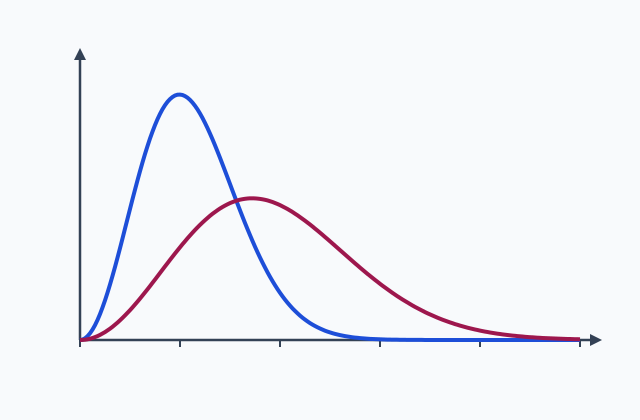
Two samples of neon gas hold the same number of atoms. One is at 300 K and the other at 900 K. The graph shows how many atoms in each sample have each speed. The curves are labeled X and Y, and the graph does not say which is which.
 Tap to open the picture full size
Case question 1 · Multiple choice
Using the graph of samples X and Y: which sample is at 900 K, and what in the graph shows it?
Case question 2 · Calculate
Using the graph of samples X and Y: the rms speed of the atoms in the 300 K sample is 609 m/s. What is the rms speed of the atoms in the 900 K sample? Give your answer to the nearest 1 m/s.
The rest stand on their own and do not use the case.
Check yourself · Fill the statement
Tap a blank, then an answer.
An atom that bounces off a wall changes its , so the wall pushes on the atom and the atom pushes back on the wall. Only the part of each atom's force adds to the gas's pressure on the wall. The pressure is the total of those parts divided by .
Check yourself · Spot the error
A student compares sample P, helium at 300 K, with sample Q, argon at 600 K. An argon atom has 10 times the mass of a helium atom. Tap the first line that goes wrong.
Part 7 Keep it Hold on to it
This is the first lesson of the course, so there is nothing earlier to bring back yet. From the next lesson on, two questions from earlier lessons appear here.
In three lines
- Pressure is the push of atoms colliding with a surface: the perpendicular parts of their forces divided by the area, , and it exists everywhere in the gas.
- Temperature measures the average kinetic energy of the atoms, , with in kelvins, so at one temperature lighter atoms move faster.
- Atoms have a spread of speeds; heating a gas moves the peak of its speed distribution to higher speeds and makes the curve lower and wider, with the same area.
Exam strategy for this topic
- Section I, Multiple Choice: 42 questions in 85 minutes.
- Section II, Free Response: 4 questions in 95 minutes.
- This lesson's Explain it is shaped like free-response question 4, Qualitative/Quantitative Translation.
- A four-function, scientific, or graphing calculator is allowed on both sections of the exam.
When a question compares gases, first ask what is the same. The same temperature means the same average kinetic energy per atom, whatever the gas; then sorts out the speeds.
Questions students ask
What causes gas pressure?
Atoms colliding with a surface. Each bounce changes an atom's momentum, so the surface pushes on the atom and the atom pushes back. The perpendicular parts of those forces, added up and divided by the area, are the pressure.
What does the temperature of a gas measure?
The average kinetic energy of its atoms, , with in kelvins. It describes the whole gas, since its atoms have a spread of speeds.
What is the rms speed of a gas?
The square root of the average of the squared speeds: the speed an atom with the average kinetic energy would have, .
Do I need the formula for the Maxwell-Boltzmann distribution?
No. You need its features: it starts at zero, rises to a peak and has a long tail at high speeds, and heating the gas moves the peak to higher speeds and spreads the curve out, with the same area underneath.
Beyond the AP Exam
College Board sets this limit on what the AP Exam asks about this topic. Anything past it is not on the exam.
AP Physics 2 only expects students to perform qualitative and quantitative analysis of collisions in one and two dimensions. Students are not expected to know the functional form of the Maxwell-Boltzmann distribution but are expected to be familiar with how features of the distribution are related to the temperature of the gas.
Course alignment, for teachers
AP Physics 2: Algebra-Based topic 9.1, Unit 9: Thermodynamics.
- Skill 1.A: Create diagrams, tables, charts, or schematics to represent physical situations.
- Skill 2.C: Compare physical quantities between two or more scenarios or at different times and locations in a single scenario.
- Skill 3.B: Apply an appropriate law, definition, theoretical relationship, or model to make a claim.
- Skill 3.C: Justify or support a claim using evidence from experimental data, physical representations, or physical principles or laws.
This lesson maps all 7 essential knowledge statements of the topic to the part that teaches each one: 7 are checked by a scored question. The map is in the lesson file.