Unit 9 · Topic 9.2 · about 30 minutes · 7 parts · 10 scored checks, 1 of them multiple choice, plus 2 from earlier lessons
AP Physics 2: Algebra-Based 9.2: The Ideal Gas Law
Unit 9: 15 to 18% of the multiple-choice section
What you'll be able to do
- Describe the properties of an ideal gas: the assumptions of the model, the law PV = nRT that it obeys, and what graphs of pressure, volume and temperature show, including absolute zero.
Key vocabulary
| Term | What it means | The exam trap |
|---|---|---|
| Ideal gas law | The relationship between the pressure, volume, amount and absolute temperature of an ideal gas. | Temperatures in the law are always in kelvins, so convert a Celsius reading first. |
| Mole | An amount of substance holding particles; counts moles and counts particles. | Use with a number of moles and with a number of particles, since mixing them is off by a factor of . |
| Extrapolate | To extend a trend in data beyond the range that was measured, such as following a best-fit line past the last point. | An extrapolated value is only as good as the line behind it, so small errors in the data move it a long way. |
 Tap to open the picture full size
Part 1 Think first A tire on a cold night
Commit to a guess first. Being wrong now makes the right idea stick better.
Predict first
Jonah pumps up his bike tire in a garage at 20 °C, then leaves the bike outside on a night when the air falls to −5 °C. The tire hardly changes size and no air leaks out. In the morning, before he rides, how does the pressure in the tire compare with the pressure in the garage?
In short. An ideal gas is a model gas of tiny, randomly moving atoms that interact only in elastic collisions, and its pressure, volume, amount and temperature obey .
- Temperatures go in kelvins and volumes in cubic meters; J/(mol·K) goes with moles and with numbers of particles.
- Hold two quantities fixed and the other two are proportional, such as in a rigid, sealed tank.
- Pressure against volume at constant temperature is a curve, not a straight line, and pressure against Celsius temperature extrapolates to zero near −273 °C, absolute zero.
Part 2 Learn it One law for ideal gases
2a. The ideal gas model
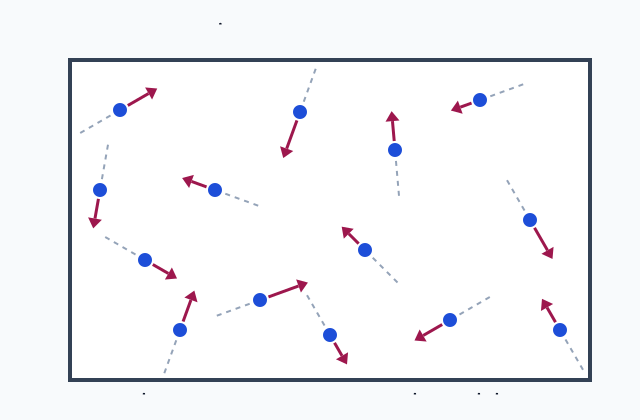
Kinetic theory pictures a gas as atoms in motion. The ideal gas model, shown in the picture at the top of this lesson, makes four simplifications:
- The velocities of the atoms are random: every direction is equally likely.
- The atoms are so small that their own volume is negligible compared with the volume the gas fills.
- Collisions between atoms, and with the walls, are elastic.
- The only forces on the atoms that matter are the ones during collisions. Between collisions, atoms move in straight lines.
Real gases fit this model well when their particles are far apart and moving fast, which describes most gases at room temperature and everyday pressures. The model breaks down when a gas is squeezed so hard that its particles fill a real fraction of the space, or cooled until the attractions between particles start to matter, as they do just before a gas condenses into a liquid.
Quick check · Sort it
Tap a card, then whether the ideal gas model fits the gas it describes.
The model fits
The model breaks down
2b. The ideal gas law
An ideal gas obeys the ideal gas law:
is the pressure in pascals, the volume in cubic meters and the absolute temperature in kelvins. The amount of gas is counted either as moles, with J/(mol·K), or as particles, with J/K. A mole is particles, and is times that number, so the two forms say the same thing. A liter is m³.
The law does not name the gas. The mass of its particles appears nowhere in it.
Hold two quantities fixed and the other two are proportional:
- Fixed and : .
- Fixed and : , so stays the same.
- Fixed and : .
For example, 2.0 mol of gas at 300 K in 0.050 m³ has Pa, about the pressure of the air around you.
Quick check · Calculate
A rigid tank with a volume of 0.010 m³ holds 0.50 mol of helium at 27 °C. Treat the helium as an ideal gas and take J/(mol·K). What is the pressure of the helium? Give your answer in kilopascals, to the nearest 1 kPa.
2c. Graphs of a gas, and absolute zero
Graphs show these relationships at a glance, and read backward they tell you about the gas.
- Pressure against volume at constant temperature is a curve that falls more and more gently, because : twice the volume, half the pressure. It is not a straight line. Plot pressure against instead and the points fall on a straight line through the origin, with slope .
- Pressure against temperature at constant volume is a straight line with slope . With the temperature in kelvins, the line passes through the origin.
Plot the pressure against the temperature in degrees Celsius and the line meets zero pressure at a negative temperature. Extending the line beyond the data to find where, called extrapolating, gives close to −273 °C for every gas. That temperature is absolute zero, 0 K, where an ideal gas would have no pressure at all, and it is where the kelvin scale starts.
Quick check · Calculate
A rigid, sealed container of gas reads a pressure of 100.0 kPa at 20 °C and 120.0 kPa at 80 °C. Assume the pressure changes linearly with temperature. Extrapolate these two readings: at what temperature, in degrees Celsius, would the pressure be zero? Give your answer to the nearest 1 °C.
Part 3 Watch it done Heating a sealed tank
Predict first, then watch each step, then finish the problem yourself.
A rigid steel tank holds nitrogen at 20 °C and a pressure of Pa. The tank is heated until the nitrogen is at 120 °C. No gas escapes, and the nitrogen behaves as an ideal gas. What is its new pressure?
Predict first
Before you open the first step, predict the new pressure.
Step 1 · Decide what stays fixed
The tank is rigid and sealed, so and do not change. From , stays the same, so .
Step 2 · Change both temperatures to kelvins
K and K.
Why this step?
Why can the ratio of the Celsius temperatures, 120 to 20, not be used?
Pressure is proportional to the absolute temperature, measured from absolute zero. A Celsius temperature is measured from the freezing point of water, so its ratio would say the pressure grows six times, when the gas has warmed by only about a third of its absolute temperature.
Your step · Calculate
Finish it. A sealed, rigid tank of ideal gas is at Pa and 293 K. It is heated to 393 K with no gas escaping. What is the new pressure? Give your answer in kilopascals, to the nearest 1 kPa.
kPa
Part 4 Try it How much gas is in there?
Rearranged, the ideal gas law counts the particles in a container: . Predict first: a container at twice the pressure and twice the absolute temperature of another, with the same volume, holds more gas, less gas, or the same amount?
Try it · Rank it
Four containers hold ideal gases. Container A's pressure, volume and absolute temperature are P, V and T. Container B is at 2P, V and T. Container C is at P, 2V and 2T. Container D is at 3P, V and 2T. Rank the containers by the number of gas particles they hold.
Most particles first
Give each one a place, 1 for first. Give two the same place if they are equal.
Your ranking: none yet
Now predict factors of change without any numbers.
Try it · Fill the statement
Tap a blank, then an answer.
A sealed gas is heated at constant volume until its absolute temperature doubles, so its pressure . A sealed gas is squeezed slowly at constant temperature to a third of its volume, so its pressure . A sealed gas in a rigid tank is heated from 100 °C to 200 °C, so its pressure .
Part 5 Explain it Find absolute zero with a flask
On the exam this is handwritten, so answer on paper first. Nothing you type here leaves this page. Then check your answer against the model and each scoring point.
Free response is 50% of the exam score. This one is shaped like Question 3, Experimental Design and Analysis.
Free-response practice · Question 3 style
A student wants to find absolute zero, the temperature in degrees Celsius at which an ideal gas would have zero pressure. She has a sealed, rigid flask holding 1.00 L of air, joined to a pressure sensor by a short tube, a thermometer, and large beakers of water that she can heat or cool.
(a) Describe a procedure she could use to collect data for a graph from which she can find absolute zero. Say what she changes, what she measures, and one step that reduces experimental uncertainty.
(b) Her results are below. On paper, plot the pressure against the temperature in degrees Celsius, with a scale and units on each axis. Let the temperature axis run from −300 °C to 100 °C, so there is room to extrapolate. Draw a best-fit line and extend it to zero pressure. Do this by hand before you open the model.
- 0 °C: 90.6 kPa
- 20 °C: 97.6 kPa
- 40 °C: 104.0 kPa
- 60 °C: 110.6 kPa
- 80 °C: 117.5 kPa
- 100 °C: 124.0 kPa
(c) Use your line to determine the temperature at which the pressure would be zero, and calculate the number of moles of air in the flask. Take J/(mol·K).
Model answer
(a) Hold the flask completely under the water in a beaker, starting with ice water at 0 °C. Stir, wait until the pressure reading stops changing, then record the water's temperature and the pressure. Warm the water in steps of about 20 °C up to boiling and repeat. To reduce uncertainty, stir and wait each time so the air in the flask reaches the water's temperature, keep the whole flask under water, and repeat each reading and average.
(b) See the graph below: a labeled scale on each axis, the six points rising in a straight line, and one best-fit line extended down to zero pressure.
(c) The line passes through about (0 °C, 90.7 kPa) with a slope of kPa per °C. It reaches zero pressure at °C, close to absolute zero. Since , the slope is , so mol.
Pressure against Celsius temperature, with the best-fit line extended
The line reaches zero pressure near −272 °C.
Score your own answer. This is a self-check, not a grade. Tick each point your answer makes.
Part 6 Check yourself Air in a syringe
Both case questions use the graph.
A student traps air in a syringe whose tip is sealed onto a pressure sensor. She moves the plunger slowly, so the air stays at room temperature, 22 °C, and records the pressure at six volumes. No air gets in or out.
Pressure of the trapped air at each volume
Readings at 10, 15, 20, 25, 30 and 40 mL.
Case question 1 · Multiple choice
Using the syringe data: the student wants a graph of these data that is a straight line through the origin. What should she plot?
Case question 2 · Calculate
Using the syringe data: at 20 mL the pressure is 100 kPa. Treat the air as an ideal gas and take J/(mol·K). How many moles of air are in the syringe? Give your answer in millimoles, to two decimal places.
The rest stand on their own and do not use the case.
Check yourself · Decide and justify
Two identical rigid tanks are at the same temperature. One holds 1.0 mol of helium and the other 1.0 mol of nitrogen, whose molecules each have 7 times the mass of a helium atom. Both behave as ideal gases. A student says the two gases are at the same pressure. Is the student right?
Which reason supports your answer?
Check yourself · Spot the error
A student finds the pressure of 0.20 mol of an ideal gas in a 5.0 L container at 25 °C, with R = 8.31 J/(mol·K). Tap the first line that goes wrong.
Part 7 Keep it Bring back earlier ideas
Temperature and pressure from the last lesson are two of the four quantities in the ideal gas law. Pulling them back up is what makes them last.
Mass and temperature both set how fast atoms move. Predict first: is argon at 1200 K faster than neon at 600 K, slower, or the same speed? An argon atom has about twice the mass of a neon atom.
Now go from pressure to force on a wall.
From 9.1 Kinetic Theory of Temperature and Pressure · Rank it
Four samples of ideal gas are listed with the mass of one atom, in atomic mass units (u), and the temperature. Sample A: helium, 4 u, at 300 K. Sample B: neon, 20 u, at 600 K. Sample C: argon, 40 u, at 300 K. Sample D: argon, 40 u, at 1200 K. Rank the samples by the rms speed of their atoms.
Fastest first
Give each one a place, 1 for first. Give two the same place if they are equal.
Your ranking: none yet
From 9.1 Kinetic Theory of Temperature and Pressure · Fill the statement
Tap a blank, then an answer.
An atom that bounces off a wall changes its , so the wall pushes on the atom and the atom pushes back on the wall. Only the part of each atom's force adds to the gas's pressure on the wall. The pressure is the total of those parts divided by .
In three lines
- An ideal gas has randomly moving particles of negligible volume that collide elastically and exert forces only in collisions; real gases fit when their particles are far apart and fast.
- , with in kelvins and in cubic meters; hold two quantities fixed and the other two are proportional.
- Pressure against volume at constant temperature is a curve; pressure against Celsius temperature is a line that extrapolates to zero pressure near −273 °C, absolute zero.
Exam strategy for this topic
- Section I, Multiple Choice: 42 questions in 85 minutes.
- Section II, Free Response: 4 questions in 95 minutes.
- This lesson's Explain it is shaped like free-response question 3, Experimental Design and Analysis.
- A four-function, scientific, or graphing calculator is allowed on both sections of the exam.
Before you calculate, decide what stays fixed: a rigid, sealed tank fixes and , so is constant; a slow squeeze at room temperature fixes and , so is constant. Then put temperatures in kelvins and volumes in cubic meters.
Questions students ask
What is an ideal gas?
A model gas whose particles move randomly, take up negligible volume, collide elastically and exert forces only during collisions. Most real gases at room temperature and everyday pressures behave very nearly like one.
What is the ideal gas law?
: pressure times volume equals the number of moles times times the absolute temperature, or the number of particles times times the absolute temperature.
Why must the temperature be in kelvins?
Pressure and volume are proportional to the absolute temperature, measured from absolute zero. A Celsius temperature starts from the freezing point of water, so it gives wrong ratios and wrong values.
How do you find absolute zero from a graph?
Measure the pressure of a sealed, rigid container of gas at several temperatures, plot pressure against Celsius temperature, and extend the best-fit line to zero pressure. It lands near −273 °C.
Course alignment, for teachers
AP Physics 2: Algebra-Based topic 9.2, Unit 9: Thermodynamics.
- Skill 1.B: Create quantitative graphs with appropriate scales and units, including plotting data.
- Skill 2.C: Compare physical quantities between two or more scenarios or at different times and locations in a single scenario.
- Skill 2.D: Predict new values or factors of change of physical quantities using functional dependence between variables.
- Skill 3.A: Create experimental procedures that are appropriate for a given scientific question.
- Skill 3.B: Apply an appropriate law, definition, theoretical relationship, or model to make a claim.
This lesson maps all 4 essential knowledge statements of the topic to the part that teaches each one: 4 are checked by a scored question. The map is in the lesson file.