Unit 1 · Topic 1.1 · about 30 minutes · 7 parts · 14 scored checks, 2 of them multiple choice
AP Physics C: Mechanics 1.1: Scalars and Vectors
Unit 1: 10 to 15% of the multiple-choice section
What you'll be able to do
- Describe a quantity as a scalar, by its magnitude, or as a vector, by its magnitude and direction, and write a vector in unit vector notation or as a magnitude and a direction.
Key vocabulary
| Term | What it means | The exam trap |
|---|---|---|
| Scalar | A quantity described by its magnitude only, such as a distance or a speed. | A speedometer reports a scalar, so its reading alone never says which way an object is heading. |
| Vector | A quantity described by both magnitude and direction, drawn as an arrow whose length is proportional to its magnitude; position, displacement, velocity and acceleration are vectors. | Along one axis a vector's direction is carried by a sign, so state which way is positive before you write one. |
| Magnitude | The size of a vector, the length of its arrow; for it is . | A magnitude is written with bars, , or as the letter with no arrow, ; the letter with an arrow means the whole vector. |
| Unit vector | A vector of magnitude 1 that shows a direction only: , and point along , and , and points along a position vector . | Round its components too far and its magnitude drifts from 1, so keep enough digits that it still works out to 1, and give it no unit. |
| Position vector | The vector from the origin to a point, written in unit vector notation by its , and components. | A position depends on where you put the origin; a displacement, the change between two positions, does not. |
| Distance | The length of the path an object follows, a scalar that can only grow as the object moves. | A car's odometer counts distance, so it keeps climbing even when the car doubles back. |
| Displacement | The change in an object's position, , a vector from where it starts to where it ends. | Subtract final minus initial; the other order gives an arrow of the same length pointing the opposite way. |
| Component | The signed part of a vector along one axis: for , the components are and . | A vector's components depend on the axes you choose; its magnitude and direction do not. |
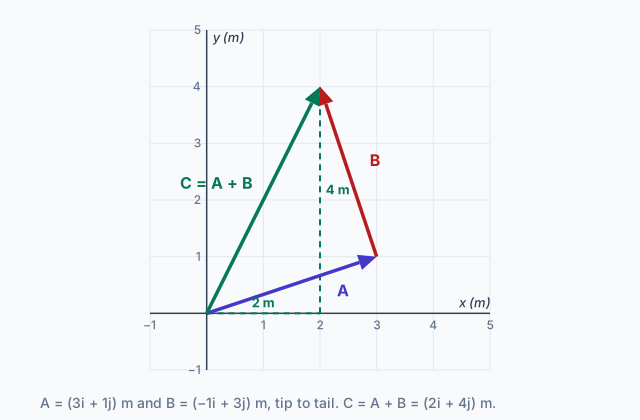
| Resultant vector | The vector sum of two or more vectors, whose components are the sums of their components: . | Drawn tip to tail, the resultant runs from the first arrow's tail to the last arrow's tip, not from tip to tip. |
 Tap to open the picture full size
Part 1 Think first How far from the trailhead?
Commit to a guess first. Being wrong now makes the right idea stick better.
Predict first
A hiker walks 9 km due east, then 12 km due north. When she stops, how far is she from where she started, measured in a straight line?
In short. A scalar is a quantity with magnitude only, such as distance or speed; a vector has magnitude and direction, such as position, displacement, velocity or acceleration, and is drawn as an arrow or written in components as .
- An arrow's length is proportional to the vector's magnitude, and along a single axis the sign of a component gives its direction.
- A vector can be written in unit vector notation or as a magnitude and a direction, and links the two.
- To add vectors, add their components: .
Part 2 Learn it Four ideas, with a check after each
2a. Magnitude only, or magnitude and direction
Some quantities are described completely by one number with a unit. A scalar has a magnitude only: a size, such as 12 m or 5 s. A vector has a magnitude and a direction: 12 m east, or 5 m/s straight up.
Distance and speed are scalars. Distance counts every meter of the path, whichever way the object went, and speed says how fast without saying which way. Position, displacement, velocity and acceleration are vectors. A position says how far and which way a point is from an origin, and a displacement says how far and which way an object ended up from where it started.
One trip can give two different answers. A dog runs 8 m out to a stick and 8 m back: it covers 16 m of distance, but its displacement is zero, because it ends where it began.
A speedometer reads speed, not velocity. Two cars at 25 m/s, one heading north and one heading south, have the same speed and different velocities, because their directions differ.
Quick check · Decide and justify
A runner on a circular track holds a steady 6 m/s for a full lap. Her coach says that because her speed never changes, her velocity never changes either. Is the coach right?
Which reason supports your answer?
2b. Arrows, and signs along a line
A vector is drawn as an arrow. The arrow points in the vector's direction, and its length is proportional to the vector's magnitude. Pick a scale, such as 1 cm for every 5 m/s, and a velocity of 20 m/s becomes an arrow 4 cm long. In the picture at the top of this page one grid square stands for 1 m.
An arrow can be slid anywhere without changing the vector, as long as its length and direction stay the same. That is what lets you place the tail of one arrow at the tip of another, as the picture does.
Along a single line, a direction needs only a sign. Choose which way is positive and say so; the opposite direction is then negative. With east positive, a cart moving 3 m/s west has m/s. The minus sign is the direction, not a smaller amount: m/s and m/s are arrows of the same length pointing opposite ways. The subscript says this is the component along the axis, so it needs no arrow over it.
Quick check · Fill the statement
A cart rolls along a straight track at 4 m/s toward the west. Take east as positive, and draw velocity arrows at a scale of 1 cm for every 2 m/s.
The cart's speed is , its velocity is , and its velocity arrow is long.
2c. Components and unit vectors
To write a vector with numbers, split it into components along the axes. The unit vectors , and each have magnitude 1 and point along , and . In unit vector notation a vector is the sum of its components:
Each of , and is a number with a sign. For a point, is its position vector, the arrow from the origin to the point. With up, a bird at m is 4 m along , 2 m along and 4 m up.
The magnitude comes from the Pythagorean theorem, used once for each extra dimension:
For the bird, m. Every term under the root is a square, so it is never negative.
Dividing a vector by its own magnitude gives the unit vector in its direction, . For the bird, . It has magnitude 1 and no unit, so it carries the direction alone.
Quick check · Calculate
A drone hovers at position m from its launch pad, with east, north and up. How far is the drone from the launch pad?
2d. From magnitude and direction to components, and adding
A vector can also be given as a magnitude and a direction, such as 20 m at 30° north of east. To find its components, sketch the arrow and the right triangle under it. With east and north, the side next to the 30° angle lies along , so
which gives m. That pairing holds only when is measured from the axis; cosine always goes with the side next to the angle. Then give each component the sign of its direction: an arrow pointing north of west has a negative component.
To add vectors, add their components. The resultant is
In the picture at the top of this page, m and m, so m. Drawn tip to tail, runs from the first tail to the last tip. Its magnitude, m, is less than m, because the two arrows do not point the same way. To get a direction back from components, use and read the quadrant from the signs.
Quick check · Match
Take east and north. Tap a displacement given as a magnitude and a direction, then the same displacement in unit vector notation.
Part 3 Watch it done A delivery robot's two legs
Watch each step, then do the last one yourself.
A delivery robot crosses a parking lot. Take east and north. It drives 8.0 m at 30° north of east, then 6.0 m at 45° north of west. What is the magnitude of its resultant displacement?
Step 1 · Resolve the first leg
The 30° is measured from east, the axis, so m and m. That makes m.
Step 2 · Resolve the second leg, with signs
The 45° is measured from west, the axis, so the side along is m, pointing west, and the side along is m, pointing north. That makes m.
Why this step?
Why is negative when is positive?
The cosine gives only the size of the side along the axis. The direction comes from the sketch: the second leg heads partly west, the negative direction, so its component carries a minus sign.
Step 3 · Add like components
m. The westward part of the second leg undoes most of the first leg's eastward part, and the two northward parts add.
Your step · Calculate
Finish it. What is the magnitude of the robot's resultant displacement?
m
Part 4 Try it New situations
Try it · Rank it
Four carts move along the same straight track; take east as positive. Their velocities are: cart A, m/s; cart B, m/s; cart C, m/s; cart D, m/s. Each velocity is drawn as an arrow to the same scale. Rank the arrows by length.
Longest first
Give each one a place, 1 for first. Give two the same place if they are equal.
Your ranking: none yet
Try it · Calculate
A camera on a low cable rig over a practice field moves from position m to position m, both measured from one corner of the field with east, north and up. What is the magnitude of the camera's displacement?
Try it · Multiple choice
A displacement has magnitude and points at an angle north of west. Take east and north. Which expression gives in unit vector notation?
On paper. A kayaker paddles 7.0 m at 20° north of east, then 5.0 m at 50° south of east. With a ruler and a protractor, draw both legs tip to tail at 1 cm for every 1 m, draw the resultant from the first tail to the last tip, and measure its length and its angle from east. Then find the resultant by components and compare. A careful drawing lands within a few millimeters and a degree or two of the calculation. There is nothing to submit here.
Part 5 Explain it Draw it, then write it in symbols
Nothing you type leaves this page. Check your answer against the model and each scoring point.
Free response is 50% of the exam score. This one is shaped like Question 2, Translation Between Representations.
Free-response practice · Question 2 style
A student leaves a classroom door and walks a distance due east down a hallway, then a distance due north. Take east and north, with the origin at the door.
(a) On paper, draw the two displacements tip to tail, with lengths in proportion to their magnitudes, and draw the student's resultant displacement. Label all three arrows.
(b) Write the resultant displacement in unit vector notation, in terms of .
(c) Derive an expression for the magnitude of the resultant displacement in terms of , and write the unit vector in its direction.
(d) For m, calculate the magnitude of the resultant displacement and its direction as an angle north of east.
(e) A classmate says the student ends up from the door. Using your drawing, explain why the classmate is wrong, and name the quantity that does equal .
Model answer
(a) An arrow of length pointing east from the door; from its tip, an arrow twice as long pointing north; and the resultant from the door to the tip of the second arrow, pointing up and to the right, steeper than 45°.
(b) .
(c) . The unit vector is .
(d) m, at north of east.
(e) In the drawing, the two legs and the resultant form a right triangle, and the resultant is its hypotenuse. A hypotenuse is shorter than the two legs added together, so the student ends up from the door, not . The is the distance walked, a scalar that adds the lengths of the legs whatever their directions.
Score your own answer. This is a self-check, not a grade. Tick each point your answer makes.
Part 6 Check yourself A robot's survey log
The case questions use the robot's log. Answer them from that table.
A field robot maps a level field. It starts at the origin; take east and north. Its log lists each leg's displacement and the distance its wheels rolled during that leg, which did not always follow a straight path.
| Leg | Displacement (m) | Distance rolled (m) |
|---|---|---|
| 1 | 15 | |
| 2 | 11 | |
| 3 | 8 |
Case question 1 · Calculate
Using the log, how far is the robot from its starting point at the end of leg 3?
Case question 2 · Multiple choice
Using the log, which is the unit vector in the direction of the robot's position vector at the end of leg 1?
Case question 3 · Spot the error
A student uses the log to find the robot's position vector at the end of leg 2. Tap the first line with a mistake.
The rest stand on their own and do not use the case.
Check yourself · Sort it
Take east and north, and let m. Tap a card, then say whether it describes the same vector as .
Same vector as A
Not the same vector
Check yourself · Decide and justify
A cart rolls along a straight track toward the west at 3 m/s. With east as positive, its velocity is m/s. A student redoes the problem with west as positive. What is the cart's now?
Which reason supports your answer?
Check yourself · Put it in order
A problem gives two displacements, each as a magnitude and an angle, and asks for the magnitude and direction of their sum. Put the steps in order.
Part 7 Keep it Hold on to it
There is no earlier lesson in this course to review yet. Starting with 1.2, this part asks two questions from lessons you have already done.
In three lines
- A scalar has magnitude only, as distance and speed do; a vector has magnitude and direction, as position, displacement, velocity and acceleration do.
- A vector is an arrow whose length is proportional to its magnitude, written as or as a magnitude and a direction; along one axis its sign is its direction.
- To add vectors, resolve each into components with signs, add like components, and then find the magnitude and direction of the resultant.
Exam strategy for this topic
- Section I, Multiple Choice: 42 questions in 85 minutes.
- Section II, Free Response: 4 questions in 95 minutes.
- This lesson's Explain it is shaped like free-response question 2, Translation Between Representations.
- A four-function, scientific, or graphing calculator is allowed on both sections of the exam.
When a question gives a vector as a magnitude and an angle, sketch the arrow and its right triangle before you write a single component. Mark the side next to the angle and the positive direction on each axis. A swapped sine and cosine or a dropped minus sign is easy to make in your head and easy to catch on a sketch.
Questions students ask
Is speed just velocity without the sign?
Along one axis, yes: speed is the magnitude of the velocity, so m/s means a speed of 4 m/s. In two or three dimensions the velocity has several components, and the speed is the magnitude found from all of them.
Should I write a vector in unit vector notation or as a magnitude and a direction?
Both describe the same vector. m and 13 m at 67.4° below the axis are one displacement written two ways. Use the form the question asks for, and be ready to convert between them.
Where does come in?
It points along the third axis, , which you need to locate a point in space. AP Physics C: Mechanics asks you to analyze motion quantitatively in at most two dimensions, but a position or another vector may still be written with a component.
Why does my calculator give the wrong angle?
The inverse tangent returns an angle between −90° and 90°, so it cannot tell from . Sketch the vector, read its quadrant from the signs of its components, and adjust. Also check that the calculator is in degree mode when your angles are in degrees.
Can a magnitude be negative?
No. A magnitude is a length, so it is zero or positive. Negative signs belong to components, where they show direction.
Course alignment, for teachers
AP Physics C: Mechanics topic 1.1, Unit 1: Kinematics.
- Skill 1.A: Create diagrams, tables, charts, or schematics to represent physical situations.
- Skill 2.A: Derive a symbolic expression from known quantities by selecting and following a logical mathematical pathway.
- Skill 2.B: Calculate or estimate an unknown quantity with units from known quantities, by selecting and following a logical computational pathway.
- Skill 3.B: Apply an appropriate law, definition, theoretical relationship, or model to make a claim.
This lesson maps all 8 essential knowledge statements of the topic to the part that teaches each one: 8 are checked by a scored question. The map is in the lesson file.