Unit 1 · Topic 1.2 · about 30 minutes · 7 parts · 14 scored checks, 3 of them multiple choice
AP Physics C: Mechanics 1.2: Displacement, Velocity, and Acceleration
Unit 1: 10 to 15% of the multiple-choice section
What you'll be able to do
- Describe a change in an object's position, from two positions or from a position function .
- Describe an object's average velocity and average acceleration over a time interval.
- Describe an object's position, velocity and acceleration at any instant as functions of time, moving between them by differentiating and integrating.
Key vocabulary
| Term | What it means | The exam trap |
|---|---|---|
| Object model | A model that ignores an object's size, shape and internal configuration and treats it as a single point with properties such as mass. | The model is a choice that fits a question about where something is; it stops fitting when the object's turning or change of shape matters. |
| Displacement | The change in an object's position, , final position minus initial position. | Displacement is a change, so a final position by itself is not a displacement unless the object started at the origin. |
| Average velocity | The displacement of an object divided by the time interval in which that displacement occurs, . | An average velocity uses the displacement, not the distance traveled, and the length of the interval, not the clock reading at its end. |
| Average acceleration | The change in velocity divided by the time interval in which that change occurs, . | A reversal changes the sign of the velocity, so subtract velocities with their signs, never the speeds. |
| Instantaneous velocity | The rate of change of position at one instant, the derivative , which an average over a shrinking interval approaches. | The velocity at the middle of an interval is generally not the average over it, unless the acceleration is constant. |
| Instantaneous acceleration | The rate of change of velocity at one instant, the derivative . | An acceleration is the derivative of the velocity, so it takes two derivatives of a position function, not one, to reach it. |
 Tap to open the picture full size
Part 1 Think first The top of the throw
Commit to a guess first. Being wrong now makes the right idea stick better.
Predict first
You toss a ball straight up. For one instant at the very top, it is not moving up or down. At that instant, is the ball accelerating?
In short. Displacement is an object's change in position; average velocity and average acceleration divide a change by the time interval it took, and the instantaneous values are the derivatives and .
- Treat the moving thing as a single point that keeps its mass, and find its displacement as , final position minus initial position.
- An average over an interval uses only the initial and final states; shrink the interval toward zero and the average becomes the instantaneous value, the derivative.
- Differentiate to go from position to velocity to acceleration, and integrate, with a known starting value, to go back.
Part 2 Learn it Four ideas, with a check after each
2a. A point, and its change in position
Before you describe motion, decide what is moving. A car has spinning wheels and passengers who shift in their seats, but if you only care where the car is, you can use the object model: ignore its size, shape and internal configuration and treat it as a single point that keeps its mass.
In Physics C that point's position is usually given as a function of time. A cart might sit at , with in meters and in seconds. To find where it is at an instant, substitute that instant.
Displacement is the change in position, final minus initial:
For that cart from s to s, m and m, so m. The sign is a direction: positive means the cart ended up farther along the positive axis. Displacement ignores the path in between. A cart that goes out and comes back to where it started has zero displacement, however far it traveled.
Quick check · Fill the statement
A sled moves along a straight, horizontal track with east as positive. Its position is , with in meters and in seconds.
Modeled as an object, the sled's is ignored while its is kept. Its displacement from to s is .
2b. Averages use only the two ends
An average over an interval is calculated from the initial and final states alone, whatever happened in between.
Average velocity is displacement divided by the time interval in which it happens, and average acceleration is the change in velocity divided by its time interval:
Both are vectors, so in one dimension both carry a sign. Find each change as final minus initial with the signs kept. A ball moving at m/s that comes back at m/s has the same speed as before, but its velocity changed by m/s.
That is why an object is accelerating whenever the size or the direction of its velocity changes. A car rounding a curve at a steady 20 m/s is accelerating, because the direction of its velocity keeps turning.
Quick check · Calculate
A tennis ball flies toward a wall at 30 m/s and bounces straight back at 20 m/s. It touches the wall for 0.010 s. Take the direction toward the wall as positive. What is the ball's average acceleration while it touches the wall?
2c. Shrinking the interval gives the derivative
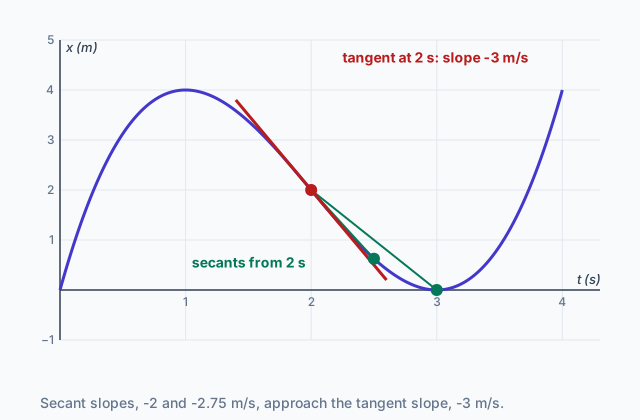
The graph at the top of this page shows , in meters and seconds. Average velocities over intervals that start at s are slopes of secant lines, and they change as the interval shrinks:
| Interval | (m) | (s) | (m/s) |
|---|---|---|---|
| 2 s to 3 s | −2 | 1 | −2 |
| 2 s to 2.5 s | −1.375 | 0.5 | −2.75 |
| 2 s to 2.1 s | −0.299 | 0.1 | −2.99 |
| 2 s to 2.01 s | −0.029999 | 0.01 | −2.9999 |
An average over a very small interval is very close to the value at that instant. As approaches zero, the average approaches the instantaneous velocity, which is the derivative of position:
Here , and at s that is m/s, the slope of the tangent line. The same limit applied to velocity gives the instantaneous acceleration, , here .
To tell whether an object is speeding up at an instant, compare the signs of and there. The same sign means speeding up; opposite signs mean slowing down. The sign of alone does not tell you.
Quick check · Decide and justify
A cart moves along a track with its position given by , with in meters and in seconds. Take the direction of increasing as positive. At s, is the cart speeding up or slowing down?
Which reason supports your answer?
2d. Integrating to work backward
Differentiation takes you from position to velocity to acceleration. Integration takes you back. Because and ,
The integral alone gives a change: is the displacement over that interval, the signed area under the velocity graph. To get a position you add the starting position, which is the constant of integration fixed by what you know at one instant.
Suppose a cart has in m/s² and starts from rest at m. Then and , so at s it is at 9 m, not 8 m.
The constant-acceleration equations of Topic 1.3, such as , hold only when the acceleration does not change. When the acceleration is a function of time, integrate.
Quick check · Calculate
A cart on a straight track has velocity , with in meters per second and in seconds. At it is at m. Take the direction of increasing as positive. Where is the cart at s?
Part 3 Watch it done A drone climbs and levels off
Watch each step, then do the last one yourself.
A delivery drone rises straight up from a rooftop; take up as positive. Its acceleration is , with in m/s² and in seconds, for s. At it is at rest at m above the ground. How far does the drone rise in the first 3 s?
Step 1 · Integrate the acceleration
. The drone starts from rest, so the constant is zero. Check: differentiating gives back .
Step 2 · Read the velocity
At s, m/s. The acceleration is positive before 3 s and negative after, so 9 m/s is the drone's greatest upward velocity, and at 6 s it is back to , hovering.
Why this step?
Why not average 0 and 9 m/s and multiply by 3 s?
Averaging the starting and ending velocities works only when the acceleration is constant, and here it falls from 6 m/s² to 0 over the first 3 s. The drone gains most of its speed early, so it covers more ground than a steady acceleration would. The displacement is the integral of the velocity.
Your step · Calculate
Finish it. How far does the drone rise from to s? Up is positive.
m
Part 4 Try it New situations
Try it · Rank it
Three carts move along parallel tracks. Each position is in meters with in seconds: cart A at , cart B at and cart C at . Rank the carts by average velocity from to s.
Greatest first
Give each one a place, 1 for first. Give two the same place if they are equal.
Your ranking: none yet
Try it · Calculate
A model rocket car's position on a straight track is , with in meters and in seconds. Take the direction of increasing as positive. What is its average velocity from s to s?
On paper. The rocket car's positions at , 2 and 3 s are 2 m, 16 m and 54 m. Plot them, against , with scales and units on both axes, and draw a smooth curve through them. Then describe how you would use a motion sensor in your lab to estimate the car's velocity at exactly 2 s: which readings you would take, and why closer readings give a better estimate. There is nothing to submit here; compare your description with the sensor readings in Check yourself.
Part 5 Explain it Derive it, then put numbers in
Nothing you type leaves this page. Check your answer against the model and each scoring point.
Free response is 50% of the exam score. This one is shaped like Question 1, Mathematical Routines.
Free-response practice · Question 1 style
A cart moves along a straight track; take right as positive. Its velocity is , with in meters per second and in seconds, and at it is at .
(a) Derive an expression for the cart's position .
(b) Calculate the cart's acceleration at s.
(c) Calculate the cart's displacement and its average velocity from to s.
(d) On paper, sketch against from 0 to 3 s. Label the velocity at , 1, 2 and 3 s.
(e) A classmate says that because the average velocity in part (c) is zero, the cart was at rest the whole time. Use your answers to explain why the classmate is wrong.
Model answer
(a) , since .
(b) , so m/s², to the right.
(c) , so and m/s.
(d) A parabola that starts at 6 m/s at , crosses zero at 1 s, reaches its lowest value, m/s, at 2 s, and comes back to zero at 3 s. Compare your sketch with that shape and those four labeled values.
(e) The velocity is not zero during the interval: it is m/s at the start and m/s at 2 s. The cart moves right until 1 s, reaching m, then moves left back to at 3 s. Its average velocity is zero only because it ended where it started, after traveling about 5.3 m.
Score your own answer. This is a self-check, not a grade. Tick each point your answer makes.
Part 6 Check yourself A cart with a fan
The case questions use the sensor readings and the fit. Answer them from those.
A physics class sends a fan cart along a level track while one student turns the fan up steadily; take the cart's direction of travel as positive. A motion sensor records the cart's position, and the software fits the readings with , with in meters and in seconds. Some of the readings:
| (s) | (m) |
|---|---|
| 0 | 0 |
| 1.0 | 1.200 |
| 2.0 | 3.600 |
| 2.9 | 7.778 |
| 3.0 | 8.400 |
| 3.1 | 9.058 |
| 4.0 | 16.800 |
Case question 1 · Multiple choice
Using the sensor readings, what is the cart's average velocity from to s? The direction of travel is positive.
Case question 2 · Calculate
Using the software's fit, what is the cart's instantaneous acceleration at s? The direction of travel is positive.
Case question 3 · Multiple choice
A student who does not trust the fit wants the best estimate of the cart's velocity at s from the sensor readings alone. Which two readings should the student use?
The rest stand on their own and do not use the case.
Check yourself · Sort it
Tap a card, then say which operation finds what it asks for.
Differentiate
Integrate
Check yourself · Spot the error
A cart starts from rest and has acceleration , with in m/s² and in seconds. A student finds its velocity at s. Tap the first line with a mistake.
Part 7 Keep it Bring back earlier ideas
This lesson stands on vectors from Topic 1.1. Pulling them back up is what makes them last.
Bring it back · Multiple choice
Two displacements are m and m. What is ?
Bring it back · Sort it
Tap a card, then say whether the quantity is a scalar or a vector.
Scalar
Vector
In three lines
- Displacement is final minus initial position, , found from a position function by substituting both times.
- Average velocity and acceleration use only the two ends of an interval; as the interval shrinks to zero they become and .
- Integrate to go back, adding the starting value, and save the constant-acceleration equations for a constant acceleration.
Exam strategy for this topic
- Section I, Multiple Choice: 42 questions in 85 minutes.
- Section II, Free Response: 4 questions in 95 minutes.
- This lesson's Explain it is shaped like free-response question 1, Mathematical Routines.
- A four-function, scientific, or graphing calculator is allowed on both sections of the exam.
On a free-response question, write the calculus before the numbers: the derivative or the integral with its limits, then the substitution, then the result with its unit. When a question gives the acceleration or the velocity as a function of time, that is your signal to integrate rather than reach for a constant-acceleration equation.
Questions students ask
Do I really need calculus for this topic in AP Physics C?
Yes. The course defines instantaneous velocity and acceleration as derivatives, and expects you to find position, velocity and acceleration functions by differentiating and integrating. You will often take a derivative or an integral of a polynomial in time.
When can I still use the constant-acceleration equations?
Only when the acceleration does not change during the interval, such as an object in free fall near Earth's surface. If the acceleration is a function of time, integrate it instead.
What is the difference between displacement and distance traveled?
Displacement is final position minus initial position, with a sign. Distance adds up every meter moved in either direction. A cart that goes 3 m right and 3 m back has a displacement of 0 and a distance of 6 m.
Where does the constant of integration come from?
Integrating a velocity tells you how the position changes, not where the object began. The constant is the starting position, or any position you know at one instant, and it has to come from the question.
Can I estimate an instantaneous velocity from a data table?
Yes. Take the average velocity over the shortest interval that brackets the instant you want, ideally one centered on it. The smaller the interval, the closer the estimate.
Course alignment, for teachers
AP Physics C: Mechanics topic 1.2, Unit 1: Kinematics.
- Skill 1.B: Create quantitative graphs with appropriate scales and units, including plotting data.
- Skill 2.B: Calculate or estimate an unknown quantity with units from known quantities, by selecting and following a logical computational pathway.
- Skill 2.C: Compare physical quantities between two or more scenarios or at different times and/or locations within a single scenario.
- Skill 3.A: Create experimental procedures that are appropriate for a given scientific question.
- Skill 3.C: Justify or support a claim using evidence from experimental data, physical representations, or physical principles or laws.
This lesson maps all 11 essential knowledge statements of the topic to the part that teaches each one: 11 are checked by a scored question. The map is in the lesson file.