Unit 5 · Topic 5.4 · about 30 minutes · 7 parts · 12 scored checks, 2 of them multiple choice, plus 2 from earlier lessons
AP Physics C: Mechanics 5.4: Rotational Inertia
Unit 5: 10 to 15% of the multiple-choice section
What you'll be able to do
- Describe the rotational inertia of a rigid system about a given axis, from the masses of its parts and their distances from that axis, by adding or by integrating.
- Describe the rotational inertia of a rigid system about an axis that does not pass through its center of mass, using the parallel axis theorem.
Key vocabulary
| Term | What it means | The exam trap |
|---|---|---|
| Rotational inertia | A measure of a rigid system's resistance to changes in its rotation, which depends on the system's mass and on how that mass is distributed relative to the axis of rotation. | A rotational inertia belongs to a system and an axis together, so a value with no axis named is incomplete. |
| Rigid system | A system whose parts keep the same distances from one another as it moves, so it turns as one piece. | The value of holds only while the parts stay where they are; once mass moves, work the rotational inertia out again. |
| Axis of rotation | The line a rigid system turns about; every distance in a rotational inertia is the perpendicular distance from this line. | The axis is part of the question, not a property of the object, and it need not pass through the object at all. |
| Differential mass | A tiny piece of mass of a solid, small enough that every bit of it is the same distance from the axis, used in . | is not a variable you can integrate over as it stands; it has to be rewritten in terms of a position variable first. |
| Center of mass | The point that represents the average position of a system's mass, weighted by mass. | The center of mass need not sit on any material: a ring's center of mass is at its empty middle. |
| Parallel axis theorem | The relation , which gives a rigid system's rotational inertia about any axis parallel to one through its center of mass, where is the distance between the two axes. | The distance is between two parallel axes, and the formula only works from one particular starting axis. |
 Tap to open the picture full size
Part 1 Think first The stick with a clamp on one end
Commit to a guess first. Being wrong now makes the right idea stick better.
Predict first
A 1 m wooden stick has a heavy metal clamp fixed to one end. You hold the stick by one end and wave it quickly back and forth, like a windshield wiper, with your wrist as the pivot. Which grip makes the waving easier to start and stop?
In short. Rotational inertia measures how strongly a rigid system resists a change in its rotation about a given axis; it is for separate pieces and for a solid, where is each piece's perpendicular distance from the axis.
- Rotational inertia depends on the mass and on where that mass sits relative to the axis, and because is squared, mass far from the axis counts much more.
- A collection's rotational inertia is the sum of its parts' rotational inertias about the same axis, and a solid's is the integral of over all of it.
- About any axis parallel to one through the center of mass, , so the axis through the center of mass gives the least rotational inertia of all those parallel axes.
Part 2 Learn it Four ideas, with a check after each
4a. What rotational inertia measures
Mass measures how hard it is to change an object's velocity. Rotational inertia does the same job for rotation: it measures how strongly a rigid system resists a change in how it rotates about a given axis of rotation. A system with a large rotational inertia is hard to start spinning and hard to stop.
Rotational inertia depends on two things: the system's mass, and how that mass is distributed relative to the axis. Change the axis and the rotational inertia changes, even though the mass does not.
For a small object whose size is tiny compared with its distance from the axis, the rotational inertia is
where is the perpendicular distance from the axis to the object. A 0.50 kg ball on a light string 0.40 m long, swung in a circle, has kg·m² about the center. Because is squared, moving the ball out to 0.80 m multiplies by four, while doubling the mass at 0.40 m only doubles it. The unit is kg·m².
Quick check · Rank it
Three small pucks are each fixed to a light rod that turns in a horizontal plane about a vertical axis through the rod's other end. Puck A has mass 4.0 kg and sits 0.10 m from the axis, puck B has mass 1.0 kg at 0.30 m, and puck C has mass 0.50 kg at 0.40 m. Rank the three systems by rotational inertia about their axes.
Greatest first
Give each one a place, 1 for first. Give two the same place if they are equal.
Your ranking: none yet
4b. Adding up a collection
A system made of several small objects has a total rotational inertia equal to the sum of each object's rotational inertia about the same axis:
Each is that object's own perpendicular distance from the axis, so first decide where the axis is, then measure every distance from it.
A light rod 0.60 m long with a 0.20 kg bead at each end turns about its center. Each bead is 0.30 m from the axis, so kg·m². Turn the same rod about one end instead and one bead sits on the axis, contributing nothing, while the other is 0.60 m away: kg·m², twice as much for the same mass.
The same sum works for anything you can break into parts whose rotational inertias you know: a rod plus a motor plus a sensor, each taken about the one shared axis.
Quick check · Calculate
A light rod 0.60 m long lies horizontally and turns about a vertical axis through its left end. Three small objects are fixed to it: 0.50 kg at 0.20 m from the left end, 0.50 kg at 0.40 m from the left end, and 1.0 kg at the right end. What is the rotational inertia of the system about the axis?
4c. Integrating over a solid
A solid rod or disk has no separate pieces to add, so you cut it into tiny pieces of mass and add them with an integral:
where is the perpendicular distance from each to the axis. To integrate, write in terms of a position variable.
A thin rod about one end. A uniform rod of mass and length lies along the -axis from to , turning about . Its mass per unit length is , so a slice of width has and sits a distance from the axis:
If the rod is not uniform, becomes a function and stays inside the integral.
Rings and shells. For a disk, a shell or a washer turning about its central axis, cut it into thin coaxial rings. Every bit of a thin ring of radius is the same distance from the axis, so a thin hoop of mass and radius has . A solid disk of the same mass and radius has , less than the hoop, because much of its mass is near the center.
Quick check · Fill the statement
A thin rod 3.0 m long lies along the -axis from to m, and it gets denser toward the far end: its mass per unit length is , with in kilograms per meter and in meters. Its total mass is 9.0 kg. It turns about an axis through , perpendicular to the rod.
A slice of width at position has mass . The rotational inertia is the integral from 0 to 3.0 m of , which comes to .
4d. Axes that miss the center of mass
Many objects turn about an axis that does not pass through their center of mass: a door on its hinges, a bat swung from the handle. The parallel axis theorem connects the rotational inertia about such an axis to the one about a parallel axis through the center of mass:
Here is the system's total mass and is the perpendicular distance between the two parallel axes. Both axes must be parallel, and one of them must pass through the center of mass.
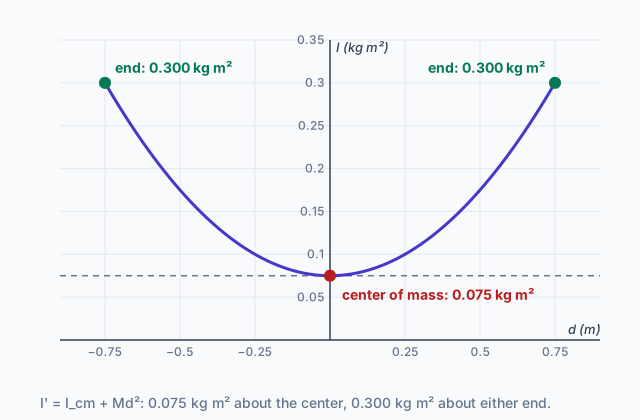
The rod graph at the top of the page, rotational inertia against axis position, shows it for a uniform rod with kg and m. About its center, kg·m². About an end, m, so kg·m², which matches from the integral in the last section.
Because can never be negative, among all axes parallel to a given direction, a rigid system's rotational inertia is least for the one through its center of mass. Every other axis adds .
Quick check · Decide and justify
A light rod 0.90 m long has a 2.0 kg ball at its left end and a 1.0 kg ball at its right end; treat each ball as a point. The rod can be spun about any axis that crosses it at a right angle. About which of these axes is the rotational inertia least?
Which reason supports your answer?
Part 3 Watch it done A flywheel shaped like a washer
Watch each step, then do the last one yourself.
A flywheel is a flat, uniform washer of mass with inner radius and outer radius . Derive its rotational inertia about the axis through its center, perpendicular to its face, then calculate it for kg, m and m.
Step 1 · Find the mass per unit area
The face is the area between two circles, , so the mass per unit area is .
Step 2 · Cut it into thin rings
A thin ring of radius and width has area , so , and every bit of that ring is the same distance from the axis.
Step 3 · Integrate across the washer
.
Step 4 · Simplify
Factor and substitute : the cancels, leaving . Check: with it becomes , a solid disk, and as approaches it becomes , a thin hoop.
Why this step?
Why does the integral start at and not at 0?
There is no material inside the hole. Starting at 0 would add rings of mass the washer does not have. The limits of the integral are where the mass actually is.
Your step · Calculate
Finish it. A flat, uniform steel washer has mass 40 kg, inner radius 0.10 m and outer radius 0.30 m. What is its rotational inertia about the axis through its center, perpendicular to its face?
kg·m²
Part 4 Try it New situations
Try it · Sort it
Tap a card, then say what happens to the rotational inertia about the axis named on the card.
Increases
Decreases
Stays the same
Try it · Calculate
A uniform disk of mass 2.0 kg and radius 0.25 m hangs from a nail through a small hole at its edge, and it can swing in its own plane. The nail is perpendicular to the disk's face. About a parallel axis through its center, the disk has rotational inertia . What is its rotational inertia about the nail?
On paper. Draw the disk hanging from the nail in the question above. Mark its center of mass, the nail, and the distance between the two parallel axes, labeled with its value. Then, beside it, sketch a graph of the disk's rotational inertia against as the nail hole is moved from the center out to the rim, to m, and label the value at . There is nothing to submit here. Your graph should start at its lowest value at and curve upward like the rod graph at the top of the page, since the shift term grows as .
Part 5 Explain it Design it, then plot it on paper
On the exam this is handwritten, so answer on paper first. Nothing you type here leaves this page. Then check your answer against the model and each scoring point.
Free response is 50% of the exam score. This one is shaped like Question 3, Experimental Design and Analysis.
Free-response practice · Question 3 style
A lab group mounts a light aluminum rod horizontally on a rotary motion sensor, so the rod turns about a vertical axis through its center. A string wound on the sensor's spool is pulled with a steady force read by a force sensor, and the software reports the rotational inertia of everything mounted, from the torque the string exerts and the angular acceleration it produces. The group has a set of identical 50 g brass washers and clamps that hold washers at any point on the rod.
(a) The group wants to know whether the rotational inertia that small objects add at a fixed distance from the axis is proportional to their mass. Describe a procedure they could use. Say what they change, what they keep the same, what they measure and with what, and one step that reduces experimental uncertainty.
(b) Describe how they could analyze the data from (a) to answer the question: what they would graph, and what feature of the graph would show the answer.
(c) A second group asks a different question. They fix two identical clamps, each of mass , at equal distances on opposite sides of the axis and record the total rotational inertia :
- = 0.050 m: = 3.6 kg·m²
- = 0.100 m: = 4.9 kg·m²
- = 0.150 m: = 7.6 kg·m²
- = 0.200 m: = 10.9 kg·m²
- = 0.250 m: = 15.6 kg·m²
On paper, plot a graph of quantities that should give a straight line, with a scale and units on each axis, and draw a best-fit line. Do this by hand before you open the model.
(d) Use your best-fit line to calculate the mass of one clamp.
(e) Explain what the vertical intercept of your line represents.
Model answer
(a) Fix one clamp on each side of the axis, both 0.20 m from it, and record from the software. Add washers to the clamps in equal pairs, one on each side, up to five per side, keeping the clamps 0.20 m from the axis and the string's pulling force the same, and record each time. Run each setting three times and average.
(b) Graph against the total added mass. If the added rotational inertia is proportional to the mass, the points fall on a straight line, with a slope of m², and the intercept is the rotational inertia with no washers.
(c) Since , plot against . The values of are 2.5, 10.0, 22.5, 40.0 and 62.5, in units of m². See the graph below: one straight best-fit line through the points, not a line joining them.
(d) The slope is . From two points on the line, and , in units of m² and kg·m², the slope is kg, so kg.
(e) The intercept, about kg·m², is the rotational inertia when : that of the rod and the sensor's turning parts, plus the clamps' own small rotational inertia, the part that does not depend on where the clamps sit.
Rotational inertia against distance squared, with the best-fit line
The line crosses the vertical axis near kg·m² and passes through (62.5, 15.5).
Score your own answer. This is a self-check, not a grade. Tick each point your answer makes.
Part 6 Check yourself Where to put the pivot
The case questions use the team's measurements. Answer them from those.
A robotics team is choosing where to put the pivot of a uniform steel bar 0.60 m long that will swing in a horizontal plane. They mount the bar on a rotary motion sensor at different points along its length and record its rotational inertia about each vertical axis. The distance is measured from the bar's center to the axis.
| (m) | (kg·m²) |
|---|---|
| 0 | 0.036 |
| 0.10 | 0.048 |
| 0.20 | 0.084 |
| 0.30 | 0.144 |
Case question 1 · Calculate
Using the table, calculate the mass of the bar.
Case question 2 · Multiple choice
A team member predicts that moving the axis from m to m will make the rotational inertia four times as large, since doubles. Do the measurements agree?
Case question 3 · Multiple choice
The team tapes a 0.20 kg sensor, small enough to treat as a point, to one end of the bar, 0.30 m from its center. Using the table, what is the rotational inertia of the bar and sensor together about the vertical axis through the bar's center?
The rest stand on their own and do not use the case.
Check yourself · Spot the error
A uniform rod has mass and length . A student knows its rotational inertia about an axis through one end, perpendicular to the rod, and wants it about a parallel axis a distance from that end. Tap the first line with a mistake.
Check yourself · Put it in order
Put the steps in order to derive the rotational inertia of a uniform rod of mass and length about an axis through its center, perpendicular to the rod. The rod lies along the -axis with its center at .
Part 7 Keep it Bring back earlier ideas
This lesson stands on integration from Topic 1.2, which adds up small pieces the way adds up every bit of mass, and on the lever arms measured from the axis in Topic 5.3. Pulling them back up is what makes them last.
From 1.2 Displacement, Velocity, and Acceleration · Calculate
A cart on a straight track has velocity , with in meters per second and in seconds. At it is at m. Take the direction of increasing as positive. Where is the cart at s?
From 5.3 Torque · Calculate
A mechanic grips a wrench 30 cm from the center of a bolt and pulls with a 120 N force. Her pull makes a 30° angle with the wrench handle, which runs straight from the bolt's center to her hand. What is the size of the torque her pull exerts on the bolt about its center?
In three lines
- Rotational inertia measures resistance to a change in rotation about a given axis, and depends on the mass and how far it sits from that axis: for a point.
- Add the parts about the same axis, , or integrate over a solid, , with written in terms of a position variable.
- About an axis parallel to one through the center of mass, , so the center of mass axis gives the least.
Exam strategy for this topic
- Section I, Multiple Choice: 42 questions in 85 minutes.
- Section II, Free Response: 4 questions in 95 minutes.
- This lesson's Explain it is shaped like free-response question 3, Experimental Design and Analysis.
- A four-function, scientific, or graphing calculator is allowed on both sections of the exam.
On a free-response question that asks for a rotational inertia, write the general form first, , or , then substitute. In an experimental design part, say which single quantity you change, what you keep the same, and what you measure with which instrument, and choose a graph whose slope or intercept is the quantity you want.
Questions students ask
Is rotational inertia the same thing as moment of inertia?
Yes. They are two names for the same quantity, , measured in kg·m². The course framework calls it rotational inertia.
Which rotational inertia derivations do I need to do with calculus?
Thin rods, uniform or with a density that changes along them, about any axis perpendicular to the rod, and thin cylindrical shells, disks and objects built from coaxial rings or shells, such as a washer, about their central axis. For other shapes you need to know qualitatively how the distribution of mass changes .
Why does a hoop have more rotational inertia than a disk of the same mass and radius?
All of a hoop's mass is at the rim, the full radius from the axis. A disk has much of its mass closer to the center, where is small. That gives for the hoop and for the disk.
Can I use the parallel axis theorem between any two parallel axes?
Only when one of them passes through the center of mass. To go between two axes that both miss it, shift back to the center of mass axis first, then out to the new one.
Does a wheel's rotational inertia change when it spins faster?
No. Rotational inertia depends on the mass and where it is relative to the axis, not on the angular velocity. A wheel spinning fast takes more to stop because there is more angular velocity to remove, not because its rotational inertia grew.
Beyond the AP Exam
College Board sets this limit on what the AP Exam asks about this topic. Anything past it is not on the exam.
AP Physics C: Mechanics only expects students to use calculus in the derivations of the rotational inertia of thin rods of uniform or nonuniform density about an arbitrary axis perpendicular to the rod, as well as derivations of the rotational inertia of a thin cylindrical shell, disk, or rigid bodies that can be considered to be made up of coaxial rings or shells about an axis that passes through their centers (e.g., annular rings). Students should have a qualitative understanding of the factors that affect rotational inertia; for example, how rotational inertia is greater when mass is farther from the axis of rotation, which is why a hoop has more rotational inertia than a solid puck of the same mass and radius.
Course alignment, for teachers
AP Physics C: Mechanics topic 5.4, Unit 5: Torque and Rotational Dynamics.
- Skill 1.B: Create quantitative graphs with appropriate scales and units, including plotting data.
- Skill 2.A: Derive a symbolic expression from known quantities by selecting and following a logical mathematical pathway.
- Skill 2.C: Compare physical quantities between two or more scenarios or at different times and/or locations within a single scenario.
- Skill 3.A: Create experimental procedures that are appropriate for a given scientific question.
- Skill 3.B: Apply an appropriate law, definition, theoretical relationship, or model to make a claim.
This lesson maps all 6 essential knowledge statements of the topic to the part that teaches each one: 6 are checked by a scored question. The map is in the lesson file.