Unit 5 · Topic 5.6 · about 30 minutes · 7 parts · 12 scored checks, 2 of them multiple choice, plus 2 from earlier lessons
AP Physics C: Mechanics 5.6: Newton’s Second Law in Rotational Form
Unit 5: 10 to 15% of the multiple-choice section
What you'll be able to do
- Describe when a system's angular velocity changes, and find its angular acceleration from the net torque and its rotational inertia.
Key vocabulary
| Term | What it means | The exam trap |
|---|---|---|
| Net torque | The sum of all the torques exerted on a system about one axis, each with its sense, written or . | Adding torque sizes without their senses gives a net torque that is too large. |
| Angular velocity | The rate at which a system's angular position changes, , described as clockwise or counterclockwise about an axis. | How fast a system spins does not tell you the net torque on it; what matters is whether the angular velocity is changing. |
| Angular acceleration | The rate at which a system's angular velocity changes, . | It measures how fast the angular velocity changes, not how fast the system turns, so a slowly turning wheel can have a large one. |
| Rotational inertia | A system's resistance to a change in its rotation about an axis, or , set by its mass and how far that mass lies from the axis. | It depends on the axis and on how the mass is spread out, so the formula has to match the object's shape. |
| Rigid system | A system whose parts keep fixed distances from one another, so every part turns through the same angle with the same angular velocity and angular acceleration. | Objects joined by a cord are not one rigid system, so each one gets its own equation. |
 Tap to open the picture full size
Part 1 Think first A yo-yo that will not fall
Commit to a guess first. Being wrong now makes the right idea stick better.
Predict first
A yo-yo hangs at rest from its string. You pull the string upward so that its tension always equals the yo-yo's weight, moving your hand however you need to. What does the yo-yo do?
In short. A rigid system's angular velocity changes only when the net torque on it is not zero, and its angular acceleration is the net torque divided by its rotational inertia, , in the same sense as the net torque.
- Add every torque about the axis with its sense; a nonzero total changes the angular velocity, and a zero total leaves it constant.
- The angular acceleration is directly proportional to the net torque and inversely proportional to the rotational inertia, and when the torque changes with time, .
- Translation and rotation are analyzed separately: for the center of mass and for the turning, linked by conditions such as a cord that does not slip.
Part 2 Learn it Four ideas, with a check after each
2a. A net torque changes the angular velocity
In Topic 5.5 a rigid system with zero net torque keeps a constant angular velocity. The other side of that rule is this topic: when the net torque on a system is not zero, its angular velocity changes. It may speed up, slow down or reverse, but it cannot stay the same.
To find the net torque, add every torque about the axis with its sense. Choose one sense as positive, say counterclockwise as seen from the front, and give each clockwise torque a negative sign. A force whose line of action passes through the axis exerts no torque about it, however large the force. A torque from friction at an axle counts like any other.
A spinning object does not need a net torque to keep spinning. A record turntable running at a steady rate has a motor torque that balances the friction torque, so the net torque is zero. Switch the motor off and friction's torque is left on its own, so the angular velocity changes until the turntable stops.
Quick check · Sort it
Each card describes the torques on a rigid system that turns about a fixed axis. Tap a card, then say whether the system's angular velocity is changing or constant.
Angular velocity changing
Angular velocity constant
2b. The second law in rotational form
How quickly the angular velocity changes depends on the net torque and on the rotational inertia about the axis. Newton's second law in rotational form is
The angular acceleration is directly proportional to the net torque and inversely proportional to the rotational inertia.
A bicycle wheel modeled as a hoop with kg and m has kg·m². A net torque of 0.90 N·m counterclockwise gives rad/s², counterclockwise.
Because , a torque that changes with time is integrated, the way Topic 1.2 integrated an acceleration:
A constant net torque gives a constant , so the angular velocity changes by the same amount every second. When the torque varies, multiplying one value of by the time is wrong; integrate instead.
Quick check · Calculate
A grinding wheel is a solid disk of mass 4.0 kg and radius 0.25 m, with rotational inertia about its axle. A belt exerts a 6.0 N force tangent to its rim, turning it counterclockwise as seen from the front, and friction at the axle exerts a 0.25 N·m clockwise torque. Take counterclockwise as positive. What is the wheel's angular acceleration?
2c. Same sense, and factors of change
The angular acceleration has the same sense as the net torque. To tell whether a system is speeding up, compare that sense with the sense of its angular velocity. The same sense means the angular speed grows; opposite senses mean it shrinks. A wheel spinning clockwise with a counterclockwise net torque slows, stops for an instant and, if the torque keeps acting, spins up counterclockwise.
The equation also predicts factors of change without any numbers. Write each new quantity as a multiple of the old one and substitute. Three times the net torque on an object with twice the rotational inertia gives
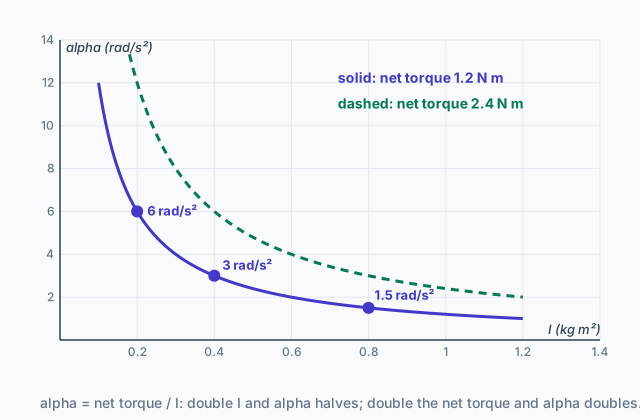
Rotational inertia depends on how far the mass sits from the axis, not only on how much there is. A hoop of the same mass but twice the radius has , four times the rotational inertia. And a force exerted farther from the axis exerts a larger torque. When a change moves both, track both factors before you divide. The graph near the top of this page shows the inverse part: along either curve, doubling halves .
Quick check · Multiple choice
Rod 1, a uniform rod of mass and length , lies on a frictionless horizontal air table and pivots about a fixed axle through one end, where its rotational inertia is . A force perpendicular to the rod at its free end turns it counterclockwise as seen from above. Rod 2 has mass and length , and the same force is exerted perpendicular to it at its free end. How does rod 2's angular acceleration compare with rod 1's, ?
2d. Two analyses, one system
A force can change how an object's center of mass moves, how the object turns, or both, and the two are analyzed separately. For the center of mass, ; for the turning about an axis, . The net force can be zero while the net torque is not, as with the yo-yo, and the reverse can happen too.
When objects are connected, write one equation for each object and each kind of motion. For a block hanging from a light cord wrapped around a pulley on a fixed, frictionless axle:
- the block only translates: , with down as positive;
- the pulley only rotates: , with the sense the falling block turns it as positive (the axle's force and the pulley's weight act at the axle and exert no torque about it);
- a cord that does not slip links them: , from Topic 5.2.
That is three equations for three unknowns, , and . The tension is shared by the block and the pulley, and it comes out of solving them, never out of an assumption.
Quick check · Decide and justify
A light cord is wrapped around a solid disk pulley that turns on a fixed, frictionless horizontal axle, and a block hangs from the cord's free end. The block is released from rest and falls while the pulley spins up. As it falls, how does the cord's tension compare with the block's weight?
Which reason supports your answer?
Part 3 Watch it done A block spins up a pulley
Watch each step, then do the last one yourself.
A solid disk pulley of mass kg and radius m turns on a fixed, frictionless horizontal axle, with rotational inertia . A light cord wrapped around its rim holds a block of mass kg, released from rest. Seen from the front the block hangs on the right, so the pulley turns clockwise as the block falls. Take down as positive for the block and clockwise as positive for the pulley, and use m/s². Find the pulley's angular acceleration.
Step 1 · Linear analysis of the block
Two forces act on the block: its weight down and the cord's tension up. With down positive, .
Step 2 · Rotational analysis of the pulley
About the axle, only the cord exerts a torque: acts tangentially at the rim, so , clockwise. Then . The cord does not slip, so , and dividing by gives .
Why this step?
Why not use for the tension?
If the tension equaled the weight, the net force on the block would be zero and it could not speed up. The block does speed up, so the tension is less than , and how much less depends on the pulley's rotational inertia. The tension is an unknown to solve for.
Your step · Calculate
Finish it. Combine , and to find the pulley's angular acceleration, with kg, kg, m and m/s². Clockwise as seen from the front is positive.
rad/s²
Part 4 Try it New situations
Try it · Rank it
Three objects each have mass and radius and turn about a fixed, frictionless axle through their centers. Object A is a thin hoop (), object B is a solid disk (), and object C is an identical solid disk. A force tangent to the object is exerted at the rim of A and the rim of B, and on C it is exerted tangent to a circle of radius about the axle. Each force turns its object counterclockwise as seen from the front. Rank the objects by angular acceleration.
Greatest first
Give each one a place, 1 for first. Give two the same place if they are equal.
Your ranking: none yet
Try it · Calculate
A flywheel with rotational inertia 0.20 kg·m² starts from rest. Its motor exerts a net torque , with in N·m and in seconds, turning it counterclockwise as seen from the motor end. Take counterclockwise as positive. What is the flywheel's angular velocity at s?
On paper. A student exerts known net torques on a rotating platform and measures its angular acceleration each time: net torques of 0.10, 0.20, 0.30 and 0.40 N·m give 0.41, 0.79, 1.22 and 1.60 rad/s². Plot against with scales and units on both axes and draw a best-fit line. Its slope is , so use it to find the platform's rotational inertia. Then describe how you would run this in your lab: how you would exert a known torque (a force sensor pulling a string wrapped around a hub of known radius, for example), what you would measure the angular acceleration with, what you would vary and what you would keep the same. There is nothing to submit; compare your procedure with the turntable lab in Check yourself.
Part 5 Explain it Derive it, then put numbers in
Nothing you type leaves this page. Check your answer against the model and each scoring point.
Free response is 50% of the exam score. This one is shaped like Question 1, Mathematical Routines.
Free-response practice · Question 1 style
A thin uniform rod of mass and length is attached at its left end to a fixed, frictionless horizontal pivot. Its rotational inertia about the pivot is . The rod is held horizontal and released from rest, and a small coin rests on its right end. Seen from the front, the rod swings down clockwise; take clockwise as positive for rotation and down as positive for linear motion.
(a) Derive an expression for the rod's angular acceleration just after release, in terms of , and physical constants as appropriate.
(b) The rod has kg and m. Calculate its angular acceleration just after release.
(c) On paper, draw a force diagram of the rod just after release, with each force drawn at the point where it is exerted.
(d) Calculate the magnitude and direction of the force the pivot exerts on the rod just after release.
(e) A classmate says the coin stays on the rod's end as the rod starts to fall, because no part of the rod can fall faster than an object in free fall. Use your answer to part (a) to explain whether the classmate is right.
Model answer
(a) The weight acts at the center, from the pivot and perpendicular to the horizontal rod, so ; the pivot's force acts at the axis and exerts no torque. Then , clockwise.
(b) rad/s², clockwise.
(c) Two forces: the weight , down, drawn at the rod's center, and the pivot's force, drawn at the left end. Compare your diagram: nothing else is on the rod, and part (d) shows the pivot's force points up and is smaller than the weight.
(d) The center of mass moves on a circle of radius , so m/s², down. The rod is not yet moving, so there is no inward acceleration and no horizontal force. Then gives N, upward.
(e) The right end's acceleration is m/s², more than . The coin's downward acceleration can be at most , because gravity is the only downward force on it and the rod can only push up. The end needs 15 m/s², more than , so the end drops away from the coin and contact is lost. The classmate is wrong: the end's acceleration comes from the torque on the whole rod, not from the weight of the end alone.
Score your own answer. This is a self-check, not a grade. Tick each point your answer makes.
Part 6 Check yourself A turntable on a string
The case questions use the turntable data. Answer them from those.
A class measures a turntable's rotation. A string wrapped around the turntable's hub, of radius 0.050 m, is pulled tangentially by a force sensor that holds the tension steady, and a rotary motion sensor records the angular acceleration. Counterclockwise as seen from above is positive. Friction at the axle is the same in every trial.
| Tension (N) | Angular acceleration (rad/s²) |
|---|---|
| 1.0 | 3.0 |
| 2.0 | 8.0 |
| 3.0 | 13.0 |
| 4.0 | 18.0 |
Case question 1 · Calculate
Using the data, what is the turntable's rotational inertia? Counterclockwise as seen from above is positive.
Case question 2 · Multiple choice
A best-fit line of against the applied torque crosses at a positive applied torque, . What does that tell you about the turntable?
Case question 3 · Calculate
The class rewraps the string around the turntable's rim, of radius 0.15 m, and pulls with a steady 2.0 N, counterclockwise as seen from above. Using what the data show about the turntable, predict its angular acceleration. Counterclockwise is positive.
The rest stand on their own and do not use the case.
Check yourself · Spot the error
A 2.0 kg block hangs from a light cord wrapped around a pulley of rotational inertia 0.020 kg·m² and radius 0.10 m, on a frictionless axle. The block is released from rest. Down is positive for the block, and the sense the falling block turns the pulley is positive for the pulley. A student finds the pulley's angular acceleration. Tap the first line with a mistake.
Check yourself · Fill the statement
A desk fan's blades spin counterclockwise as seen from the front. After the fan is switched off, air drag exerts a clockwise net torque on the blades.
The blades' angular acceleration is , so their angular speed is . The net torque and the angular acceleration point .
Part 7 Keep it Bring back earlier ideas
This lesson stands on Topic 5.5's rule that unbalanced torques change an angular velocity, and on Topic 1.2's integral from a rate back to a quantity. Pulling them back up is what makes them last.
On paper. A uniform shelf board 1.2 m long and weighing 30 N is screwed to two brackets, one 0.2 m from each end, and a 50 N stack of books sits at the board's right end. Draw a force diagram of the board, with each force starting at the point where it is exerted, and label each force's lever arm about the left bracket. Then write the torque sum about the left bracket with counterclockwise positive, seen from the front, and set it to zero. You do not need to solve it. There is nothing to submit here. To compare: measured from the left bracket, the left bracket's force is at 0, the board's 30 N weight at 0.4 m, the right bracket's force at 0.8 m and the books' 50 N at 1.0 m, and the sum is .
From 5.5 Rotational Equilibrium and Newton’s First Law in Rotational Form · Calculate
A flywheel turns counterclockwise as seen from above, and keeps turning counterclockwise for the whole time described; counterclockwise is positive. Its motor exerts a torque , with in N·m and in seconds, for s (a negative value means the motor brakes). Friction at the axle exerts a steady torque of 2.0 N·m clockwise. At what time is the flywheel's angular velocity greatest?
From 1.2 Displacement, Velocity, and Acceleration · Calculate
A cart on a straight track has velocity , with in meters per second and in seconds. At it is at m. Take the direction of increasing as positive. Where is the cart at s?
In three lines
- A rigid system's angular velocity changes only when the net torque on it is not zero.
- , in the sense of the net torque; integrate when the torque changes with time.
- Analyze translation with and rotation with separately, and link them only through conditions such as .
Exam strategy for this topic
- Section I, Multiple Choice: 42 questions in 85 minutes.
- Section II, Free Response: 4 questions in 95 minutes.
- This lesson's Explain it is shaped like free-response question 1, Mathematical Routines.
- A four-function, scientific, or graphing calculator is allowed on both sections of the exam.
When a free-response question joins something that translates to something that rotates, write the equations before any numbers: for each object that moves along a line, for each object that turns, and the condition that links them, such as . State your positive direction and your positive sense of rotation next to the diagram, and carry them through every equation.
Questions students ask
Is really the same law as ?
It is the rotational form of Newton's second law for a rigid system turning about a fixed axis: torque takes the place of force, rotational inertia takes the place of mass, and angular acceleration takes the place of acceleration. Each still has to be measured about the same axis.
Does a spinning wheel need a torque to keep spinning?
No. A net torque changes the angular velocity. A wheel spinning at a constant rate has zero net torque on it, although its motor may be supplying a torque that balances friction.
Why is the cord's tension not equal to the hanging block's weight?
The block accelerates, so the forces on it cannot balance. The tension is less than the weight while the block speeds up downward, and you find it by solving the block's equation and the pulley's equation together.
What do I do when the torque changes with time?
Divide it by the rotational inertia to get , then integrate: . The constant angular acceleration equations work only when the net torque stays constant.
Can the net force on an object be zero while the net torque is not?
Yes. Two equal and opposite forces that do not act along the same line give zero net force but a nonzero torque, so the object's center of mass stays at rest while it spins up. That is why translation and rotation are analyzed separately.
Course alignment, for teachers
AP Physics C: Mechanics topic 5.6, Unit 5: Torque and Rotational Dynamics.
- Skill 1.B: Create quantitative graphs with appropriate scales and units, including plotting data.
- Skill 2.A: Derive a symbolic expression from known quantities by selecting and following a logical mathematical pathway.
- Skill 2.D: Predict new values or factors of change of physical quantities using functional dependence between variables.
- Skill 3.A: Create experimental procedures that are appropriate for a given scientific question.
- Skill 3.C: Justify or support a claim using evidence from experimental data, physical representations, or physical principles or laws.
This lesson maps all 3 essential knowledge statements of the topic to the part that teaches each one: 3 are checked by a scored question. The map is in the lesson file.