Unit 6 · Topic 6.1 · about 30 minutes · 7 parts · 12 scored checks, 1 of them multiple choice, plus 2 from earlier lessons
AP Physics C: Mechanics 6.1: Rotational Kinetic Energy
Unit 6: 10 to 15% of the multiple-choice section
What you'll be able to do
- Describe the rotational kinetic energy of a rigid system from its rotational inertia and angular velocity, and explain why it equals the kinetic energy of all its moving pieces added up.
Key vocabulary
| Term | What it means | The exam trap |
|---|---|---|
| Rotational kinetic energy | The energy associated with a rigid system's rotation, . | Both the one half and the square on belong in the equation; dropping either is the most common slip. |
| Rotational inertia | A measure of a rigid system's resistance to changes in its rotation, about a given axis, in kg·m². | It belongs to an object and an axis together, so the same object has a different value about a different axis. |
| Angular velocity | The rate at which a rigid system's angular position changes, , the same for every point of the system. | In the energy equation it must be in radians per second; a rate in revolutions per second or per minute has to be converted first. |
| Rigid system | A system whose shape and size do not change as it moves, so every piece keeps its distance from the axis and turns at the same angular velocity. | A system that changes shape, such as a skater pulling in her arms, is not rigid while it changes, and its rotational inertia changes with it. |
| Translational kinetic energy | The kinetic energy of a system's center of mass moving as a whole, . | Use the speed of the center of mass, not the speed of a point on the rim or an end. |
| Center of mass | The point that moves as if all of a system's mass were concentrated there and every external force were exerted on it. | It does not have to lie on the object itself: a hoop's center of mass is in its empty middle. |
| Total kinetic energy | The kinetic energy of a rigid system's center of mass moving plus the rotational kinetic energy of its turning about the center of mass. | When the translational part uses the center of mass's speed, the rotational part must use the rotational inertia about the center of mass, not about some other point. |
| Scalar quantity | A quantity with a size and no direction, such as mass, time or energy. | Neither the spin's sense nor the direction of travel shows up anywhere in an energy; watch for a step that treats them as if they do. |
 Tap to open the picture full size
Part 1 Think first Two lumps of clay
Commit to a guess first. Being wrong now makes the right idea stick better.
Predict first
A potter's wheel spins fast on its axle, and its center stays exactly where it is. Two equal lumps of clay are stuck to it, one near the center and one near the rim. Which lump has more kinetic energy?
In short. Rotational kinetic energy is the kinetic energy a rigid system has because it turns, , with its rotational inertia about the axis and its angular velocity in rad/s.
- Every piece of a turning object moves at , so a wheel whose center stays put still has kinetic energy, and adding over all its pieces gives exactly .
- An object that moves and turns has : translation of the center of mass plus rotation about the center of mass.
- Kinetic energy is a scalar, so the two parts add as plain numbers, and the energy grows with the square of .
Part 2 Learn it Four ideas, with a check after each
2a. The energy of turning
A spinning object stores energy in its motion even when it goes nowhere. For a rigid system turning with angular velocity about an axis, its rotational kinetic energy is
where is the system's rotational inertia about that axis. With in kg·m² and in rad/s, comes out in joules. The equation needs radians: a wheel turning at 2 revolutions per second has rad/s, about 12.6 rad/s.
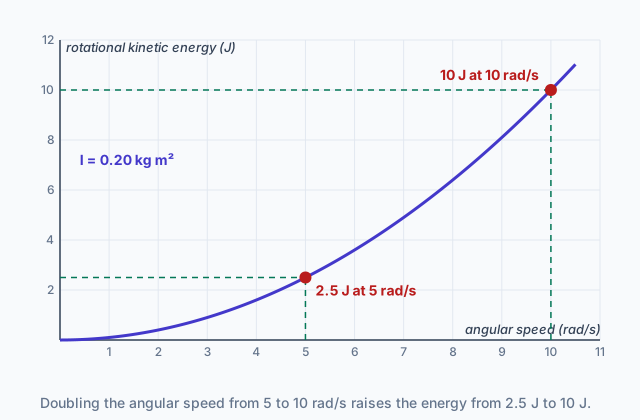
The graph at the top of the page shows against for a wheel with kg·m². The curve bends upward because is squared.
Rotational kinetic energy is a scalar: it has a size and no direction, and it is never negative. A wheel turning clockwise and an identical wheel turning counterclockwise at the same rate have the same .
Quick check · Calculate
A bench grinder's wheel has a rotational inertia of 0.040 kg·m² about its axle and turns at 50 revolutions per second. What is its rotational kinetic energy?
2b. Where the energy comes from
Why should a wheel whose center stays put have kinetic energy at all? Because every piece of it away from the axis is moving. A small piece of mass at distance from the axis travels in a circle at speed , so its kinetic energy is . Add up every piece:
The comes out of the integral because every piece of a rigid system turns at the same angular velocity, and what is left, , is the rotational inertia. So for an object turning about a fixed axis, is not a new kind of energy. It is the translational kinetic energy of all its pieces, added up, and it is the object's whole kinetic energy.
For a few small masses the integral becomes a sum, , where each is measured from the axis.
Quick check · Fill the statement
A baton is two small 0.50 kg balls on the ends of a light rod 0.80 m long. It spins at 6.0 rad/s about a fixed axis through the middle of the rod, perpendicular to it, so its center of mass stays at rest.
Each ball moves at . Adding the two balls' gives , and with comes out .
2c. Moving and turning at once
A football thrown in a spiral moves down the field and spins at the same time. The speeds of its pieces mix both motions, but the total kinetic energy splits into two simple terms: the translational kinetic energy of the center of mass, plus the rotational kinetic energy about the center of mass.
Here is the speed of the center of mass and is the rotational inertia about an axis through the center of mass. Both terms are scalars, so the total is their plain sum. A 0.40 kg ball moving at 5.0 m/s has J of translational kinetic energy; if its spin adds J, its kinetic energy is 5.3 J, whichever way it spins and whichever way it flies.
Either term can be zero. A puck sliding without turning has only the first. A wheel turning on a fixed axle through its center has only the second, because its center of mass is at rest.
Quick check · Calculate
A 0.20 kg flying disc glides with its center of mass moving at 12 m/s while it spins at 60 rad/s about its center. Its rotational inertia about its center is 0.0020 kg·m². What is the disc's total kinetic energy?
2d. Comparing turning objects
Because , the energy is proportional to and to the square of . Two objects turning at the same rate store energy in proportion to their rotational inertias, and an object that turns 3 times as fast stores 9 times as much.
Rotational inertia depends on where the mass sits, not only on how much there is. Picture a dumbbell of two 1.0 kg balls on a light rod, turning at 4.0 rad/s about its center. With the balls 0.20 m from the axis, kg·m² and J. Slide the balls out to 0.40 m and kg·m², so J: the same mass and the same , four times the energy, because each ball now moves twice as fast.
To compare objects, work out each , or compare the factors and . Comparing masses, or the product , can rank them wrong.
Quick check · Rank it
Three wheels each turn about a fixed axle through their centers. Wheel A has kg·m² and rad/s, wheel B has kg·m² and rad/s, and wheel C has kg·m² and rad/s. Rank the wheels by rotational kinetic energy.
Greatest first
Give each one a place, 1 for first. Give two the same place if they are equal.
Your ranking: none yet
Part 3 Watch it done Energy stored in a flywheel
Watch each step, then do the last one yourself.
A flywheel for storing energy is a uniform solid disk of mass 20 kg and radius 0.30 m, turning about a fixed axle through its center at 200 rad/s. A uniform disk's rotational inertia about that axis is . How much energy does the flywheel store, and how fast would it have to turn to store twice as much?
Step 1 · Find the rotational inertia
kg·m².
Step 2 · Find the stored energy
J. The axle is fixed, so the center of mass is at rest and this is all of the flywheel's kinetic energy.
Why this step?
Why not use with the speed of the rim?
The rim moves at m/s, but only the rim does. Pieces nearer the axle move more slowly, down to zero at the center. Using the rim speed for the whole 20 kg counts every piece as if it were at the edge and overestimates the energy. adds each piece at its own speed.
Your step · Calculate
Finish it. At what angular speed would the flywheel store 36,000 J, twice as much?
rad/s
Part 4 Try it New situations
Try it · Sort it
Write each object's kinetic energy as . Tap a card, then say which terms are not zero.
Rotational term only
Translational term only
Both terms
Try it · Decide and justify
A thin hoop and a uniform solid disk each have a mass of 2.0 kg and a radius of 0.30 m. Each turns about a fixed axle through its center, perpendicular to its face, at 10 rad/s. Which has more rotational kinetic energy?
Which reason supports your answer?
On paper. Sketch two graphs. First, against for one wheel whose rotational inertia stays the same. Second, against for a set of different wheels that all turn at the same . Label each axis with its quantity and unit, and write one sentence under each graph saying what shape it has and what its slope stands for. There is nothing to submit here.
Part 5 Explain it Make a claim, derive it, then check the agreement
Nothing you type leaves this page. Check your answer against the model and each scoring point.
Free response is 50% of the exam score. This one is shaped like Question 4, Qualitative/Quantitative Translation.
Free-response practice · Question 4 style
A thin uniform rod of mass and length lies on a frictionless horizontal table. It turns at a constant angular speed about a fixed vertical axle through one end. The rod's rotational inertia about an axis through its center, perpendicular to the rod, is .
(a) A student says the rod's kinetic energy is , treating the whole rod as if it moved at the speed of its center. Is the rod's kinetic energy greater than, less than or equal to the student's value? Justify your claim without deriving an equation.
(b) Derive an expression for the rod's kinetic energy in terms of , and by adding up the kinetic energy of small pieces of the rod.
(c) The rod's kinetic energy can also be found as the translational kinetic energy of its center of mass plus its rotational kinetic energy about its center of mass. Calculate it that way, and justify why your answers to (a) and (b) agree or do not agree with it.
Model answer
(a) Greater. A piece of the rod at distance from the axle moves at , so pieces beyond the center move faster than and pieces inside it move slower. Kinetic energy depends on the square of speed, so the fast outer pieces gain more energy than the slow inner pieces lose, and the total is more than if every piece moved at the center's speed.
(b) A piece of length at distance has mass and speed . So .
(c) The center of mass moves in a circle of radius at , and the rod turns once about its center for each trip around the axle, so it also rotates about its center of mass at . . This agrees with (b), because both methods count the motion of every piece. It also agrees with (a): the student's value is only the first term, and the rotational term about the center of mass is the extra energy the student left out.
Score your own answer. This is a self-check, not a grade. Tick each point your answer makes.
Part 6 Check yourself Flywheels for a ball launcher
The case questions use the robotics team's table. Answer them from it.
A robotics team is choosing a flywheel for a ball launcher. Each candidate turns on a fixed axle through its center, so its center of mass stays at rest. The team weighed each one, looked up its rotational inertia about the axle, and measured the greatest angular speed its motor reached.
| Flywheel | Mass (kg) | (kg·m²) | Top (rad/s) |
|---|---|---|---|
| P | 1.2 | 0.0060 | 400 |
| Q | 1.5 | 0.0080 | 300 |
| R | 0.6 | 0.0040 | 500 |
Case question 1 · Multiple choice
At its top angular speed, which flywheel stores the most kinetic energy?
Case question 2 · Calculate
Flywheel P is at its top angular speed when a ball is fed in, and the launch slows P to 200 rad/s. How much rotational kinetic energy does P lose?
Case question 3 · Calculate
The team wants flywheel Q to store as much kinetic energy as flywheel P does at P's top speed. At what angular speed would Q have to turn?
The rest stand on their own and do not use the case.
Check yourself · Spot the error
A 0.50 kg wrench is tossed across a workshop. Its center of mass moves at 4.0 m/s, and it spins at 10 rad/s about its center of mass, where its rotational inertia is 0.0040 kg·m². A student finds its total kinetic energy. Tap the first line with a mistake.
Check yourself · Match
Match each quantity to the expression that gives it.
Part 7 Keep it Bring back earlier ideas
This lesson adds up kinetic energy piece by piece with an integral, the same move you used in Topic 1.2 to go from velocity to displacement.
From 1.2 Displacement, Velocity, and Acceleration · Sort it
Tap a card, then say which operation finds what it asks for.
Differentiate
Integrate
From 1.2 Displacement, Velocity, and Acceleration · Calculate
A cart on a straight track has velocity , with in meters per second and in seconds. At it is at m. Take the direction of increasing as positive. Where is the cart at s?
In three lines
- A rigid system turning with angular velocity has rotational kinetic energy , with in rad/s.
- It is the kinetic energy of all the moving pieces added up, so an object can have it while its center of mass is at rest.
- An object that moves and turns has , two scalars added as numbers.
Exam strategy for this topic
- Section I, Multiple Choice: 42 questions in 85 minutes.
- Section II, Free Response: 4 questions in 95 minutes.
- This lesson's Explain it is shaped like free-response question 4, Qualitative/Quantitative Translation.
- A four-function, scientific, or graphing calculator is allowed on both sections of the exam.
When a question asks for the kinetic energy of something that turns, first ask whether its center of mass moves. If it turns about a fixed axis, about that axis is the whole answer; if it moves and spins, write both terms before you put in numbers. On a free-response derivation, show the setup, and in terms of the position variable, before you integrate.
Questions students ask
Is rotational kinetic energy a different kind of energy from ordinary kinetic energy?
No. It is the ordinary kinetic energy of every moving piece of the object, , added up. Writing each piece's speed as and summing gives , a shortcut that uses one for the whole object.
Why does have to be in radians per second?
The equation comes from , which is true only when angles are measured in radians. A rate in revolutions per second is times too small, so the energy would be times too small.
Can an object have rotational kinetic energy if its center of mass is not moving?
Yes. A fan, a flywheel or a merry-go-round turning about its center has a center of mass at rest, but every other piece of it moves in a circle, and each moving piece has kinetic energy.
When do I add translational and rotational kinetic energy?
When the center of mass moves and the object also turns about the center of mass, such as a spinning ball in flight. Then . For an object turning about a fixed axis, about that axis already counts every piece.
Does the direction of spin change the kinetic energy?
No. Kinetic energy is a scalar and depends on , so an object turning clockwise has the same kinetic energy as the same object turning counterclockwise at the same rate.
Course alignment, for teachers
AP Physics C: Mechanics topic 6.1, Unit 6: Energy and Momentum of Rotating Systems.
- Skill 1.C: Create qualitative sketches of graphs that represent features of a model or the behavior of the physical system.
- Skill 2.C: Compare physical quantities between two or more scenarios or at different times and/or locations within a single scenario.
- Skill 3.B: Apply an appropriate law, definition, theoretical relationship, or model to make a claim.
- Skill 3.C: Justify or support a claim using evidence from experimental data, physical representations, or physical principles or laws.
This lesson maps all 5 essential knowledge statements of the topic to the part that teaches each one: 5 are checked by a scored question. The map is in the lesson file.