Unit 7 · Topic 7.5 · about 30 minutes · 7 parts · 12 scored checks, 1 of them multiple choice, plus 2 from earlier lessons
AP Physics C: Mechanics 7.5: Simple and Physical Pendulums
Unit 7: 10 to 15% of the multiple-choice section
What you'll be able to do
- Describe a physical pendulum, a simple pendulum and a torsion pendulum, and find the period of each for small oscillations from Newton's second law in rotational form.
Key vocabulary
| Term | What it means | The exam trap |
|---|---|---|
| Physical pendulum | A rigid body that undergoes oscillation about a fixed axis, such as a ruler swinging from a nail through one of its holes. | Its rotational inertia, its mass and the distance all belong to the same pivot axis, so a quantity taken about a different axis gives a wrong period. |
| Restoring torque | A torque that turns a system back toward its equilibrium position; for a pendulum it comes from the gravitational force exerted at the center of mass, , where is the distance from the pivot to the center of mass. | Measure from the equilibrium position, where the center of mass is directly below the pivot, not from the horizontal or from where the pendulum was released. |
| Small-angle approximation | For small angles measured in radians, , which makes a pendulum's restoring torque proportional to its angular displacement. | It holds only with the angle in radians; in degrees, and are not close at all. |
| Simple harmonic motion (SHM) | Motion described by the second-order differential equation , in which the acceleration is proportional to the displacement and opposite to it. | Here is the angular frequency, not the pendulum's angular velocity , which changes during each swing. |
| Simple pendulum | A special case of a physical pendulum in which the hanging object can be modeled as a point mass at a distance from the pivot, such as a small, dense bob on a light string. | runs from the pivot to the center of the bob, and the model fits only when the bob is small compared with and the string's mass can be ignored. |
| Torsion pendulum | A rotating system, such as a horizontal disk hung from a wire through its center of mass, whose restoring torque is proportional to its angular displacement, . | Its is a torsion constant in N·m/rad, not a spring constant in N/m, and its angle is a twist about the wire, not a swing away from vertical. |
 Tap to open the picture full size
Part 1 Think first A stick and a ball
Commit to a guess first. Being wrong now makes the right idea stick better.
Predict first
A meter stick hangs from a nail through a small hole at one end. Beside it, a small heavy ball hangs from a light string, with the center of the ball 1.00 m below its nail. You pull each aside a little and let go. Which one takes longer to swing out and back once?
In short. A physical pendulum is a rigid body that oscillates about a fixed axis; for small angles the gravitational torque on it, , makes its motion simple harmonic with period .
- Gravity acts at the center of mass, a distance from the pivot, so the restoring torque is , and is the rotational inertia about the pivot.
- With , Newton's second law in rotational form becomes with , and .
- A simple pendulum is the special case of a point mass a distance from the pivot, ; a torsion pendulum twists on a wire with .
Part 2 Learn it Four ideas, with a check after each
7a. A rigid body on a fixed axis
A physical pendulum is a rigid body that undergoes oscillation about a fixed axis: a ruler swinging from a nail, a swinging leg, a sign rocking on its hook. Unlike a mass on a string, its mass is spread out, so you describe it with three properties: its mass , the distance from the pivot to its center of mass, and its rotational inertia about the pivot.
At equilibrium the center of mass hangs directly below the pivot. Turn the body through an angle , measured from that position, and the gravitational force , exerted at the center of mass, has a lever arm about the pivot. It exerts a restoring torque:
The minus sign says the torque turns the body back toward equilibrium: if counterclockwise is positive and the body is turned counterclockwise, the torque is clockwise. The pivot's force on the body passes through the axis, so it exerts no torque about it.
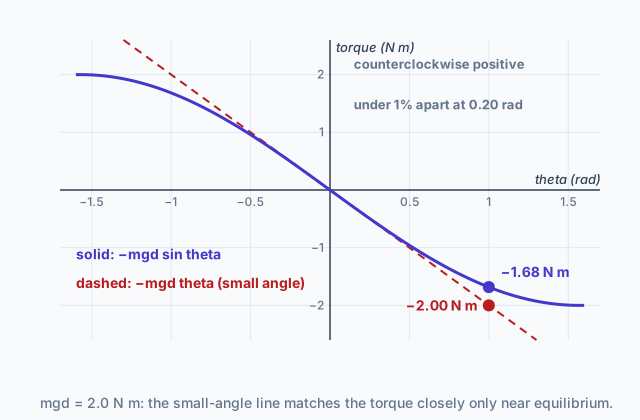
The diagram at the top of the page graphs this torque for one pendulum with N·m.
Quick check · Calculate
A 1.5 kg wooden sign hangs from a hook at its top and can rock in its own plane about the hook. When it hangs at rest, its center of mass is 0.20 m directly below the hook. A gust turns it to rad from that position, counterclockwise as seen from the street, and counterclockwise is positive. Using the exact form of the restoring torque, without the small-angle approximation, what torque does the gravitational force exert on the sign about the hook at that instant?
7b. Small angles turn it into SHM
Newton's second law in rotational form, about the pivot, says , and . With the restoring torque,
That torque is not proportional to . For small amplitudes, though, the small-angle approximation applies: with in radians, . At 0.20 rad, . Then , and dividing by :
This is the second-order differential equation of simple harmonic motion, , with . So , and the period, , is
A larger rotational inertia about the pivot makes the swing slower; a larger gravitational torque per radian, , makes it faster.
Quick check · Fill the statement
A wrench of mass hangs from a nail through a hole in its handle and swings in a vertical plane. Its center of mass is a distance from the nail, and its rotational inertia about the nail is . The angle is measured from equilibrium, counterclockwise positive, and stays small.
Using , Newton's second law in rotational form becomes . That is the SHM equation with , so the period is .
7c. The simple pendulum is a special case
A simple pendulum is a physical pendulum whose hanging object can be modeled as a point mass a distance from the pivot: a small, dense bob on a light string. For a point mass, the rotational inertia about the pivot is , and the center of mass is the bob itself, so . Substitute both into the physical pendulum's period:
A 0.90 m pendulum has s. The length is measured from the pivot to the center of the bob.
When the object is not small compared with its distance from the pivot, the point-mass model no longer fits, and you return to with the object's real rotational inertia about the pivot. That is why a meter stick swinging from one end does not keep time with a 1.00 m simple pendulum.
Quick check · Decide and justify
A small aluminum ball on a light 0.90 m string swings through small angles. A student replaces it with a small brass ball of the same size, which has three times the mass, on the same string, and swings it through the same small angle. Compared with the aluminum ball, what is the brass ball's period?
Which reason supports your answer?
7d. A torsion pendulum twists instead
Hang a horizontal disk from a thin wire attached at its center of mass, twist it, and let go: it turns back and forth about the wire in the horizontal plane. This is a torsion pendulum. The restoring torque comes from the twisted wire, not from gravity, and it is proportional to the angular displacement:
Here is the wire's torsion constant, in N·m/rad, and is the rotational inertia about the wire. Writing and measuring from the untwisted position gives , the SHM equation with , so
There is no here to approximate. As long as the wire's torque stays proportional to the twist, the motion is SHM at any amplitude in that range, which is why torsion pendulums are used in clocks and in measurements of tiny torques.
Quick check · Calculate
A horizontal disk with rotational inertia 0.045 kg·m² about a vertical wire through its center hangs from that wire. The wire's torsion constant is 0.20 N·m/rad: twisted through an angle from its untwisted position, it exerts a torque on the disk. What is the period of the disk's twisting oscillation?
Part 3 Watch it done A rod hung off center
Watch each step, then do the last one yourself.
A uniform rod 1.20 m long with mass 0.50 kg hangs from a horizontal pin through a hole 0.30 m from its top end, and swings in a vertical plane. Its rotational inertia about its center is . Find its period for small swings.
Step 1 · Locate the center of mass
The rod is uniform, so its center of mass is at its middle, 0.60 m from the top end. The pin is 0.30 m from the top, so m.
Step 2 · Rotational inertia about the pin
kg·m². The pin is m from the center, so kg·m².
Why this step?
Why not use for in the period?
The rod turns about the pin, not about its center. Newton's second law in rotational form uses the rotational inertia about the axis the body actually turns about, and the mass on the far side of the center from the pin adds a lot of it.
Step 3 · Match the SHM equation
For small angles, , so s⁻².
Your step · Calculate
Finish it. What is the rod's period for small swings about the pin?
s
Part 4 Try it New situations
Try it · Rank it
Three pendulums swing through small angles. A is a small, dense ball on a light string, 0.60 m from the pivot to the center of the ball. B is a uniform rod 1.50 m long hung from a pin at one end; about its center, a rod has rotational inertia . C is a uniform disk of radius 0.40 m hung from a pin through a hole at its rim, swinging in its own plane; about its center, a disk has rotational inertia . Rank the pendulums by period.
Longest period first
Give each one a place, 1 for first. Give two the same place if they are equal.
Your ranking: none yet
Try it · Calculate
A 2.0 kg steel bracket of irregular shape hangs from a horizontal pivot pin and swings in a vertical plane. Its center of mass is 0.25 m from the pin. For small swings, a photogate measures a period of 1.40 s. What is the bracket's rotational inertia about the pin?
On paper. Draw any rigid object you like hanging from a pivot, turned counterclockwise through a small angle from equilibrium. Mark the pivot, the center of mass, the distance between them and the gravitational force exerted on the object at its center of mass, and write the torque that force exerts about the pivot, with its sign. Then describe how you would measure the period of small swings with a stopwatch so that your reaction time matters as little as possible. There is nothing to submit here.
Part 5 Explain it Design it, then plot it on paper
On the exam this is handwritten, so answer on paper first. Nothing you type here leaves this page. Then check your answer against the model and each scoring point.
Free response is 50% of the exam score. This one is shaped like Question 3, Experimental Design and Analysis.
Free-response practice · Question 3 style
A lab group has a clamp on a stand, light string, four solid balls of the same 3.0 cm diameter made of wood, aluminum, steel and brass, an electronic balance, a meter stick, a protractor and a stopwatch.
(a) The group wants to know whether the period of a simple pendulum depends on the mass of the bob. Describe a procedure they could use. Say what they change, what they keep the same, what they measure and with what, and one step that reduces experimental uncertainty.
(b) Describe how they could analyze the data from (a), by a graph or a comparison, to answer the question.
(c) A second group wants the rotational inertia of a flat, irregular aluminum plate of mass 0.80 kg about an axis through its center of mass, perpendicular to the plate. They drill holes along a line through the center of mass, hang the plate from a horizontal pin through each hole in turn, measure the distance from the pin to the center of mass, and time small swings. Starting from , where is about the pin, derive an expression showing that a graph of against should be a straight line, and say what its slope and its vertical intercept equal.
(d) Their data:
- = 0.050 m: = 1.41 s
- = 0.100 m: = 1.13 s
- = 0.150 m: = 1.09 s
- = 0.200 m: = 1.11 s
- = 0.250 m: = 1.16 s
On paper, plot against with a scale and units on each axis, and draw a best-fit line. Do this by hand before you open the model.
(e) Use your best-fit line to calculate .
Model answer
(a) Tie the wooden ball on so that the distance from the pivot to the center of the ball is 1.00 m, measured with the meter stick, and find the ball's mass on the balance. Pull it aside to 10°, measured with the protractor, release it, and time 10 full oscillations with the stopwatch; divide by 10 to get . Repeat three times and average. Do the same with the aluminum, steel and brass balls, keeping the length at 1.00 m and the release angle at 10°. The balls are the same size, so the pivot-to-center length does not change when the mass does.
(b) Graph against the mass of the bob. If the points fall on a horizontal line, a slope near zero within the spread of the repeated trials, the period does not depend on the mass. A line with a clear slope would show that it does.
(c) By the parallel axis theorem, , so . Multiplying by :
That is a straight line in , with slope and vertical intercept .
(d) The values of are 2.5, 10.0, 22.5, 40.0 and 62.5, in units of m², and the values of are 0.099, 0.128, 0.178, 0.246 and 0.336 s²·m. See the graph below: one straight best-fit line through the points, not a line joining them.
(e) Two points on the line are and , so the slope is s²/m and the intercept is about 0.089 s²·m. Dividing the intercept by the slope cancels : m², so kg·m². As a check on the data, the slope gives m/s².
T squared times d against d squared, with the best-fit line
The line crosses the vertical axis near 0.089 s²·m and passes through (62.5, 0.336).
Score your own answer. This is a self-check, not a grade. Tick each point your answer makes.
Part 6 Check yourself A twisting disk in a museum
The case questions use the museum's measurements. Answer them from those.
A science museum hangs a horizontal disk from a thin vertical steel wire attached at the disk's center, so the disk can twist back and forth about the wire. Take counterclockwise as seen from above as positive, with where the wire is untwisted. Twisted through , the wire exerts a torque on the disk. Staff hang three different disks on the same wire, twist each to 0.40 rad, release it and time the oscillation:
| Disk | about the wire (kg·m²) | Period (s) |
|---|---|---|
| P | 0.050 | 0.99 |
| Q | 0.100 | 1.40 |
| R | 0.200 | 1.99 |
Case question 1 · Calculate
Using disk R's row of the table, what is the wire's torsion constant ?
Case question 2 · Multiple choice
Staff twist disk Q to 0.80 rad instead of 0.40 rad and release it. What period should they measure?
Case question 3 · Calculate
Using disk Q's row of the table: as disk Q swings through rad, what is its angular acceleration? Counterclockwise as seen from above is positive.
The rest stand on their own and do not use the case.
Check yourself · Sort it
Tap a card, then say which model fits the oscillating object best.
Simple pendulum
Physical pendulum
Torsion pendulum
Check yourself · Spot the error
A thin hoop of mass and radius hangs on a nail through its rim and swings in its own plane through small angles. Its rotational inertia about its center is . A student finds its period. Tap the first line with a mistake.
Part 7 Keep it Bring back earlier ideas
This lesson stands on Topic 7.4's oscillator, where a restoring push toward equilibrium trades energy back and forth on every swing, as gravity's restoring torque does on a pendulum, and on Topic 5.4's parallel axis theorem, which gives a pendulum's rotational inertia about its pivot. Pulling them back up is what makes them last.
From 7.4 Energy of Simple Harmonic Oscillators · Decide and justify
A glider on a level, frictionless air track is attached to a spring and oscillates with amplitude 0.10 m. Equilibrium is at , and right is positive. At one instant the glider is at m and moving left. Just after that instant, is the system's kinetic energy increasing or decreasing?
Which reason supports your answer?
On paper. Draw the disk hanging from the nail in the question above. Mark its center of mass, the nail, and the distance between the two parallel axes, labeled with its value. Then, beside it, sketch a graph of the disk's rotational inertia against as the nail hole is moved from the center out to the rim, to m, and label the value at . There is nothing to submit here. Your graph should start at its lowest value at and curve upward like the rod graph at the top of the page, since the shift term grows as .
From 5.4 Rotational Inertia · Calculate
A uniform disk of mass 2.0 kg and radius 0.25 m hangs from a nail through a small hole at its edge, and it can swing in its own plane. The nail is perpendicular to the disk's face. About a parallel axis through its center, the disk has rotational inertia . What is its rotational inertia about the nail?
In three lines
- A physical pendulum is a rigid body oscillating about a fixed axis; gravity at its center of mass exerts a restoring torque .
- For small angles, turns into the SHM equation with , so , with about the pivot.
- A simple pendulum is the point-mass case, ; a torsion pendulum obeys , so .
Exam strategy for this topic
- Section I, Multiple Choice: 42 questions in 85 minutes.
- Section II, Free Response: 4 questions in 95 minutes.
- This lesson's Explain it is shaped like free-response question 3, Experimental Design and Analysis.
- A four-function, scientific, or graphing calculator is allowed on both sections of the exam.
On a lab question about a pendulum, rearrange the period equation until one measured quantity is a straight-line function of another, then say which physical quantity the slope or the intercept equals before you plot anything. In a derivation, write about the pivot first, state that the angle is small, and only then replace with .
Questions students ask
What is the difference between a simple pendulum and a physical pendulum?
A simple pendulum is a model: all the mass sits at one point a distance from the pivot, so and . A physical pendulum is any rigid body swinging about a fixed axis, with its mass spread out, so you need its rotational inertia about the pivot and the distance from the pivot to its center of mass.
Why does the period equation need small angles?
The gravitational torque is , which is not proportional to . Only for small angles in radians is close to , and then the motion follows the SHM equation. At larger amplitudes the pendulum still oscillates, but its period is no longer given by .
Does a heavier pendulum swing faster?
Not by being heavier alone. Mass appears in both the restoring torque and the rotational inertia. What sets the period is how the mass is arranged around the pivot, through and .
Do I have to solve the differential equation?
No. You are expected to know that describes SHM and that its solutions are sines and cosines with angular frequency , to derive the equation for a given pendulum, and to read from it. Proving that the solution works is not expected.
How is a torsion pendulum different from a swinging pendulum?
Its restoring torque comes from a twisted wire, not from gravity, and the twist happens in a horizontal plane about the wire. Matching to the SHM equation gives and .
Course alignment, for teachers
AP Physics C: Mechanics topic 7.5, Unit 7: Oscillations.
- Skill 1.B: Create quantitative graphs with appropriate scales and units, including plotting data.
- Skill 2.A: Derive a symbolic expression from known quantities by selecting and following a logical mathematical pathway.
- Skill 2.B: Calculate or estimate an unknown quantity with units from known quantities, by selecting and following a logical computational pathway.
- Skill 3.A: Create experimental procedures that are appropriate for a given scientific question.
- Skill 3.B: Apply an appropriate law, definition, theoretical relationship, or model to make a claim.
This lesson maps all 7 essential knowledge statements of the topic to the part that teaches each one: 7 are checked by a scored question. The map is in the lesson file.