Unit 7 · Topic 7.4 · about 30 minutes · 7 parts · 12 scored checks, 1 of them multiple choice, plus 2 from earlier lessons
AP Physics C: Mechanics 7.4: Energy of Simple Harmonic Oscillators
Unit 7: 10 to 15% of the multiple-choice section
What you'll be able to do
- Describe the mechanical energy of an oscillating system: how its kinetic and potential energies add to a constant total, where each is greatest and least, and how the amplitude sets the total.
Key vocabulary
| Term | What it means | The exam trap |
|---|---|---|
| Simple harmonic motion | Periodic motion in which the restoring force on an object is proportional to its displacement from equilibrium and points opposite to it, such as a block on an ideal spring. | Not every back-and-forth motion is simple harmonic; the energy statements in this topic are written for one that is, with no friction. |
| Kinetic energy | The energy an object has because it moves, . | It uses the speed at the instant you are asked about, not the greatest speed of the motion. |
| Potential energy | Energy stored in a system's configuration; for a block and spring, in how far the spring is stretched or compressed. | The stretch is measured from equilibrium, where the spring is relaxed, not from where the block was released. |
| Total energy | The sum of a system's kinetic and potential energies at one instant, . | Both energies must come from the same instant; adding values from two different moments gives a number that is not the total. |
| Conservation of energy | With nothing outside the system doing work on it, the system's total energy stays constant. | It is the total that stays constant, not either part, and friction in a real lab slowly drains it. |
| Amplitude | The greatest displacement of an oscillating object from its equilibrium position, . | It is measured from equilibrium to one turning point, not the full distance between the two turning points. |
 Tap to open the picture full size
Part 1 Think first Halfway out
Commit to a guess first. Being wrong now makes the right idea stick better.
Predict first
A cart on a spring glides back and forth on a level track in your lab. At one instant it is exactly halfway between the point where the spring is relaxed and the farthest point it reaches. Of the system's total energy at that instant, how much is the cart's kinetic energy?
In short. The total energy of an oscillating system is the sum of its kinetic and potential energies, , and with no friction that total stays constant while energy moves back and forth between the two.
- Kinetic energy is greatest where potential energy is least, at equilibrium, and potential energy is greatest where kinetic energy is least, zero, at the turning points.
- Find the total once, at any instant where you know both and , and use it at every other position.
- For a spring and object, , so the energy grows with the square of the amplitude.
Part 2 Learn it Four ideas, with a check after each
2a. Total energy is U plus K
Take a block on a horizontal spring as the system. The block's kinetic energy is . The spring's potential energy is , where is the block's displacement from equilibrium, the position where the spring is relaxed and .
The total energy of the system at any instant is the sum of the two:
Both terms belong to the same instant. A 0.40 kg block on a spring with N/m that is at m and moving at 0.50 m/s has
so J. The minus sign on drops out when you square it: a spring compressed by 0.20 m stores the same energy as one stretched by 0.20 m. Neither energy is ever negative here.
Quick check · Calculate
A 0.80 kg cart on a level, frictionless track is attached to a spring with spring constant 200 N/m. Equilibrium is at , and right is positive. At one instant the cart is at m and moving left at 1.5 m/s. What is the total energy of the cart and spring system at that instant?
2b. The total stays the same
With no friction or drag, nothing outside the block and spring takes energy from them or gives it, so by conservation of energy the total stays constant through every oscillation. The spring and the block pass energy back and forth, but the sum does not change:
That makes the total a tool. Find it once, at the instant you know the most about, and use it at any other position.
A 1.0 kg glider on a spring with N/m is released from rest at m. At release , so J. When the glider reaches m, the spring still holds J, so
The spring's energy at 0.30 m uses the displacement from equilibrium, 0.30 m, not the 0.20 m the glider has moved since release.
Quick check · Calculate
A 2.0 kg block on a level, frictionless surface is attached to a spring with spring constant 50 N/m. Equilibrium is at , and right is positive. The block is released from rest at m. What is its speed when it reaches m?
2c. Where each energy peaks
Because the total is fixed, one energy can only grow when the other shrinks.
- At equilibrium, , the potential energy is at its minimum, zero for the spring. So the kinetic energy is at its maximum there, and the block moves fastest.
- At each turning point, or , the block stops for an instant. Its kinetic energy is at its minimum, which is zero, and the potential energy is at its maximum.
Between those places, watch the displacement. While the block moves toward equilibrium, shrinks, so falls and rises. While it moves away from equilibrium, rises and falls. The sign of the velocity alone says nothing, because a block can move left toward equilibrium or left away from it.
The same trade runs a pendulum swinging through small angles. The gravitational potential energy of the pendulum and Earth is least at the lowest point of the swing, so that is where the bob moves fastest, and it is greatest at the ends of the swing, where the bob stops.
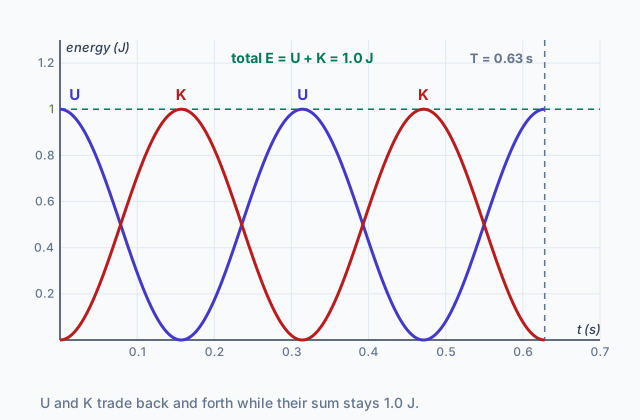
The graph at the top of the page shows the trade in time: each energy peaks twice in every period: at each turning point, and each time the block passes equilibrium, once in each direction.
Quick check · Decide and justify
A glider on a level, frictionless air track is attached to a spring and oscillates with amplitude 0.10 m. Equilibrium is at , and right is positive. At one instant the glider is at m and moving left. Just after that instant, is the system's kinetic energy increasing or decreasing?
Which reason supports your answer?
2d. The amplitude sets the energy
At a turning point the kinetic energy is zero and the displacement is the amplitude , so the whole total is in the spring:
The total never changes, so this one value holds at every instant of the motion, not only at the turning points.
Two things follow. First, the amplitude enters squared. A spring with N/m oscillating with m has J; pull it out to m, three times as far, and the total becomes J, nine times as much. Second, the mass of the block does not appear. For a given spring and amplitude, a heavier block has the same total energy; it just moves more slowly at equilibrium.
In Topic 7.3 you saw that a larger amplitude does not change the period. It does change the energy, because the maximum potential energy grows, and with it the total.
Quick check · Rank it
Three blocks oscillate on horizontal springs on frictionless surfaces. Oscillator P has N/m, amplitude 0.10 m and a 1.0 kg block. Oscillator Q has N/m, amplitude 0.20 m and a 4.0 kg block. Oscillator R has N/m, amplitude 0.20 m and a 1.0 kg block. Rank the oscillators by the total energy of each block and spring system.
Greatest first
Give each one a place, 1 for first. Give two the same place if they are equal.
Your ranking: none yet
Part 3 Watch it done A block that is already moving
Watch each step, then do the last one yourself.
A 0.50 kg block on a level, frictionless surface is attached to a spring with spring constant 200 N/m. Equilibrium is at , and right is positive. At the block is at m and moving right at 0.80 m/s. What is the amplitude of its motion?
Step 1 · Find the total energy at t = 0
J and J, so J. Both terms are at the same instant, so they add.
Why this step?
Why is the amplitude not 0.030 m, where the block starts?
At 0.030 m the block is still moving, so it has kinetic energy and keeps going right, stretching the spring further. The amplitude is the displacement where it stops for an instant, where the kinetic energy is zero.
Step 2 · Put all the energy in the spring
At the turning point , so J. The total is the same there as at , because no friction takes any away.
Your step · Calculate
Finish it. Solve J for the amplitude of the block's motion, in centimeters.
cm
Part 4 Try it New situations
Try it · Sketch the graph
A 1.0 kg block on a level, frictionless surface is attached to a spring with spring constant 500 N/m and oscillates with amplitude 0.10 m about equilibrium at ; right is positive. Sketch the system's kinetic energy against the block's position from to m.
One shape that fits
Drag a point up or down, or tap it and use the arrow keys. Only the shape is checked.
Try it · Match
A block on a horizontal spring oscillates on a frictionless surface with amplitude and total energy , about equilibrium at ; right is positive. Tap a position, then how the energy is split when the block is there.
On paper. Describe how you would test, in your lab, whether a cart on a spring on a level track keeps the same total energy as it oscillates. Say what you would measure and with what equipment, what you would calculate from each set of readings, and what graph you would make to judge the result. There is nothing to submit here; compare your plan with the readings in Check yourself.
Part 5 Explain it Derive it, then put numbers in
Nothing you type leaves this page. Check your answer against the model and each scoring point.
Free response is 50% of the exam score. This one is shaped like Question 1, Mathematical Routines.
Free-response practice · Question 1 style
A block of mass on a level, frictionless surface is attached to a horizontal spring with spring constant . Equilibrium is at , and right is positive. The block is pulled to and released from rest.
(a) Derive an expression for the block's speed at position , in terms of , , and .
(b) The block has kg, the spring has N/m, and m. Calculate the total energy of the block and spring system and the block's greatest speed.
(c) Calculate the positions at which the kinetic energy and the potential energy are equal.
(d) On paper, sketch the potential energy and the kinetic energy against from to on one set of axes, and draw a line for the total energy. Label each energy's value at and at .
(e) The block is replaced with a 1.60 kg block, released from rest at the same amplitude on the same spring. Predict whether the total energy and the greatest speed increase, decrease or stay the same, and justify each prediction with your answers to (a) and (b).
Model answer
(a) At release , so . The total is constant, so at position , , which gives .
(b) J. The speed is greatest at : m/s.
(c) Equal shares means , so and m.
(d) is an upward-opening parabola, 0 at and 0.20 J at . is a downward-opening parabola, 0.20 J at and 0 at . The total is a horizontal line at 0.20 J, and the two curves cross at m, at 0.10 J each. Compare your sketch with those shapes and labels.
(e) The total energy stays the same, 0.20 J: has no mass in it, and and did not change. The greatest speed decreases: from (a), , so four times the mass halves it, to 0.50 m/s. The same 0.20 J of kinetic energy at equilibrium moves a heavier block more slowly.
Score your own answer. This is a self-check, not a grade. Tick each point your answer makes.
Part 6 Check yourself A glider on an air track
The case questions use the sensor readings. Answer them from those.
A class attaches a 0.50 kg glider to a spring with spring constant 20 N/m on a level air track, where friction is small enough to ignore. Equilibrium is at , and right is positive. A motion sensor records the glider's position and velocity at five instants, listed in the order they were taken:
| Reading | (m) | (m/s) |
|---|---|---|
| 1 | 0.180 | −1.518 |
| 2 | 0.090 | −2.100 |
| 3 | 0.000 | −1.897 |
| 4 | −0.270 | +0.827 |
| 5 | 0.240 | +1.138 |
Case question 1 · Calculate
Using reading 1, what is the total energy of the glider and spring system?
Case question 2 · Multiple choice
Friction is small enough to ignore, so the total energy should be the same at every reading. One reading cannot be right. Which one?
Case question 3 · Calculate
Using the readings that agree with each other, what is the amplitude of the glider's motion?
The rest stand on their own and do not use the case.
Check yourself · Sort it
Each oscillator moves with no friction. Tap a card, then say which energy is at its maximum at that moment.
Kinetic energy at its maximum
Potential energy at its maximum
Check yourself · Spot the error
A 0.60 kg block on a horizontal spring with spring constant 300 N/m oscillates on a frictionless surface with amplitude 0.10 m. A student pulls it out to an amplitude of 0.20 m instead and finds the block's new greatest kinetic energy. Tap the first line with a mistake.
Part 7 Keep it Bring back earlier ideas
This lesson stands on the velocity of an oscillator from Topic 7.3, found by differentiating its position function, and on velocity and acceleration as derivatives from Topic 1.2: kinetic energy uses the speed at one instant, and whether that speed is rising tells you whether the kinetic energy is.
From 1.2 Displacement, Velocity, and Acceleration · Decide and justify
A cart moves along a track with its position given by , with in meters and in seconds. Take the direction of increasing as positive. At s, is the cart speeding up or slowing down?
Which reason supports your answer?
On paper. This time the glider starts on the left, at , not at as in the items above. It is released from rest there at , with right positive. Sketch its position, velocity and acceleration against time for one full period on three sets of axes stacked one above the other, so the same instant lines up on all three. Mark , , and on each time axis, and label each graph's largest value in terms of and . There is nothing to submit here; once you open the Explain it model, check that each of your three graphs is that model's graph turned upside down.
From 7.3 Representing and Analyzing SHM · Calculate
A glider on a level air track oscillates about its equilibrium position, , with right positive. Its position is , with in meters, in seconds and the angle in radians. What is the glider's velocity at ?
In three lines
- The total energy of an oscillating system is , both taken at the same instant, and with no friction it is constant.
- Kinetic energy peaks where potential energy is least, at equilibrium; potential energy peaks where kinetic energy is zero, at the turning points.
- For a spring and object, : the amplitude sets the energy, squared, and the mass does not enter.
Exam strategy for this topic
- Section I, Multiple Choice: 42 questions in 85 minutes.
- Section II, Free Response: 4 questions in 95 minutes.
- This lesson's Explain it is shaped like free-response question 1, Mathematical Routines.
- A four-function, scientific, or graphing calculator is allowed on both sections of the exam.
When a question asks for a speed at some position or for an amplitude, start from energy, not from forces. Write at the instant you know fully, write it again at the instant you are asked about, and set the two equal. Show each energy with its symbols before the numbers, so a reader can follow which displacement and which speed you used.
Questions students ask
Can the potential energy of a spring be negative?
Not with at equilibrium. squares the displacement, so a compressed spring and a stretched one store positive energy, and the same amount for the same distance.
What happens to the energy when there is friction?
Friction does negative work on the oscillator, so the total mechanical energy falls a little each cycle and the amplitude shrinks. The statements in this topic describe a system where friction and drag are small enough to ignore.
Does a pendulum work the same way?
Yes. For a pendulum the potential energy is gravitational, in the pendulum and Earth system, and it is least at the lowest point. Topic 7.5 treats the pendulum's motion itself, for small angles.
Why do the energy graphs repeat twice in one period?
The spring stores the same energy at as at , so the potential energy peaks at both turning points in each cycle, and the kinetic energy peaks each time the object passes equilibrium, going either way.
How does this connect to the greatest speed from Topic 7.3?
Setting all the energy kinetic at equilibrium, , gives , the same result the position function gives.
Course alignment, for teachers
AP Physics C: Mechanics topic 7.4, Unit 7: Oscillations.
- Skill 1.C: Create qualitative sketches of graphs that represent features of a model or the behavior of the physical system.
- Skill 2.B: Calculate or estimate an unknown quantity with units from known quantities, by selecting and following a logical computational pathway.
- Skill 2.D: Predict new values or factors of change of physical quantities using functional dependence between variables.
- Skill 3.C: Justify or support a claim using evidence from experimental data, physical representations, or physical principles or laws.
This lesson maps all 6 essential knowledge statements of the topic to the part that teaches each one: 6 are checked by a scored question. The map is in the lesson file.