Timed practice
Full practice exams
Pick an exam. Each one shows its format first, then runs one section at a time on its own clock.
Practice Exam 1
55 multiple-choice and 4 free-response questions, in the format of the AP U.S. Government and Politics Exam.
| Section | Questions | Time |
|---|---|---|
| Section I: Multiple Choice | 55 | 80 minutes |
| Section II: Free Response | 4 | 100 minutes |
How the exam works
- One section at a time. When a section's clock reaches zero, the section ends and is scored.
- Multiple choice is scored when its section ends, with an explanation for every choice.
- Free response is never scored by the page. When the section ends, you see the scoring guide and a model response for each part and tick the points your answer earns.
- At the end you get your score and the time you used for each section.
- In study mode each multiple-choice answer is checked as soon as you give it, with its explanation, and each free-response question has a button that opens its scoring guide.
- Switching to study mode partway keeps your answers and checks the ones you have given. Start over clears everything and lets you choose a mode again.
- Your answers are kept in this browser tab if the page reloads, and nowhere else.
Section I: Multiple Choice
-
A town charter requires regular elections and limits public offices. A delegate claims electoral popularity lets officials ignore the charter. Which principle most directly challenges the claim?
Answer: B.
- A
The scenario concerns limited authority rather than state representation.
- B
Electoral support does not erase legal boundaries on officeholders.
- C
Judicial selection is not the source of the stated restriction.
- D
Unrestricted authority is the claim being challenged.
- A
-
Competing trade associations and neighborhood organizations bargain over a city zoning bill. Which democratic model does their activity most directly illustrate?
Answer: D.
- A
The scenario features competing organizations rather than a single narrow leadership.
- B
The groups are influencing lawmakers, not directly enacting a ballot proposition.
- C
The stated activity is specifically organized group competition.
- D
Competition among organized interests is central to the pluralist model.
- A
-
A reform group argues that more residents should attend public meetings, deliberate, and join civic activities. Which model most closely matches that emphasis?
Answer: A.
- A
The emphasis is broad civic involvement by citizens.
- B
The proposal seeks broader rather than more restricted participation.
- C
Trustee judgment concerns representatives deciding by their own knowledge.
- D
Competition among established associations is different from the stated broad-participation emphasis.
- A
-
How does Madison’s argument in Federalist No. 10 defend a large republic?
Answer: C.
- A
Madison accepts diversity of interests rather than assuming uniformity.
- B
Removing liberty would be an unacceptable remedy for faction.
- C
An extended republic multiplies interests and makes a majority faction harder to coordinate.
- D
The argument seeks to check faction, not guarantee its command of representatives.
- A
-
Under the Articles of Confederation, Congress depended on state legislatures to raise money for common expenses. How did this arrangement affect national governing capacity?
Answer: B.
- A
The Articles did not establish the described presidency.
- B
Reliance on state contributions limited dependable centralized revenue.
- C
The Articles did not create that national judicial system.
- D
Congress lacked that direct exclusive revenue authority.
- A
-
At a new constitutional convention, small states demand equal representation while large states demand population-based representation. Which arrangement most closely parallels the Great Compromise?
Answer: A.
- A
The compromise combined population-based House representation with equal-state Senate representation.
- B
Population alone would omit the small states’ equal-state chamber.
- C
Equal states alone would omit the large states’ population-based chamber.
- D
County equality does not supply the population-based component.
- A
-
Questions 7 to 10 refer to the following.
Primary-source paraphrase of Federalist No. 51 (1788): Public officials should possess institutional means and motives to resist encroachment by other departments. Dependence on the people is the primary control, yet structural precautions are also needed. In the American compound republic, authority is divided between distinct governments and then among departments within each, creating an additional security for rights. The essay is a defense of a constitutional design, not a measurement of whether every check succeeds. Federalist No. 51, institutional checks and compound-republic passages
What reasoning does the source offer for institutional checks?
Answer: D.
- A
Its argument calls for precautions beyond good intentions.
- B
The source explicitly treats popular dependence as primary but insufficient alone.
- C
Concentration conflicts with the divided structure being defended.
- D
The source links structural safeguards to officeholders’ interests in resisting encroachment.
- A
-
Uses the material above question 7.
How does the compound-republic passage relate to federalism?
Answer: C.
- A
The source retains distinct governments rather than assigning all authority nationally.
- B
States are governing institutions, not merely private associations.
- C
The passage describes two divisions: between governments and among departments.
- D
The passage does not establish a unanimity requirement for each administrative act.
- A
-
Uses the material above question 7.
Which implication for civic advocates follows from the divided structure described?
Answer: B.
- A
Multiple venues can remain even when one official opposes a request.
- B
Different levels and departments provide distinct routes, although none guarantees success.
- C
Political access does not authorize ignoring law.
- D
A state-level action does not automatically decide a national vote.
- A
-
Uses the material above question 7.
How does Senate review of a presidential judicial nominee fit the source’s reasoning?
Answer: A.
- A
Shared appointment authority supplies a structural check on unilateral executive action.
- B
A check constrains power rather than eliminating accountability.
- C
The nominee cannot compel the Senate’s approval.
- D
The check involves the national Senate, not a governor.
- A
-
Which pairing accurately describes the constitutional dispute in McCulloch v. Maryland?
Answer: A.
- A
The case upheld the bank as an appropriate means and rejected Maryland’s interfering tax.
- B
The case did not concern abolition of courts.
- C
McCulloch was about the bank, implied powers, and national supremacy.
- D
The school-zone gun dispute belongs to United States v. Lopez.
- A
-
How do the regular election cycles of the House and Senate differ?
Answer: D.
- A
The House renews every two years and the Senate only a portion at a time.
- B
The term lengths are reversed.
- C
Both chambers have scheduled elections.
- D
Two-year House terms and staggered six-year Senate terms create different electoral exposure.
- A
-
Questions 13 to 14 refer to the following.
Original fictional House committee record. The table follows the same forty proposals through successive stages.
Original fictional teaching data Stage Bills Referred 40 Reported to floor 12 Passed House 9 Which statement accurately describes the committee record?
Answer: A.
- A
The reported-to-floor row lists 12 bills.
- B
Twenty-eight is 40 minus 12: the bills not reported.
- C
Thirty-one is 40 minus 9: bills not shown as passing.
- D
The final row lists nine passed bills.
- A
-
Uses the material above question 13.
How many of the referred bills were not reported to the floor?
Answer: C.
- A
Thirty-one subtracts passed bills, measuring a different stage.
- B
Three is the difference between 12 reported and nine passed.
- C
Forty referred minus 12 reported equals 28 not reported.
- D
Reported bills are the group that did advance to the floor.
- A
-
What did Baker v. Carr establish about an equal-protection challenge to legislative apportionment?
Answer: D.
- A
The decision did not create presidential preapproval of maps.
- B
The holding opened a route to federal judicial review.
- C
The holding concerned judicial review, not automatic criminal penalties.
- D
Baker recognized justiciability of the equal-protection apportionment claim.
- A
-
Questions 16 to 17 refer to the following.
Original fictional presidential record of regular vetoes, not pocket vetoes. Hint: the override share is overrides divided by regular vetoes in the same year.
Original fictional teaching data Year Regular vetoes Overrides 1 3 0 2 5 1 3 8 2 Which pattern appears in this record?
Answer: B.
- A
Both series rise rather than decrease or stay unchanged.
- B
Vetoes rise from 3 to 5 to 8, and overrides from 0 to 1 to 2.
- C
Overrides are below vetoes in each row.
- D
The veto counts are different in every row.
- A
-
Uses the material above question 16.
Which comparison accurately describes the share of regular vetoes overridden?
Answer: C.
- A
The record moves in the opposite direction.
- B
The listed shares differ and none is one-third.
- C
The shares are 0/3, 1/5, and 2/8: 0%, 20%, and 25%.
- D
Two of eight is one-quarter, not one-half.
- A
-
Hamilton defended a single executive as promoting energy and identifiable responsibility. Which explanation describes that rationale?
Answer: D.
- A
Energy is not a claim that the executive has no constitutional limits.
- B
The argument does not eliminate the legislature’s constitutional checks.
- C
Hamilton criticizes the divided responsibility of a plural executive.
- D
Hamilton connects unity with energy and identifiable accountability.
- A
-
A president broadcasts a short message asking residents to urge Congress to prioritize port repairs. How does the communication tool affect the policy process?
Answer: B.
- A
Communication does not itself appropriate funds.
- B
The bully pulpit and rapid communication can mobilize public pressure and set priorities.
- C
A presidential message is not a judicial ruling.
- D
Viewers do not become members of the committee.
- A
-
How does Marbury v. Madison’s judicial-review reasoning relate to Federalist No. 78 and constitutional judicial independence?
Answer: A.
- A
Marbury treats the Constitution as controlling over an incompatible statute; Federalist No. 78 defends independent constitutional judgment.
- B
Both accounts support independent constitutional judgment rather than obligatory deference to conflicting legislation.
- C
Hamilton distinguishes judicial judgment from executive force; Marbury does not give courts independent enforcement forces.
- D
Judicial review applies constitutional limits; it does not replace Article V amendment procedures.
- A
-
A lower court applies a controlling precedent to a new case with materially similar facts. Which judicial principle is illustrated?
Answer: C.
- A
The facts describe adherence to controlling precedent, not a willingness to depart from restraint to address policy questions.
- B
Judicial review concerns judging governmental action against the Constitution; the distinguishing fact here is following precedent.
- C
Stare decisis describes reliance on precedent in materially similar cases.
- D
Independence concerns insulation from improper outside influence; no such pressure or safeguard is described.
- A
-
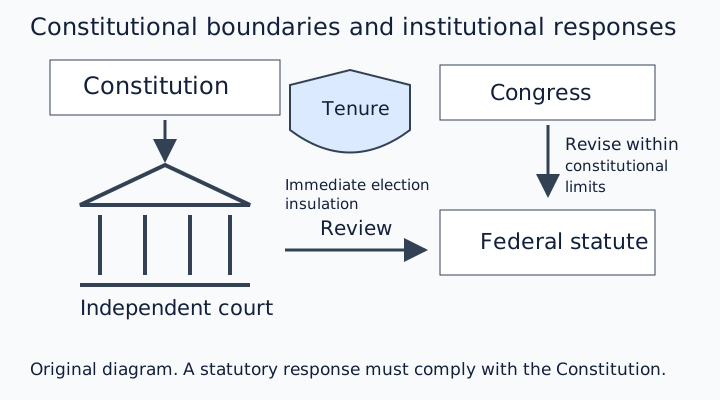
Questions 22 to 23 refer to the following.
Original institutional infographic. Arrows show claimed constitutional routes and limits, not an actual case outcome.
How does the tenure shield contribute to the infographic’s judicial-independence argument?
Answer: B.
- A
Independence remains tied to applying law and the Constitution.
- B
The shield connects tenure to independence from an immediate reelection threat.
- C
The symbol does not assign legislative appointment power to judges.
- D
The separate revision arrow shows a possible legislative response within legal limits.
- A
-
Uses the material above question 22.
What does the Congress-to-revised-statute arrow illustrate?
Answer: D.
- A
The arrow’s limitation distinguishes statutory revision from constitutional amendment.
- B
A statute’s revision is not the removal of judges.
- C
A congressional response does not supply unlimited executive power to ignore orders.
- D
The labeled route represents legislative revision while preserving constitutional constraints.
- A
-
An agency selects technical inspectors through examinations and relevant experience rather than campaign loyalty. How does this differ from patronage?
Answer: C.
- A
Rewarding political service is the patronage contrast.
- B
Career inspection roles are not made elected offices by merit selection.
- C
Merit selection rests on qualifications rather than political support.
- D
Party membership is not the described merit criterion.
- A
-
A statute directs an agency to set specific equipment-safety thresholds within a stated range. The agency chooses a threshold through rulemaking. What power is it using?
Answer: B.
- A
An agency rule is not an Article V amendment.
- B
Congress delegates implementation choices within a statutory framework.
- C
Congress appropriates funds; threshold setting is implementation.
- D
Rulemaking is not a presidential response to a bill.
- A
-
Questions 26 to 27 refer to the following.
Original fictional oversight record. Staffing also increased during these reporting periods; the observations do not isolate any one cause of changes in compliance.
Original fictional teaching data Period Overdue inspections Accountability action 1 30% Congressional committee hearing 2 18% Presidential directive to improve scheduling 3 10% Court order enforcing a statutory deadline Which conclusion appropriately connects the numerical pattern to accountability?
Answer: A.
- A
The percentages show a declining share overdue, while staffing and several accountability actions change. They do not establish the total amount of work overdue.
- B
The observations do not isolate the hearing from other influences.
- C
The listed chronological percentages decline rather than rise.
- D
The description states that staffing increased and records a presidential directive.
- A
-
Uses the material above question 26.
What do the recorded actions illustrate about the agency’s political environment?
Answer: C.
- A
A compliance trend does not establish exclusive congressional control.
- B
Implementation data do not transfer judicial authority to the agency.
- C
The record identifies legislative oversight, executive direction, and a judicial enforcement order.
- D
A court order does not erase other branches’ lawful tools.
- A
-
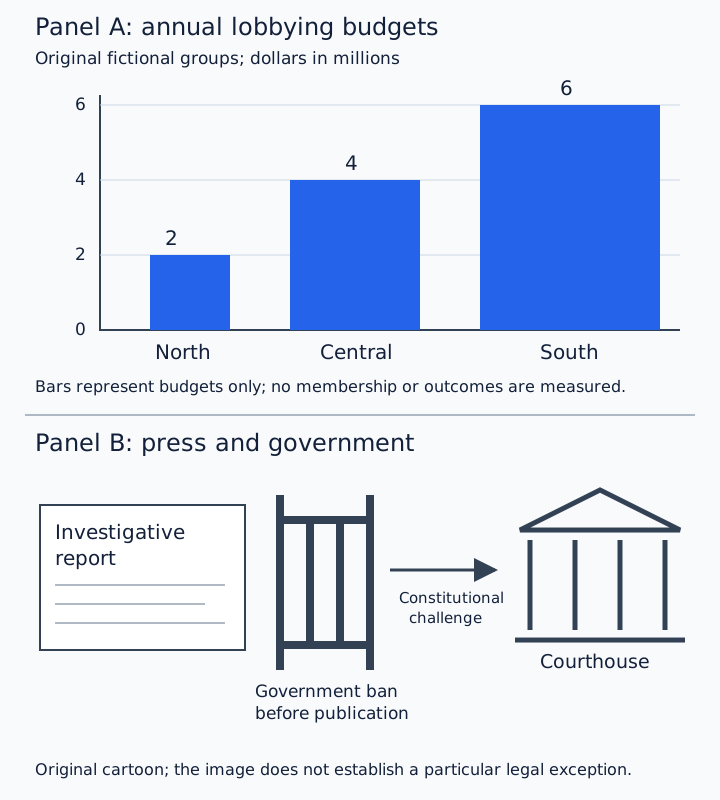
Questions 28 to 29 refer to the following.
Original press cartoon. Interpret Panel B; the image communicates an argument rather than documenting a specific lawsuit.
How does the government gate illustrate a civil-liberties concern?
Answer: D.
- A
The barrier is labeled as government action, not a private buying choice.
- B
The paper is seeking a remedy, not appointing an official.
- C
A challenge arrow does not establish the outcome of judicial review.
- D
The gate represents government interference with the communication of ideas.
- A
-
Uses the material above question 28.
How do the gate and its label communicate the cartoon’s constitutional concern?
Answer: B.
- A
The timing is before publication, not later liability for defamation.
- B
A government barrier before publication represents prior restraint.
- C
The gate is government action rather than a private purchasing decision.
- D
The gate is explicitly before publication; a condition imposed only after distribution does not match its timing.
- A
-
Which feature was central to the Establishment Clause issue in Engel v. Vitale?
Answer: A.
- A
State sponsorship of the school prayer created the Establishment Clause issue in Engel.
- B
A student’s private voluntary religious expression differs from the state’s arranging a prayer.
- C
The relevant issue is the state-sponsored exercise, not merely whether an individual may decline participation.
- D
Neutral access for private student groups differs from official sponsorship of a school prayer.
- A
-
How does McDonald v. Chicago illustrate selective incorporation?
Answer: C.
- A
The decision imposes a constitutional limit rather than immunity.
- B
A city ordinance cannot repeal a constitutional amendment.
- C
McDonald applied the individual arms right to the states through the Fourteenth Amendment.
- D
Incorporation limits state action rather than making rights solely a state choice.
- A
-
Which reasoning supports providing counsel to an indigent defendant in a state felony prosecution?
Answer: A.
- A
The right to counsel supports fair procedures for an accused person.
- B
Counsel and jury protections serve different functions.
- C
Representation does not guarantee a particular verdict.
- D
State criminal proceedings remain subject to applicable constitutional protections.
- A
-
Which statement accurately describes the relationship among Roe v. Wade and Dobbs v. Jackson Women’s Health Organization?
Answer: D.
- A
Dobbs rejected rather than reaffirmed Roe’s constitutional abortion holding.
- B
Both are judicial decisions, not an amendment and a statute.
- C
Dobbs returned abortion regulation decisions to legislatures subject to the legal framework.
- D
Dobbs held that the Constitution does not confer a right to abortion and overturned Roe.
- A
-
How does Brown v. Board of Education connect a constitutional provision to a governmental response to discrimination?
Answer: B.
- A
Brown’s holding concerns state-imposed segregation and equal protection, not an identical state-federal funding formula.
- B
Brown held state-mandated racial segregation in public schools unconstitutional under the Equal Protection Clause.
- C
Brown addressed segregated public education under equal protection; it did not forbid every distinction among districts.
- D
The Fifteenth Amendment concerns racially discriminatory voting restrictions; Brown did not require direct election of school officials.
- A
-
In Shaw v. Reno, the Court allowed a Fourteenth Amendment challenge to a district alleged to separate voters by race. In Gomillion v. Lightfoot, plaintiffs alleged a city-boundary change excluded nearly all Black voters while excluding no white voters; the Court held that these allegations stated a Fifteenth Amendment claim and reversed dismissal. Which comparison accurately connects the constitutional issues? Gomillion, 364 U.S. 339, majority opinion
Answer: C.
- A
Neither summary creates a rule against every boundary change.
- B
Those subjects do not describe the supplied racial districting disputes.
- C
Shaw involves equal protection under the Fourteenth Amendment; Gomillion involves race-based voting exclusion under the Fifteenth.
- D
Gomillion reversed dismissal of a federal constitutional claim, and Shaw did not create presidential map approval.
- A
-
Questions 36 to 39 refer to the following.
Primary-source paraphrase: In his January 11, 1944 State of the Union message, Franklin Roosevelt argued that economic insecurity undermines individual freedom. He proposed protections concerning employment, medical care, education, and fair business competition without monopoly domination, and asked Congress to explore implementation. These were proposed economic rights in a presidential message, not a newly ratified constitutional amendment. Roosevelt, January 11, 1944 message, economic-rights section
How does the source connect its economic proposals to an American core value?
Answer: D.
- A
The paraphrase proposes protections, not identical earnings.
- B
It does not argue for official immunity.
- C
The source criticizes monopoly domination rather than treating it as necessary competition.
- D
Roosevelt’s argument links material security to the ability to exercise freedom.
- A
-
Uses the material above question 36.
How does the proposed public role relate to the major parties’ general ideological alignments?
Answer: D.
- A
The proposed program goes beyond protecting property alone.
- B
A presidential proposal does not establish universal contemporary agreement.
- C
The source cannot reverse the general alignment of conservative positions with a more limited national role.
- D
A larger public role addressing insecurity aligns with the general liberal tendency; this does not predict every member’s vote.
- A
-
Uses the material above question 36.
If Congress funds a national medical-care program in response to the message, how would that tool differ from a Fed rate decision?
Answer: A.
- A
Congressional spending is a fiscal tool, distinct from the Fed’s monetary tools.
- B
Enacting program funds does not itself transfer the Fed’s rate decision to Congress.
- C
Funding a program does not redefine the Fed as a state agency.
- D
The use of money alone does not identify monetary policy; the tool and institution matter.
- A
-
Uses the material above question 36.
Which policy implication is most consistent with the message’s proposed education and medical-care protections?
Answer: B.
- A
The source proposes protections rather than abolishing every program.
- B
The proposals call for a public response rather than leaving all insecurity to private action.
- C
The message advocates public engagement on these issues.
- D
A proposed program in a message is different from ratified constitutional text.
- A
-
Questions 40 to 41 refer to the following.
Original fictional one-time survey. Each age group contains 100 respondents. Each selected one strongest reported influence; family counts are a subset of each group. The support column concerns the same proposed national service program in each group.
Original fictional teaching data Age group Family named strongest Support for program 18-29 35 44% 30-49 40 49% 50 and older 30 53% Which description accurately reports the family responses?
Answer: A.
- A
The family counts sum to 35 plus 40 plus 30, or 105 among 300 people.
- B
The total is 105 across groups, not within every group.
- C
The table does not cross-tabulate each person’s influence choice and policy support.
- D
The middle group has the highest family count, at 40.
- A
-
Uses the material above question 40.
Which description of policy support stays within the data?
Answer: C.
- A
A one-time survey compares different people, not individual changes.
- B
The gap is nine percentage points, not a ninefold ratio.
- C
The percentages rise from 44 to 49 to 53 across the ordered groups.
- D
The middle group names family most often, while the oldest group has the highest program support.
- A
-
A campaign compares repeated candidate polls but changes the last wave from neutral wording to praise for its candidate. Why does the change weaken its claim that support grew?
Answer: B.
- A
Sampling and wording address different sources of error.
- B
Leading framing changes the measurement and can create apparent movement.
- C
Exit polls are defined by voting respondents and timing, not favorable language.
- D
Repeated polls may sample different people.
- A
-
Questions 43 to 45 refer to the following.
Original fictional county study. Eligible populations are equal. Party contact is a count of eligible residents reached, not a randomly assigned treatment. A separate exit survey asked 200 voters in each county for their main voting reason. Counties differ in age composition, early-voting access, and campaign activity. Hint: divide votes by eligible residents for turnout.
Original fictional teaching data County Eligible residents Votes cast Residents contacted by parties Pine 20,000 12,000 8,000 Mesa 20,000 8,000 3,000 Original fictional teaching data Main voting reason in exit survey Pine voters Mesa voters Incumbent’s past performance 90 70 Candidate’s future plans 60 80 Choosing one party across races 50 50 What does the largest voting-reason category in Pine illustrate?
Answer: C.
- A
Future plans account for 60 of 200 responses rather than all voters.
- B
Straight-ticket choice has 50 responses, below the 90 past-performance responses.
- C
Ninety Pine respondents selected past performance, more than 60 or 50; that is retrospective reasoning.
- D
Ninety of 200 is 45%, below a majority.
- A
-
Uses the material above question 43.
Which turnout conclusion fits the observations?
Answer: A.
- A
Pine has 60% turnout and Mesa 40%; several other conditions differ.
- B
Contact was not randomly assigned, and access and demographics also differ.
- C
The eligible populations are identical, and Mesa cast fewer votes.
- D
Equal denominators do not require the same number to participate.
- A
-
Uses the material above question 43.
How do the party-contact counts illustrate parties’ role as linkage institutions?
Answer: D.
- A
The contact totals are not linked to every person’s ballot choice.
- B
The study does not measure or exclude other communications.
- C
Outreach does not confer government election-administration authority.
- D
Reaching residents is a route for parties to communicate and mobilize, although the counts do not guarantee voting.
- A
-
A party loses support among younger workers and responds with new portable-benefit proposals and mobile outreach. How does this illustrate party adaptation?
Answer: C.
- A
The scenario explicitly changes both proposals and communication methods, rather than preserving them.
- B
The response changes policy proposals and communication; it does not change the legal administration of elections.
- C
The strategy connects coalition weakness to revised policy appeals and communication methods.
- D
The scenario does not say candidate-specific messages disappear; organizational adaptation can coexist with candidate-centered campaigning.
- A
-
In a single-seat plurality contest, a third-party candidate attracts supporters but finishes behind two major-party candidates. How does the voting rule affect representation?
Answer: B.
- A
That would be a proportional arrangement rather than the stated rule.
- B
One-seat winner-take-all rules award the seat to the plurality winner.
- C
A single seat cannot be awarded to every candidate.
- D
Support below the winning plurality does not confer the seat.
- A
-
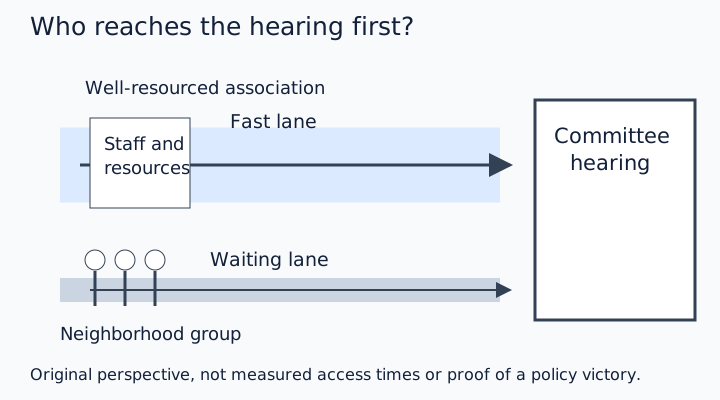
Questions 48 to 49 refer to the following.
Original cartoon about organized influence. It is a perspective on political access, not measured proof that any group wins a policy dispute.
How do the unequal lanes express the cartoon’s perspective on interest groups?
Answer: A.
- A
The fast and waiting lanes visualize unequal ease of reaching the hearing.
- B
The cartoon supplies no membership counts or proportional scale.
- C
Unequal routes emphasize differences rather than identical resources.
- D
Access can facilitate influence without guaranteeing outcomes.
- A
-
Uses the material above question 48.
How does the common hearing-door endpoint relate to policymaking?
Answer: D.
- A
Providing input differs from formal enactment.
- B
Waiting for legislative access does not confer judicial office.
- C
A hearing receives input without guaranteeing agreement.
- D
The hearing is an institutional stage at which organized actors can provide views and evidence.
- A
-
Which claim about the Electoral College is defensible?
Answer: B.
- A
National popular-vote rank does not automatically award all state electors.
- B
State-based elector allocation can yield different electoral and nationwide popular outcomes.
- C
Most states use winner-take-all allocation rather than mandatory proportional allocation.
- D
The ordinary process uses electoral votes, with a contingent House role only under specified conditions.
- A
-
Which evidence best supports the claim that incumbency can help a congressional candidate?
Answer: C.
- A
Challengers do not automatically inherit the incumbent’s office resources.
- B
Incumbents must still win election.
- C
Constituent relationships and recognition can provide electoral advantages.
- D
Congressional seats are not awarded by residence seniority.
- A
-
Which reasoning best explains why reliance on professional campaign consultants can have both benefits and costs?
Answer: D.
- A
Consultants neither eliminate costs nor guarantee results.
- B
Campaign law still applies to professionally managed campaigns.
- C
Hiring expertise does not transfer ownership or control of media.
- D
The reasoning identifies a strategic benefit and a financial or organizational tradeoff.
- A
-
Which statement accurately connects Citizens United v. FEC to the First Amendment?
Answer: A.
- A
The decision invalidated restrictions on independent corporate expenditures and upheld challenged disclosure and disclaimer provisions.
- B
Independent expenditures are different from direct candidate contributions.
- C
The Court upheld the disclosure and disclaimer provisions at issue.
- D
Independence from a campaign is a relevant distinction.
- A
-
How does horse-race election reporting differ from reporting that compares candidates’ policy proposals?
Answer: C.
- A
That reverses the distinction between standings and substantive policy detail.
- B
Polling shifts do not enact policy.
- C
Horse-race framing centers on standings and competition.
- D
A reporting frame does not compel uniform preferences.
- A
-
How does Citizens United relate to debates about changing media and political communication?
Answer: B.
- A
Private corporate speech is not automatically government speech.
- B
The case concerns protected political expression and the identity of the speaker, relevant to media channels.
- C
Protection of expression does not compel agreement.
- D
Protected speech does not confer exclusive control over debate.
- A
Section II: Free Response
-
Question 1: Concept Application 3 points
Original fictional scenario: Congress authorizes a transportation agency to establish passenger-disclosure standards within broad statutory limits. The agency adopts a detailed rule. A House committee says the agency’s interpretation exceeds the program’s intended scope and schedules a hearing. The president supports the rule.
-
A.
Describe the authority the agency uses to adopt the rule.
Score part A
Model response
The agency uses rulemaking discretion delegated by Congress to implement the statutory program.
-
B.
Explain how the scheduled hearing can check the agency.
Score part B
Model response
The committee can question officials and examine whether implementation follows statutory intent, exposing departures and creating pressure to revise the rule.
-
C.
Explain one additional formal congressional action that could affect implementation despite presidential support.
Score part C
Model response
Congress could restrict funding for the disputed implementation through appropriations, using its power of the purse to constrain the agency. A law must still satisfy the constitutional lawmaking process.
Your score: 0 of 3, from the boxes you ticked.
-
-
Question 2: Quantitative Analysis 4 points
Original fictional county study. Counties also differ in age composition, campaign mobilization, and polling-place access. There is no random assignment. Hint: turnout rate is ballots cast divided by voting-eligible adults; compare rates in percentage points.
Original fictional registration and turnout data County Voting-eligible adults Ballots cast Registration procedure Cedar 10000 6200 Automatic registration option Flint 10000 4700 Individual registration application -
A.
Identify the county with the higher turnout rate.
Score part A
Model response
Cedar has the higher rate.
-
B.
Describe the difference in turnout rates using the data.
Score part B
Model response
Cedar’s rate is 62% and Flint’s is 47%, a gap of 15 percentage points.
-
C.
Explain how a registration rule could influence participation.
Score part C
Model response
An automatic registration option can reduce the procedural steps eligible residents face, lowering a structural barrier to participation.
-
D.
Explain why these data cannot establish that the registration difference caused the entire turnout gap.
Score part D
Model response
Age composition, mobilization, and access differ too, so the comparison does not isolate registration from other turnout influences.
Your score: 0 of 4, from the boxes you ticked.
-
-
Question 3: SCOTUS Comparison 4 points
Required case: Tinker v. Des Moines Independent Community School District (1969).
Non-required case summary: In Hazelwood School District v. Kuhlmeier (1988), a principal removed pages from a school-sponsored newspaper produced as part of a journalism course that had not been opened as a public forum. The Court distinguished personal student expression from school-sponsored curricular expression. It held that educators could exercise editorial control over the latter when their actions were reasonably related to legitimate pedagogical concerns. This summary concerns school-sponsored curricular speech, not every form of student expression. Hazelwood, 484 U.S. 260, majority opinion
-
A.
Identify the constitutional protection at issue in both cases.
Score part A
Model response
Both concern freedom of speech under the First Amendment.
-
B.
Describe the relevant facts and outcome in Tinker.
Score part B
Model response
Public-school students wore black armbands to protest the Vietnam War. The Court held that the school’s prohibition violated their speech rights when the record did not show the required substantial disruption or interference with others’ rights.
-
C.
Explain why the different facts support different outcomes.
Score part C
Model response
Tinker concerned personal symbolic expression, whereas Hazelwood involved a school-sponsored curricular newspaper. The latter setting supported editorial authority tied to legitimate pedagogical concerns rather than treating the publication as the students’ wholly independent expression.
-
D.
Explain how the comparison illustrates balancing liberty and public institutional responsibilities.
Score part D
Model response
The cases protect student expression while recognizing that a school’s responsibility for curricular material can support a different kind of regulation. That responsibility is limited by the stated pedagogical connection rather than a blanket right to suppress every unpopular student opinion.
Your score: 0 of 4, from the boxes you ticked.
-
-
Question 4: Argument Essay 6 points
Develop an argument about whether dividing national government power among branches improves citizens’ opportunities to influence public policy. Use at least one of these foundational documents: the U.S. Constitution or Federalist No. 51. Support your argument with two relevant pieces of evidence, at least one from a listed document. Explain how each supports the argument. Respond to an opposing or alternate perspective through explicit rebuttal or refutation. This is original argument practice; use your own reasoning and compare with the rubric after writing.
-
A.
State a defensible thesis that establishes a line of reasoning.
Score part A
Model response
Dividing national power improves civic access because citizens can seek legislative changes, executive implementation choices, and judicial remedies through distinct institutions, even though the divisions can slow decisions.
-
B.
Provide two specific pieces of relevant evidence, including evidence from a listed foundational document.
Score part B
Model response
Article I gives Congress lawmaking and taxing authority, allowing citizens to seek statutory and funding changes. Article III establishes courts, and judicial review offers a route for constitutional challenges. Federalist No. 51 explains how institutional checks restrain concentrated power.
-
C.
Explain how the evidence supports your thesis.
Score part C
Model response
Because Congress controls legislation and appropriations, advocates can press committees even when an administration disagrees. Because courts apply constitutional limits, challengers can seek a legal remedy through a separate institution. These routes create alternative opportunities rather than requiring agreement from one dominant official.
-
D.
Explicitly rebut or refute an opposing or alternate perspective.
Score part D
Model response
An opposing view is that checks create gridlock and therefore reduce public influence. Delay is a real cost, but it does not eliminate access: an advocate blocked by executive opposition can still pursue legislation or a legal challenge where appropriate. Distinct routes can preserve opportunities even when immediate policy success is uncertain.
Your score: 0 of 6, from the boxes you ticked.
-
Your results
| Section | Score | Time used |
|---|---|---|
| Section I | ||
| Section II |
Free-response scores are the points you ticked against the scoring guide. The page never grades them.
Practice Exam 2
55 multiple-choice and 4 free-response questions, in the format of the AP U.S. Government and Politics Exam.
| Section | Questions | Time |
|---|---|---|
| Section I: Multiple Choice | 55 | 80 minutes |
| Section II: Free Response | 4 | 100 minutes |
How the exam works
- One section at a time. When a section's clock reaches zero, the section ends and is scored.
- Multiple choice is scored when its section ends, with an explanation for every choice.
- Free response is never scored by the page. When the section ends, you see the scoring guide and a model response for each part and tick the points your answer earns.
- At the end you get your score and the time you used for each section.
- In study mode each multiple-choice answer is checked as soon as you give it, with its explanation, and each free-response question has a button that opens its scoring guide.
- Switching to study mode partway keeps your answers and checks the ones you have given. Start over clears everything and lets you choose a mode again.
- Your answers are kept in this browser tab if the page reloads, and nowhere else.
Section I: Multiple Choice
-
A town charter requires regular elections and states that officeholders exercise authority delegated by residents. Which democratic ideal is most directly illustrated by the source of that authority?
Answer: B.
- A
Limited government concerns boundaries on authority, rather than its stated source.
- B
The question asks where authority comes from: the residents.
- C
Regular elections can reflect representation, but the stated source of authority specifically identifies popular sovereignty.
- D
No distribution of functions across branches is described.
- A
-
Neighborhood associations with competing interests mobilize members and bargain with one another over a transit proposal before city officials. Which model emphasizes this pattern?
Answer: D.
- A
The focus is organized group competition rather than broad individual participation as the defining feature.
- B
No single narrow dominant elite is identified.
- C
Groups seek to influence officials rather than directly decide the policy by referendum.
- D
Competition and bargaining among organized interests fit pluralism.
- A
-
Several associations organize around different priorities and negotiate about the same municipal proposal. How does their behavior provide a channel for political influence?
Answer: A.
- A
Pluralist group activity links preferences to policy through organizing and bargaining.
- B
Private advocacy does not itself confer legislative enactment power.
- C
Group bargaining does not remove electoral selection of officials.
- D
Groups can share interests and bargain despite disagreement.
- A
-
Under the Articles of Confederation, Congress requests state funds for national obligations, but several states decline. The national government lacks independent tax enforcement and a separate executive. How does this arrangement help explain the financial difficulty?
Answer: C.
- A
The source specifies no separate executive, so this explanation invents one.
- B
The source describes inability to compel revenue, not inability to allocate funds.
- C
The source identifies national dependence on states and lack of independent tax enforcement.
- D
A national request does not automatically compel state payment under this arrangement.
- A
-
A proposed constitutional amendment receives the required proposal vote in both houses of Congress. What additional action completes the ordinary state-legislature ratification route?
Answer: B.
- A
Presidential and gubernatorial approval do not replace the specified ratification bodies.
- B
This is the stated Article V state-legislature ratification threshold.
- C
Two-thirds relates to proposing an amendment through a convention request, not ratification.
- D
Article V does not substitute a national popular referendum for state ratification.
- A
-
Delegates agree that one legislative chamber will allocate seats by population and the other will give states equal representation. What problem does this arrangement address?
Answer: A.
- A
The arrangement combines population and equal-state representation.
- B
The chambers’ representation is distinct from the president’s lawmaking role.
- C
The compromise concerns Congress rather than eliminating Article V ratification.
- D
The compromise does not require direct election of every national office.
- A
-
Questions 7 to 10 refer to the following.
James Madison, Federalist No. 51 (1788), short extracts: “Ambition must be made to counteract ambition. The interest of the man must be connected with the constitutional rights of the place.” The essay also states: “A dependence on the people is, no doubt, the primary control on the government; but experience has taught mankind the necessity of auxiliary precautions.”
These are extracts from a defense of the proposed Constitution, not an original scenario. Source: Library of Congress, Federalist No. 51.
Which claim is most directly supported by the two extracts?
Answer: D.
- A
The proposed use of competing institutional ambitions opposes concentrating every power.
- B
The first extract builds on officials’ incentives rather than relying only on virtue.
- C
The second extract explicitly says auxiliary precautions are needed.
- D
The excerpt treats popular control as primary but calls institutional precautions necessary.
- A
-
Uses the material above question 7.
How does the first extract’s use of ambition relate to checks and balances?
Answer: C.
- A
Checks matter precisely when officials disagree.
- B
The safeguards depend on distinct powers rather than identical functions.
- C
The source links an official’s interests to the constitutional powers of the office.
- D
Popular control and auxiliary precautions both appear in the excerpt.
- A
-
Uses the material above question 7.
Which implication follows from calling popular control primary while still requiring auxiliary precautions?
Answer: A.
- A
The excerpt calls for auxiliary precautions even though dependence on the people is primary.
- B
The source anticipates ongoing incentives and conflicts after selection of officials.
- C
This drops the institutional safeguards the source defends.
- D
Popularity does not supply a constitutional transfer of functions.
- A
-
Uses the material above question 7.
Which institutional relationship best illustrates the argument in the source?
Answer: B.
- A
An internal schedule does not provide the constitutional counterweight described.
- B
Reciprocal constitutional powers illustrate ambition counteracting ambition.
- C
This concentrates rather than counteracts power.
- D
The source argues for institutional precautions beyond personal trust.
- A
-
Questions 11 to 13 refer to the following.
Fictional committee activity. Reports are recommendations for floor consideration, not final enactments.
Original fictional data for this practice exam. Committee Bills referred Bills reported House committee A 24 9 Senate committee B 18 6 How do the table’s measures relate to the bicameral legislative process?
Answer: D.
- A
More reports do not change the constitutional roles of both chambers.
- B
Reporting is different from passage by both chambers and presentment.
- C
A committee recommendation does not transfer chamber authority.
- D
The table measures one legislative stage, while bicameral enactment requires later action.
- A
-
Uses the material above question 11.
Which statement accurately describes the counts in the record?
Answer: A.
- A
Nine minus six is three.
- B
Twelve is Committee B’s unreported count, not its reported count.
- C
Nine and six are reported counts; referrals were twenty-four and eighteen.
- D
Six is the difference in referrals, not reports.
- A
-
Uses the material above question 11.
What fraction of the bills referred to Committee B was reported to the floor?
Answer: C.
- A
Three-fourths does not match six of eighteen.
- B
One-half of eighteen is nine, not six.
- C
Six of eighteen equals one-third.
- D
Two-thirds of eighteen is twelve, the unreported count.
- A
-
In Baker v. Carr, what issue did the Court resolve concerning challenges to legislative districting?
Answer: D.
- A
Equal land area was not Baker’s requirement.
- B
The holding did not create a guaranteed allotment for losing parties.
- C
This reverses the Court’s justiciability holding.
- D
Baker held that the described equal protection challenge was justiciable.
- A
-
Questions 15 to 17 refer to the following.
Fictional records from successive years. Confirmations are counts of nominations approved by the Senate; the data contain no individual senators’ reasons.
Original fictional data for this practice exam. Year Public appeals Related executive orders Judicial nominees confirmed A 4 6 8 B 7 6 6 C 11 5 3 Which pattern appears in the fictional records?
Answer: B.
- A
The appeal sequence increases and the order sequence does not increase.
- B
The sequences are four, seven, eleven and six, six, five.
- C
Orders remain six rather than rising by three.
- D
Appeals rise from seven to eleven while orders decline.
- A
-
Uses the material above question 15.
Which statement accurately describes the confirmation data?
Answer: C.
- A
Eight is the Year A count.
- B
Eleven is the Year C public-appeal count, not confirmations.
- C
The Year C confirmation column reports three.
- D
Six is the Year B count.
- A
-
Uses the material above question 15.
Which limitation applies to explaining the relationship between public appeals and confirmations?
Answer: A.
- A
The series show an association without measuring the causes of senators’ decisions.
- B
The source specifically lacks individual voting reasons.
- C
Temporal association does not isolate the broadcasts’ effect on votes.
- D
Counts of confirmations do not establish loss of constitutional nomination authority.
- A
-
A president uses a nationally streamed address to urge voters to contact legislators about a proposal stalled in committee. How does this communication seek to advance the agenda?
Answer: D.
- A
An address does not enact a statute.
- B
Public support does not transfer Congress’s constitutional legislative authority.
- C
The appeal can pressure committees but does not automatically bypass their procedures.
- D
The president seeks agenda influence through public attention and pressure.
- A
-
Marbury v. Madison treats the Constitution as superior law when a statute conflicts with it. How does that reasoning relate to the judicial role?
Answer: C.
- A
This replaces rather than describes the Court’s judicial review role.
- B
Marbury supports declining to apply unconstitutional law.
- C
Marbury connects judicial review to the Constitution’s superior legal status.
- D
An ordinary statute cannot remove a constitutional limitation merely by disagreement.
- A
-
An appeals court follows an earlier decision when deciding a new dispute with materially similar facts. Which principle does this conduct illustrate?
Answer: B.
- A
Judicial review evaluates constitutionality; the specific behavior described is following precedent.
- B
Following an applicable precedent illustrates stare decisis.
- C
Original jurisdiction concerns where a case begins, not how precedent guides a later decision.
- D
The conduct emphasizes adherence to precedent rather than departure from it.
- A
-
Supplied unfamiliar-case summary: Hazelwood v. Kuhlmeier upheld editorial control reasonably related to legitimate pedagogical concerns over a supervised curricular newspaper that was not a public forum. Which comparison with Tinker accurately distinguishes the Court’s reasoning in the two cases?
Answer: A.
- A
Tinker concerned personal armbands; Hazelwood distinguished supervised curricular expression and pedagogical control.
- B
This reverses the relevant sponsorship difference.
- C
Neither case establishes unlimited authority based simply on viewpoint dislike.
- D
This substitutes curricular sponsorship for the personal expression in Tinker.
- A
-
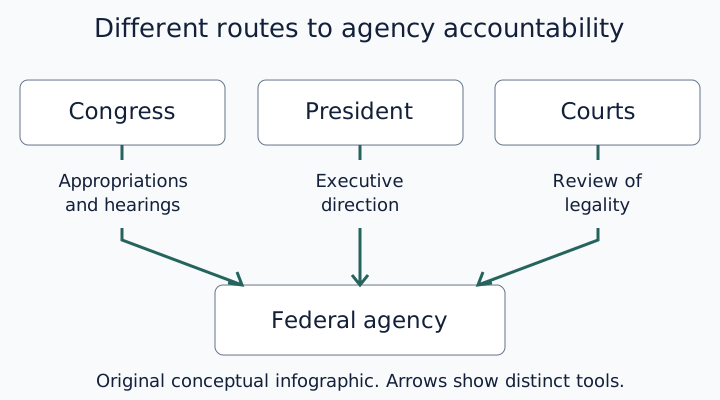
Questions 22 to 23 refer to the following.
Original teaching infographic about the federal bureaucracy. Arrow labels identify methods of influence, not a chronological order or equal quantities of influence.
 Tap to open the picture full size
Original conceptual infographic. Arrow labels, rather than line thickness, identify distinct institutional powers. How do the labeled arrows illustrate the distribution of power over the agency?
Answer: C.
- A
Equal graphic thickness is not a quantitative or legal equality claim.
- B
The source explicitly does not portray a chronological sequence.
- C
Appropriations, executive direction, and legal review are distinct methods of influence.
- D
The arrows run from branches to the agency and do not convey appointment authority.
- A
-
Uses the material above question 22.
Which interpretation of a specific visual element accurately links design to an institutional power?
Answer: B.
- A
Reviewing legality differs from enacting appropriations.
- B
The visual connects Congress’s funding authority with its capacity to constrain implementation.
- C
Multiple access points do not require every citizen to use every venue.
- D
Executive direction remains subject to statutory and constitutional limits.
- A
-
Agency A hires technical employees through competitive qualifications. Agency B rewards campaign allies with positions regardless of technical qualifications. Which comparison accurately describes the selection methods?
Answer: D.
- A
This reverses the meanings of merit and patronage.
- B
Campaign-service reward is not selection solely by professional qualifications.
- C
Civil-service employment does not require elected legislative office.
- D
The comparison distinguishes competence criteria from political reward.
- A
-
Congress authorizes a transportation agency to set detailed safety standards within statutory goals. The agency selects the specific inspection requirements. What does the action illustrate?
Answer: A.
- A
The agency chooses implementation details under authority Congress supplied.
- B
The agency’s authority is delegated, rather than freestanding constitutional legislative power.
- C
An implementation rule is not necessarily a change to the statutory delegation.
- D
Selecting standards within the statute’s goals does not veto those goals.
- A
-
A House committee demands agency records and questions officials about whether program funds were spent as Congress intended. Which explanation best connects these actions to accountability?
Answer: B.
- A
Congressional oversight is not a court’s final judgment in a lawsuit.
- B
Hearings and investigations are legislative oversight of implementation.
- C
An information request does not surrender appropriations power.
- D
Monitoring differs from taking over every operational task.
- A
-
Congress funds an enforcement program, the president directs its administration, and a court reviews a challenge to an agency action. Which conclusion follows?
Answer: C.
- A
Reviewing legality is different from administering every program function.
- B
Appropriations do not give Congress control of judicial decisions in individual cases.
- C
The scenario shows distinct constitutional roles affecting the same program.
- D
Implementation does not end Congress’s funding authority.
- A
-
Federal officials prohibit a peaceful group from petitioning an agency because they dislike its criticism. Which constitutional issue is most directly raised?
Answer: D.
- A
The action targets a liberty rather than identifying an undelegated governmental power.
- B
The scenario concerns petitioning rather than counsel in a criminal prosecution.
- C
No government search or warrant is described.
- D
The action suppresses a group’s petition and criticism.
- A
-
Questions 29 to 31 refer to the following.
Justice Hugo Black’s majority opinion in Engel v. Vitale (1962), short extracts: “the State of New York has adopted a practice wholly inconsistent with the Establishment Clause.” The Court explains that neither the prayer’s “denominationally neutral” wording nor the fact that student observance was “voluntary” frees the official program from the Establishment Clause’s limits.
Context: state officials composed the prayer, and a public school directed its recitation at the beginning of the day; objectors could abstain. Quoted phrases and original contextual summary are from the majority, not a dissent. Source: 370 U.S. 421, 424 and 430-431.
Which description best identifies the reasoning expressed in the majority excerpt?
Answer: B.
- A
An individual’s nonparticipation does not end the government program.
- B
The opinion rejects neutrality and voluntariness as cures for official sponsorship.
- C
An opt-out does not remove the state’s composition and school’s sponsorship.
- D
The quoted reasoning rejects denominational neutrality as a complete defense.
- A
-
Uses the material above question 29.
How does the source relate to the constitutional distinction between official sponsorship and individual exercise?
Answer: A.
- A
The actor and activity in the source connect the claim to the Establishment Clause.
- B
The source addresses an official program rather than all individual belief.
- C
That describes Yoder’s distinct religious-exercise issue.
- D
The opinion expressly rejects voluntariness as removing the constitutional question.
- A
-
Uses the material above question 29.
Which implication of the quoted reasoning applies to a district defending its state-composed prayer solely by allowing students not to participate?
Answer: C.
- A
Popularity does not change the identity of the government sponsor.
- B
A purpose claim does not eliminate the Establishment Clause constraint.
- C
The majority’s reasoning directly addresses this proposed defense.
- D
The source says neutral wording does not cure the official program.
- A
-
Which description accurately states the procedural protection recognized in Gideon v. Wainwright?
Answer: A.
- A
Gideon recognizes the applicable counsel guarantee regardless of inability to pay.
- B
Instructions do not substitute for the assistance of counsel recognized by Gideon.
- C
A constitutional right does not depend on prosecutorial permission.
- D
Court-clerk advice is not appointed defense counsel.
- A
-
What principle is illustrated by a court recognizing a protected liberty that the constitutional text does not expressly name?
Answer: D.
- A
General constitutional language can constrain government through interpretation.
- B
Judicial interpretation and Article V amendment ratification are distinct processes.
- C
The scenario illustrates the opposite of this listed-rights-only claim.
- D
Constitutional interpretation has recognized liberties not explicitly named in the text.
- A
-
How does Brown v. Board of Education relate to the Fourteenth Amendment?
Answer: B.
- A
Legislative approval did not cure the equal protection violation.
- B
Brown treats segregated public schooling as a denial of equal protection.
- C
The holding concerns racial segregation rather than identical curricula.
- D
Equal protection review does not abolish every local educational function.
- A
-
Supplied unfamiliar-case summary: Cooper v. Aaron (1958) rejected an effort to delay public-school desegregation amid public hostility and reaffirmed the constitutional obligation of state officials to comply. Which comparison with Brown v. Board of Education is best supported?
Answer: C.
- A
Brown rejects material comparability as a sufficient cure.
- B
The holdings do not require that sweeping financial condition.
- C
Brown rejects racial segregation in public schools; Cooper enforces the constitutional duty to comply despite state resistance.
- D
Local authority remains constitutionally constrained.
- A
-
A mayor is required to comply with the same lawful disclosure rules as other residents holding comparable obligations. Which core political value does this most directly illustrate?
Answer: D.
- A
Opportunity concerns a chance to compete rather than the stated accountability requirement.
- B
Individualism emphasizes personal choices and responsibility, not the specific legal equality described.
- C
Market competition is not the official’s disclosure obligation.
- D
The scenario emphasizes officials’ accountability to the same law.
- A
-
Questions 37 to 39 refer to the following.
Fictional retrospective survey of 400 adults. Each selected the influence they considered most important in forming early political beliefs. These are reported influences, not experimentally established causes.
Original fictional data for this exam. Influence Respondents Family 160 School 100 Peers 80 Media 60 Which statement accurately describes the survey responses?
Answer: A.
- A
Family’s count of 160 is larger than any other individual category.
- B
Media’s count is sixty rather than one hundred.
- C
Family’s forty percent is a plurality, not a majority.
- D
School plus peers is 180, greater than 160.
- A
-
Uses the material above question 37.
What does the distribution illustrate about the process of political socialization?
Answer: B.
- A
A leading reported category does not establish deterministic effects for each person.
- B
Family, school, peers, and media are agents through which political beliefs can develop.
- C
The question concerns early belief formation rather than an adult-only start.
- D
The survey asks about perceived influences, not party votes.
- A
-
Uses the material above question 37.
Which limitation applies to a claim that the table proves how strongly each influence caused political beliefs?
Answer: D.
- A
A larger family count does not rule out school influence.
- B
A forced choice about greatest importance does not exclude other influences.
- C
An aggregate sample does not establish exact local proportions everywhere.
- D
The responses describe recalled importance rather than experimentally identified causes.
- A
-
Questions 40 to 41 refer to the following.
Fictional statewide polls on the same proposal during the same week. The probability-sample poll reports a sampling margin; the voluntary poll does not claim a probability sample.
Original fictional data for this practice exam. Method Respondents Support estimate Reported sampling margin Probability sample 1,000 51% ±4 percentage points Voluntary website response 10,000 68% Not reported What range results from applying the reported margin to the probability-sample support estimate?
Answer: C.
- A
This uses two points rather than the reported four.
- B
This omits the lower half of the uncertainty range.
- C
Subtracting and adding four percentage points gives forty-seven to fifty-five.
- D
This shifts the estimate upward rather than centering the margin on fifty-one.
- A
-
Uses the material above question 40.
Which limitation is most relevant to treating the larger website poll as necessarily the better statewide estimate?
Answer: A.
- A
Selection method matters; sample size alone does not correct voluntary response.
- B
This confuses size with representativeness.
- C
Sampling uncertainty does not measure deliberate falsehood.
- D
Different estimates and methods do not establish identical reliability.
- A
-
A party platform favors greater national regulation of business practices to address market problems. Which ideological alignment is most consistent with the course’s general party comparison?
Answer: D.
- A
Reliance solely on private competition does not fit the proposed national regulation.
- B
This identifies the contrasting general orientation.
- C
The described greater regulation exceeds the stated libertarian preference.
- D
The course’s general comparison associates greater business regulation with liberal Democratic positions.
- A
-
A voter evaluates whether to reelect an incumbent by assessing the administration’s performance during the previous term. Which voting model best fits?
Answer: B.
- A
The choice is based on an evaluation rather than random selection.
- B
The voter uses past performance as the basis of the choice.
- C
The scenario does not state that the voter chooses every candidate of one party.
- D
Prospective voting emphasizes predictions of future performance.
- A
-
Questions 44 to 45 refer to the following.
Fictional turnout as a share of eligible voters. The figures describe different electorates and do not measure individual motives.
Original fictional data for this exam. Jurisdiction Presidential election Midterm election R 68% 47% S 63% 44% Which conclusion is supported by the turnout figures?
Answer: A.
- A
Both within-jurisdiction comparisons show higher presidential turnout.
- B
Aggregate figures do not track the same individuals or explain each difference.
- C
The gaps are twenty-one points in R and nineteen in S.
- D
Percentages without electorate sizes do not establish actual voter totals.
- A
-
Uses the material above question 44.
Which limitation applies to comparing the jurisdictions’ numbers of voters using only these percentages?
Answer: C.
- A
Aggregate rates do not identify individual participation histories.
- B
Turnout rates do not directly measure beliefs about political influence.
- C
Percentages alone do not provide the denominators needed to compare numbers of voters.
- D
A smaller electorate can have a higher percentage but fewer actual voters.
- A
-
A political party trains potential candidates, develops a platform, and organizes voter outreach. How do these activities connect citizens and government?
Answer: B.
- A
The stated party activities do not confer universal nomination power on congressional committees.
- B
Parties recruit, mobilize, and communicate preferences across electoral and governing institutions.
- C
Platforms do not legally require voters to accept every policy.
- D
Mobilization supports rather than replaces the election.
- A
-
A party supplies voter databases and targeted outreach to candidates whose campaigns emphasize their individual identities. How does this behavior illustrate party adaptation?
Answer: D.
- A
The source describes coordination rather than required abandonment.
- B
The source describes using tools to retain influence, not replacing every message with a platform.
- C
The source expressly identifies continued use of voter databases.
- D
The statement describes party support adapted to candidate-centered campaigns.
- A
-
Questions 48 to 49 refer to the following.
Original fictional data: Group A had 20 meetings with policymakers; Group B had 40. The designer claims square area is proportional to meetings. Side lengths are shown in arbitrary diagram units. Evaluate the encoding, not the accuracy of real-world lobbying records.
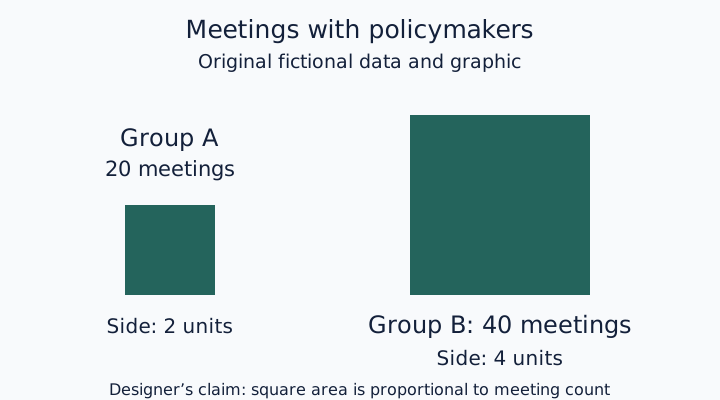 Tap to open the picture full size
Original fictional graphic. The designer’s encoding claim is part of the source to evaluate. How does the square-area encoding affect the source’s portrayal of relative access to policymakers?
Answer: C.
- A
Twenty is the difference in counts, not their ratio. Forty divided by twenty is two.
- B
The shared color does not erase the distinct areas and labeled counts; size is the claimed quantitative encoding.
- C
Side length doubles, so area quadruples while the meeting ratio is only two to one; the graphic exaggerates the depicted access gap.
- D
The designer claims an area encoding. Doubling side length creates four times the area, not twice the area.
- A
-
Uses the material above question 48.
What political relationship is represented by the meeting-labeled squares, and which inference would exceed that representation?
Answer: A.
- A
The symbols and labels represent meetings with officials. No legislative stage or enacted-policy result is represented.
- B
Square area depicts the designer’s attempted meeting-count comparison, not constitutional lawmaking authority or enactments.
- C
Meeting labels and square sizes do not represent the content of either group’s preferences.
- D
The positive meeting count shows some access; neither legal exclusion nor every policy stage is portrayed.
- A
-
A candidate narrowly wins several states that allocate all electors to the statewide winner but loses the nationwide popular vote. Which claim is most defensible?
Answer: D.
- A
The allocation described does not change with the statewide margin.
- B
A national popular-vote lead does not automatically invalidate state allocations.
- C
Under the stated rule the statewide winner receives the state’s electors.
- D
State-based allocation can yield a different winner from the national aggregate.
- A
-
Questions 51 to 52 refer to the following.
Original conceptual infographic: two candidates begin an election campaign with different resources. The incumbent has existing name recognition and a constituent-service record. The challenger must build recognition. The graphic makes no prediction about the winner.
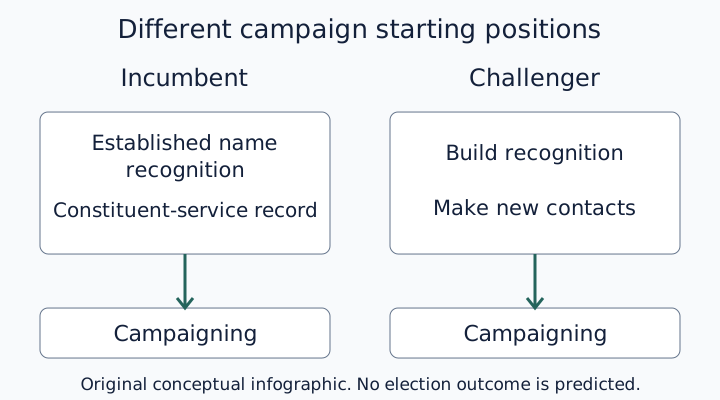 Tap to open the picture full size
Original conceptual infographic. Boxes represent types of campaign resources, not measured amounts or a predicted election outcome. How does the incumbent’s starting position in the source illustrate incumbency advantage?
Answer: C.
- A
Building contacts describes outreach, not a prohibition.
- B
The depicted resources are advantages rather than an exemption from elections.
- C
The image identifies advantages that can come from current officeholding.
- D
No amounts of money are encoded by the arrows.
- A
-
Uses the material above question 51.
What is the political significance of both candidates’ arrows ending at the same “Campaigning” stage?
Answer: B.
- A
The upper boxes distinguish existing recognition and service records from the challenger’s work to build contacts.
- B
Each arrow leads to campaigning, linking different officeholding resources to continued electoral competition.
- C
Both paths lead to campaigning, not a legal exemption for the incumbent.
- D
The arrows show a process connection; no vote margin or isolated causal quantity is encoded.
- A
-
How does Citizens United v. Federal Election Commission relate to the First Amendment?
Answer: A.
- A
Citizens United concerns independent expenditures as protected expression.
- B
The decision did not establish that speech protection eliminates all disclosure requirements.
- C
This reverses the required case’s central speech holding.
- D
Independent expenditures and direct contributions are distinct legal categories.
- A
-
A news program devotes most election coverage to which candidate leads in polls and gives little attention to policy proposals. How can this choice affect the information citizens routinely encounter?
Answer: C.
- A
Standings do not necessarily supply substantive platform information.
- B
A media frame can influence attention without forbidding other sources.
- C
Agenda setting can shape what audiences treat as important and emphasize popularity over substance.
- D
Coverage does not transfer formal certification authority.
- A
-
Citizens United recognizes independent political spending as protected expression. Audiences increasingly choose media that reinforce existing views. Which connection between the case’s principle and democratic participation is most defensible?
Answer: D.
- A
Media selection does not transfer formal election certification authority.
- B
Speech protection is not a guarantee of accuracy.
- C
Protected expression does not impose uniform editorial viewpoints.
- D
The principle permits expression without guaranteeing audience diversity or factual reliability.
- A
Section II: Free Response
-
Question 1: Concept Application 3 points
Original scenario: Congress authorizes a federal transit agency to create detailed safety standards within the goals of a new statute. The agency proposes an inspection schedule. A riders’ association submits comments favoring more inspections, while operators ask a House committee to investigate the agency’s costs. The committee schedules a hearing and considers recommending restrictions on program funds.
-
A.
Describe the agency power illustrated by creating the inspection schedule.
Score part A
Model response
The agency exercises delegated rulemaking discretion by selecting inspection requirements within the law’s goals.
-
B.
Explain how one action available to the House committee could hold the agency accountable.
Score part B
Model response
A hearing can require officials to explain the schedule and spending, allowing Congress to assess compliance with the statute. The committee can also recommend funding restrictions; those restrictions constrain implementation if enacted through the lawmaking process, rather than by committee preference alone.
-
C.
Explain how the scenario illustrates multiple access points for influencing national policy.
Score part C
Model response
The riders contact the agency during rulemaking, while operators seek congressional oversight and funding action. Divided responsibilities give the groups different institutional routes to influence the same policy.
Your score: 0 of 3, from the boxes you ticked.
-
-
Question 2: Quantitative Analysis 4 points
Original fictional data: turnout as a percentage of eligible voters in two jurisdictions. These are aggregate observations, not results of an experiment. Jurisdiction names are fictional; the figures do not identify individuals or measure voters’ motives.
Original fictional turnout data; percentages of eligible voters. Jurisdiction Presidential election Midterm election Harbor 72% 49% Ridge 64% 46% -
A.
Identify which jurisdiction had the higher midterm turnout.
Score part A
Model response
Harbor had the higher midterm turnout at 49%.
-
B.
Describe the difference, in percentage points, between presidential and midterm turnout in Harbor.
Score part B
Model response
Presidential turnout exceeded midterm turnout in Harbor by 23 percentage points.
-
C.
Explain how election type could contribute to the pattern shared by both jurisdictions.
Score part C
Model response
Presidential contests often attract greater attention and mobilization, which can encourage participation by people less engaged in midterm elections. That mechanism is consistent with higher presidential turnout in both jurisdictions, although these data do not prove its cause.
-
D.
Explain one limitation of using these aggregate figures to conclude that changes in political efficacy caused the turnout differences.
Score part D
Model response
The figures contain no individual measures of political efficacy and do not isolate it from other influences. Higher turnout therefore cannot by itself establish that a change in efficacy caused the differences.
Your score: 0 of 4, from the boxes you ticked.
-
-
Question 3: SCOTUS Comparison 4 points
Unfamiliar case summary: In Hazelwood School District v. Kuhlmeier (1988), students produced a newspaper as part of a supervised public-school journalism course for academic credit. The principal removed pages containing articles about student pregnancy and divorce, citing concerns including privacy and the appropriateness of the material. The Supreme Court held that the newspaper had not been opened as a public forum and that educators could exercise editorial control over school-sponsored student expression when reasonably related to legitimate pedagogical concerns. The majority distinguished that curricular sponsorship from students’ personal expression in Tinker v. Des Moines.
This is an original paraphrase of the majority opinion, not a quotation. Source: Hazelwood, 484 U.S. 260, 268-273.
-
A.
Identify the constitutional provision common to Hazelwood and Tinker.
Score part A
Model response
Both concern freedom of speech or expression under the First Amendment.
-
B.
Describe a relevant fact in Tinker that supported the Court’s holding.
Score part B
Model response
The students wore black antiwar armbands, and the record did not support a finding of substantial interference with school or invasion of others’ rights.
-
C.
Explain how a difference in the facts helps explain the different reasoning in Hazelwood and Tinker.
Score part C
Model response
Hazelwood involved a faculty-supervised curricular publication bearing the school’s apparent approval, allowing editorial control reasonably tied to educational concerns. Tinker involved students’ own political armbands rather than a school-sponsored publication, so the unsupported fear of disruption did not justify the ban.
-
D.
Explain one way Tinker illustrates a constitutional limit on public-school officials.
Score part D
Model response
Public-school officials act for government and remain subject to the First Amendment. Tinker prevents them from suppressing personal political expression merely because they dislike it or fear disagreement without a supported constitutional justification.
Your score: 0 of 4, from the boxes you ticked.
-
-
Question 4: Argument Essay 6 points
Develop an argument about whether dividing national power among branches is more effective at protecting liberty than concentrating policymaking authority in one branch.
Use at least two specific pieces of relevant evidence, including at least one from the following foundational documents:
- The U.S. Constitution
- Federalist No. 51
- Federalist No. 70
State a defensible thesis. Use the evidence to support the thesis and explain the reasoning connecting it to your argument. Respond to an opposing or alternative perspective with rebuttal or refutation. Either position can earn credit when supported by accurate evidence and reasoning. This is original practice with a self-check rubric.
-
A.
Write your argument.
Score part A
Model response
Dividing national power among branches better protects liberty because officials must confront independent institutions capable of resisting abuses, even though coordination can slow decisions. Federalist No. 51 argues that officials’ ambitions should counteract one another. Giving institutions their own powers and incentives makes protection less dependent on the personal virtue of a single leader. The Constitution supplies a concrete example through the presidential veto and Congress’s power to override it with the required supermajorities. These reciprocal checks mean that one branch cannot assume its policy preference automatically becomes law. An alternative argument emphasizes Federalist No. 70’s defense of an energetic, unified executive, which can act decisively and be held responsible. That is a serious advantage for administration, but it supports unity within the executive rather than eliminating the legislature and courts. Energy can coexist with checks; placing every policymaking power in one branch would remove independent mechanisms that constrain misuse.
Your score: 0 of 6, from the boxes you ticked.
Your results
| Section | Score | Time used |
|---|---|---|
| Section I | ||
| Section II |
Free-response scores are the points you ticked against the scoring guide. The page never grades them.