Unit 1 · Topic 1.3 · about 30 minutes · 7 parts · 11 scored checks, 2 of them multiple choice, plus 2 from earlier lessons
AP Biology 1.3: Introduction to Macromolecules
Unit 1: 8 to 11% of the multiple-choice section
What you'll be able to do
- Describe how dehydration synthesis joins monomers into polymers and how hydrolysis breaks polymers into smaller molecules, including what happens to water in each.
Key vocabulary
| Term | What it means | The exam trap |
|---|---|---|
| Monomer | A small molecule that can be joined to others like it to build a larger molecule. | A question may count monomers, bonds or water molecules, so read which one it asks for before you calculate. |
| Polymer | A large molecule made of many monomers joined by covalent bonds. | A polymer can be broken partway into shorter chains, so read whether a question means complete or partial breakdown. |
| Dehydration synthesis | A reaction that joins two molecules with a covalent bond, removing an H from one and an OH from the other. | Questions often ask what happens to water, so track whether it is a product or a reactant before you choose. |
| Hydrolysis | A reaction that breaks a covalent bond between monomers by adding water across it. | The name tells you water is involved, but questions test which side of the reaction it is on, so read the arrow. |
| Hydroxyl group | An oxygen atom bonded to a hydrogen atom, written OH, attached to a larger molecule. | Models label the H and the OH on different monomers, so check which monomer each piece comes from or goes to. |
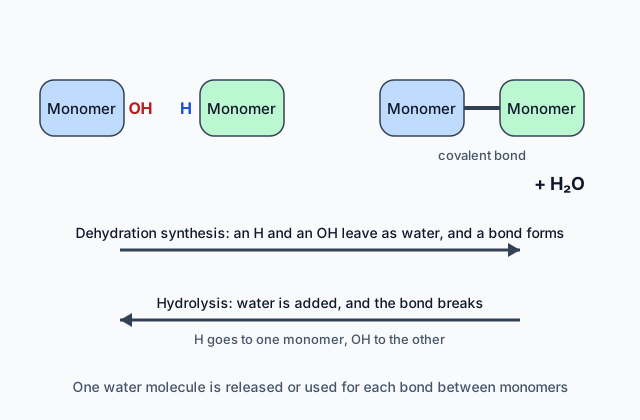 Tap to open the picture full size
Part 1 Think first A cracker that turns sweet
Commit to a guess first. Being wrong now makes the right idea stick better.
Predict first
A plain cracker is made mostly of starch and has almost no sugar in it. If you chew a piece for a minute or two without swallowing, it starts to taste sweet. Why?
In short. Cells build large molecules by joining small units with covalent bonds, releasing a water molecule for each bond, and break them apart by adding water back across those bonds.
- Dehydration synthesis removes a hydrogen from one monomer and a hydroxyl group from the other, losing the equivalent of one water molecule.
- Joining many monomers this way is polymerization, and it builds polymers.
- Hydrolysis adds water to the bond between monomers: the hydrogen goes to one monomer and the hydroxyl group to the other.
Part 2 Learn it Building and breaking large molecules
2a. Monomers and polymers
Many of the large molecules in a cell are built the way a train is built from cars. A small building block is a monomer. A long molecule made of many monomers joined in a chain is a polymer.
The monomers are held together by covalent bonds, in which neighboring atoms share electrons. Joining many monomers into a chain is called polymerization.
The same idea runs through the next four topics. Starch is a polymer of sugar monomers. A protein is a polymer of amino acids. DNA is a polymer of nucleotides. Because the parts repeat, a cell can build a huge variety of polymers from a short list of monomers, and it can take them apart again to reuse the pieces.
Two reactions do the work: one joins monomers, and one separates them.
Quick check · Match
Match each term to its description.
2b. Dehydration synthesis: joining, and losing water
To join two monomers, a cell runs a reaction called dehydration synthesis. "Dehydration" means losing water, and "synthesis" means building.
Here is what happens to the atoms. A hydrogen (H) is removed from one monomer. A hydroxyl group (OH, an oxygen bonded to a hydrogen) is removed from the other monomer. That H and that OH together make the equivalent of one water molecule, H₂O, which leaves. The two monomers, each now missing a piece, join through a new covalent bond.
So every bond made this way releases one water molecule. Joining three monomers into a chain takes two bonds and releases two water molecules; a chain of 100 monomers has 99 bonds and released 99 water molecules as it was built. Repeating the reaction monomer after monomer is polymerization.
Quick check · Fill the statement
Complete the description of a model showing two monomers joining.
A hydrogen is removed from one monomer and a group is removed from the other. Together they leave as one molecule of , and the two monomers are joined by a bond.
2c. Hydrolysis: adding water to break a bond
The reverse reaction is hydrolysis, from words meaning "water" and "splitting". It cleaves the covalent bond between two monomers and breaks a large molecule into smaller ones.
Water is used up, not released. A water molecule is added across the bond between two monomers. The water splits: its hydrogen ion is added to one monomer, and its hydroxyl group is added to the other. Each monomer gets back the piece it lost when the bond was made, and the bond is broken.
Hydrolysis is how you digest food. The starch in a cracker is hydrolyzed into sugars, and proteins in a meal are hydrolyzed into amino acids, which your cells can then use to build their own polymers by dehydration synthesis.
A quick way to keep the two straight: building releases water; breaking uses water.
Quick check · Sort it
Each card describes part of a reaction. Tap a card, then the reaction it belongs to.
Dehydration synthesis
Hydrolysis
Part 3 Watch it done Counting the water
Predict first, then watch each step, then finish the reasoning yourself.
A cell joins 6 monomers into one unbranched chain by dehydration synthesis. How many water molecules are released?
Predict first
Before you open the first step, predict: how many water molecules are released?
Step 1 · Count the bonds
In a chain, each monomer is bonded to the next. With 6 monomers in a row there are 5 joins between them: 1 to 2, 2 to 3, 3 to 4, 4 to 5 and 5 to 6. That is 6 − 1 = 5 covalent bonds.
Step 2 · Match each bond to its water
Each bond made by dehydration synthesis releases one water molecule. So 5 bonds release 5 water molecules.
Why this step?
Why one water molecule per bond, and not one per monomer?
Each bond takes an H from one monomer and an OH from the next, and those two pieces make exactly one water molecule. The two end monomers each keep one free end, so there is one fewer bond than there are monomers.
Step 3 · Check it
The general rule for an unbranched chain of n monomers is n − 1 bonds and n − 1 water molecules. For 6 monomers that gives 5, which matches the count.
Your step · Calculate
Now run it the other way. A cell completely breaks an unbranched chain of 10 monomers into single monomers by hydrolysis. How many water molecules does it use?
The count is the same in both directions. The 9 water molecules released when the chain was built are exactly the 9 used to break it back down, one for each bond.
Part 4 Try it Following the water
Two new situations. First, a student puts an unbranched chain of 50 monomers in a tube with an enzyme that hydrolyzes some of its bonds. When the reaction stops, the tube holds 10 shorter chains, each 5 monomers long, and no single monomers.
Try it · Calculate
How many water molecules did the hydrolysis use?
Second, another student hydrolyzes a polymer in water whose oxygen atoms have been tagged so they can be traced. Before the reaction, the polymer holds no tagged oxygen.
Try it · Decide and justify
After hydrolysis, will some of the tagged oxygen be found in the monomers that were released?
Which reason supports your decision?
Part 5 Explain it Read a model of a reaction
On the exam this is handwritten, so answer on paper first. Nothing you type here leaves this page. Then check your answer against the model and each scoring point.
Free response is 50% of the exam score. This one is shaped like Question 5, Analyze Model or Visual Representation of a Biological Concept or Process.
Free-response practice · Question 5 style
A model shows two monomers. The first has an OH group drawn on its right end; the second has an H drawn on its left end. An arrow points to a single molecule in which the two monomers are joined, with a separate H₂O beside it.
(a) Identify the reaction the model shows.
(b) Describe where the atoms of the H₂O in the model come from.
(c) Describe how the reverse reaction would change the molecule, including what happens to water.
(d) Predict how many water molecules are released when 4 monomers are joined into one unbranched chain by the reaction shown, and justify your prediction.
Model answer
(a) Dehydration synthesis.
(b) The hydroxyl group (OH) comes from one monomer and the hydrogen (H) comes from the other; together they make one water molecule.
(c) In hydrolysis, a water molecule is added across the covalent bond between the monomers. Its hydrogen goes to one monomer and its hydroxyl group to the other, the bond breaks, and the two separate monomers are restored.
(d) 3 water molecules. A chain of 4 monomers has 3 bonds between them, and each bond formed by dehydration synthesis releases one water molecule.
Score your own answer. This is a self-check, not a grade. Tick each point your answer makes.
Part 6 Check yourself Two tubes of monomers and chains
All three case questions use the table.
A student runs a reaction in each of two tubes and records what each tube holds before and after, and how the number of water molecules changed. Every chain is unbranched. These numbers are a teaching example.
| Tube | At the start | At the end | Change in water molecules |
|---|---|---|---|
| 1 | 600 single monomers | 30 chains, each 20 monomers long | not measured |
| 2 | 40 chains, each 15 monomers long | 600 single monomers | 560 fewer |
Case question 1 · Multiple choice
Using the table: which reaction took place in tube 2?
Case question 2 · Calculate
Using the table: by how many water molecules did tube 1 change? Give the number of water molecules released.
Case question 3 · Multiple choice
Using the table: tube 2 ended with 600 monomers but lost only 560 water molecules. Which explanation best accounts for the difference?
The rest stand on their own and do not use the case.
Check yourself · Put it in order
Put the events of building a chain by dehydration synthesis in order.
Check yourself · Spot the error
A student describes a model of hydrolysis. Tap the line with the mistake.
Part 7 Keep it Bring back earlier ideas
Polymers are built from the elements of the last topic, in a cell that is mostly water. Pulling both back up is what makes them last.
From 1.2 Elements of Life · Fill the statement
Complete the description of the elements in biological molecules.
The three most common elements in carbohydrates, proteins, lipids and nucleic acids are carbon, hydrogen and . Phosphorus is used to build phospholipids and . A sugar such as glucose is built from carbon, hydrogen and oxygen .
From 1.1 Structure of Water and Hydrogen Bonding · Match
Match each property of water to the observation it best explains.
In three lines
- Polymers are chains of monomers joined by covalent bonds, and building them is polymerization.
- Dehydration synthesis removes an H from one monomer and an OH from the other, releasing one water molecule per bond.
- Hydrolysis adds water across a bond: the hydrogen goes to one monomer, the hydroxyl group to the other, and the bond breaks.
Exam strategy for this topic
- Section I, Multiple Choice: 60 questions in 90 minutes.
- Section II, Free Response: 6 questions in 90 minutes.
- This lesson's Explain it is shaped like free-response question 5, Analyze Model or Visual Representation of a Biological Concept or Process.
- A four-function, scientific, or graphing calculator is allowed on both sections of the exam.
When a question shows monomers joining or splitting, say which reaction it is, then say what happens to water: released when a bond forms, used when a bond breaks, with one water per bond.
Questions students ask
What is the difference between dehydration synthesis and hydrolysis?
Dehydration synthesis joins monomers with a covalent bond and releases a water molecule. Hydrolysis breaks that bond by adding a water molecule. They are the reverse of each other.
Where does the water come from in dehydration synthesis?
A hydrogen is removed from one monomer and a hydroxyl group (OH) from the other. Together they make one water molecule.
What happens to the water in hydrolysis?
It is split across the bond being broken: its hydrogen ion is added to one monomer and its hydroxyl group to the other.
How many water molecules are released when a chain is built?
One for each bond. An unbranched chain of n monomers has n − 1 bonds, so building it releases n − 1 water molecules.
What is polymerization?
The joining of many monomers into a polymer, one dehydration synthesis reaction at a time.
Course alignment, for teachers
AP Biology topic 1.3, Unit 1: Chemistry of Life.
- Skill 2.A: Describe characteristics of visual representations of biological concepts and processes.
This lesson maps all 2 essential knowledge statements of the topic to the part that teaches each one: 2 are checked by a scored question. The map is in the lesson file.