Unit 1 · Topic 1.4 · about 30 minutes · 7 parts · 11 scored checks, 2 of them multiple choice, plus 2 from earlier lessons
AP Biology 1.4: Carbohydrates
Unit 1: 8 to 11% of the multiple-choice section
What you'll be able to do
- Describe the structure of carbohydrates, from simple sugar monomers to linear and branched polysaccharides, and how that structure relates to their function.
Key vocabulary
| Term | What it means | The exam trap |
|---|---|---|
| Carbohydrate | A sugar, or a larger molecule built from sugars, made of carbon, hydrogen and oxygen. | Carbohydrates include sugars, starch and much more, so do not assume every carbohydrate in a question tastes sweet. |
| Monosaccharide | A simple sugar, the monomer of carbohydrates. | A single sugar has no bonds to other sugars, so watch for questions that count bonds or water for one. |
| Polysaccharide | A complex carbohydrate: a polymer of many monosaccharides joined by covalent bonds. | Two polysaccharides with the same number of sugars can still differ in shape, so do not assume they behave alike. |
| Branched | Describes a polymer with side chains that start partway along its main chain. | Branched and linear polysaccharides can hold the same sugars, so read what a question counts before you compare them. |
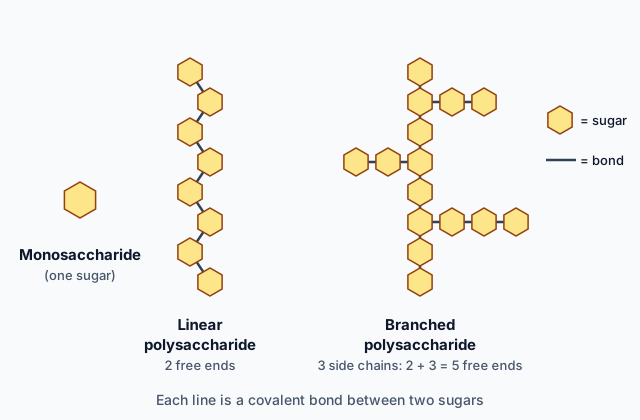 Tap to open the picture full size
Part 1 Think first Pasta or a sports drink?
Commit to a guess first. Being wrong now makes the right idea stick better.
Predict first
Two runners each take in the same total amount of sugar units before a race. One eats a bowl of plain pasta, which is mostly starch. The other drinks a sports drink sweetened with glucose, a simple sugar. Whose blood sugar rises sooner?
In short. Carbohydrates are sugars and the larger molecules built from them: simple sugars are the monomers, and covalent bonds join them into complex carbohydrates that can be linear or branched.
- Monosaccharides, or simple sugars, are the monomers of carbohydrates.
- Polysaccharides, or complex carbohydrates, are polymers of monosaccharides joined by covalent bonds.
- A polysaccharide may be a single linear chain or a branched one, and branching adds free ends.
Part 2 Learn it Sugars and the chains built from them
2a. Simple sugars are the monomers
A carbohydrate is a sugar or a larger molecule built from sugars, made of carbon, hydrogen and oxygen.
The smallest carbohydrates are single sugar units, the monosaccharides or simple sugars. Glucose is one. They are the monomers of the carbohydrate world.
Monosaccharides can be joined to each other by covalent bonds, using the dehydration synthesis reaction from Topic 1.3: each new bond releases one water molecule. Join enough of them and you have a polymer, a polysaccharide, also called a complex carbohydrate. Starch, in a potato or a grain of wheat, is a polysaccharide made of hundreds or thousands of sugar units.
Going the other way, hydrolysis breaks those bonds and frees the simple sugars, which is what digestion does to the starch in pasta.
Quick check · Fill the statement
Complete the description of how carbohydrates are built.
The monomers of carbohydrates are , also called simple sugars. They are joined by bonds to form , the complex carbohydrates.
2b. Straight or branched
Polysaccharides do not all have the same shape. Some are linear: one long unbranched chain, each sugar joined to the one before and the one after.
Others are branched: side chains start from sugars partway along the main chain, the way twigs come off a branch. Branching is still the same kind of covalent bond joining sugar to sugar; the difference is where the new sugar attaches.
One consequence is easy to count. A linear chain has exactly two ends. Each side chain adds one more free end. So a branched polysaccharide with 10 side chains has 2 + 10 = 12 ends, even if it has the same number of sugars as a linear chain with only 2.
Why might that matter? Many enzymes that take sugars off a polysaccharide work at the free ends of its chains. More ends means more places to work at once.
Quick check · Sort it
Each card describes a carbohydrate. Tap a card, then the bin that describes it.
Monosaccharide
Linear polysaccharide
Branched polysaccharide
2c. Built up and broken down
Cells build polysaccharides and take them apart with the two reactions from Topic 1.3.
To build one, each new sugar is added by dehydration synthesis, releasing a water molecule as its covalent bond forms. It does not matter whether the new sugar extends the main chain or starts a branch: every sugar after the first joins by exactly one new bond. So a polysaccharide of 1,000 sugars, linear or branched, took 999 bonds and released 999 water molecules.
To use the sugar, a cell hydrolyzes the bonds, adding water to each one and freeing monosaccharides. This is why a polysaccharide works as a store: the sugar is held in one large molecule until the cell breaks it down.
The details of how particular polysaccharides are built are beyond this course. What matters is the pattern: sugar monomers, covalent bonds, and chains that are linear or branched.
Quick check · Put it in order
Starch from a meal ends up as sugar in your blood. Put the events in order.
Part 3 Watch it done Counting the ends
Predict first, then watch each step, then finish the reasoning yourself.
Suppose an enzyme removes one sugar per second from each free end of a polysaccharide, and can work at every free end at once. Polymer A is a linear chain of 400 sugars. Polymer B has the same 400 sugars, arranged as a main chain with 18 side chains. How many sugars per second does the enzyme release from each polymer at the start?
Predict first
Before you open the first step, predict: which polymer releases sugar faster at the start?
Step 1 · Count A's ends
A linear chain has 2 free ends. At one sugar per second per end, A releases 2 sugars per second.
Step 2 · Count B's ends
B's main chain has 2 ends, and each of its 18 side chains adds 1 more: 2 + 18 = 20 free ends. At one sugar per second per end, B releases 20 sugars per second.
Why this step?
Why does the number of sugars not decide the rate here?
Both polymers have 400 sugars, but the enzyme can only work where there is a free end. The rate depends on how many ends there are, and branching is what adds ends.
Step 3 · Compare
B's rate divided by A's is 20 divided by 2, which is 10. At the start, the branched polymer releases sugar 10 times as fast.
Your step · Calculate
Polymer C also has 400 sugars, with 48 side chains. Using the same enzyme, how many times as fast as linear polymer A does C release sugar at the start?
Same sugars, same bonds, very different speed. A branched polysaccharide offers an enzyme many more places to work at once, which is one way a carbohydrate's structure fits a job like releasing sugar quickly.
Part 4 Try it Building a branched chain
A new question about the same idea. A cell builds a single branched polysaccharide from 30 simple sugars by dehydration synthesis. The finished molecule has a main chain and 4 side chains.
Try it · Calculate
How many water molecules were released in building it?
Try it · Decide and justify
A classmate says a linear chain of the same 30 sugars would release fewer water molecules as it was built, because it has fewer ends. Is the classmate right?
Which reason supports your decision?
Part 5 Explain it Two polysaccharides, two rates
On the exam this is handwritten, so answer on paper first. Nothing you type here leaves this page. Then check your answer against the model and each scoring point.
Free response is 50% of the exam score. This one is shaped like Question 6, Analyze Data.
Free-response practice · Question 6 style
A student gives the same enzyme equal masses of two polysaccharides, P and Q, each made of the same simple sugar, with the same number of sugars in every molecule. The enzyme removes sugars only from free ends. She measures the sugar released in the first minute: 4 micromoles from P and 16 micromoles from Q. These numbers are a teaching example.
(a) Calculate how many times as much sugar Q released as P in the first minute.
(b) Describe the reaction the enzyme catalyzes, including what happens to water.
(c) Identify the kind of molecule the enzyme releases.
(d) Explain how a difference in the structure of P and Q could account for the difference in the amount of sugar released.
Model answer
(a) 16 divided by 4 is 4, so Q released 4 times as much sugar as P.
(b) Hydrolysis: a water molecule is added across the covalent bond between two sugars, the bond breaks, and a sugar is freed.
(c) Monosaccharides (simple sugars).
(d) Q is likely more branched than P. Each branch adds a free end, so Q has more ends where the enzyme can work at once, and more sugar is released per minute.
Score your own answer. This is a self-check, not a grade. Tick each point your answer makes.
Part 6 Check yourself Three carbohydrates broken down
All three case questions use the table.
A student completely hydrolyzes one molecule each of three carbohydrates, R, S and T, all made of the same simple sugar, and records what she finds. These numbers are a teaching example.
| Carbohydrate | Sugars released | Water molecules used | Free ends before hydrolysis |
|---|---|---|---|
| R | 1 | 0 | not a chain |
| S | 300 | 299 | 2 |
| T | 300 | 299 | 41 |
Case question 1 · Multiple choice
Using the table: which carbohydrate is a monosaccharide?
Case question 2 · Calculate
Using the table: T's main chain has two free ends, and each side chain adds one more. How many side chains does T have?
Case question 3 · Multiple choice
Using the table: S and T are each given to an enzyme that removes sugars only from free ends. Which prediction about the first minute is best supported?
The rest stand on their own and do not use the case.
Check yourself · Spot the error
A student describes a polysaccharide. Tap the line with the mistake.
Check yourself · Match
Match each term to its description.
Part 7 Keep it Bring back earlier ideas
Carbohydrates are built and broken by the reactions of the last topic, in a world shaped by water. Pulling both back is what makes them last.
From 1.3 Introduction to Macromolecules · Fill the statement
Complete the description of a model showing two monomers joining.
A hydrogen is removed from one monomer and a group is removed from the other. Together they leave as one molecule of , and the two monomers are joined by a bond.
From 1.1 Structure of Water and Hydrogen Bonding · Put it in order
A person exercising on a hot day starts to sweat. Put the events in the order they happen.
In three lines
- Monosaccharides, or simple sugars, are the monomers of carbohydrates.
- Covalent bonds join monosaccharides into polysaccharides, complex carbohydrates built by dehydration synthesis and broken by hydrolysis.
- A polysaccharide may be linear or branched; branching does not change the number of bonds, but it adds free ends.
Exam strategy for this topic
- Section I, Multiple Choice: 60 questions in 90 minutes.
- Section II, Free Response: 6 questions in 90 minutes.
- This lesson's Explain it is shaped like free-response question 6, Analyze Data.
- A four-function, scientific, or graphing calculator is allowed on both sections of the exam.
When a carbohydrate question gives you counts, decide first whether it is about bonds (one per sugar after the first, whatever the shape) or about ends (two, plus one per branch).
Questions students ask
What is the difference between a monosaccharide and a polysaccharide?
A monosaccharide is a single simple sugar, the monomer. A polysaccharide is a complex carbohydrate made of many monosaccharides joined by covalent bonds.
How are monosaccharides joined together?
By dehydration synthesis: a covalent bond forms between two sugars and a water molecule is released for each bond.
What does it mean for a polysaccharide to be branched?
It has side chains that start partway along its main chain. A linear polysaccharide is a single unbranched chain with two ends.
Why can simple sugar be absorbed faster than starch?
Simple sugars are already single units. Starch is a polymer, so its bonds must be broken by hydrolysis before its sugars can be absorbed.
Do I need to know the structure of specific polysaccharides?
No. The molecular structure of specific carbohydrate polymers is beyond the scope of the AP Exam. Know that simple sugars are joined by covalent bonds into linear or branched polymers.
Beyond the AP Exam
College Board sets this limit on what the AP Exam asks about this topic. Anything past it is not on the exam.
The molecular structure of specific carbohydrate polymers is beyond the scope of the AP Exam.
Course alignment, for teachers
AP Biology topic 1.4, Unit 1: Chemistry of Life.
- Skill 1.A: Describe biological concepts and processes.
This lesson maps the one essential knowledge statement of the topic to the part that teaches each one: 1 is checked by a scored question. The map is in the lesson file.