Unit 1 · Topic 1.5 · about 30 minutes · 7 parts · 12 scored checks, 3 of them multiple choice, plus 2 from earlier lessons
AP Biology 1.5: Lipids
Unit 1: 8 to 11% of the multiple-choice section
What you'll be able to do
- Describe the structure of lipids, including saturated and unsaturated fatty acids, and the functions of fats, steroids, cholesterol and phospholipids in living things.
Key vocabulary
| Term | What it means | The exam trap |
|---|---|---|
| Hydrophobic | Describes a nonpolar molecule or part of a molecule that does not form hydrogen bonds with water and so does not dissolve in it. | Many lipids have a hydrophobic part and a hydrophilic part, so check which part of the molecule a question means. |
| Saturated fatty acid | A fatty acid with only single bonds between its carbon atoms. | Saturated refers to the bonds between carbons, so count double bonds rather than judging by the name of the food. |
| Unsaturated fatty acid | A fatty acid with at least one double bond between carbon atoms. | Some questions compare degrees of unsaturation, so a fat with one double bond and a fat with three are not equally unsaturated. |
| Steroid | A lipid built around rings of carbon atoms; many steroids act as hormones. | Cholesterol is a steroid with a structural job, so not every steroid in a question is a hormone. |
| Phospholipid | A lipid with a hydrophilic head containing phosphate and two hydrophobic fatty acid tails. | Diagrams of membranes show many lipids, so identify which molecules form the bilayer and which sit within it. |
| Lipid bilayer | Two layers of phospholipids with their tails facing inward, the basic structure of cell membranes. | A bilayer has two layers of heads facing water, so a model with heads in the middle has it backward. |
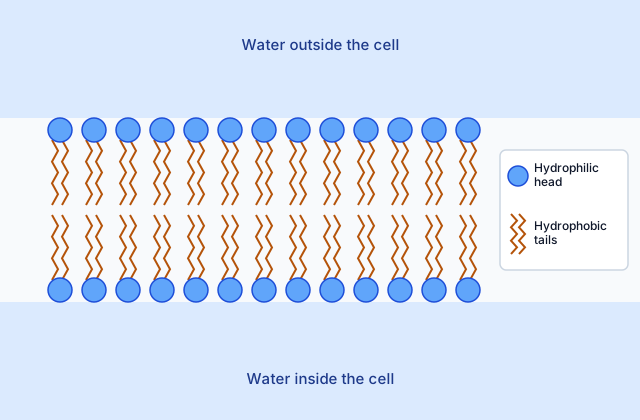 Tap to open the picture full size
Part 1 Think first Butter and olive oil
Commit to a guess first. Being wrong now makes the right idea stick better.
Predict first
A stick of butter and a bottle of olive oil sit side by side on a kitchen counter at the same room temperature. Both are fats, made of very similar building blocks. The butter is solid; the olive oil is liquid. Which explanation is most likely?
In short. Lipids are mostly nonpolar, hydrophobic molecules whose structure, such as how saturated their fatty acids are, sets how they behave and what they do in living things.
- Saturated fatty acids have only single bonds between carbons; unsaturated ones have at least one double bond, which kinks the chain.
- The more double bonds a lipid's fatty acids have, the more unsaturated it is and the more liquid it is at room temperature.
- Fats store energy and insulate, steroids act as hormones, cholesterol stabilizes animal membranes, and phospholipids form bilayers.
Part 2 Learn it How lipids are built and what they do
2a. Lipids avoid water
Lipids are a varied group: fats and oils, steroids such as cholesterol, and phospholipids. What they share is that they are typically nonpolar. Their long chains of carbon and hydrogen share electrons almost evenly, so they carry few partial charges.
That makes them hydrophobic, "water-fearing". Water molecules are polar and form hydrogen bonds with each other and with other polar molecules (Topic 1.1), but they cannot form hydrogen bonds with a nonpolar chain. So lipids do not dissolve in water; they clump together and separate out, like oil drops on soup.
Unlike carbohydrates, lipids are not long polymers of one repeating monomer. A lipid's structure, and so its function, comes from how its smaller subcomponents are assembled. A fat, for example, is built with long chains called fatty acids.
Quick check · Multiple choice
Cooking oil poured into water forms a separate layer instead of dissolving. Which explanation is best supported?
2b. Saturated and unsaturated
A fatty acid is a long chain of carbon atoms. Fatty acids come in two kinds.
A saturated fatty acid has only single bonds between its carbon atoms. Each carbon holds as many hydrogens as it can, so the chain is "saturated" with hydrogen, and it lies straight.
An unsaturated fatty acid has at least one double bond between carbon atoms. Each double bond causes the carbon chain to kink. The more double bonds in a fatty acid's tail, the more unsaturated it is.
Shape decides how the chains pack. Straight saturated chains stack tightly, like pencils in a box, and hold together into a solid. Kinked chains cannot pack closely, so the molecules stay apart. That gives the rule: the more unsaturated a lipid is, the more liquid it is at room temperature. Butter, mostly saturated, is solid; olive oil, mostly unsaturated, is liquid.
Quick check · Rank it
Four fats differ only in their fatty acids. Fat A's fatty acids have no double bonds; fat B's have two each; fat C's have one each; fat D's have three each. Rank the fats by how liquid they are at room temperature.
Most liquid first
Give each one a place, 1 for first. Give two the same place if they are equal.
Your ranking: none yet
2c. Fats, steroids and cholesterol
Lipids do several different jobs.
Fats store energy and support cell function. An animal stores fat when food is plentiful and breaks it down when food is short. In some mammals, a layer of fat under the skin also provides insulation that helps keep the body warm, as the blubber of a seal does.
Steroids are lipids built around rings of carbon atoms rather than long chains. Many steroids are hormones, chemical signals that support growth and development, energy metabolism and homeostasis.
Cholesterol is a steroid with a structural job. It sits in the membranes of animal cells and provides essential structural stability to them.
So "lipid" does not name one job. Ask which lipid a question is about, and you will know what it does.
Quick check · Match
Match each lipid to its function.
2d. Phospholipids build membranes
A phospholipid has two parts that behave differently in water. Its head contains a phosphate group and is hydrophilic, "water-loving": it is polar and attracts water. Its two fatty acid tails are nonpolar and hydrophobic.
In water, phospholipids group together so that the heads face the water and the tails are hidden from it. The result is a lipid bilayer: two layers of phospholipids, tails pointing inward toward each other, heads facing the water on both sides.
That bilayer is the basic structure of the plasma membrane around every cell and of the membranes inside cells. In animal cells, cholesterol sits among the phospholipids and steadies the bilayer.
You will see in Unit 2 how this structure decides what can cross a membrane. For now, the key idea is that the bilayer forms because of how the phospholipid's two parts interact with water.
Quick check · Fill the statement
Complete the description of a cell membrane.
Cell membranes are built from grouped into a lipid . Their hydrophilic heads face the water, and their hydrophobic point toward the middle.
Part 3 Watch it done Solid or liquid on the counter?
Predict first, then watch each step, then finish the reasoning yourself.
A student finds the temperature at which four fatty acids melt. They are the same length and differ only in the number of double bonds between their carbons.
- No double bonds: melts at 70 °C
- One double bond: melts at 14 °C
- Two double bonds: melts at −5 °C
- Three double bonds: melts at −11 °C
These numbers are a teaching example. Which of them are liquid on a kitchen counter at 22 °C?
Predict first
Before you open the first step, predict: how many of the four are liquid at 22 °C?
Step 1 · Read the trend
As the number of double bonds rises from 0 to 3, the melting temperature falls: 70, 14, −5, −11 °C. More double bonds means more unsaturated, and more unsaturated means it stays liquid down to a lower temperature.
Step 2 · Find the biggest change
Adding the first double bond drops the melting temperature from 70 °C to 14 °C, a fall of 70 − 14 = 56 °C. The second drops it 14 − (−5) = 19 °C, and the third 6 °C more. The first kink makes the largest difference to how tightly the chains pack.
Why this step?
Why compare fatty acids of the same length?
So the only difference between them is the number of double bonds. Then the change in melting temperature can be pinned on unsaturation, not on chain length.
Step 3 · Compare with the counter
A substance is liquid at 22 °C if it melts below 22 °C. The fatty acid with no double bonds melts at 70 °C, far above 22 °C, so it is solid on the counter.
Your step · Decide and justify
Is the fatty acid with one double bond solid or liquid at 22 °C?
Which reason supports your decision?
Three of the four are liquid at 22 °C. Only the saturated one, with straight chains that pack tightly, is solid. That is the butter and olive oil on the counter, explained by the bonds in their chains.
Part 4 Try it Bacteria in the cold
A new situation. A student grows the same kind of bacteria at two temperatures and measures what share of the fatty acids in their membranes are unsaturated. These numbers are a teaching example.
- Grown at 10 °C: 72% of membrane fatty acids are unsaturated
- Grown at 37 °C: 45% of membrane fatty acids are unsaturated
Try it · Calculate
The share of unsaturated fatty acids in the bacteria grown at 10 °C is how many times the share in those grown at 37 °C? Give your answer to one decimal place.
Try it · Decide and justify
If the bacteria grown at 37 °C are moved to 10 °C and could not change their fatty acids, would their membranes become less fluid, more like a solid?
Which reason supports your decision?
Part 5 Explain it Design a melting test
On the exam this is handwritten, so answer on paper first. Nothing you type here leaves this page. Then check your answer against the model and each scoring point.
Free response is 50% of the exam score. This one is shaped like Question 3, Scientific Investigation.
Free-response practice · Question 3 style
A student wants to test whether the number of double bonds in a fat's fatty acids affects the temperature at which the fat melts. She has fats whose fatty acids have 0, 1, 2 and 3 double bonds and are otherwise the same, a water bath she can set to any temperature, and a thermometer.
(a) Identify the independent variable in her investigation.
(b) Identify one variable she should keep the same for every fat.
(c) State the null hypothesis for her investigation.
(d) Predict how the melting temperature of the fat with 3 double bonds will compare with that of the fat with 0, and justify your prediction.
Model answer
(a) The number of double bonds in the fats' fatty acids.
(b) The amount of each fat tested (or the length of the fatty acids, or how fast the water bath is warmed).
(c) The number of double bonds in a fat's fatty acids has no effect on the temperature at which the fat melts.
(d) The fat with 3 double bonds will melt at a lower temperature. Double bonds kink the fatty acid chains so they cannot pack tightly, and the more unsaturated a lipid is, the more liquid it is.
Score your own answer. This is a self-check, not a grade. Tick each point your answer makes.
Part 6 Check yourself Seals in cold and warm water
All three case questions use the table.
A biologist measures the layer of fat (blubber) under the skin of adult seals of two populations, one living in cold water and one in warm water. She measures it again after 30 days during which the seals do not eat. These numbers are a teaching example.
| Population | Water temperature | Before 30 days without food | After 30 days without food |
|---|---|---|---|
| Cold-water seals | 2 °C | 6.0 | 4.5 |
| Warm-water seals | 18 °C | 2.5 | 1.5 |
Case question 1 · Calculate
Using the table: by what percentage did the cold-water seals' blubber thickness decrease over the 30 days without food? Give your answer to the nearest whole percent.
Case question 2 · Multiple choice
Using the table: the thicker blubber of the cold-water seals before fasting best supports which function of fat?
Case question 3 · Multiple choice
Using the table: the blubber of both populations got thinner during the 30 days without food. Which claim does that best support?
The rest stand on their own and do not use the case.
Check yourself · Spot the error
A student describes an animal cell's membrane. Tap the line with the mistake.
Check yourself · Sort it
Each card describes a fatty acid or a fat. Tap a card, then the bin that describes it.
Saturated
Unsaturated
Part 7 Keep it Bring back earlier ideas
Lipids are the other way, besides carbohydrates, that organisms store energy, and phospholipids need the element from Topic 1.2. Pulling both back up is what makes them last.
From 1.4 Carbohydrates · Spot the error
A student describes a polysaccharide. Tap the line with the mistake.
From 1.2 Elements of Life · Match
Match each element to what a cell uses it to build.
In three lines
- Lipids are typically nonpolar and hydrophobic, and their structure comes from how their subcomponents, such as fatty acids, are assembled.
- Double bonds make a fatty acid unsaturated and kink its chain; the more unsaturated a lipid, the more liquid it is at room temperature.
- Fats store energy and insulate, steroids are hormones, cholesterol stabilizes animal membranes, and phospholipids form bilayers.
Exam strategy for this topic
- Section I, Multiple Choice: 60 questions in 90 minutes.
- Section II, Free Response: 6 questions in 90 minutes.
- This lesson's Explain it is shaped like free-response question 3, Scientific Investigation.
- A four-function, scientific, or graphing calculator is allowed on both sections of the exam.
For a lipid question, first name the lipid (fat, steroid, cholesterol or phospholipid) and give its job; for a fatty acid, count the double bonds and say what they do to the chain's shape and to how liquid the lipid is.
Questions students ask
What is the difference between a saturated and an unsaturated fatty acid?
A saturated fatty acid has only single bonds between its carbons and a straight chain. An unsaturated fatty acid has at least one double bond, which kinks the chain.
Why are unsaturated fats liquid at room temperature?
Double bonds kink the fatty acid chains so they cannot pack tightly. The more unsaturated a lipid is, the more liquid it is at room temperature.
What do fats do in living things?
Fats store energy and support cell function, and in some mammals a layer of fat under the skin provides insulation that helps keep the body warm.
What is the difference between cholesterol and a phospholipid?
Phospholipids group together to form the lipid bilayer of membranes. Cholesterol is a steroid that sits within animal cell membranes and gives them structural stability.
Why are lipids hydrophobic?
Lipids are typically nonpolar, so water molecules cannot form hydrogen bonds with them, and they do not dissolve in water.
Course alignment, for teachers
AP Biology topic 1.5, Unit 1: Chemistry of Life.
- Skill 6.E: Predict the causes or effects of a change in, or disruption to, one or more components in a biological system.
This lesson maps all 2 essential knowledge statements of the topic to the part that teaches each one: 2 are checked by a scored question. The map is in the lesson file.